
You’ve done the research, visited a few breeder websites, and now you’re more confused than when you started. “English Cream,” “American line,” “British type”, the terminology alone feels like a full-time job, and you haven’t even chosen a dog yet.
The problem? Most of the information out there comes from breeders with puppies to sell, not from veterinary studies or official breed clubs. That makes it nearly impossible to know what’s true and what’s marketing.
In this guide, you’ll learn the real differences between the English vs American Golden Retriever, backed by breed club standards and veterinary research, so you can make a confident, informed decision. We’ll compare their physical traits, temperament, health data, and lifespan, then help you decide which type actually fits your life.
stockier build
leaner frame
no type advantage
Kent et al., 2018
Author Credentials
📝 Written by: Coral Drake
✅ Reviewed by: Brianna York, Former Veterinary Technician
📅 Last updated: 4 May 2026
ℹ️ Transparency Notice
This article compares English (British) and American Golden Retrievers based on AKC, UK Kennel Club, GRCA, and peer-reviewed veterinary research. All claims have been verified by our editorial team.
How Do English vs. American Golden Retrievers Compare at a Glance?
Both the English and American Golden Retriever are the same breed recognized by the American Kennel Club, the differences reflect regional breeding standards, not separate genetics. Think of them not as competing breeds, but as the same dog seen through different regional lenses, that’s The Breed Lens Framework at its simplest. The table below summarizes the key differences at a glance; we’ll explore each in detail throughout this guide.
| Trait | English Golden Retriever | American Golden Retriever |
|---|---|---|
| Build | Stockier, heavier-boned | Leaner, more athletic |
| Head Shape | Broader, blockier | Narrower, more defined |
| Coat Color | Cream to light gold | Light gold to dark golden red |
| Height (Male) | 22-24 inches | 23-24 inches |
| Height (Female) | 20-22 inches | 21.5-22.5 inches |
| Weight (Male) | 65-75 lbs | 65-75 lbs |
| Weight (Female) | 55-65 lbs | 55-65 lbs |
| Topline | Level | May slope slightly |
| Temperament | Calmer, more laid-back | More energetic, playful |
| Breed Standard | UK Kennel Club | American Kennel Club (AKC) |
| Lifespan | 10-12 years | 10-12 years |
| AKC Recognized? | Yes (as Golden Retriever) | Yes (as Golden Retriever) |
Size and weight ranges reflect official breed standards. Individual dogs may vary based on genetics, diet, and breeder selection. Sources: GRCA size standards and GRCA ideal weight guide (GRCA, 2024).
Both the English and American Golden Retriever are recognized as a single breed by the AKC, the differences reflect regional breeding standards, not separate genetics.
Now let’s look at each of these differences in detail, starting with what you’ll notice first: how they look.
How Do Their Physical Differences Compare?

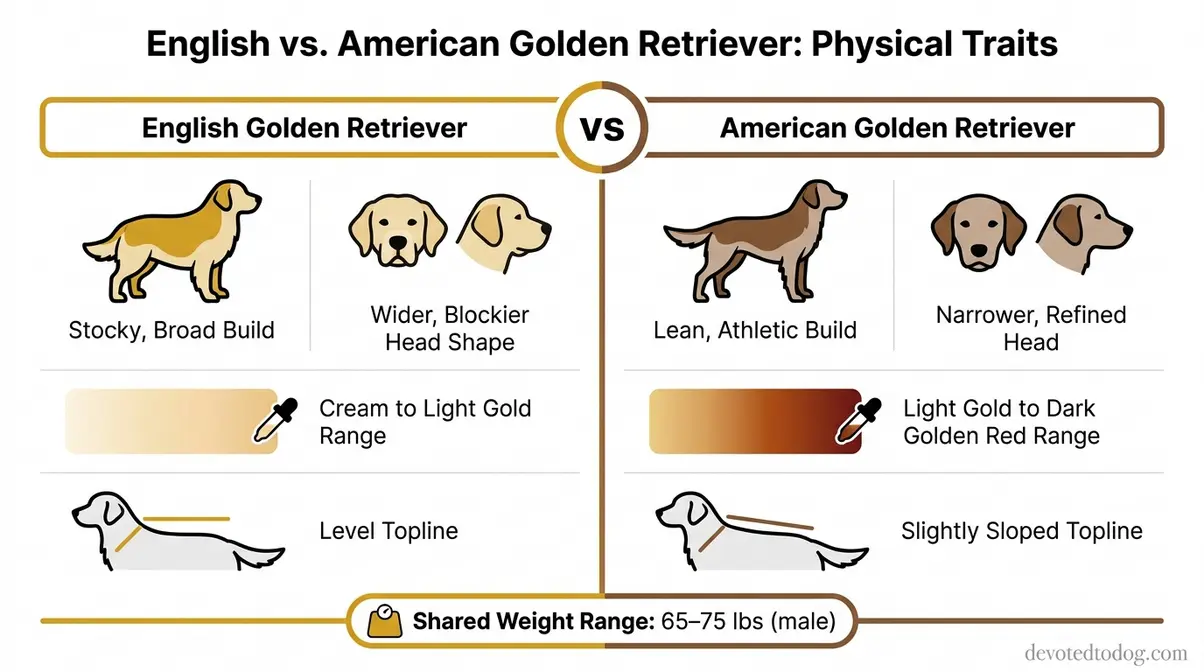
The most visible difference between the English Golden Retriever, the stockier, cream-coated variant bred to UK Kennel Club standards, and the American Golden Retriever, the leaner, more athletic type recognized by the American Kennel Club (AKC), is body type. According to the GRCA weight guide, both types share nearly identical weight ranges, males 65-75 lbs, females 55-65 lbs, yet look noticeably different side by side. For most owners, these differences are subtle enough that both types look unmistakably like Golden Retrievers, but they become clear once you know what to look for.
English Golden Retrievers are stockier with a broader, blockier head and a cream-to-gold coat, while American Golden Retrievers are leaner with a narrower head and a coat ranging from light to dark golden red. This is the Breed Lens Framework in action, the same genetic blueprint, shaped by different regional standards.
Body Shape and Size: Who’s Bigger?
The English Golden Retriever is built stockier, with a wider chest, thicker leg bones, and a heavier overall frame than its American counterpart. The American Golden Retriever has a more streamlined, athletic build that reflects its field-working heritage. Stand them side by side and the English Golden looks like a compact show dog; the American Golden looks like a working dog ready to run.
One term you’ll see in breed standards is “topline”, this means the line from the base of the neck to the base of the tail, viewed from the side. English Goldens have a level topline, giving them a solid, square appearance. American Goldens may slope slightly toward the hindquarters, which contributes to their more dynamic, athletic silhouette.
Here’s the detail that surprises most people: despite how different they look, official weight standards are nearly identical. The GRCA weight guide sets males at 65-75 lbs and females at 55-65 lbs for both types (GRCA, 2024). The difference is in BUILD, not necessarily in total size. What this means for you: if you’re looking for a dog that looks powerful and compact, the English type may appeal more. If you prefer a leaner, more athletic look, the American type is your match.
The build difference is real, but the weight difference is often overstated by breeders. Both types fall within the same official weight range per GRCA standards.
“The build difference is real, but the weight difference is often overstated. Both types fall within the same official weight range per GRCA standards.”
The build is the first thing you notice, but look up at their faces and you’ll see another clear difference: the head shape.
Head Shape and Facial Features: The Blockier Head vs. the Refined Muzzle
English Goldens have a broader, blockier head, wider skull, deeper stop, and a shorter, wider muzzle. The “stop” is the indentation between a dog’s forehead and muzzle, like the bridge of a nose. English Goldens have a more pronounced stop, giving them that “puppy face” look, the classic teddy-bear expression that many owners find irresistible.
“English Golden Retrievers are generally stockier and have a broader head, while American Golden Retrievers are leaner and have a more athletic build.”
The American Golden Retriever has a more refined, narrower head with a longer, more tapered muzzle. This reflects their field-working heritage, a leaner facial structure that looks slightly more elegant and less plush than the English type. Some owners find this look equally appealing; it’s entirely a matter of personal preference.
What this means for you: if you love that classic teddy-bear face, English Goldens tend to deliver it. American Goldens have a more refined look that many owners find equally beautiful. Neither is “better”, they simply reflect the different aesthetics each breed club historically prioritized.
For more context on how these physical traits fit into the broader picture, see our guide to different types of Golden Retrievers and their physical traits.
Head shape and build are easy to observe, but coat color is where the biggest confusion (and the most marketing hype) lives.
Coat Color and Texture: From Cream to Dark Golden Red
The UK Kennel Club’s breed standard for English Goldens allows coats ranging from cream to golden, but explicitly excludes dark golden or red. This is why English lines tend to look lighter overall, often appearing pale or cream-colored, especially in North American markets.
The AKC’s breed standard for American Goldens allows light golden, golden, and dark golden, but does NOT recognize cream or white as acceptable colors (AKC, 2024). In practice, American Goldens range from a warm light gold to a rich, dark golden red. Both types have a dense double coat with a water-repellent outer layer, the texture is similar between types. The key difference is color, not texture.
This is exactly where the term “english cream golden retriever” comes from, it describes a coat color within the English type, not a separate breed. If you’ve fallen in love with the pale, cream-colored Golden Retrievers you see on social media, you’re likely looking at English-line dogs. If you love the classic lustrous golden coat, that’s typically the American type. We’ll cover the “English Cream” marketing term in full detail in the next section.
As the infographic above illustrates, the full color spectrum of both types overlaps more than most people realize.
Coat color is one of the most misunderstood differences, and it’s at the heart of a marketing term that confuses thousands of buyers every year: “English Cream.” Here’s what that actually means.
What Do Temperament, Health, and Lifespan Data Show?

The temperament and health differences between the English and American Golden Retriever are the deciding factors for most prospective owners, and this is where data matters more than breeder opinions. The Golden Retriever Lifetime Study, a long-term research project tracking the health of over 3,000 Golden Retrievers, has produced some of the most reliable breed-level health data available. Here’s what the research actually shows.
Temperament and Energy Levels: Calmer vs. More Energetic
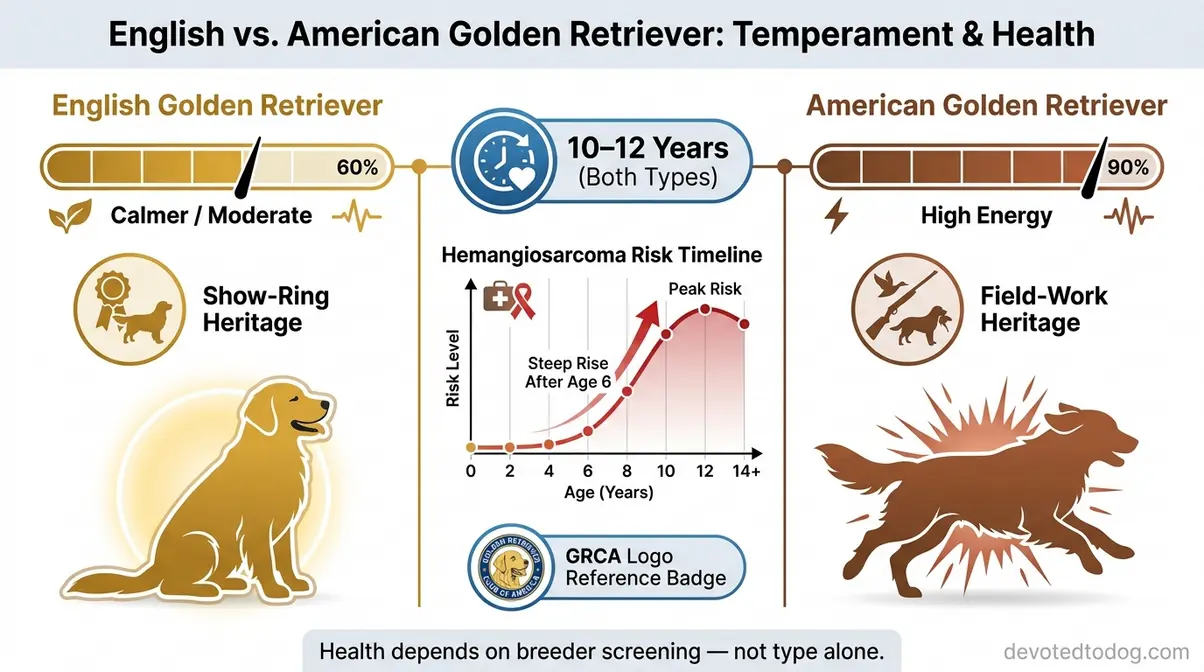
English Golden Retrievers are generally described as calmer and more laid-back. Their breeding history emphasizes the show ring, where a composed, controlled demeanor is prized, leading breeders to select for mellower personalities over generations. Through the Breed Lens Framework, this makes complete sense: English breeders historically selected for calm show-ring demeanor; American breeders selected for energetic field performance.
American Golden Retrievers were bred with more emphasis on field work and hunting retrieval, which requires high energy, drive, and enthusiasm. They tend to be more playful and energetic, and they often have a longer adolescent phase, meaning they may act like puppies for an extended period. This isn’t a flaw, it’s a feature for active families who love that exuberant energy.
One important nuance: individual variation exists within both types. A high-energy English Golden from a working bloodline may be MORE energetic than a calm American Golden from a show bloodline. Breeding, socialization, and training matter more than type alone. If you have young children or a quieter household, the English type’s calmer temperament may be a better fit. If you’re an active family that loves outdoor adventures, the American type’s energy will match your lifestyle.
For more on this, see our resource on when Golden Retrievers calm down, it covers what to expect at each life stage for both types.
Knowing how energetic your dog will be matters for training, here’s how the two types compare on exercise and training needs.
Training and Exercise Needs: What to Expect Daily
Both types need significant daily exercise, at least 1-2 hours of activity per day is standard for adult Golden Retrievers. This is NOT a low-energy breed, regardless of type. Plan for walks, play sessions, and mental stimulation every single day.
American Goldens may need slightly more vigorous exercise due to their higher baseline energy. English Goldens may be more satisfied with moderate walks and structured play sessions, but they still need regular activity to prevent boredom and destructive behavior. Neither type thrives in a sedentary household.
Training ease is where both types genuinely shine. Golden Retrievers are among the most trainable breeds in the world, highly intelligent and eager to please. The English Golden’s calmer temperament can make early training sessions feel more manageable for first-time owners, as they tend to focus better during initial lessons. Either way, plan for at least 1 hour of active exercise per day, and consider puppy training classes for both types, it builds the foundation for a lifetime of good behavior.
Training and exercise are manageable for most owners, but the health differences between the two types deserve more serious attention. Here’s what the research shows.
Health Differences and Cancer Risk: What the Data Actually Says
The “silent killer” in Golden Retrievers most commonly refers to hemangiosarcoma, a fast-spreading, malignant cancer of the blood vessels that typically affects the spleen or heart. It develops with few early symptoms, making it extremely difficult to detect before it becomes life-threatening. Lymphoma, a cancer of the lymphatic system, is another primary health concern in the breed.
According to a descriptive analysis published in PubMed, hemangiosarcoma is a relatively common malignant tumour in Golden Retrievers, representing a primary health outcome of interest in long-term breed research (Golden Retriever Lifetime Study on haemangiosarcoma, Hillman et al., Veterinary and Comparative Oncology, 2023). Research from the Golden Retriever Lifetime Study further indicates that hemangiosarcoma incidence grows steeply after age 6, becoming the most common cancer in the study cohort around age 8 (Labadie et al., PLoS ONE, 2022). Cornell University veterinary oncologists describe hemangiosarcoma as highly malignant, most commonly affecting the spleen or heart of older large-breed dogs like Golden Retrievers (Cornell Vet on hemangiosarcoma in dogs, Cornell Vet, 2024).
In the Golden Retriever Lifetime Study, hemangiosarcoma incidence rose steeply after age 6, and it became the most common cancer in the study cohort around age 8 (Labadie et al., PLoS ONE, 2022).
Now, the question many buyers ask: are English Goldens healthier than American Goldens? The PMC cohort profile of the Golden Retriever Lifetime Study does note that cancer mortality rates among Golden Retrievers in UK and Scandinavian populations were documented at 20-39%, compared to higher rates in U.S. cohorts (Labadie et al., PLoS ONE, 2022). However, these differences likely reflect multiple factors, environment, diet, gonadectomy rates, and breeding practices, not type alone. The GRCA explicitly warns against claims that English Cream dogs are inherently healthier. No single peer-reviewed study provides a definitive head-to-head cancer rate comparison by English vs. American type. Use qualified language when discussing this with breeders: “research suggests” and “may be at higher risk”, not guarantees.
What matters most: health screening. Responsible breeders test for hip dysplasia, elbow dysplasia, eye conditions, and heart conditions regardless of bloodline. Always ask for OFA (Orthopedic Foundation for Animals) health clearances for both parents. Focus less on whether English or American Goldens are “healthier” and more on whether your breeder conducts all recommended health screenings, that’s the most reliable predictor of a healthy puppy.
For a comprehensive overview, see our guide to Golden Retriever health issues and warning signs.
Always consult your veterinarian for breed-specific health screening recommendations before purchasing a puppy.
Cancer risk is the most sobering reality for Golden Retriever owners, but both types share a similar lifespan. Here’s what to expect.
Lifespan and What to Expect Long-Term
Both English and American Golden Retrievers have an average lifespan of 10-12 years (GRCA health survey data; AKC breed information, 2024). There is no significant, research-confirmed difference in lifespan between the two types. Breeder claims of longer-lived English Cream dogs are not supported by peer-reviewed studies, though some early data suggests slight variation between U.S. and European populations, the evidence is not definitive.
The final 2-3 years of a Golden Retriever’s life often involve increased health monitoring, particularly for cancer. Ask your vet how often your Golden should be checked as it ages, particularly after age 6.
Quality of life factors have a measurable impact on longevity: diet, regular exercise, weight management, and consistent veterinary care matter more than whether your dog is English or American type. Budget for increased veterinary care as your dog ages, pet insurance taken out while your dog is young can significantly reduce the financial burden of cancer treatment or other age-related conditions.
Now that you understand the health picture, let’s clear up one of the most confusing marketing terms in the Golden Retriever world: the “English Cream.”
What Is an “English Cream” Golden Retriever?
The term “English Cream Golden Retriever”, a marketing term used to describe light-colored English Golden Retrievers, not a separate breed, is one of the most searched phrases in the Golden Retriever world. Despite being marketed as a premium or rare variety, the Golden Retriever Club of America (GRCA) classifies “English Cream” as a marketing term with no special breed designation. Here’s what you need to know before you pay a premium for a “cream” puppy.
The Golden Retriever Club of America states that “English Cream” is often a marketing term, and there is no evidence that cream-colored Golden Retrievers are inherently healthier or longer-lived than other Golden Retrievers (GRCA, 2024).
What “English Cream” Actually Means
The english cream golden retriever simply describes English Golden Retrievers with a very pale, cream-colored coat. The UK Kennel Club’s breed standard allows coats ranging from cream to golden, breeders in North America began using “English Cream” as a marketing term to emphasize the lighter end of this spectrum, making it sound exclusive.
The AKC’s breed standard for American Goldens does NOT recognize cream or white as acceptable colors, which is partly why “English Cream” became strongly associated with English-type dogs in the U.S. market. The GRCA clarifies on regional Golden Retriever standards that “English” Golden Retrievers are dogs bred to UK standards, they are not a separate breed (GRCA, 2024).
All “English Cream” Golden Retrievers are English Golden Retrievers. The cream color does not indicate a separate lineage, special health status, or rare genetics. Think of it like calling a white Labrador Retriever an “English Cream Labrador”, it’s still a Labrador, just with a specific coat color.
If you’re searching for English Cream Golden Retriever puppies for sale, be sure to ask any breeder for GRCA-recognized health clearances regardless of coat color. For a full deep-dive, see our English Cream Golden Retriever guide.
Understanding what “English Cream” means is one thing, but what about the claim that English Cream dogs are healthier? Here’s the honest answer.
Is the English Cream Golden Retriever Healthier? Separating Fact from Marketing
When comparing english cream vs american golden retriever health claims, the GRCA is unambiguous: there is NO evidence that cream-colored Golden Retrievers are inherently healthier, longer-lived, or have better temperaments than golden or dark-coated dogs. The GRCA on English Cream marketing myths warns that “English Cream” is often a marketing ploy, with no evidence of superior health or temperament (GRCA, 2024).
The health of any Golden Retriever, regardless of coat color, is primarily determined by the health screening practices of the breeder, not by coat color. Always request OFA health clearances for hips, elbows, eyes, and heart for both parents. Breeders who charge premium prices solely for the cream color, without providing full health clearances, are engaging in marketing, not responsible breeding.
A cream-colored Golden Retriever from a breeder without health clearances is a riskier choice than a dark golden dog from a breeder with full OFA documentation. Coat color does not equal health.
With the English Cream myth cleared up, let’s briefly cover the third major Golden Retriever type, the Canadian, so you have the complete picture.
What About the Canadian Golden Retriever?
The Canadian Golden Retriever, a third recognized type that is taller, darker-coated, and has a thinner coat than either the English or American, is the least commonly encountered by buyers in the United States. Recognized by the Canadian Kennel Club (CKC), Canadian Goldens are typically taller and darker-coated than both English and American types, with a thinner, less dense coat. Here’s a brief overview, so you have the complete picture.
The Canadian Golden Retriever is taller and darker-coated than both the English and American types, and recognized by the Canadian Kennel Club, though rarely encountered by buyers outside of Canada.
According to the Canadian Kennel Club breed standard, males stand 23-24 inches at the withers and females 21.5-22.5 inches, similar in height to American Goldens, but with a more pronounced athletic build and a coat that tends toward deep golden to rich reddish gold. The coat is thinner and less wavy than either the English or American type. In terms of temperament, Canadian Goldens share the same friendly, loyal, and intelligent personality as both other types, though their working-dog heritage is more pronounced.
The AKC Golden Retriever breed information page confirms that the AKC recognizes the Golden Retriever as a single breed regardless of regional lineage (AKC, 2024). Most dogs marketed as “Canadian” in the U.S. are simply American Goldens with darker coats, a true Canadian Golden Retriever from CKC-registered lines is relatively rare south of the border.
Unless you’re specifically working with a Canadian breeder or importing a dog, you’re unlikely to encounter a true Canadian Golden Retriever at a U.S. breeder. For a deeper look at all three types side by side, see our guide to all three types of Golden Retrievers, including Canadian.
Now for the practical question most readers are really asking: how do you find a puppy, and what should you expect to pay?
How Do You Find a Reputable Breeder and What to Ask?

Finding a reputable English or American Golden Retriever breeder requires knowing what to look for, and what to avoid. Prices vary significantly based on bloodline, health testing, and location, and the term “English Cream” often comes with a premium price tag that isn’t always justified by what’s actually behind it. Here’s what to expect.
What to Expect to Pay for Each Type
English cream golden retriever puppies for sale from reputable breeders typically range from $1,500 to $3,500 or more, with imported European bloodlines and extensive health testing pushing prices toward the higher end. Specialized “English Cream” marketing can drive prices even higher, though premium pricing alone is not an indicator of quality or health (as of 2026).
American Golden Retriever puppies from reputable breeders typically range from $1,000 to $2,500. Show-quality bloodlines and champion lineage push prices higher. Market data from multiple sources confirms the average price across both types hovers around $2,000 from a quality breeder (Rover.com, 2026; SpotPet, 2026).
Price alone is NOT a reliable indicator of puppy quality. A $3,000 “English Cream” puppy from a breeder without OFA health clearances is a worse investment than a $1,500 American Golden from a fully health-tested litter. Rescue and shelter adoption typically costs $100-$500 and often includes microchipping, spaying/neutering, and vaccinations, a meaningful alternative worth considering.
Prices and availability are subject to change. Verify current pricing directly with breeders. Prices as of 2026. For a full breakdown of what Golden Retriever ownership costs beyond the purchase price, see our full breakdown of Golden Retriever puppy costs.
Price is just the starting point, finding the right breeder is what actually determines whether you bring home a healthy, well-socialized puppy.
How to Choose a Reputable Breeder
Reputable English golden retriever breeders, and American golden retriever breeders, should provide OFA (Orthopedic Foundation for Animals, the organization that certifies health clearances for hips, elbows, and other conditions) clearances for BOTH parents. This applies to every reputable breeder, regardless of type. It is non-negotiable.
Green flags to look for: GRCA membership, full health testing documentation, willingness to answer all your questions, allows you to meet the parents in person, and provides a written contract with health guarantees. Red flags to avoid: multiple litters always available, no health clearances provided, unwillingness to let you visit, claims that “English Cream” puppies are inherently healthier without documentation, or shipping puppies without meeting the buyer.
5 Questions to Ask Any Golden Retriever Breeder:
- Can you provide OFA health clearance certificates for both parents?
- Are you a member of the Golden Retriever Club of America (GRCA)?
- Can I meet the puppy’s mother, and ideally the father, in person?
- What health guarantee do you provide with your puppies?
- How do you socialize puppies before they go to their new homes?
When searching for puppies near you, prioritize breeders who are GRCA members, it’s the single most reliable quality signal available. For a complete guide to vetting breeders, see our resource on how to find reputable Golden Retriever breeders.
You now have everything you need to understand both types. The final question: which one is actually right for YOU?
Are English and American Golden Retrievers the same breed?
Yes, English and American Golden Retrievers are the same breed, recognized as one Golden Retriever by the AKC, UK Kennel Club, and Canadian Kennel Club. The difference between English and American Golden Retrievers is regional breed standard variation, not a separate breed. English (British) lines tend to be stockier with paler coats; American lines are leaner with richer gold coats. Whether you search for english vs american golden retriever, american vs english golden retriever, or british golden retriever vs american, you’re comparing the same breed across two regional standards.
Is the English Golden Retriever calmer than the American?
On average, yes. English Golden Retriever temperament tends to be calmer and more mellow than American Golden Retriever temperament, particularly when comparing show-line English to field-line American. The english cream golden retriever versus american golden retriever calmness gap is about 15-30 minutes less daily exercise needed for the English line. That said, individual variation within each line is larger than the average difference between lines, so socialization and training matter more than country of origin.
Which Type Is Right for You?
The Breed Lens Framework brings the decision into focus: neither the English nor the American Golden Retriever is the “better” dog, they’re the same breed, seen through different regional lenses. Both are loving, loyal, and deeply family-oriented. The right choice is the one that matches your lifestyle, activity level, and household environment. Here’s how to choose based on your actual life.
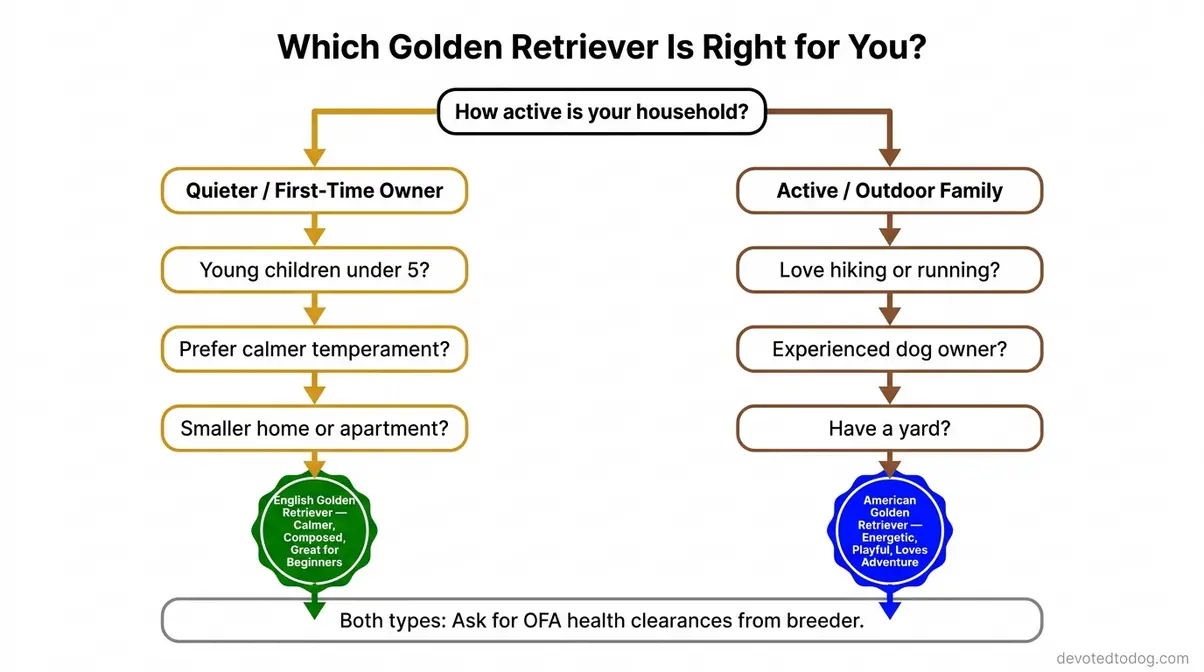
The Breed Lens Framework: Neither the English nor American Golden Retriever is “better”, the right choice is the one that matches your lifestyle, activity level, and household environment.
Best for Active Families and Outdoor Enthusiasts
The American Golden Retriever is the better fit if your lifestyle involves regular high-energy activity:
- You have an active family with older children (ages 8 and up) who love to play outdoors
- You run, hike, or cycle regularly and want a dog to join you
- You have a yard and spend meaningful time outside each week
- You’re experienced with high-energy dogs and enjoy the challenge
If your family spends weekends hiking and your kids are always on the go, the American Golden’s enthusiasm and stamina will match, and even challenge, your energy levels. Their playful, driven nature thrives in active environments where there’s always something to do.
If that doesn’t sound like your household, the English type may be the better match.
Best for Calmer Households and First-Time Owners
The English Golden Retriever is the better fit if your household is quieter or you’re new to dog ownership:
- You’re a first-time dog owner who wants a more manageable early training experience
- You have young children (under 5) or elderly family members who need a gentler companion
- You prefer a calmer, more predictable temperament day-to-day
- You live in a smaller home or apartment with reliable access to a park or green space
If you have toddlers at home and need a dog that’s gentle and patient from day one, the English Golden’s calmer disposition makes early life with a new dog significantly less overwhelming. Their composed nature during training sessions is often cited by first-time owners as a genuine relief.
Before you make your final decision, there’s one more thing every prospective Golden Retriever owner should understand: what this comparison can’t tell you.
What Can’t This Comparison Tell You?
Even the most thorough comparison of English vs. American Golden Retrievers has real limits, and acknowledging them is part of giving you genuinely useful information. Breed-level data describes tendencies, not guarantees. Here’s what to keep in mind.
Common Misconceptions to Avoid
Three misconceptions come up repeatedly in Golden Retriever communities, and all three can lead buyers astray:
Misconception 1: “English Goldens are always calmer than American Goldens.” Individual variation is significant. Bloodline, socialization, and training matter more than type. A high-energy English Golden from a working line can be more boisterous than a calm American Golden from a show line.
Misconception 2: “English Cream Goldens are healthier.” No peer-reviewed evidence supports this as a universal claim. Health depends on breeder health testing practices, not coat color.
Misconception 3: “The type determines the dog’s personality.” Every Golden Retriever is an individual. Type is a tendency, not a guarantee. Across Golden Retriever owner communities, the consistent feedback is that socialization and early training shape personality far more than type alone.
What this means for you: meet the puppy’s parents. A calm, friendly mother and father are the best predictor of a calm, friendly puppy, regardless of whether they’re English or American type.
When to Seek Expert Guidance
Before purchasing, consult your veterinarian about breed-specific health screening recommendations and what to look for in OFA health clearance documentation. Your vet can help you evaluate paperwork from breeders and flag anything that looks incomplete or suspicious.
If you have specific needs, a therapy dog, service dog, or working companion, consult a breed-specific trainer or contact the GRCA directly for referrals to breeders who specialize in those roles. General family pet breeders and working-dog breeders select for different traits, and the distinction matters.
This article provides general breed information only. Always consult your veterinarian for health and medical guidance specific to your dog.
Frequently Asked Questions
Which is better, an English or American Golden Retriever?
Neither the English nor the American Golden Retriever is definitively “better”, the right choice depends entirely on your lifestyle. American Golden Retrievers are typically more energetic and better suited for active families, while English Golden Retrievers are generally calmer and more laid-back, making them a great fit for first-time owners or quieter households. Both types are loyal, loving, and highly intelligent companions. The question to ask isn’t “which is better?”, it’s “which fits my life?”
Which type of Golden Retriever is the calmest?
English Golden Retrievers are generally considered the calmer of the two types. Their breeding history emphasizes the show ring, where a composed, controlled temperament is valued, leading breeders to select for mellower personalities over generations. American Goldens, by contrast, were bred with more emphasis on field work, resulting in higher baseline energy and a longer adolescent phase. That said, individual variation exists in both types, a dog’s upbringing and socialization matter as much as its type.
How do I know if my Golden Retriever is English or American?
Look at your dog’s build, head shape, and coat color. English Golden Retrievers are stockier with a broader, blockier head and a cream-to-light-gold coat. American Golden Retrievers are leaner and more athletic, with a narrower head and a coat ranging from light gold to dark golden red. English Goldens also tend to have a level topline, the line from neck to tail base, while American Goldens may slope slightly toward the hindquarters. Your breeder’s paperwork and bloodline records will confirm the type definitively.
What is the silent killer in Golden Retrievers?
The “silent killer” in Golden Retrievers most commonly refers to hemangiosarcoma, a fast-spreading, malignant cancer of the blood vessels that typically affects the spleen or heart. It develops with few early symptoms, making it difficult to detect before it becomes life-threatening. Golden Retrievers as a breed are particularly predisposed to this cancer, with research from the Golden Retriever Lifetime Study showing that its incidence rose steeply after age 6 (Labadie et al., PLoS ONE, 2022). Regular veterinary check-ups and awareness of subtle behavioral changes, sudden lethargy, pale gums, reluctance to eat, are your best early-detection tools.
How Do You Make Your English vs. American Choice?
The english vs american golden retriever comparison comes down to one question: which lifestyle does your household reflect? English Golden Retrievers are stockier, calmer, and cream-to-gold coated, bred to UK Kennel Club standards that emphasize a composed temperament. American Golden Retrievers are leaner, more energetic, and range from light to dark golden, bred to AKC standards with a working-dog heritage. Both share a 10-12 year lifespan and an equally loving, loyal personality that makes either type a wonderful family companion.
The Breed Lens Framework offers the clearest way to think about this decision: these are not competing breeds, they’re the same dog, shaped by different regional standards and purposes. Stop asking “which is better?” and start asking “which fits my life?” That shift is what leads to a successful, lasting match between owner and dog.
Ready to take the next step? Start by reviewing our guide on how to find reputable Golden Retriever breeders, it covers the exact questions to ask, health clearances to request, and red flags to avoid. Before you bring any puppy home, check our full breakdown of Golden Retriever puppy costs so there are no financial surprises waiting for you.
Keep reading: the coat and color differences and where the breed came from.