Your Golden Retriever was built for adventure. But the gear lists you’ve found online were written for any dog, not for a breed with a thick double coat, joints that need protecting, and a love of water that can turn dangerous fast.
Packing the wrong gear, or skipping key items, can mean a hike cut short by overheating, a tick buried in dense fur, or a paw torn up on hot pavement. The stakes feel high because they are.
By the end of this guide, you’ll have a complete, expert-selected golden retriever hiking gear checklist built specifically around your Golden’s needs. You’ll find everything organized by category, from safety and first aid to hydration, paw care, and what your dog can carry herself.
A golden retriever hiking gear checklist should go beyond a standard dog kit. Goldens face breed-specific risks including overheating, hip stress, and tick entanglement in thick fur.
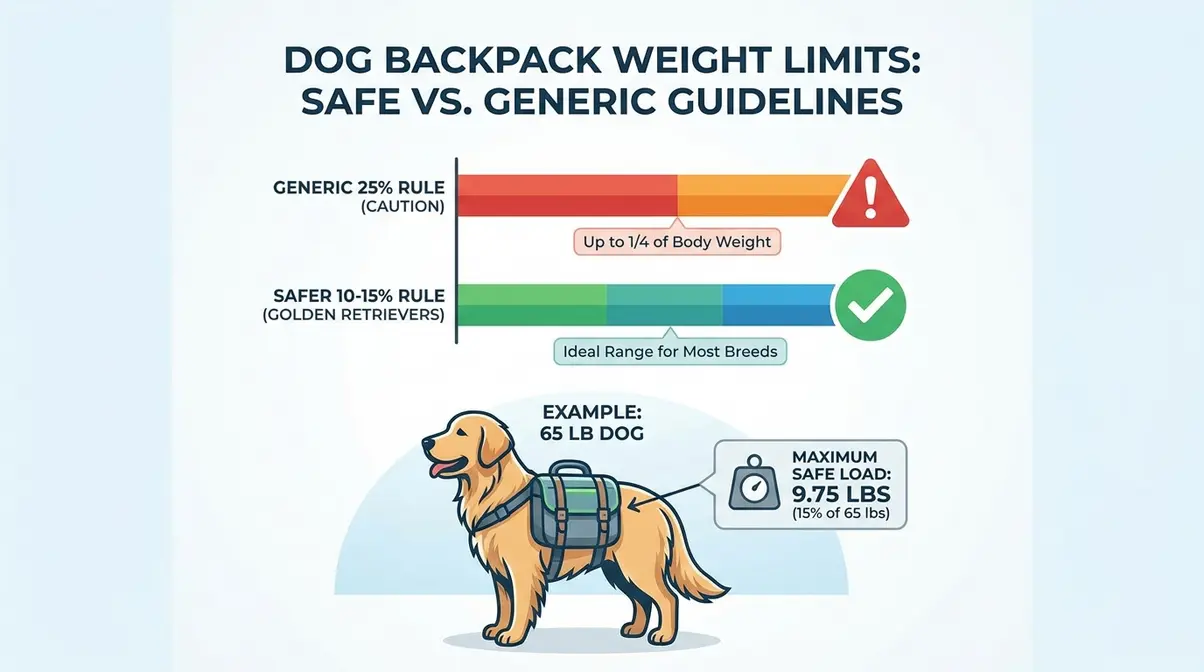
- Joint protection matters: Cap your Golden’s backpack at 10-15% of body weight, not the generic twenty-five percent rule, to protect dysplasia-prone hips
- Heat is a real danger: The AKC flags Golden Retrievers as a heat-sensitive breed, making cooling gear non-negotiable on warm days
- First aid first: A rescue harness, tick remover, and vet wrap belong in every trail bag before you leave the trailhead
- “The Golden Standard Checklist” organizes gear by breed vulnerability: joint stress, heat management, and coat hazards, so nothing critical gets left behind
Are Golden Retrievers Good Hiking Dogs?
Yes, Golden Retrievers make excellent hiking companions. This high-energy sporting breed has the stamina and enthusiasm for day hikes and multi-day backcountry trips. However, the American Kennel Club (AKC) identifies Golden Retrievers as a heat-sensitive breed because of their thick double coat, making breed-specific preparation essential for every trail outing.
Healthy adult Goldens between ages 2 and 8 handle 5 to 10 mile day hikes well when conditioned gradually over several weeks. Puppies under 18 months should avoid long hikes because their growth plates are still forming and stress on developing joints can cause lasting damage. Seniors over 8 years do best on shorter, flatter trails with more frequent rest stops. For a full guide to building up your dog’s fitness safely, see understanding your Golden Retriever’s exercise needs.
Golden Retrievers are classified as a heat-sensitive breed by the American Kennel Club (AKC, 2026), making cooling gear a non-negotiable part of any trail kit. The breed’s double coat traps heat efficiently, which is wonderful in winter and genuinely risky in summer. On warm days, plan your hike for early morning and watch for heavy panting, slowing down, or your dog seeking shade repeatedly. Those are signs to stop and cool down immediately.
This article introduces “The Golden Standard Checklist,” a breed-specific gear framework that organizes trail supplies around the three vulnerabilities unique to Golden Retrievers: joint stress, heat exposure, and double-coat hazards. Every section that follows maps to one or more of those categories.
When Should You Skip the Hike?
Skip if:
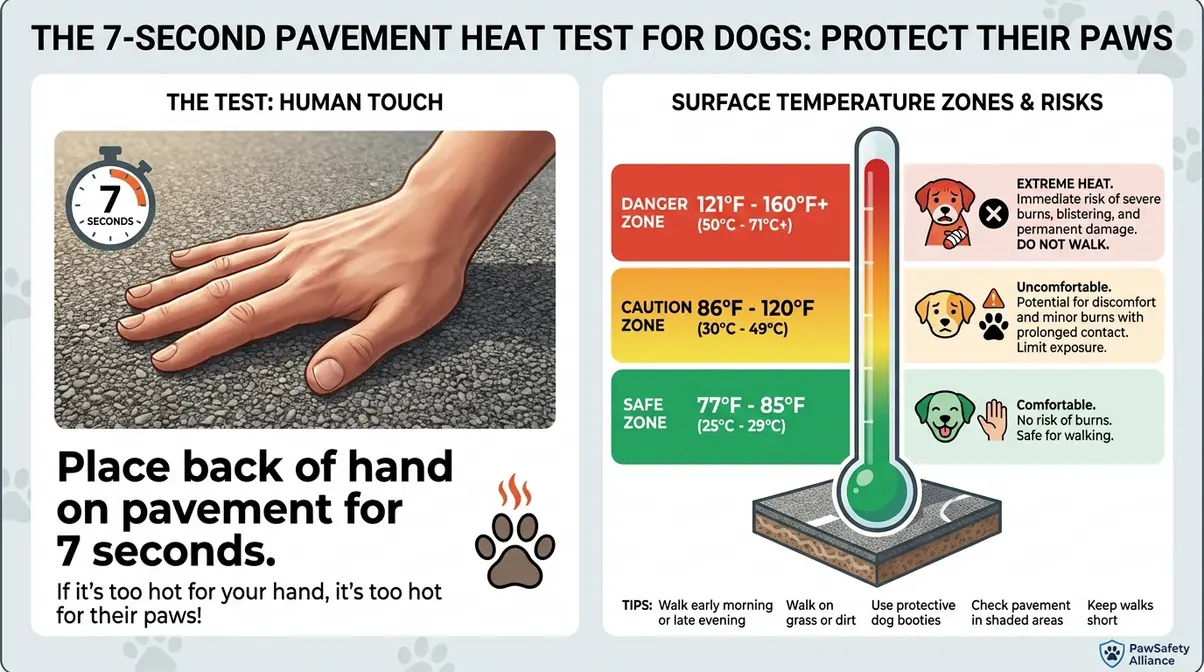
- The temperature is above 85°F, especially with humidity, which raises heatstroke risk in thick-coated breeds
- The trail has icy or jagged rock surfaces and your Golden doesn’t have paw protection ready
- Your dog is limping, moving stiffly, or seems reluctant to get moving before you even reach the trailhead
Though all dogs can be susceptible to hot weather hazards, certain breeds, including the Golden Retriever, may be less heat-tolerant than others (AKC heat tolerance warnings for Golden Retrievers, AKC, 2026).
Is a 10 mile hike too much for a dog?
A 10-mile hike is manageable for a healthy, well-conditioned adult Golden Retriever, but it depends on fitness level, age, and trail difficulty. Build up distance gradually over several weeks before attempting anything that long. On the day of, offer water every 15 to 20 minutes and watch for slowing, excessive panting, or limping. Senior dogs and puppies should stay well below 10 miles, and any dog showing fatigue before the halfway point should turn around.
As Coral Drake notes from trail experience with Goldens, the difference between a safe hike and an emergency often comes down to having the right harness. The safety and navigation gear in this section is the foundation layer every hike requires, regardless of length or terrain. Get this category right before worrying about anything else.
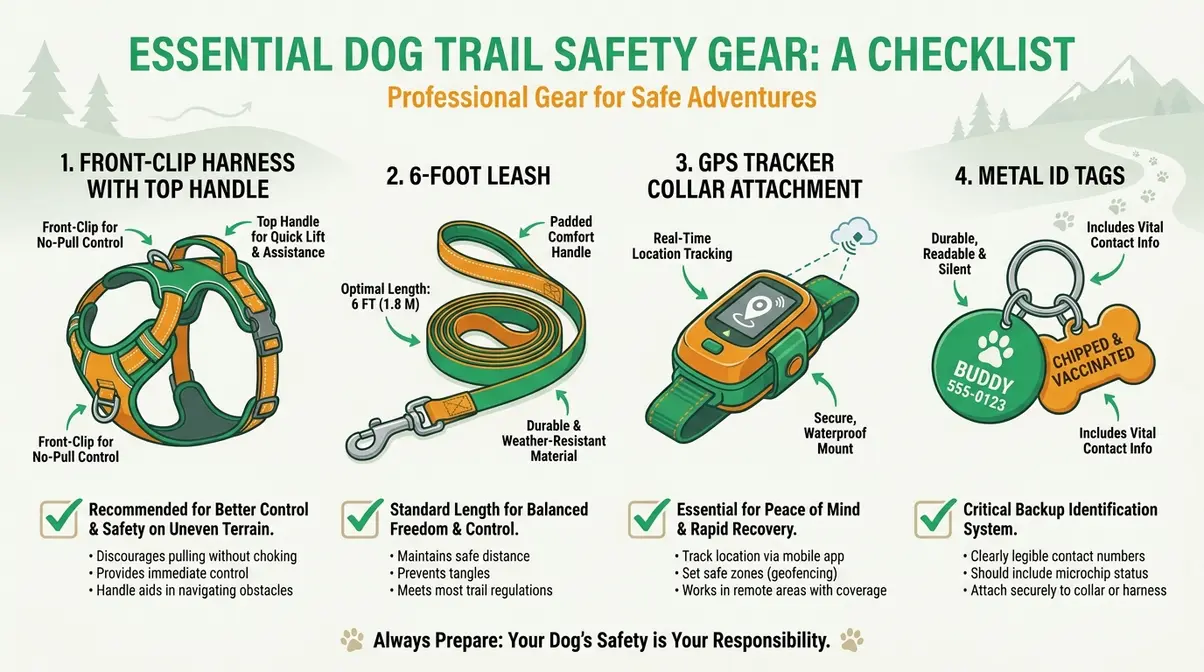
Control and Movement Gear
The three items below keep your Golden under physical control and protect her joints at the same time. All three belong in the joint-protection category of The Golden Standard Checklist.
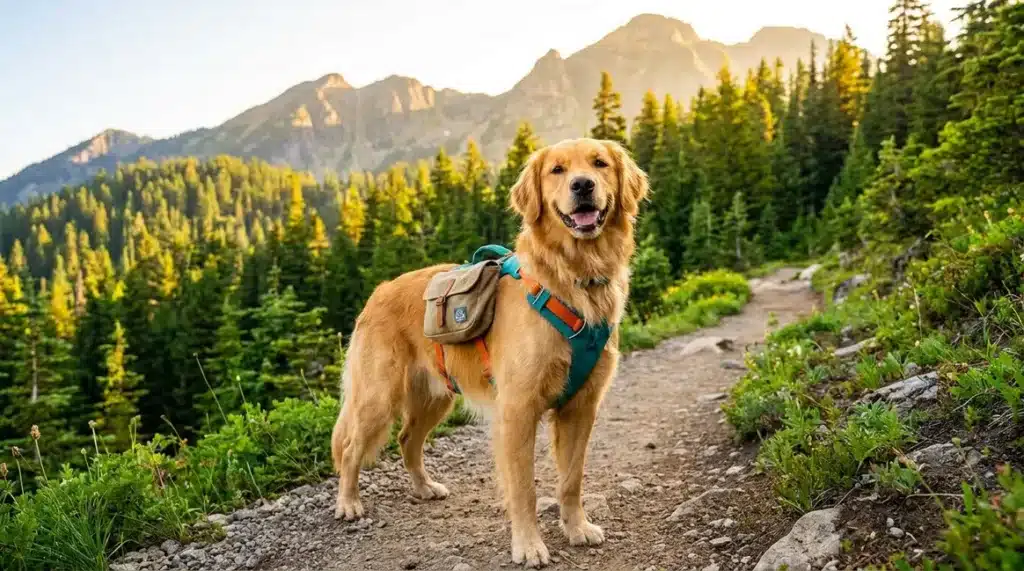
- Harness: A front-clip, back-clip harness with a top-handle lift assist (such as the Ruffwear Front Range or similar) is the right choice for Golden Retrievers. It distributes pressure across the chest, not the neck or hips. The top handle lets you guide her over rocks and steep scrambles without straining her hips. A front-clip harness with a top-handle lift assist protects your Golden Retriever’s joints on steep terrain by distributing pressure across the chest, not the neck or hips. For detailed help choosing the right fit, see choosing the right hiking harness for your Golden.
- Leash: Use a 6-foot non-retractable leash for standard trail use. Retractable leashes are unsafe on narrow trails with drop-offs or other hikers passing close by.
- Long line: A long line (a 20 to 30 foot lightweight leash used for recall training before your dog earns off-leash privileges) is useful in open meadows or low-traffic areas where you want to practice her recall without losing control.
Stay on trails and keep your dog on a leash to prevent heatstroke, infectious disease, and snakebite (UC Davis veterinary outdoor safety tips, UC Davis, 2026, guidance remains current best practice).
Visibility and Identification Gear
Control gear keeps your Golden close. Identification gear makes sure she can be found and returned if she gets away.
- ID tags: Engrave your current contact number on a durable metal tag. Add a second tag with your vet’s phone number as a backup.
- Vaccination papers: Carry a copy of her rabies vaccination certificate on overnight trips where parks require proof at the trailhead.
- GPS tracker: A GPS tracker (a small clip-on device that attaches to your dog’s collar and sends real-time location data to your phone, such as the Fi Collar GPS or similar) is critical for wooded terrain where Goldens can vanish into the brush within seconds.
- Safety light: A clip-on LED light is essential for early morning starts, late finishes, or hunting season in forested areas.
Once your Golden is secured and identifiable, the next priority is being ready for anything the trail throws at her body, from ticks in her thick coat to a cut paw pad.
What Should Go in Your Dog’s Trail First Aid Kit?
Picture this: you’re at mile 4 and you notice your Golden limping slightly. You look at her paw and find a small cut between the pads. Or you run your hand through the thick fur on her neck after a brushy section and feel something small and firm attached to the skin. Both situations are manageable with the right kit. Without it, you’re improvising with nothing.
Brianna York, Vet Tech, recommends keeping all first aid items in a waterproof zip pouch inside your own pack, not your dog’s backpack, so you can access them quickly when your hands are already busy.
Wound Care Essentials
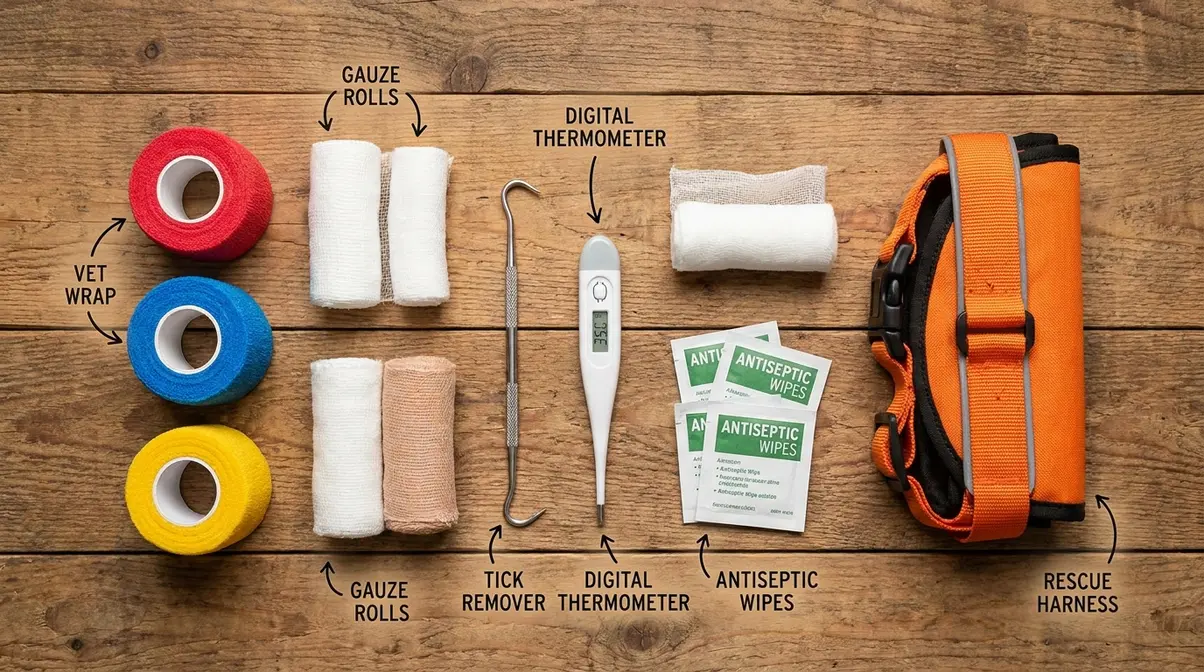
Here is what belongs in your dog’s trail first aid kit, and why each item earns its place:
- Vet wrap (a self-adhesive bandage that sticks to itself but not to fur or skin): Stops bleeding from paw cuts and covers scrapes. Without it, a small paw cut can become a hike-ending injury. Do not wrap too tightly.
- Gauze roll: Padding under vet wrap and useful as an emergency muzzle. Even gentle dogs can bite when they’re in pain.
- Antiseptic wipes or spray: Clean wounds before bandaging to prevent infection on the trail.
- Digital thermometer: Normal dog temperature is 101 to 102.5°F. Above 104°F is a heat emergency requiring immediate cooling and a vet call.
- Emergency contact card: Your vet’s number, the nearest emergency animal hospital address, and your dog’s medical history including allergies, medications, and microchip number.
- Rescue harness (a sling-style device that lets you carry an injured dog over rough terrain): A 65 to 75 lb Golden cannot be carried any distance without one. On a remote trail, this item can be the difference between a safe evacuation and a crisis.
The California Department of Food and Agriculture’s Pet First Aid Kit Checklist includes tick removal kits, fine-point tweezers, and a small flashlight as essential trail items (California state pet first aid kit checklist, CDFA).
Tick and Parasite Removal Tools
Wound care handles injuries you can see. Ticks are the threat hiding in plain sight, and your Golden’s thick double coat makes them significantly harder to find and remove than on short-coated breeds.
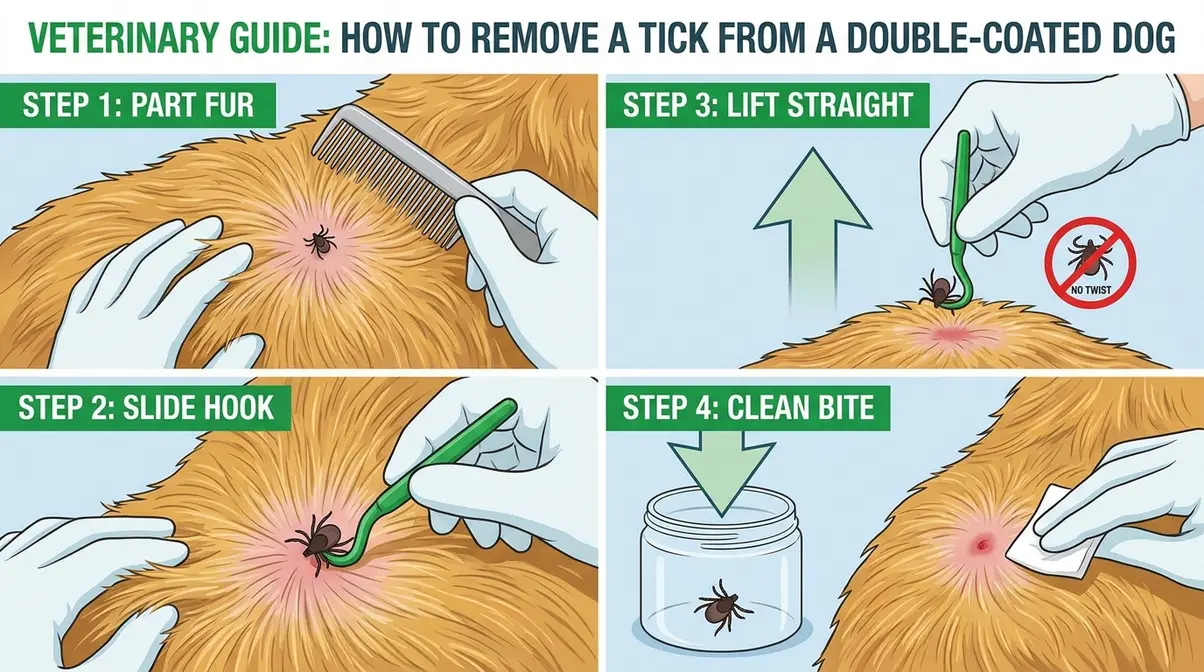
- Tick remover tool: A hook-style tick remover (such as the Tick Twister) works better in dense fur than flat tweezers because it gets under the tick without compressing the body.
- Proper technique: Tufts University’s Cummings School of Veterinary Medicine advises gently pressing the remover against the skin near the tick and lifting free, rather than twisting, to prevent mouthpart fragments from remaining embedded (Tufts University tick removal instructions, Tufts, 2026). “Tufts University’s Cummings School of Veterinary Medicine advises sliding a tick remover against the skin near the tick and lifting free, rather than twisting, to prevent mouthpart fragments from remaining embedded (Tufts, 2026).”
- Backup method: Remove attached ticks using fine-tipped tweezers, pulling straight upward with steady pressure and not twisting (AVMA tick removal guidelines, AVMA, 2026).
- After removal: Disinfect the bite site. Monitor for 30 days for a bullseye rash or swelling, which can signal Lyme disease.
- Double-coat check: Part your Golden’s fur section by section after every hike. Ticks prefer warm spots: the neck, groin, between the toes, and under the collar. For more on breed-specific health concerns to watch for, see common health concerns for Golden Retrievers on the trail.
Your first aid kit handles emergencies. The next section covers the steady, mile-by-mile need: keeping your Golden hydrated and fueled throughout the hike.
Hydration and Trail Fuel for Goldens
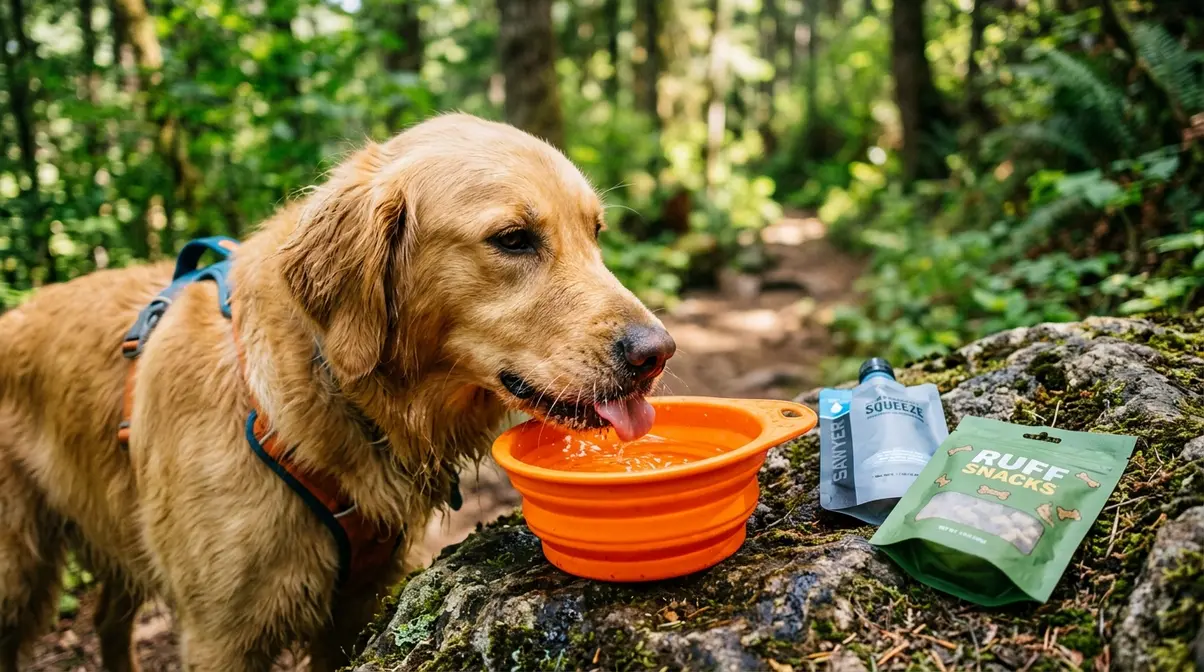
How much water does your Golden actually need on the trail? According to the AKC (2026), dogs require at least one ounce of water per pound of body weight per day. For a 65 lb Golden Retriever on a warm hike, that means carrying at least 65 ounces of fresh water, and more if the weather is hot or the terrain is strenuous. According to the AKC (2026), dogs require at least one ounce of water per pound of body weight per day, and for a 65 lb Golden Retriever on a warm hike, that means carrying at least 65 ounces of fresh water.
Offer water every 15 to 20 minutes on warm days. A collapsible silicone bowl (a bowl that folds flat and fits in a side pocket) is the minimum gear you need to make this practical. On hikes longer than 5 miles, bring a lightweight water filter such as a Sawyer Squeeze or similar so you can safely refill from streams and extend your supply without carrying everything from the car (AKC daily dog hydration formula, AKC, 2026).
Signs of dehydration to watch for mid-hike:
- Sunken or dull-looking eyes
- Tacky or dry gums instead of slick and moist
- Lethargy or dragging behind on the trail
- Loss of skin elasticity (pinch the scruff gently; it should spring back immediately)
For food, bring high-value treats that are small, low-fat, and contain no xylitol (an artificial sweetener toxic to dogs found in some peanut butters and snack products). Use them for recall reinforcement and energy boosts at rest stops. On hikes over 3 hours, pack a portion of your dog’s regular food. For guidance on what works best for an active Golden’s energy needs, see optimal nutrition for an active Golden Retriever.
One critical rule: do not feed a large meal within one hour before a hike. Bloat (gastric dilatation-volvulus, or GDV, a life-threatening condition where the stomach twists on itself) is a known risk in large breeds like Goldens when exercised after eating. A light snack before the trailhead is fine. A full bowl is not.
Hydration and fuel keep your Golden going mile after mile. The final gear category covers what keeps her comfortable from nose to tail, and how to handle what she leaves behind.
Comfort, Carrying, and Cleanup Gear
The last layer of your Golden’s trail kit covers comfort, carrying capacity, and the leave-no-trace responsibility every hiker shares. This category maps to the heat management and joint protection pillars of The Golden Standard Checklist.
How to Protect Your Golden’s Paws?
Durable hiking booties offer the best protection against hot pavement, sharp rocks, and ice. Use the 7-second hand test: press your palm to the ground and hold it there. If it’s too hot for your hand, it’s too hot for her paws. If your Golden won’t tolerate booties, apply a paw balm before and after every hike to condition the pads and prevent cracking from rough terrain. Reference the Pavement Heat Test Chart placed in the first section for the full temperature breakdown.
Beyond paw care, a cooling vest (a lightweight garment soaked in cold water that uses evaporation to lower your dog’s body temperature) is critical for warm-weather hikes with a thick-coated Golden. Soak it before the hike and re-wet at stream crossings. Finally, pack a lightweight microfiber towel to dry your Golden after water crossings. Wet fur in cool or windy conditions causes rapid heat loss, which becomes a problem on fall or high-elevation trails.
For experienced hiking dogs, the NPS supports the use of dog packs and notes they should fit snug and secure (NPS guidelines on dog packs, NPS, 2026). For Golden Retrievers prone to hip dysplasia (a condition where the hip joint doesn’t form correctly, leading to pain and reduced mobility), capping the load at 10-15% of body weight is safer than the generic twenty-five percent rule.
Backpack, Waste, and Overnight Basics
A properly fitted dog backpack lets your Golden carry her own water, a collapsible bowl, and poop bags, which frees up space in your pack and gives her a job to do on the trail.
The weight rule that matters for Goldens: The generic guideline of twenty-five percent body weight is too high for a breed with Golden Retrievers’ hip dysplasia prevalence. Cap the total pack weight at 10-15% of body weight instead. Here is the math: a 65 lb Golden should carry no more than 6.5 to 9.75 lbs total. Start even lighter on her first few hikes and build up gradually. According to veterinary guidance cited by Wilderdog, dogs should carry no more than 15% of body weight in a pack, with first-time dogs starting well below that threshold (Wilderdog, 2026).
“The NPS advises that dog packs should fit snug and secure, and carry only items like water bowls and food, and for Golden Retrievers prone to hip dysplasia, capping the load at 10-15% of body weight is safer than the generic twenty-five percent rule (NPS, 2026).”
- Poop bags: Pack a minimum of 2 bags per mile planned. Biodegradable bags are the better choice.
- Waste disposal: The U.S. Forest Service requires burying dog waste at least 100 feet from water or trails, or packing it out entirely. Pack-it-out is always the safer choice in high-use areas (U.S. Forest Service dog waste rules and food storage guidelines, U.S. Forest Service, 2026).
- Overnight add-ons: For overnight trips, add a lightweight closed-cell foam sleeping pad (such as a Therm-a-Rest Z Lite Sol or similar) for ground insulation and a dry bag (a waterproof sack used to store food away from moisture and wildlife) to keep food secure. After a long day on the trail, see comfortable resting solutions after a long hike for recovery-focused options.
Now that you have the full gear picture, here are the answers to the questions Golden Retriever owners ask most before hitting the trail.
Frequently Asked Questions
Can you take Golden Retrievers on hikes?
Yes, Golden Retrievers are excellent hiking companions. This high-energy sporting breed has the stamina and enthusiasm for day hikes and multi-day trips alike. Healthy adult Goldens typically handle 5 to 10 miles comfortably when conditioned gradually.
What to Pack in a Golden’s Backpack?
Your Golden can carry her own food, water, a collapsible bowl, and poop bags in a properly fitted backpack. For Golden Retrievers, keep the total weight at 10-15% of body weight (NPS, 2026), not the commonly cited twenty-five percent rule, to protect joints prone to hip dysplasia. A 65 lb Golden should carry no more than 6.5 to 9.75 lbs. Start with a lighter load on shorter hikes first and increase gradually as she builds strength and comfort with the pack.
Most Important Hiking Safety Item?
A well-fitted harness and a stocked dog-specific first aid kit are the two most critical safety items. The harness gives you physical control on uneven terrain and protects your Golden’s neck and hips from leash strain. The first aid kit handles the most common trail emergencies, including paw cuts, tick removal, and heat monitoring. Add current ID tags to your dog’s collar before leaving home. Together, these items ensure you have the safety foundation covered for any trail length or terrain type.
Your Golden Standard Trail Checklist
A complete golden retriever hiking gear checklist goes well beyond leashes and water bowls. Goldens face breed-specific risks, from hip joint stress under overloaded packs to ticks embedded in a thick double coat, that generic guides never address. The Golden Standard Checklist organizes your gear into three categories: joint protection, heat management, and coat care. Follow the AKC’s hydration formula of at least one ounce of water per pound of body weight per day, cap your dog’s backpack at 10-15% of her weight, and you’re starting every hike from a place of real safety. Coral Drake and the team at Devoted to Dog built this guide specifically so you don’t have to piece together breed-specific advice from five different sources.
The Golden Standard Checklist framework works because it addresses the three worries that brought you here. Overheating? Covered with a cooling vest, early start times, and the pavement heat test. Ticks in thick fur? Covered with the hook-style remover and the post-hike section-by-section coat check. Joints stressed by a too-heavy pack? Covered with the 10-15% weight rule and a top-handle harness that takes pressure off the hips on steep terrain.
Save this checklist or print it out and run through it the night before every hike. Then work through the trail conditioning guide to build your Golden’s fitness gradually before you tackle longer routes. A prepared dog is a happy dog, and a happy dog makes the whole trail better.
➤ Pack for your Golden’s breed, not just any dog, and every trail becomes a safer adventure for both of you.
Heading out by car? See the best dog crates for the car and best ramps and stairs.