You brought home your Goldendoodle puppy full of excitement. Three days later, you’re scrubbing the same spot on the carpet for the fourth time. Sound familiar? You’re not alone — and you’re not doing it wrong. If you are figuring out how to potty train a Goldendoodle effectively, you just need a system.
Without a consistent plan, accidents become a habit. And habits become much harder to break the longer they go unchecked. That frustration you’re feeling right now? It’s a sign that something needs to change — not that your puppy is stubborn or untrainable.
In this guide, you’ll learn exactly how to potty train a Goldendoodle using a biologically grounded schedule, positive reinforcement, and optional bell training — so your puppy understands where to go and why. We’ll cover what to expect, what supplies you need, five core training steps, troubleshooting tips, and answers to the most common questions.
“Take your pup out the first thing in the morning and every 30–60 min after and again at bedtime. Reward your pup with a treat and use a clicker.” — Goldendoodle owner community advice
Key Takeaways: How to Potty Train a Goldendoodle
When learning how to potty train a Goldendoodle, remember that success requires a schedule tied to your puppy’s actual bladder capacity — a 2-month-old can only hold it for 3 hours maximum. The Bladder Clock Method takes the guesswork out entirely.
- Start immediately: Begin potty training the day your puppy comes home
- Use the Bladder Clock Method: Age in months + 1 = max hours between breaks
- Reward within 3 seconds: Timing your praise and treat is critical to learning
- Clean with enzymatic cleaner: Regular cleaners leave scent trails that attract re-marking
- Expect 4–6 months: Full reliability takes time, but accidents drop dramatically within 2–4 weeks of consistent training
Goldendoodle Potty Training Timeline
Goldendoodles typically take 4–6 months to become reliably potty trained, though most owners see dramatic improvement within the first 2–4 weeks of consistent training. A standard veterinary rule states a puppy can hold its bladder for roughly one hour per month of age (Community Care College). This means your 8-week-old puppy physically cannot wait more than 2 hours between breaks — no matter how smart they are.
“A Goldendoodle puppy can hold its bladder for approximately one hour for every month of its age — meaning a 2-month-old puppy needs a potty break every 2–3 hours at most” (Community Care College Veterinary Assistant Program).
In Step 1, we’ll use a framework called the Bladder Clock Method to calculate your puppy’s exact schedule.
How Long Does Potty Training Take?
Full housetraining reliability (meaning your puppy consistently signals and holds it without accidents) takes 4–6 months. However, meaningful progress — fewer accidents and a growing recognition of the routine — happens within 2–4 weeks of consistent training. These are two separate milestones, and understanding the difference prevents a lot of discouragement.
Puppy bladder muscles are still physically developing until around 4–6 months of age. Accidents aren’t defiance — they’re biology. A 3-month-old Goldendoodle needs a potty break every 3–4 hours during the day, and overnight trips outside may still be necessary. Learning about Goldendoodle intelligence and trainability helps explain why these puppies respond so well once the schedule clicks.
Why Goldendoodles Are Easy to Train
Goldendoodles, a Golden Retriever–Poodle hybrid bred for intelligence and low-shedding coats, inherit the Poodle’s trainability and the Golden Retriever’s eagerness to please. Both parent breeds rank in the top five for obedience intelligence, making Goldendoodles highly receptive to positive reinforcement.
The challenge? Goldendoodles are also sensitive. Harsh training backfires with this breed — they can become anxious and shut down when pushed too hard. Positive reinforcement isn’t just recommended; it’s the only method that works reliably. Think of your Goldendoodle like a bright student who shuts down when yelled at — gentle consistency works; frustration backfires.
Are Goldendoodles hard to housebreak? Not compared to most breeds. But they do require a patient, consistent owner who understands their biology.
Now that you know what to expect, let’s gather everything you’ll need before training begins.
What You’ll Need Before You Start
You don’t need expensive equipment to potty train a Goldendoodle — just the right equipment. Having these supplies ready before your first training session removes friction and keeps you focused on the puppy, not scrambling for tools.
Estimated completion time: 4-6 months
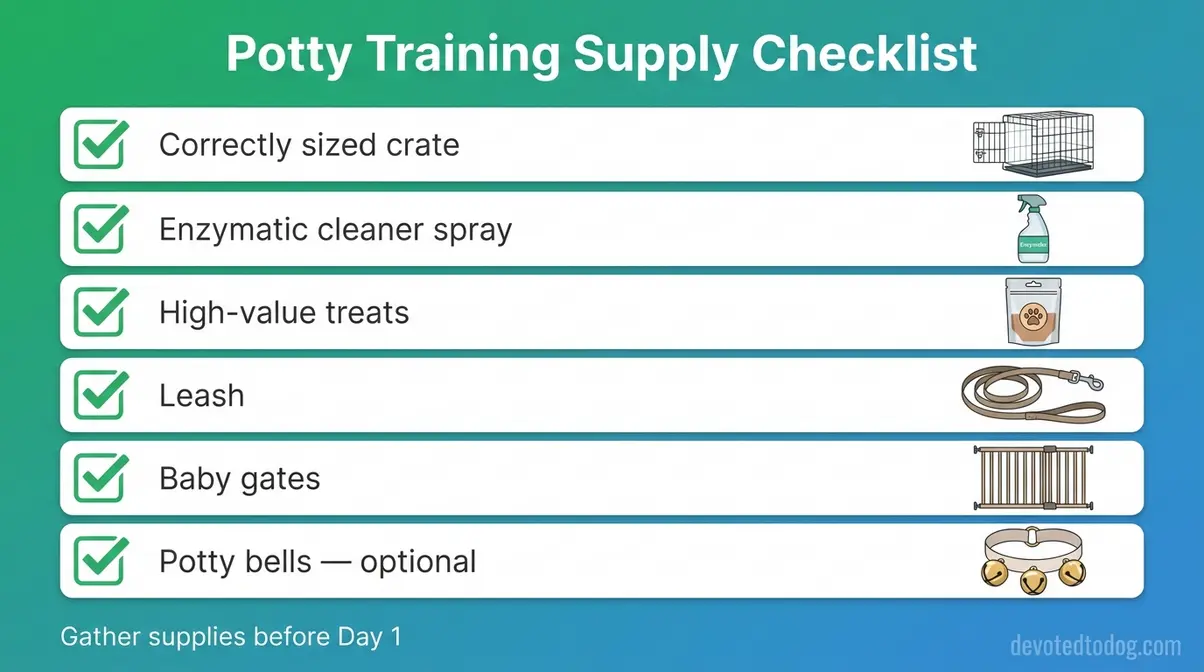
Your Potty Training Supply List
Here are the Tools and Materials you’ll need and why each item matters:
- Crate (correctly sized): Should be just large enough for your puppy to stand, turn around, and lie down. According to the American Humane Society, a national animal welfare organization, if a crate is too large, a puppy may use one end as a bathroom and the other for sleeping — defeating the entire purpose of crate training. Size matters more than brand. Check out the best dog crate for potty training to find the right fit for your Goldendoodle’s size.
- Enzymatic cleaner (a specialized spray that breaks down the proteins in urine odor, not just masks it): Products like Nature’s Miracle work at the molecular level. Regular household cleaners leave behind a scent trace that draws the puppy back to the same spot.
- High-value treats: Small, soft, smelly treats — chicken, cheese, freeze-dried liver — that your puppy only gets for potty success. Not kibble. The reward must feel special and rare.
- Potty bells (optional): A set of bells hung at door height for advanced communication training, covered in Step 4.
- Leash: For guiding your puppy directly to the potty spot without detours or distractions.
- Baby gates: For confining the puppy to one or two rooms where you can supervise them actively.
A note on pee pads: they can work in apartments, but they create a transition challenge later. If your goal is outdoor potty training, skip them from day one. If you don’t have a crate, baby gates and a leash are your next best tools for confinement — see the note on “how to potty train a puppy without a crate” as a viable backup approach.
With your supplies ready, it’s time to build the foundation of your training: a schedule your puppy’s body can actually follow.
Step 1: The Bladder Clock Method
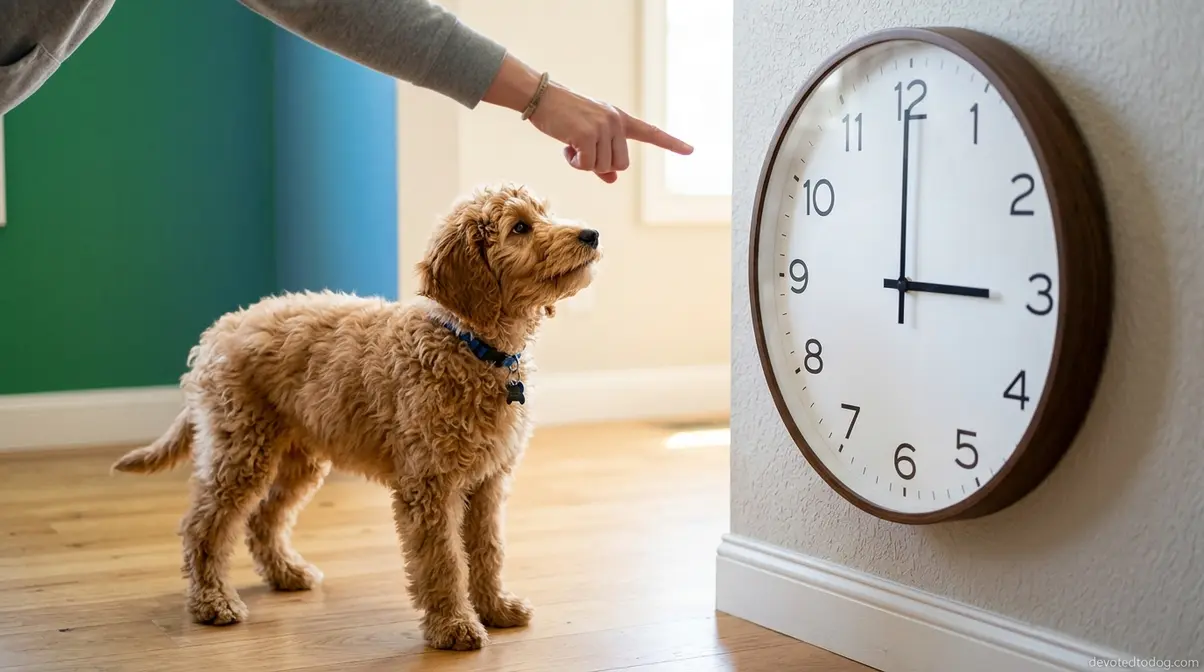
The most common potty training mistake isn’t the wrong method — it’s an impossible schedule. Owners take puppies out every hour for a day, then get busy and skip breaks, then wonder why accidents keep happening. Puppies aged 6 to 14 weeks typically need 8 to 10 elimination breaks (trips outside to urinate or defecate) per day due to their still-developing bladder capacity (UC Davis Veterinary Medicine, one of the top veterinary schools in the United States). Skipping even one break at this age almost guarantees an indoor accident.
The Bladder Clock Method gives you a formula instead of a guess.
The Bladder Clock Formula
The Bladder Clock Method is a scheduling framework that calculates your Goldendoodle’s maximum bladder hold time using a simple formula:
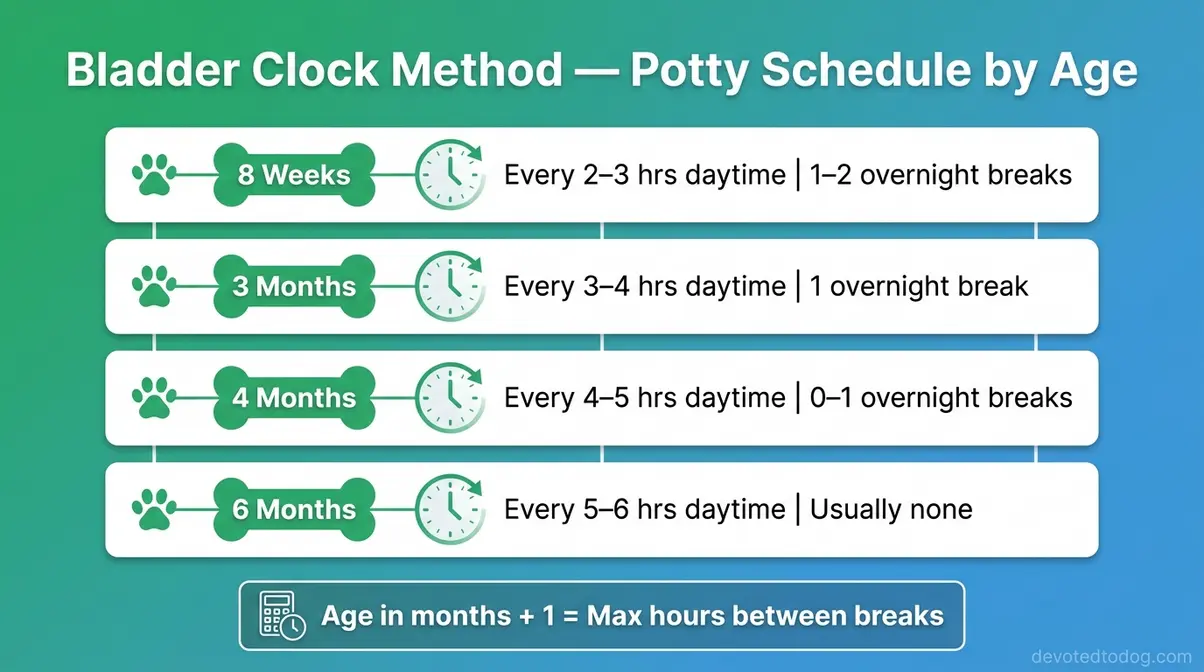
Age in months + 1 = maximum hours between potty breaks
Here’s what that looks like in practice for how to potty train a Goldendoodle puppy at different ages:
- 2 months old → maximum 3 hours between breaks
- 3 months old → maximum 4 hours between breaks
- 6 months old → maximum 7 hours between breaks (nighttime may still need one trip)
Why does this work? Bladder sphincter muscles are still physically developing until around 4–6 months of age. Think of your puppy’s bladder like a small cup — the younger they are, the smaller the cup. The formula accounts for this biology, not stubbornness.
If your Goldendoodle is 10 weeks old (roughly 2.5 months), aim for a break every 3 hours — set a phone alarm if needed. For complete age-specific guidance, see our 8-week-old Goldendoodle owner guide and 3-month-old Goldendoodle training guide.
Now that you have the formula, let’s map it onto a real daily schedule.
Sample Potty Break Schedule by Age
These maximums are based on the Bladder Clock formula. Taking your puppy out more frequently than the formula requires is always a good thing.
| Puppy Age | Max Hold Time | Daytime Break Frequency | Overnight Breaks |
|---|---|---|---|
| 8 weeks (2 months) | ~3 hours | Every 2–3 hours | 1–2 times |
| 12 weeks (3 months) | ~4 hours | Every 3–4 hours | 1 time |
| 4 months | ~5 hours | Every 4–5 hours | 0–1 times |
| 6 months | ~7 hours | Every 5–6 hours | Usually none |
Set phone alarms for the first two weeks. The schedule only becomes habit once your puppy has experienced consistent, rewarded success. How long to potty train a Goldendoodle puppy to this level of reliability? Most owners find that two weeks of alarm-based consistency creates a real routine.
Beyond the timed schedule, there are specific moments every day when you should always take your puppy out — regardless of the clock.
When to Always Take Your Puppy Out
Some moments are non-negotiable potty times, no matter where you are in the schedule:
- Immediately after waking up (morning and naps)
- Within 5–15 minutes after every meal
- After play sessions or bursts of excitement
- Before going to bed or into the crate
- Whenever you notice sniffing, circling, squatting, or whining
Scheduled meals (not free-feeding) create predictable potty times. Feed at the same times every day and you’ll be able to anticipate when your puppy needs to go — this is the feeding schedule connection that experienced trainers rely on.
The 10-10-10 Potty Training Rule
The 10-10-10 rule is a structured potty training rotation: 10 minutes of supervised indoor activity, then a trip to a 10-foot designated potty zone outside for up to 10 minutes. The outdoor potty zone should be the same spot every time. Familiar scents help the puppy recognize it as the correct elimination area. If the puppy doesn’t go within 10 minutes, bring them back inside for supervised play, then try again. This method works especially well in the first 4-6 weeks of training.
A perfect schedule is only half the equation. The other half is making your puppy want to go outside — which is where rewards come in.
Step 2: Use High-Value Rewards
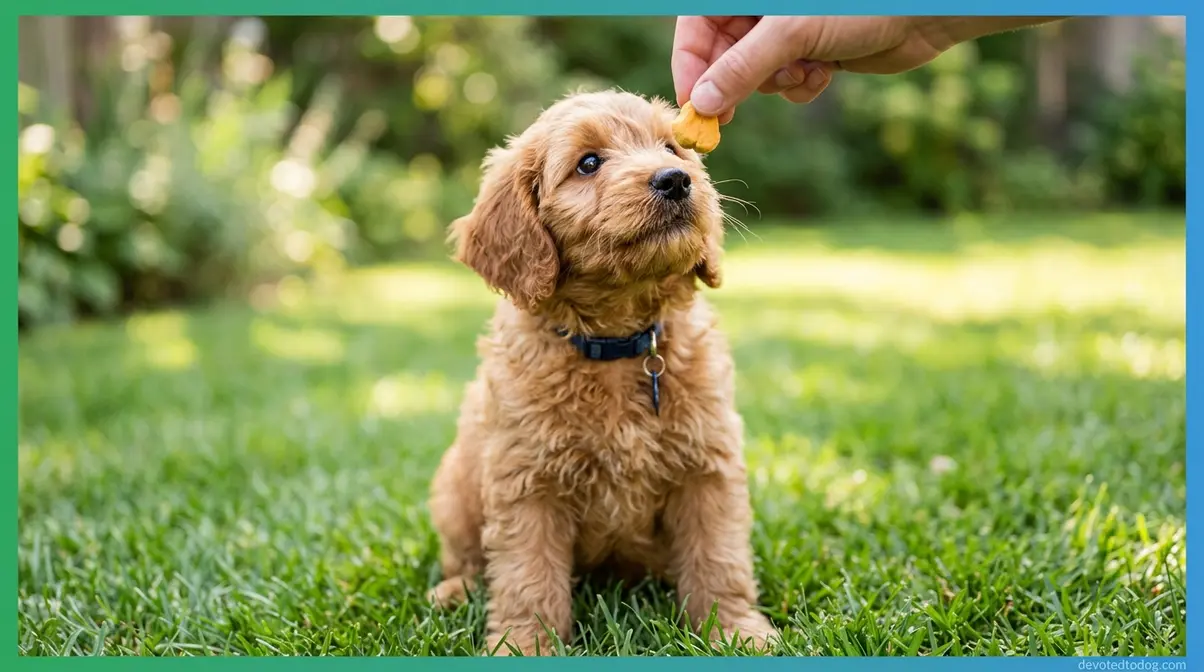
Why do some puppies seem to learn faster than others? The answer is almost always reward timing. Positive reinforcement is not optional — it’s the primary mechanism behind how to potty train a puppy effectively. The American Kennel Club, the leading canine authority in the United States, states that “establishing a consistent schedule is one of the most critical, tried-and-true methods for successfully housetraining a dog” (American Kennel Club). Pair that schedule with immediate rewards and you have a complete system.
Choosing the Right Reward
High-value treats are soft, small (pea-sized), and smelly — treats your puppy doesn’t receive for anything else. Freeze-dried chicken, small pieces of cheese, and commercially made soft training treats all work well. These create a stronger reward signal than kibble because they feel special and rare.
Verbal praise and physical affection also count as rewards for many Goldendoodles. Use an enthusiastic “YES!” or “Good potty!” in the same tone every time — consistency in your voice cue matters.
Try the “jackpot” technique occasionally: give 3–4 treats instead of one for an especially fast or clean success. This unpredictability keeps the puppy engaged and eager. Keep a small treat pouch clipped to your waist during the first 4–6 weeks. Never run back inside to get a treat — by then, the moment has passed and the learning window is closed.
Timing Your Reward for Effect
The 3-second rule is the most important concept in positive reinforcement: dogs learn by association, and the reward must happen within 3 seconds of the behavior. If you wait until you’re back inside, your puppy learns that walking through the door earns treats — not going outside.
Your puppy’s brain connects the reward to the last action taken. Wait by the door with treat in hand. The moment your Goldendoodle finishes, say “Yes!” in a happy voice and deliver the treat immediately — before they take a single step back toward the house.
You can also teach elimination on command. Say the cue word (“go potty,” “outside,” or “hurry up”) in a calm voice just as the puppy begins to squat. Over time, this phrase becomes a reliable trigger that speeds up bathroom trips in bad weather.
What NOT to do: punishment — yelling, rubbing the puppy’s nose in an accident, or scolding after the fact — is ineffective. A puppy cannot connect punishment to an event that happened more than 5 seconds ago. It damages trust and increases anxiety without improving behavior.
Rewards only work when your puppy has the opportunity to succeed. That’s where supervision and confinement come in.
Step 3: Supervise and Confine
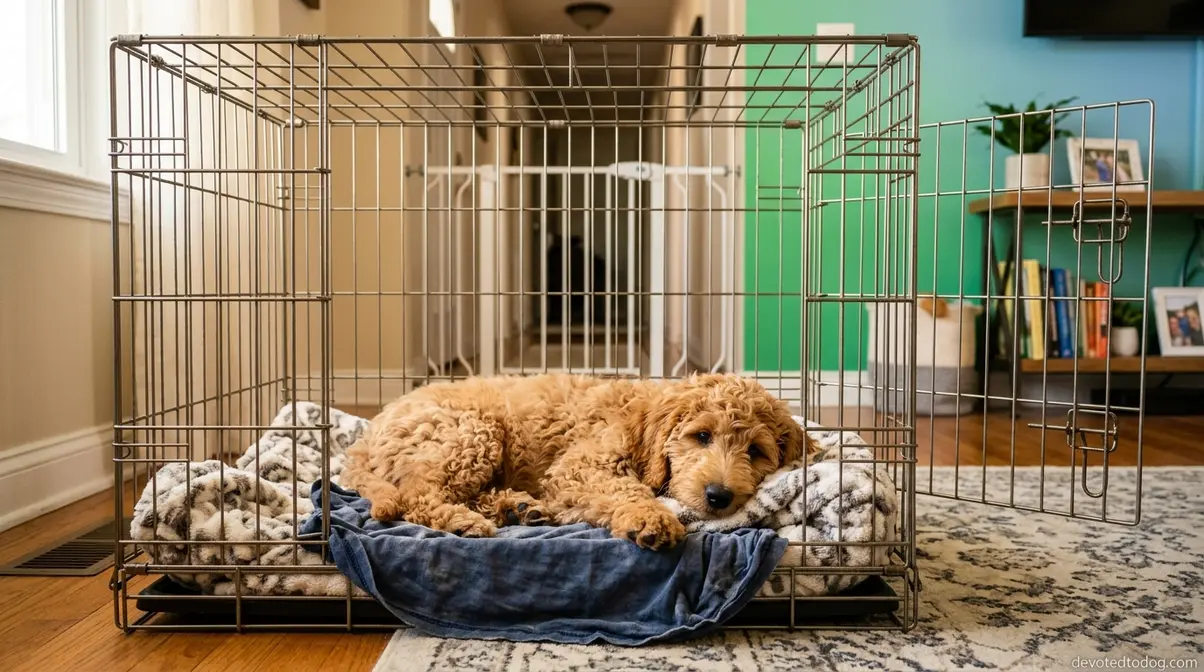
The crate is your most powerful potty training tool — when used correctly. Unsupervised time equals accident opportunities. The crate and baby gates are not punishment tools; they are management tools that prevent your puppy from practicing the wrong behavior in rooms you’re not watching.
How to Use a Crate Properly
Learning how to crate train a puppy for potty training is essential because dogs instinctively avoid soiling where they sleep. A correctly sized crate leverages this instinct. The American Veterinary Society of Animal Behavior, or AVSAB, notes that crates are extremely helpful for housetraining — most puppies become comfortable sleeping in them once properly introduced.
Here’s how to introduce the crate humanely:
- Place a worn T-shirt inside for your scent
- Feed meals inside the crate with the door open for the first 2–3 days
- Gradually close the door for short periods — start with 5 minutes
- Extend crate time slowly as the puppy grows comfortable
The ASPCA, the American Society for the Prevention of Cruelty to Animals, recommends limiting the puppy to 1–2 rooms when not in the crate — use baby gates to block off the rest of the house. More space equals more places to have accidents.
Never use the crate as punishment. If the puppy associates the crate with negative experiences, they’ll resist it and the management tool loses its effectiveness entirely.
Put the crate in your bedroom for the first few weeks. Being close to you reduces anxiety and means you’ll hear overnight whimpering — the puppy’s signal that they need to go out. For more detail on this process, see our guide on crate training techniques for puppies.
Spot the Signs Your Puppy Needs to Go
When figuring out how to potty train a puppy to go outside, the consistent advice is to watch your puppy like a hawk during the first two weeks. Most accidents happen in the 30 seconds you look away. Learn these signals:
- Sniffing the floor intensely and circling — the most reliable early signal
- Squatting or crouching — act immediately; you have seconds
- Whining or scratching at the door — a learned signal in some puppies
- Suddenly stopping play and heading toward a corner or behind furniture
- Restlessness or pacing — especially after meals or naps
When you see these signals, calmly say “outside” or “go potty,” pick up the puppy if needed, and move quickly without startling them. Startling can cause a mid-air accident. The ASPCA reinforces that limiting access to 1–2 rooms where you can actively supervise is one of the most effective ways to prevent indoor accidents.
Once your puppy is reliably following your schedule, you can introduce an advanced communication tool that many Goldendoodle owners swear by: the potty bell.
Step 4: Ring a Potty Bell
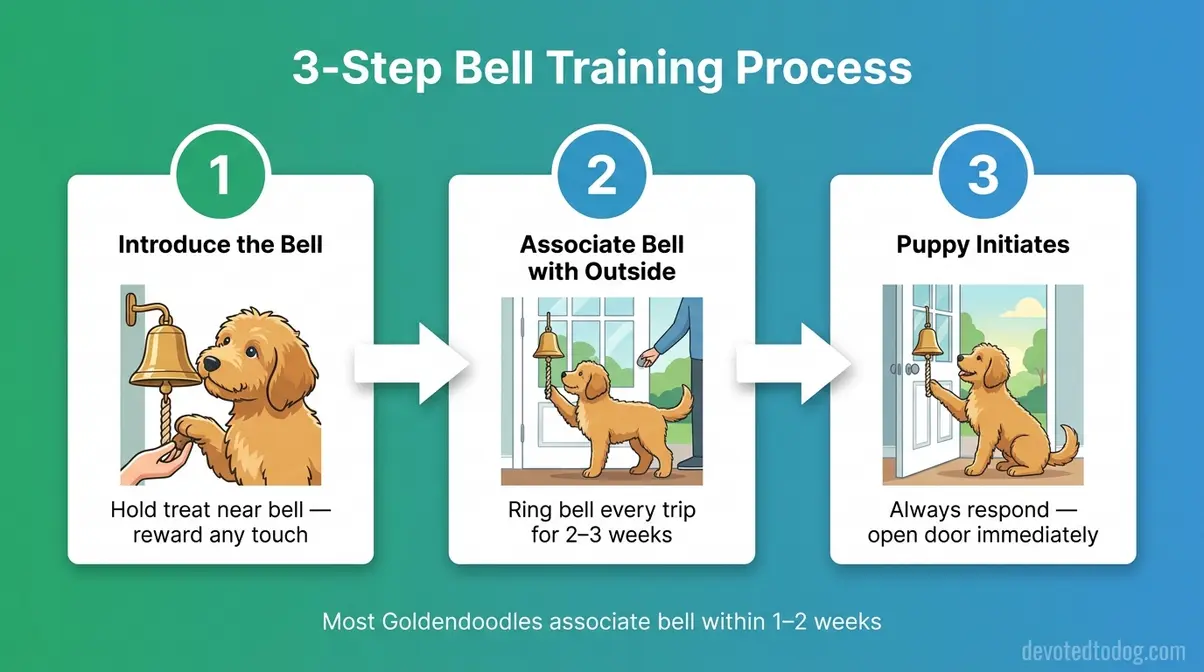
Across Goldendoodle owner communities, one technique comes up again and again when experienced owners share what made the biggest difference: bell training. It’s an optional but highly effective method that gives your puppy a consistent, learnable signal to communicate the need to go outside. “Bell training works by giving a Goldendoodle puppy a consistent, learnable signal to communicate the need to go outside — most puppies associate the bell with the door within 1–2 weeks.”
The American Humane Society emphasizes that proper setup — like correct crate sizing — is essential for effective training, and the same principle applies here: setup before training saves confusion later.
Choosing and Hanging Your Bell
If you want to know how to potty train a Goldendoodle with bells, two bell types work well for Goldendoodles:
- Hanging jingle bells on a ribbon or strap hung from the door handle — inexpensive and effective
- Standalone button bells (like generic pet training bells) — easier for small puppies to paw
Hang the bell at your Goldendoodle’s nose height when they’re standing. Too high and they can’t reach it; too low and they’ll trip over it. Only use the bell for the door that leads to the potty area — consistency in location is critical.
A ribbon of jingle bells from a craft store costs under $5 and works just as well as a $30 training bell. The puppy doesn’t care about the brand — only the association.
Once the bell is in place, training the puppy to use it takes just three steps.
The 3-Step Bell Training Process
- Introduce the bell: Hold a treat near the bell. When your puppy nudges or touches the bell to get to the treat, say “Yes!” and give the treat immediately. Repeat 5–10 times until the puppy is deliberately touching the bell.
- Associate the bell with going outside: Every single time you take your puppy to the potty door, guide their nose or paw to ring the bell. Then immediately open the door and go outside. Repeat every trip for 2–3 weeks.
- Wait for the puppy to initiate: Once your puppy understands that bell = door opens, they’ll start ringing it on their own. When they do, always respond immediately and take them outside — even if you suspect they just want to play.
A common mistake: the puppy rings the bell for attention or play, not potty. How to tell the difference — take them outside and give them 5 minutes in the potty zone. If they don’t go, bring them back inside. Don’t reward the trip with play; only reward elimination.
Across Goldendoodle owner communities, bell training consistently ranks as one of the most effective advanced techniques for how to bell train a puppy. As one owner shared: “We would ring it every time we took her out — now she practically shakes it.”
Even with the best schedule and bell training, accidents will happen — especially in the first few weeks. Here’s how to handle them without losing progress.
Step 5 – Handle Accidents Without Losing Progress
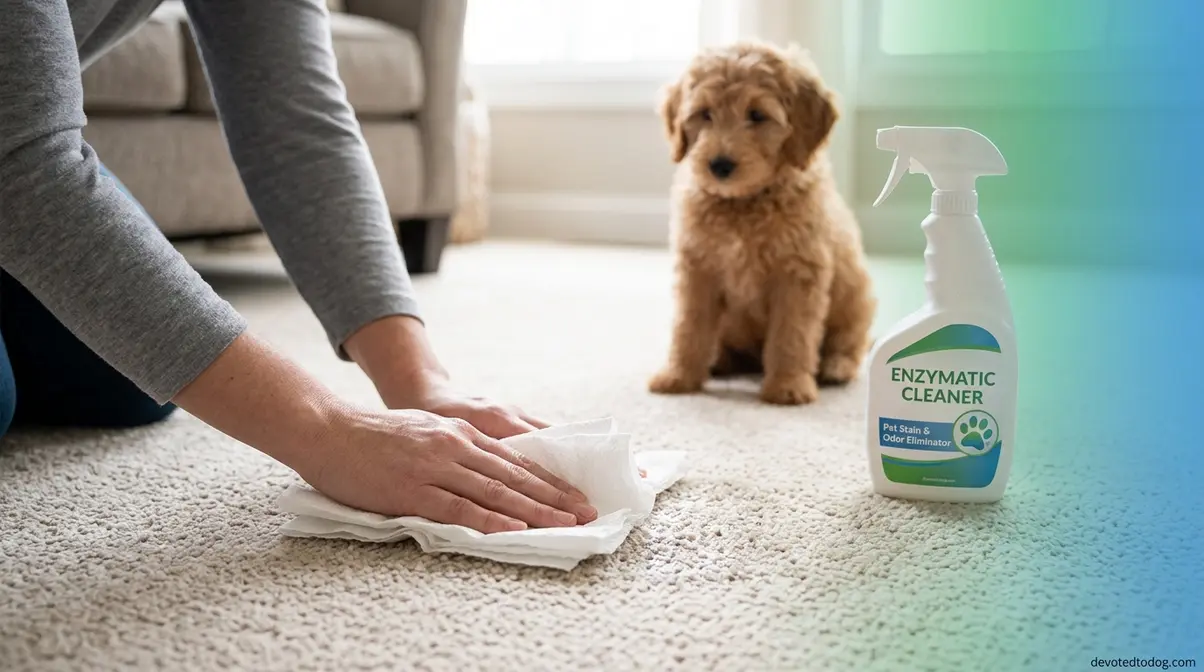
You’ve been doing everything right — and then your Goldendoodle squats on the kitchen floor. It happens. Accidents are not a sign of failure. The way you respond to them either sets back training or keeps it on track.
Clean Up Accidents the Right Way
If you catch the puppy mid-accident, calmly say “outside” (no yelling) and move them immediately to the potty spot. If they finish outside, reward them. If you find an old accident, say nothing — the puppy has no memory of it and cannot connect your reaction to what happened earlier.
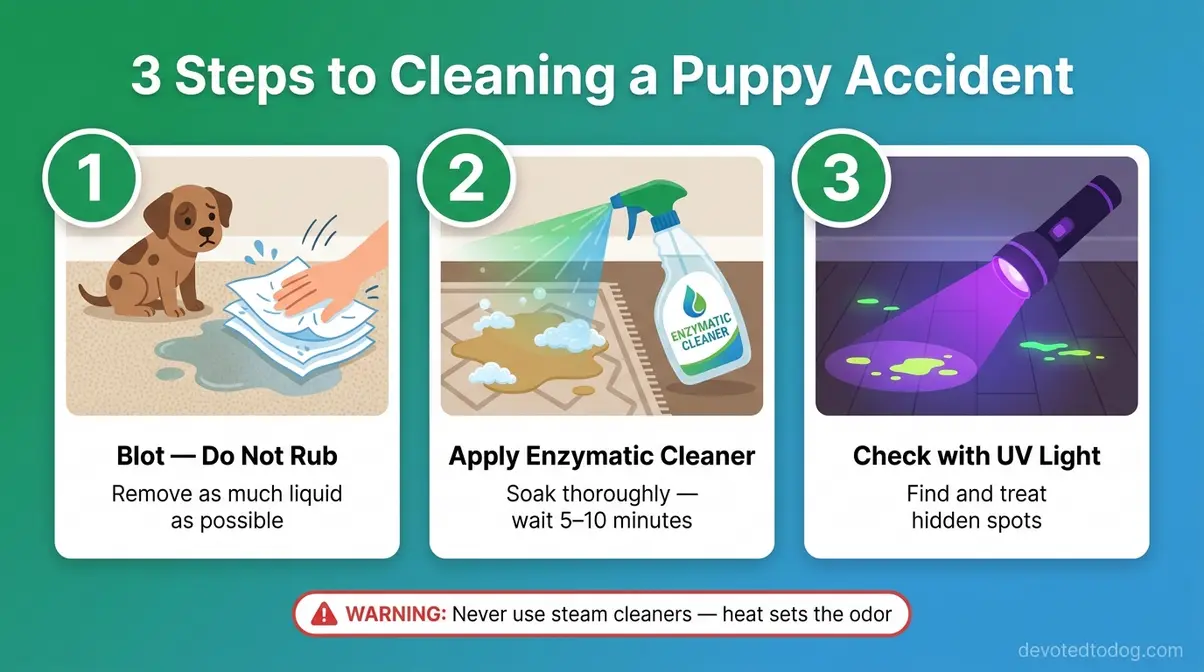
For cleanup, follow these steps:
- Blot up as much liquid as possible with paper towels — do not rub (rubbing spreads urine deeper into fibers)
- Apply enzymatic cleaner (such as Nature’s Miracle or similar) generously — enough to soak into the carpet padding if on carpet
- Let it sit for 5–10 minutes, then blot dry
- Allow to air dry completely — do not use steam cleaners, which set the odor with heat
“Enzymatic cleaners are necessary for pet accidents because they actively break down uric acid into gases that evaporate, permanently eliminating the odor — not just masking it” (Consumer Reports, the independent consumer testing organization). Regular household cleaners mask the smell to humans but leave the scent marker that draws puppies back to the same spot. This answers the common question about what scent will stop dogs peeing in the house — removing the scent entirely with an enzymatic cleaner is the answer.
Use a black light (UV flashlight) to find old accident spots you may have missed — dried urine glows under UV light. Clean every spot thoroughly or your puppy will keep returning to them.
Occasional accidents are expected. But if your well-trained puppy suddenly starts having accidents every day after months of success — that’s a regression, and it has a specific cause and solution.
Troubleshoot the 6-Month Regression
A regression is when a puppy who was doing well suddenly starts having accidents again. It’s normal and temporary — but it catches owners completely off guard. Around 5–8 months of age, many puppies who were reliably trained begin having indoor accidents again. Common causes include hormonal changes (especially in intact dogs), adolescent distraction, testing boundaries, or a change in routine.
How to re-potty train a dog going through this phase: go back to basics. Treat the puppy as if they’re 8 weeks old again. Increase potty break frequency, return to crate supervision when unsupervised, and re-establish the reward system. The Bladder Clock Method still applies here — recalculate the formula for your puppy’s current age and stick to it. This phase typically resolves within 2–4 weeks of consistent re-training.
If your Goldendoodle seems resistant, reduce their freedom in the house, increase the value of the reward, and shorten the time between breaks. Stubbornness at this stage is often a sign the schedule isn’t tight enough — not that the puppy is being defiant.
Nervous wetting is a distinct issue. Some puppies urinate when excited, frightened, or greeting people. This is an involuntary response, not a training failure. It typically resolves as the puppy matures and gains confidence. Do not punish it.
The consistent advice from experienced Goldendoodle owners: “Don’t be hard on yourself. Go back to the schedule that worked and stay patient — they come back around within a few weeks.”
Stop Indoor Peeing
To stop a Goldendoodle from peeing inside, establish a strict potty schedule, supervise constantly, and use an enzymatic cleaner on every accident immediately. Young puppies need a potty break every 2-3 hours at minimum. Unsupervised time in the house is the most common cause of repeated indoor accidents. If accidents continue despite consistent training, consult your veterinarian to rule out a urinary tract infection.
Most owners train in ideal conditions — but what if you live in an apartment or your puppy refuses to go outside in the rain?
Adapting Training for Apartments and Cold Weather
Potty Training in an Apartment
Apartment potty training for a puppy works best when you designate a consistent outdoor spot — the same corner of a parking lot or patch of grass every single time. Familiar scents help your puppy recognize the potty zone even in a busy urban environment.
If outdoor access is limited, use a real grass patch (like a PetGrass tray) indoors as a temporary bridge — not pee pads, which create a long-term transition problem. If you’ve already started with pee pads, move the pad progressively closer to the door over two weeks, then transition it outside.
Consistency in location matters as much as consistency in timing. The more predictable the experience, the faster your puppy learns.
Cold or rainy weather creates a different challenge — a puppy that simply refuses to go outside.
Training in Cold or Wet Weather
When figuring out how to potty train a puppy in winter, cold-weather training requires extra motivation and a little preparation:
- Keep a small shoveled or covered potty spot for winter — familiar smells help the puppy recognize the spot even under snow
- Bring the best treats (chicken, cheese) specifically for cold-weather potty trips — the higher the value, the more willing the puppy
- Keep trips brief and focused: go to the spot, wait 5 minutes, reward immediately, come back in
- Consider a dog jacket or booties for very small or cold-sensitive Goldendoodles
Potty training is the foundation — but your Goldendoodle is learning other behaviors at the same time. Here’s a quick guide to the most common ones.
Other Behaviors to Address Early
How to Stop Your Puppy from Biting
Biting is completely normal puppy behavior — it’s how they explore the world and relieve teething discomfort. It needs to be redirected, not punished. When your puppy bites too hard, say “ouch” in a sharp, surprised voice and immediately redirect to a chew toy. Repeat consistently. For a complete guide on how to train a puppy not to bite, see our full resource on how to stop puppy biting and nipping.
Biting and jumping often happen at the same time — here’s the quick fix for jumping and leash pulling.
Managing Jumping and Leash Manners
For jumping: turn away and give zero attention when the puppy jumps. Reward with attention only when all four paws are on the floor. Every family member must do this consistently — one person allowing jumping undoes the training. For how to train a dog not to jump on people, consistency across the household is the key variable.
For leash pulling: stop walking every time the puppy pulls. Resume only when the leash goes slack. This teaches that pulling equals no progress. For a full walkthrough, see our guide on how to teach your puppy to walk politely on a leash.
Before we wrap up, let’s look at the most common mistakes that slow potty training down — and when it’s time to call your vet.
Common Mistakes and When to Worry
5 Mistakes That Slow Progress
These are easy mistakes that are simple to fix — beginners make them because no one explained the reasoning upfront.
- Using pee pads AND outdoor training simultaneously — creates confusion about where the correct potty zone is. Choose one method and commit to it.
- Giving the puppy too much freedom too soon — before reliable training is established, unsupervised access to the whole house means accidents in rooms you’re not watching. This is the most common reason a stubborn puppy seems impossible to train.
- Punishing accidents after the fact — dogs cannot connect punishment to an event that happened more than 5 seconds ago. It only creates anxiety and damages the trust you’ve been building.
- Inconsistent rewards — sometimes rewarding outdoor potty, sometimes not. Inconsistency breaks the association between going outside and the reward.
- Using the wrong cleaner — any cleaner that isn’t enzymatic leaves a scent trail that attracts the puppy back to the same spot, creating a cycle of repeated accidents.
When to Call Your Veterinarian
If your previously trained Goldendoodle suddenly starts having frequent accidents, consider a medical cause before assuming a training problem. Urinary tract infections (UTIs) are common in female puppies and cause sudden onset of indoor accidents. Signs that warrant a vet visit immediately include straining to urinate, blood in the urine, or urinating very frequently in small amounts.
This isn’t a training failure — it’s a health issue that’s easy to treat once identified. All advice in this guide is for general educational purposes and does not substitute for professional veterinary advice. When in doubt, call your vet.
Frequently Asked Questions
Do Goldendoodles Potty Train Easily?
Goldendoodles are generally easy to potty train compared to most breeds, thanks to their high intelligence. Both parent breeds rank among the top five most trainable dogs. Most Goldendoodle owners see significant improvement within the first 2-4 weeks of consistent training.
What Is the Hardest Dog Breed to Toilet Train?
Breeds most often cited as challenging to toilet train include Basset Hounds, Beagles, Dalmatians, and Jack Russell Terriers. These breeds tend to be more independent or strong-willed, which can make consistent positive reinforcement harder to maintain. Their natural instincts can override the desire to please an owner. By comparison, Goldendoodles are among the easiest breeds to train.
Are Goldendoodles Hard to Housebreak?
No, Goldendoodles are not hard to housebreak due to their eagerness to please. They respond exceptionally well to positive reinforcement and a consistent schedule. However, they do require patience during their early bladder development phase.
What Scent Will Stop Dogs Peeing in the House?
Enzymatic cleaners are the only scents that truly stop dogs from peeing in the house. These specialized cleaners break down the uric acid scent marker that draws puppies back to the same spot. Regular household cleaners only mask the smell to human noses. If you use standard bleach or ammonia, your puppy will still smell the original accident. Always apply an enzymatic spray generously to permanently eliminate the odor.
Bringing It All Together
Learning how to potty train a Goldendoodle comes down to one principle: work with your puppy’s biology, not against it. The Bladder Clock Method — age in months + 1 = hours between breaks — gives you a schedule your puppy’s body can actually follow. Puppies aged 6 to 14 weeks need 8 to 10 elimination breaks per day (UC Davis Veterinary Medicine). Pair that schedule with immediate positive reinforcement and an enzymatic cleaner for accidents, and most Goldendoodles show significant improvement within the first two to four weeks.
The Bladder Clock Method removes the guesswork. Once you know exactly when your puppy needs to go, you can set them up to succeed — and reward every success consistently. That cycle of success and reward is what builds the habit. Your puppy’s accidents aren’t stubbornness. They’re a signal that the schedule needs adjusting, not that the training has failed.
Start today: calculate your puppy’s Bladder Clock interval (age in months + 1), set a phone alarm for that interval, and take your puppy outside immediately when it goes off. Reward every successful trip with a high-value treat within 3 seconds. The schedule becomes habit faster than you think — and the accidents on the carpet become a distant memory.
For apartment living or overnight training, compare our roundup of the best indoor dog potties.
Alliyah Strange is a CPDT-KA certified dog trainer and behaviorist. She reviews DevotedToDog training and behavior articles for accuracy and alignment with current positive-reinforcement, force-free training standards.