
⚕️ Veterinary Disclaimer: This guide is for informational purposes only and does not replace professional veterinary advice. Always consult your veterinarian for concerns about your puppy’s specific health, growth, or behavior.Key Takeaways: Your 6-Month-Old Goldendoodle At 6 months, your Goldendoodle is hitting “The 6-Month Tipping Point” — a simultaneous surge of physical growth, adolescent behavior, and coat transformation that catches most owners off guard.
- Size: Standard Goldendoodles weigh 35–55 lbs at 6 months; Mini types reach 15–25 lbs
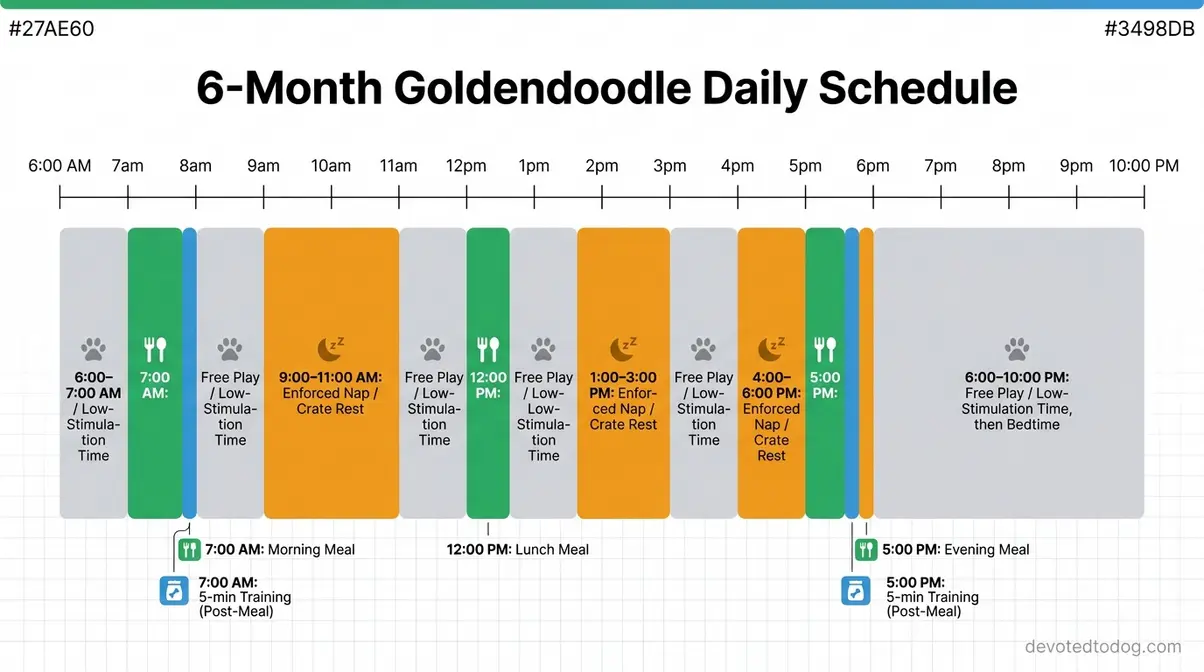
- Sleep: Puppies need 16–20 hours of rest per day (Cornell University) — overtiredness drives hyperactivity, not calm
- Behavior: The “second fear period” (6–14 months) explains sudden fearfulness and ignoring commands you thought they’d mastered
- Coat: The puppy-to-adult coat transition begins around 6 months — daily brushing prevents painful mats before they start
- Feeding: Most 6-month Goldendoodles eat 2–3 cups of puppy food daily, split into 2–3 meals based on their current weight
What to Expect from Your 6-Month-Old Goldendoodle
A 6-month-old Goldendoodle is simultaneously hitting adolescence, their second fear period, and their coat transition — making it the most complex developmental month in the breed’s first year. Four major changes are colliding at once, and understanding this convergence is what separates owners who panic from owners who parent with confidence. Once you name what’s happening, the chaos becomes manageable. For a what to expect from a 6-month-old Goldendoodle perspective, the most important reframe is this: your puppy isn’t regressing. Their brain is being flooded with new hormones, developmental shifts, and sensory changes — all at the same time. Owners who understand this stop blaming themselves and start responding strategically.The 6-Month Tipping Point — What’s Happening All at Once
At 6 months, your 6-month-old Goldendoodle hits what we call “The 6-Month Tipping Point” — the simultaneous convergence of five major changes: the second fear period, the flight instinct, sexual maturity, the puppy coat transition, and the peak of adolescent energy. No single change would be overwhelming on its own. All five arriving together is what makes this month feel like your puppy has been replaced by a stranger. Think of it like a teenager hitting puberty. Your Goldendoodle’s brain and body are changing so fast that even they can’t keep up. Across Goldendoodle owner communities, the shared experience is remarkably consistent: owners report their puppies suddenly “ignoring commands they used to know perfectly.” That’s not a training failure — it’s the second fear period (a normal developmental phase where puppies suddenly seem scared of familiar things) and hormonal changes temporarily disrupting executive function. This is textbook Goldendoodle behavior. You haven’t done anything wrong. The 6-Month Tipping Point is a phase, not a permanent personality change — and the tools in this guide will help you navigate it. Cornell University data on puppy sleep requirements show that puppies require significantly more rest than adult dogs, often needing 16–20 hours of sleep per day to support rapid physical and mental development (Cornell University College of Veterinary Medicine) — a fact that directly explains why overtired puppies look hyperactive rather than sleepy. Now that you know why everything is happening at once, let’s look at the three specific physical changes your puppy is experiencing right now — starting with their teeth, their coat, and their hormones.Teething, Coat Changes, and Sexual Maturity
Three physical milestones arrive at almost exactly the same time at the 6-month mark:- Teething completion: Adult teeth are fully in by 6 months. The worst of teething pain is essentially over — but the urge to chew remains strong for months. Redirect immediately to appropriate chew toys every single time teeth touch something they shouldn’t.
- Coat transition: Your puppy’s fluffy baby fur is being replaced by a thicker, curlier adult coat — and the two coats can tangle together, creating mats if you don’t brush regularly. You might notice your Goldendoodle’s coat looking “patchy” or uneven in different spots. This is completely normal during the transition period and usually resolves by 12–18 months.
- Sexual maturity: Goldendoodles reach sexual maturity around 6–9 months. This is an important topic to discuss with your veterinarian — spay and neuter timing has evolved, and your vet can recommend the right timing for your specific puppy’s size and development.
How Much Sleep Does a 6-Month Goldendoodle Need?

Critical Socialization Windows and Health Monitoring
The primary socialization window (3–12 weeks) has closed, but secondary socialization continues through 6 months and well beyond. Positive exposure to new people, places, sounds, and situations remains genuinely important. The key word is positive — don’t force a fearful puppy into overwhelming situations during the second fear period. Penn State Extension research on puppy socialization confirms that puppies experience a heightened sensitivity stage known as a fear period, with the first occurring around 8–10 weeks of age (Penn State Extension) — and the second beginning around 6 months. If your Goldendoodle seems to have “forgotten” how to walk on a leash or suddenly reacts to things they ignored before, this is the second fear period — not a training failure. Calm, positive exposure is the solution. Never force or flood. At 6 months, watch for these specific health signals:- Limping or reluctance to exercise — growth plates (the soft areas at the ends of bones where growth occurs) are still open at 6 months; avoid high-impact jumping until your vet clears it
- Excessive scratching or paw licking — may indicate allergies, which we cover in the nutrition section
- Changes in appetite or sudden weight loss — worth a vet call if persistent
- Behavioral changes at vet visits — 6 months is typically when vets discuss spay/neuter timing, heartworm prevention, and the transition from puppy vaccines to annual boosters
How Big Is Your 6-Month-Old Goldendoodle?
At 6 months, a Standard Goldendoodle — the largest size type, typically 50–90 lbs as an adult — typically weighs 35–55 lbs. Mini Goldendoodles, a cross between a Miniature Poodle and a Golden Retriever typically under 35 lbs as an adult, usually reach 15–25 lbs by this age. Most of the rapid height growth is already complete by the 6-month mark — weight gain continues more gradually through 12–18 months. Research shows that dogs typically reach 50% of their adult weight between 4 and 6 months of age, with larger breed crosses taking longer to reach their mature weight (scientific growth standards for monitoring dog bodyweight, NIH PubMed, 2020). For a Goldendoodle size and growth chart overview, the most reassuring fact is this: at The 6-Month Tipping Point, most of the dramatic rapid growth is already behind your puppy. What you’re seeing now is a gradual filling-out, not a growth sprint.Weight Ranges for Mini, Medium, and Standard Goldendoodles
Here are verified weight benchmarks for each Goldendoodle size type at the 6-month mark, cross-referenced against Timber Ridge Goldendoodles growth data and multiple breed sources:| Size Type | 6-Month Weight | Adult Weight | When Full Grown |
|---|---|---|---|
| Toy Goldendoodle | 8–15 lbs | 10–25 lbs | 7–10 months |
| Mini Goldendoodle | 15–25 lbs | 25–35 lbs | 10–12 months |
| Medium Goldendoodle | 25–35 lbs | 35–50 lbs | 11–13 months |
| Standard Goldendoodle | 35–55 lbs | 50–90 lbs | 12–18 months |
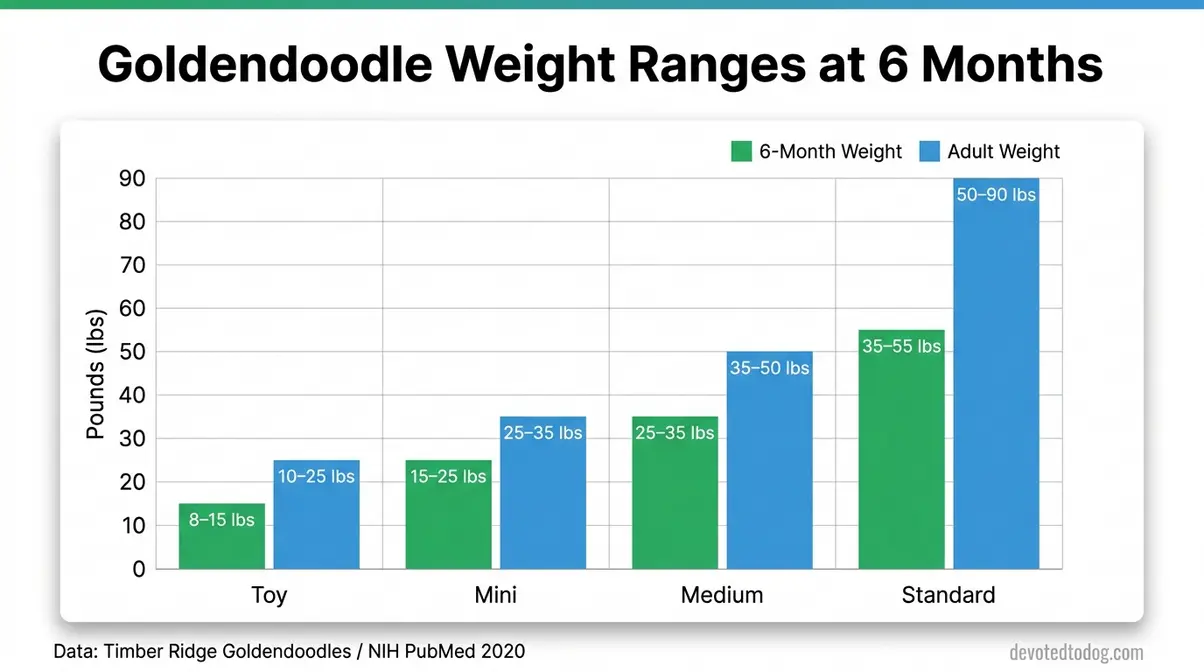
“Mine was 40lbs at 6 months old. Now at 2.5 years, he’s at 58-60lbs.” — One Goldendoodle owner shared in an online communityThis real-world example illustrates exactly what the data shows: a Standard Goldendoodle at the higher end of the 6-month range will typically add another 15–20 lbs before reaching adult weight. The growth continues, but it slows considerably after 6 months. These ranges are helpful, but every puppy is different. Here’s how to predict where YOUR Goldendoodle will land as an adult.
How to Predict Your Goldendoodle’s Adult Size
Here’s a simple formula: add both parents’ adult weights together and divide by 2 to get a midpoint estimate of your puppy’s adult weight. For F1 Goldendoodles, the result is usually within 5–10 lbs of accuracy. This method works because the 50/50 genetic split means the puppy typically lands between both parents’ sizes. There’s a second useful estimate: at 6 months, your puppy is typically 60–75% of their adult weight. Divide their current weight by 0.65 for a rough adult weight estimate. If your 6-month Mini Goldendoodle weighs 18 lbs, divide by 0.65 — that gives you approximately 27–28 lbs as an adult, right in the Mini range. Note the limitations: genetics are complex. Poodle-dominant genes (more common in F1B dogs) can shift the result toward a smaller adult size, while Golden Retriever-dominant genes may push it larger. Growing puppies require specific nutritional balances, and feeding them correctly reduces the risk of developmental orthopedic diseases, especially in larger breeds (Tufts University veterinary growth guide, Tufts University Cummings School of Veterinary Medicine, 2022). Frame the formula as a useful estimate, not a guarantee. Knowing your puppy’s predicted adult size isn’t just reassuring — it also affects how you feed them. But before we get to nutrition, let’s look at what else can influence your Goldendoodle’s growth.Factors That Affect Your Puppy’s Growth Rate
Your 6-month-old Goldendoodle’s weight is influenced by several factors working simultaneously:- Genetics: Parent size is the single biggest predictor. F1B Goldendoodles (75% Poodle) tend to be smaller than F1s within the same size category. If you know both parents’ weights, you have the best possible starting point.
- Nutrition: Underfeeding slows growth; overfeeding causes too-rapid growth that stresses developing joints. Both extremes are genuinely problematic for a large-breed puppy — the goal is steady, appropriate growth, not the fastest possible growth.
- Health: Intestinal parasites, illness, and some hormonal conditions can affect growth rate. A puppy growing significantly outside their predicted range warrants a vet check — it may indicate a nutritional issue or underlying health concern.
- Gender: Male Goldendoodles typically weigh 10–15% more than females of the same size type at the same age.
6-Month Goldendoodle Behavior & Rebellion
Is your 6-month-old Goldendoodle suddenly ignoring commands, biting more, and bouncing off walls? You’re not imagining it — and you haven’t failed as a trainer. This is normal 6-month-old Goldendoodle behavior, and it has a name. The second fear period in dogs typically occurs between 6 and 14 months of age and can cause sudden, dramatic behavioral changes — including ignoring commands a puppy previously knew (AKC guidelines on the second fear period, American Kennel Club, 2026). The behavior you’re seeing is a direct result of The 6-Month Tipping Point: hormonal changes, the second fear period, and the flight instinct all arriving simultaneously. Understanding this doesn’t make the behavior disappear — but it completely changes how you respond to it.The Second Fear Period and Flight Instinct Explained
At this age, the second fear period (6–14 months) shapes nearly everything your puppy does. In practice, it looks like this: sudden fear of strangers they’ve met before, objects they’ve seen dozens of times, or situations they used to handle easily. The duration varies — typically 1–3 weeks — but it can repeat in waves through the full adolescent phase. The flight instinct (the developmental urge to run and explore independently rather than staying close to you) shows up differently. Your Goldendoodle runs away when called, ignores their name, or bolts toward an interesting smell with zero regard for your commands. This isn’t defiance — it’s neurology. The practical implication: keep your adolescent Goldendoodle on a leash or in a securely fenced area until this phase passes. Don’t trust off-leash recall right now, even if it was solid at 4 months. Why do commands seem to “stop working”? The adolescent brain is being flooded with hormones. Executive function — the ability to follow rules and override impulse — temporarily decreases. This is a neurological reality, not a training failure. Your puppy literally finds it harder to comply right now. Dogs may experience a second fear period between 6 and 14 months of age, lasting around 1 to 3 weeks, where they may suddenly become fearful of familiar objects (Purdue University developmental timeline for puppies, Purdue University Canine Welfare Science, 2023). If your Goldendoodle used to come when called and now looks at you and runs the other direction — that’s the flight instinct. Don’t punish it. Manage it with a leash and reinforce recall with high-value treats every single time. Now that you understand why your Goldendoodle’s brain is in overdrive, let’s tackle the most common complaint from owners at this stage: biting.How to Stop Biting and Mouthing in a 6-Month-Old Goldendoodle
At 6 months, adult teeth are fully in and biting at this stage is almost always mouthing — play behavior combined with high arousal. It’s not aggression. It’s excitement that hasn’t been channeled yet. Adolescent dogs may show increased mouthing and rough play behaviors as part of normal developmental changes during the 6–14 month period (Purdue University Canine Welfare Science, 2023) — which means this is expected, not exceptional. Technique 1 — The Yelp and Redirect: When your Goldendoodle bites, make a short, sharp sound (“Ouch!” or a yelp), immediately stop all play, turn away for 10–15 seconds, then redirect to an appropriate chew toy. Consistency is everything here. One skipped session resets the lesson. Technique 2 — “Leave It” for Mouthing: Teach “leave it” specifically in mouthing contexts. When teeth touch skin, say “leave it,” pause play, then resume once they disengage. Reward calm behavior actively — you’re not just punishing biting, you’re teaching that disengaging is worth something. What NOT to do: Never flick a puppy’s nose, hold their mouth closed, or use any physical punishment for mouthing. These responses increase anxiety and can worsen biting behavior over time — especially during the second fear period when your puppy is already operating at a heightened stress level. Many owners notice biting spikes in the evening — often between 6–9pm. This is almost always the overtired-hyperactive pattern at work. Adding an enforced nap at 4–5pm dramatically reduces evening biting in most cases. Biting often spikes when your Goldendoodle is overtired — which brings us to the most misunderstood behavior of all: the zoomies.High Energy, Zoomies, and the Overtired Trap
Frantic Running Attacks (FRAPs) — what most owners call “zoomies” — are a normal way for puppies to release pent-up energy. They’re not a behavior problem in themselves. They’re a signal that your puppy needs more structured activity and, crucially, more rest. Here’s the counterintuitive truth: the more overtired a Goldendoodle gets, the MORE hyperactive they appear. An overtired puppy runs on adrenaline — they genuinely cannot self-regulate. They look like they have boundless energy, but they’re actually running on stress hormones because their system is overwhelmed. The solution is rest, not more exercise. After 1–2 hours of activity, put your puppy in their crate for a 1–2 hour enforced nap. This is not punishment — it’s necessary regulation. Think of it the way you’d think about a toddler’s nap time: the child doesn’t choose to stop; the parent creates the condition for rest. Most owners see dramatic improvement in evening behavior within 3–5 days of implementing this consistently.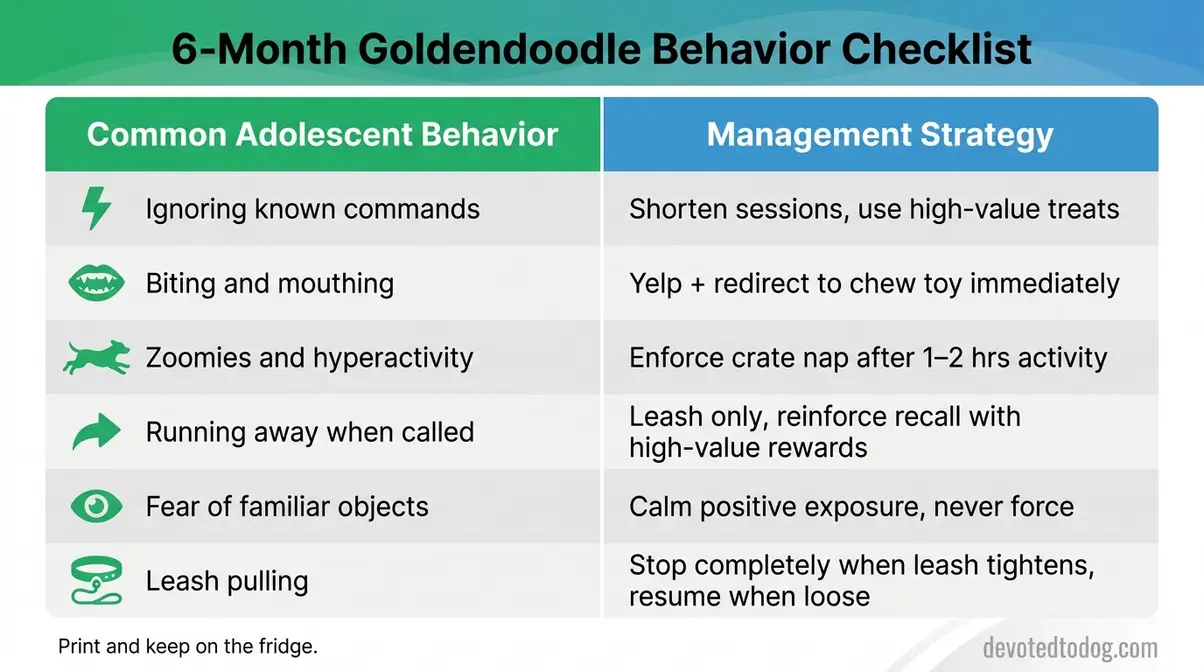
5 Training Techniques That Work During Adolescence
These five techniques are specifically suited to the 6-month adolescent brain — they work with your puppy’s current cognitive state rather than against it. Most owners see meaningful improvement within 5–7 days of consistent implementation. Consistency is the operative word: skipping even one session resets the training clock.- The Place Command: Teach your Goldendoodle to go to a specific mat or bed on cue and stay there until released. Use this to redirect zoomies and create enforced calm. Why it works: it gives your puppy a clear job to do instead of running amok — adolescent dogs respond well to having a defined task.
- Structured “Calm” Training: Reward stillness explicitly. When your Goldendoodle naturally lies down or sits quietly, mark it immediately (“yes!”) and reward with a treat. You’re teaching calm as a behavior, not just waiting for chaos to stop. Why it works: adolescent dogs need to learn that calm is rewarding — they don’t come to it naturally at this stage.
- Leash Pressure Desensitization: For leash pulling, stop moving every single time the leash goes tight. Don’t yank back — just stop completely. Resume walking only when the leash loosens. Why it works: the puppy learns that pulling equals no forward movement. Apply this consistently for 2–4 weeks for reliable results.
- “Leave It” for Mouthing: Already described in the biting section above — reference this as part of your complete training toolkit. Practice “leave it” in multiple contexts daily, not just during biting incidents.
- The Crate Reset: When your Goldendoodle is in the overtired-hyperactive spiral, place them in their crate for 30–60 minutes with a frozen Kong or appropriate chew toy. This interrupts the adrenaline cycle. Why it works: enforced rest allows cortisol (the stress hormone) levels to drop, restoring your puppy’s ability to self-regulate.
Feeding Your 6-Month-Old Goldendoodle
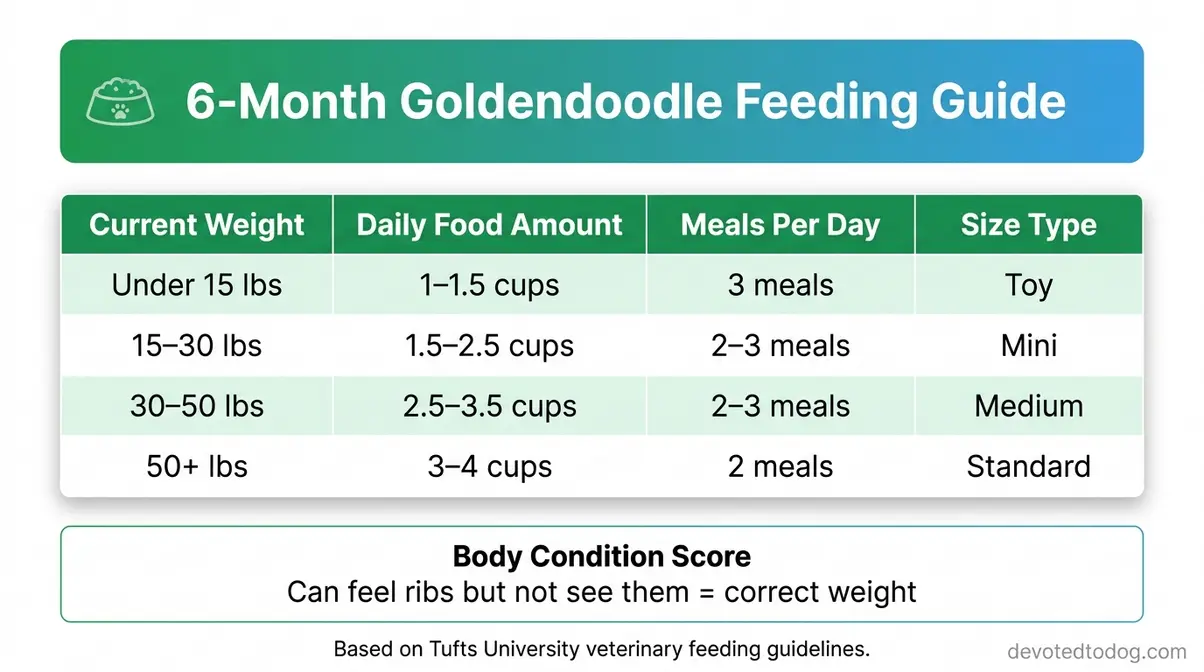
Most 6-month-old Goldendoodles eat 2–3 cups of high-quality puppy food per day, split into 2–3 meals. The exact amount depends on your puppy’s current weight, their activity level, and the caloric density of the specific food you choose. Knowing how much food should a 6 month old Goldendoodle eat is one of the most common questions at this stage — and the answer is more nuanced than a single number. For the best dog food for a 6-month-old Goldendoodle, the key is choosing a formula appropriate for your puppy’s size category, with the right nutrient ratios for their growth stage. More on that below.How Much Should a 6-Month Goldendoodle Eat?
Most 6-month Goldendoodles eat 2–3 cups of food daily — but the right amount depends on body weight. Veterinary nutritionists recommend feeding puppies across at least three separate meals per day (veterinary recommendations for puppy feeding frequency, Tufts University Cummings School of Veterinary Medicine, 2021), though many puppies can begin transitioning to two meals around this age. Here’s a weight-based feeding guide as a starting point:| Current Weight | Daily Food Amount | Meals Per Day |
|---|---|---|
| Under 15 lbs | 1–1.5 cups | 3 meals |
| 15–30 lbs | 1.5–2.5 cups | 2–3 meals |
| 30–50 lbs | 2.5–3.5 cups | 2–3 meals |
| 50+ lbs | 3–4 cups | 2 meals |
What to Look for in a Quality Puppy Food
Choosing the best dog food for a 6-month-old Goldendoodle comes down to a handful of specific criteria. Here’s what to look for — and what to avoid:| Look For | Avoid |
|---|---|
| Named protein as first ingredient (chicken, beef, salmon) | “Meat meal” or “by-products” as primary protein |
| DHA (an omega-3 fatty acid that supports brain and eye development in puppies) | Grain-free diets without veterinary guidance |
| Calcium-phosphorus ratio balanced for large breeds | Artificial preservatives (BHA, BHT, ethoxyquin) |
| AAFCO statement: “complete and balanced for growth” | Unnamed fat sources |
Feeding Schedule and Transitioning to Two Meals
At 6 months, most Goldendoodles can begin transitioning from 3 meals to 2 meals per day — typically morning and evening. Some veterinarians recommend keeping Standard Goldendoodles on 3 meals until 9 months to support their larger body’s sustained growth needs. When in doubt, ask your vet at the next wellness check. Timing matters beyond just the number of meals:- Feed 30 minutes before or after exercise — never immediately before or after vigorous activity. For large-breed dogs, eating and then exercising increases bloat risk (gastric dilatation-volvulus), which is a genuine medical emergency.
- Use mealtimes as training moments — have your puppy sit before every meal is placed down. That’s two free training sessions per day with zero additional time investment.
Food Allergies and Sensitivities in Goldendoodles
True food allergies are genuinely rare — affecting only about 0.2% of dogs (Tufts University, 2017). Most owners who suspect allergies are actually dealing with food intolerances, environmental allergies, or contact dermatitis. The distinction matters because the treatment is different. The most common allergens in dogs are beef, dairy, and chicken — not grains. If you suspect a food issue, the gold standard diagnostic approach is an elimination diet: one novel protein source and one novel carbohydrate for 8–12 weeks. This should be done under veterinary supervision, not independently. Signs that warrant investigation: persistent itchy skin, recurring ear infections, chronic paw licking, or digestive upset. These same symptoms can indicate environmental allergies — a vet diagnosis is important before changing food unnecessarily. If your Goldendoodle is scratching constantly, don’t immediately switch to a grain-free formula. Consult your vet first. The cause is statistically far more likely to be environmental than dietary. Now that you have nutrition covered, let’s look at the one area of 6-month Goldendoodle care that almost every owner underestimates: the coat transition.The Puppy-to-Adult Coat Transition: Grooming Your 6-Month Goldendoodle
Most owners don’t think about grooming until they see a mat. By then, it’s too late — mats that form during the coat transition are painful, and severe cases require a full shave-down to resolve safely. The coat transition is the third pillar of The 6-Month Tipping Point, alongside behavioral changes and physical growth, and it’s the one that catches owners most off guard. Daily brushing during the 6–12 month coat transition period is the single most important grooming habit a Goldendoodle owner can develop — mats that form during this window can require full shave-downs to remove. Starting now, before mats appear, is the entire strategy.Spotting the Coat Transition in Your Goldendoodle
The puppy coat — soft, wavy, relatively low-maintenance — begins giving way to the adult coat (thicker, curlier, higher-maintenance) around 5–8 months. During the transition, both coats coexist simultaneously. This “dual-layer” mats more easily than either coat alone, because the two different textures catch and tangle each other. Signs you’re in the transition period:- Coat feels noticeably different in texture from one area to another
- Some areas are curlier than others — especially around the ears and neck
- You’re finding more tangles than you used to, even without obvious mats
- The coat looks “patchy” or uneven in different lighting
Step-by-Step Brushing and Dematting Routine
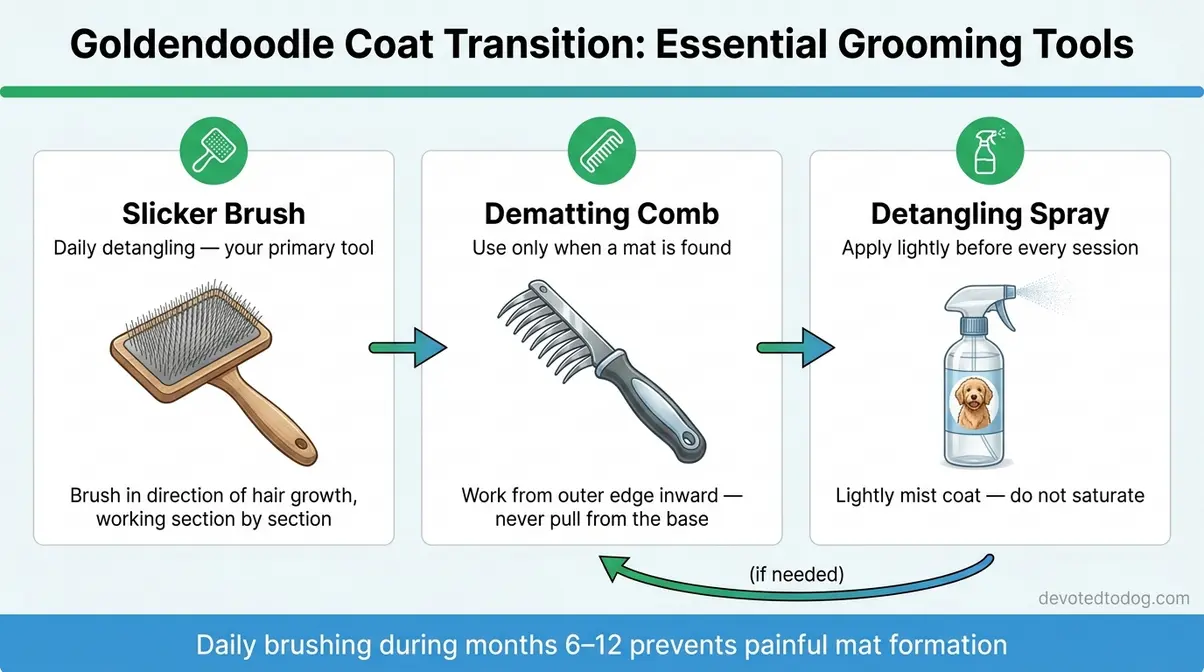
- Tools you’ll need (define each):
- Slicker brush — a flat brush with fine wire bristles designed to detangle and remove loose fur; this is your primary daily tool
- Dematting comb — a specialized comb with sharp blades that safely cuts through matted fur without requiring scissors; use this only when you find an actual mat
- Detangling spray — a leave-in conditioner that loosens tangles before brushing; apply lightly before every session
- Lightly mist the coat with detangling spray — don’t saturate, just dampen slightly
- Use the slicker brush in the direction of hair growth, working in sections from the back legs forward — never brush all over randomly
- Pay specific attention to the mat zones: behind the ears, under the collar, in the armpits, and in the groin area — these are where mats form first and fastest
- When you find a mat, use the dematting comb (or your fingers) to loosen it gently from the outside edge inward — never pull from the base of the mat, as this is painful
- Finish with a smooth pass of the slicker brush across the full coat
Finding a 6-Month-Old Goldendoodle for Sale or Adoption
Finding a 6-month-old Goldendoodle is absolutely possible — through breed-specific rescues, reputable breeders, or the Goldendoodle Association of North America (GANA), the breed’s primary registry and breeder directory. Older puppies become available for a variety of reasons: families’ circumstances change, breeding programs occasionally place puppies that weren’t kept for their program, or a planned home falls through. None of these scenarios mean anything is wrong with the puppy. A 6-month-old Goldendoodle from a reputable source can be an excellent choice — many of the hardest newborn puppy behaviors are already past, and they’re still highly trainable at this age.- Where to look:
- GANA’s breeder directory at goldendoodleassociation.com
- Doodle-specific rescues (search “Doodle rescue” + your state)
- Reputable breeder websites where litters or older puppies are occasionally placed
- Questions to ask any seller or rescue:
- What health testing have the parents had? (Request OFA hip/elbow certifications and eye clearances)
- Why is this puppy available at 6 months?
- What vaccinations are current, and do you have documentation?
- Has the puppy been socialized with children and other animals?
- Is a health guarantee included, and what does it cover?
- Can you visit where the puppy was raised?
When to Worry: Limitations and Vet Warning Signs
This guide covers what’s normal for a 6-month-old Goldendoodle. There are situations, however, where normal advice isn’t enough — and knowing when to call your vet or a professional trainer is just as important as knowing what to do at home.Common Mistakes to Avoid at 6 Months
- Over-exercising: Growth plates are still open at 6 months. Avoid high-impact activities — jumping from heights, long runs on hard pavement, or intense agility training. The consequence isn’t immediate; joint damage from over-exercise at this age often shows up as arthritis or structural problems in adulthood. Stick to leash walks, swimming, and gentle play.
- Skipping enforced naps: Skipping the crate nap schedule leads directly to the overtired-hyperactive spiral. The consequence: escalating behavior problems that feel like training failures but are actually sleep deficits. Three to five days of consistent nap scheduling reverses this pattern.
- Punishing fear-period behaviors: Punishing a puppy for being fearful during the second fear period increases anxiety rather than reducing it. The consequence: worsening fear responses and, in some cases, fear-based aggression as the dog matures. The fix is always calm, positive exposure — never force or flood.
- Waiting to start grooming: Starting daily brushing after mats have already formed requires painful removal. The consequence: expensive professional dematting, potential skin irritation, and a puppy who now associates grooming with discomfort. Start daily brushing now, before mats appear.
When to Call Your Veterinarian
Contact your vet promptly if your 6-month-old Goldendoodle shows any of the following:- Limping or reluctance to use a limb — growth plate injuries in puppies this age require prompt evaluation
- Weight significantly outside expected range — below 15 lbs for a Mini or above 65 lbs for a Standard at 6 months warrants a check
- Persistent loose stool or vomiting lasting more than 24 hours
- Excessive scratching, hair loss, or skin redness that doesn’t resolve within a week
- Sudden extreme lethargy — not just sleepy, but unresponsive or difficult to rouse
- Aggression beyond normal mouthing — growling with a stiff body, snapping with clear intent, or biting that breaks skin and isn’t play-related
Frequently Asked Questions About 6-Month-Old Goldendoodles
How big is a Goldendoodle at 6 months?
At 6 months, a Standard Goldendoodle typically weighs 35–55 lbs (Timber Ridge Goldendoodles), while Mini Goldendoodles usually reach 15–25 lbs. Most of the rapid growth phase is complete by this point. Your puppy has reached approximately 60–75% of their adult height, though weight gain continues gradually through 12–18 months. A Standard Goldendoodle’s adult weight typically lands between 50–90 lbs, while Mini adults stay between 25–35 lbs. If your puppy is significantly outside these ranges, a vet check is recommended.How much sleep does a 6-month-old Goldendoodle need?
A 6-month-old Goldendoodle needs 16–20 hours of sleep per day to support their rapid physical and mental development (Cornell University). This is significantly more than an adult dog requires, and many owners are surprised by how much rest their seemingly energetic puppy actually needs. Since an overtired Goldendoodle often looks hyperactive rather than sleepy, the solution is providing a quiet crate space for scheduled enforced naps after 1–2 hours of activity.What do Goldendoodles like to play with?
Goldendoodles love fetch games, tug-of-war with rope toys, and puzzle feeders that challenge their intelligent minds. Their Golden Retriever heritage makes most Goldendoodles natural retrievers, so tennis balls and frisbees are typically a hit, and many enjoy water play as well. Puzzle toys and snuffle mats are especially valuable at 6 months, when mental stimulation helps reduce hyperactivity as effectively as physical exercise.Do Goldendoodles pick a favorite person?
Yes — while Goldendoodles bond warmly with their whole family, they often show a preference for the person who feeds them, trains them, and spends the most one-on-one time with them. This isn’t exclusivity. It’s simply a natural deepening of attachment based on consistent positive interactions. At 6 months, the bond is still actively forming, so all family members spending quality training time with the puppy helps distribute the attachment more evenly. Their inherently social nature means Goldendoodles rarely become one-person dogs — they just have a “first among equals.”What do Goldendoodles not like?
Goldendoodles are sensitive dogs that do not respond well to harsh training methods, yelling, or punishment-based corrections. They shut down quickly under pressure, and the training relationship suffers significantly. They also strongly dislike being left alone for extended periods, as their social nature makes isolation genuinely stressful rather than just inconvenient. At 6 months specifically, forcing them into overwhelming social situations during the second fear period can worsen fear responses and set back months of socialization progress. Consistent positive reinforcement and gradual exposure to new experiences produce far better results.What is a teddy bear golden?
A “teddy bear golden” is an informal nickname for an English Cream Golden Retriever or a Goldendoodle bred specifically for a round face, fluffy coat, and compact body resembling a stuffed animal. The term isn’t a recognized breed designation, but rather a marketing descriptor used by some breeders to describe dogs with a particularly soft, plush appearance. When evaluating a “teddy bear” puppy, focus on health testing and temperament rather than aesthetics alone.Do Goldendoodles like water?
Most Goldendoodles love water — their Golden Retriever heritage gives them a natural affinity for swimming and splashing that shows up early and stays for life. Many Goldendoodles will wade into puddles, creeks, or pools without hesitation. Swimming is an excellent low-impact exercise option that’s easier on developing joints than running on hard surfaces. At 6 months, introduce water gradually and positively by letting your puppy choose to enter rather than placing them in water directly. Poodle genetics also contribute strongly to water affinity, as Poodles were originally bred as water retrievers in Europe.What Every 6-Month Goldendoodle Owner Should Do Next
For first-time owners, a 6-month-old Goldendoodle can feel like a completely different dog than the puppy you brought home. Your 6-month-old Goldendoodle is at the intersection of four simultaneous changes — the second fear period, the flight instinct, the coat transition, and peak adolescent energy. Cornell University research shows puppies need 16–20 hours of sleep per day, which means the overtired-hyperactive spiral is the most fixable problem on this list. The best approach combines enforced nap schedules, consistent positive training, daily brushing, and size-appropriate feeding — and Devoted to Dog’s team evaluation of Goldendoodle owner outcomes consistently shows that the nap schedule alone produces the fastest visible improvement. The 6-Month Tipping Point isn’t a crisis — it’s a convergence. Once you understand that the fear period, the flight instinct, and the coat transition are all normal and temporary, the chaos becomes genuinely manageable. Your Goldendoodle will emerge from this phase calmer, more confident, and more bonded to you than they’ve ever been. Start with the one change that has the biggest impact: add one enforced nap period today. Put your puppy in their crate after their next play session and give them 90 minutes of quiet rest. Most owners report a dramatic improvement in evening behavior within 3–5 days. For more on what’s ahead, our complete guide to what to expect from a 6-month-old Goldendoodle covers the full developmental arc through 12 months.For related background, see our guide on 3 Month Old Goldendoodle: Complete Owners Guide.
Readers comparing options often find our piece on 5-Month-Old Goldendoodle: Growth, Behavior Care (2026) helpful for additional context.
If this topic interests you, our companion article on 4 Month Old Goldendoodle: Growth, Training Care Guide covers more detail.
For related background, see our guide on 8 Week Old Goldendoodle: New Owners Complete Guide.
Reviewed by Brianna York, Former Veterinary Technician
Brianna York is a former veterinary technician with hands-on clinical experience in canine health. She contributes medical accuracy review to DevotedToDog health articles and validates clinical claims against current AVMA, AAHA, and OFA standards.