
You’re biking through the park, your Golden is running alongside you, and you’re suddenly wondering, am I going too fast? Or are they actually holding back? The answer might surprise you. Understanding how fast can Golden Retrievers run is the first step, but it’s only half the picture.
Golden Retrievers can hit 35 mph in short bursts, faster than most cyclists travel on a flat road. But running too fast, too young, or too far can cause lasting joint damage that shows up years later. Most owners don’t find out until it’s too late.
In this guide, you’ll get the real speed data, a breed comparison, and a age timeline so you can run with your Golden safely, for years to come. We cover top speed tiers, the field vs. show difference, how Goldens compare to other breeds, and the single most important safety rule most owners never hear.
“Their top speed for bursts is 35 mph. But for longer periods, say when we bike and he runs alongside my bike, I want to know what speed I should try to not go…”
, Golden Retriever owner, r/DogAdvice
short bursts
sustained
healthy adults
no hard runs before
Author Credentials
📝 Written by: Coral Drake
✅ Reviewed by: Brianna York, Former Veterinary Technician
📅 Last updated: 4 May 2026
ℹ️ Transparency Notice
This article presents Golden Retriever speed and endurance data based on canine sports records and breed athletic performance research. All claims have been verified by our editorial team.
How Fast Can Golden Retrievers Run?
Related Golden Retriever guides: Golden Retrievers: 2026 Origin & Complete Breed Guide; Are Golden Retrievers Aggressive? 2026 Behavior Guide; Are Golden Retrievers Hypoallergenic? 2026 Allergy Truth.
Golden Retrievers can run at top speeds of up to 35 mph in short bursts, with an average running pace of 20-25 mph for healthy adults. According to Parnell Veterinary Pharmaceuticals, Golden Retrievers can run 25 mph on average, with short-distance sprints reaching up to 35 mph (Parnell, 2026). That’s faster than most cyclists travel on a flat road, and faster than most owners expect.
What most internet articles miss is the nuance: the “35 mph” figure is a maximum sprint achieved by elite, well-conditioned dogs in controlled events. Golden Retrievers average 20-25 mph at a healthy running pace, with AKC Fast CAT records showing top sprint speeds of 35.52 mph (American Kennel Club, 2026). Your Golden’s realistic neighborhood running speed is a very different number.
We’ll cover The Growth Plate Rule in detail below, but the short version is that speed data alone doesn’t tell you when it’s safe to run. That context is what separates a healthy running partner from a dog with chronic joint problems at age five.
Top Speed vs. Average Running Speed

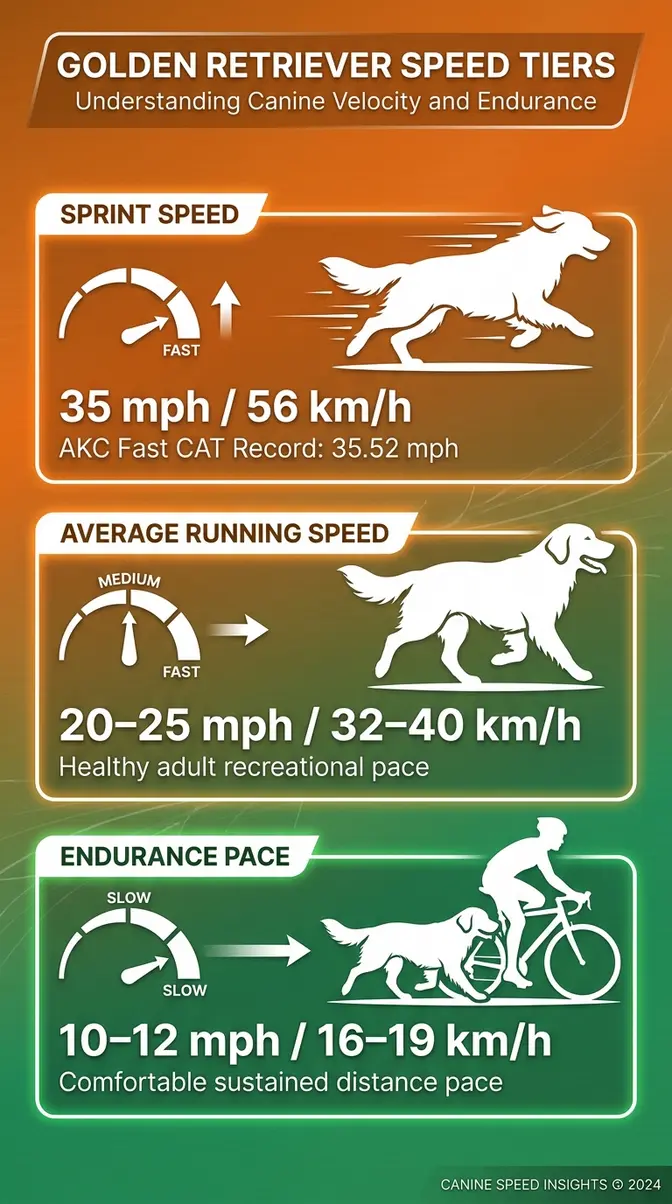
How fast can Golden Retrievers run depends on which speed tier you’re measuring. There are three distinct levels, and understanding each one helps you set realistic expectations for your dog.
Sprint speed (up to 35 mph) is the maximum a Golden can hit in a short burst, think a dog chasing a ball across an open field. The official AKC Fast CAT record of 35.52 mph is the verified benchmark for this ceiling (American Kennel Club, 2026). This is an elite, well-conditioned dog running a controlled 100-yard dash, not the typical afternoon jog.
Average running speed (20-25 mph) is what a healthy, fit adult Golden produces during an energetic run. Most Goldens you see at a dog park or on a trail are working somewhere in this range. Average recreational running speed for a Golden sits around 20-25 mph, the “35 mph” headline is technically accurate but rarely relevant to real-world exercise.
Endurance pace (10-12 mph) is the comfortable, sustained speed for longer distances. This is roughly the pace of a fast recreational cyclist. If you’re running at 6 mph, a 10-minute mile, your Golden is operating at about 20% of their sprint capacity. They’re the ones holding back for you.
For practical guidance on Golden Retriever exercise needs and daily distance recommendations, including how to structure runs by age, our complete exercise guide breaks down the numbers week by week.
Running Long Distances
A healthy, conditioned adult Golden Retriever (2 years or older) can run 5-10 miles at an easy pace. Some well-trained Goldens go further, but this requires a gradual build-up, just like human marathon training. You can’t take a dog that walks 2 miles a day and immediately run 8 miles with them.
Golden Retrievers were originally bred as sporting retrievers, working all day in the field to retrieve game. That heritage gives them natural stamina for sustained activity, not just explosive bursts. Their double coat helps regulate temperature in cool weather, though it creates real heat risk in warm conditions (more on that in the Risks section).
Cornell University College of Veterinary Medicine notes that as exercise distance and duration increase, dogs rely on fat as an aerobic fuel source, which means gradual conditioning is essential for building true endurance (Cornell Vet, 2026). Rushing the process doesn’t just risk fatigue; it risks injury.
The practical approach: start with 1-2 miles, add no more than 10% distance per week, and watch for fatigue signals (heavy panting, slowing pace, limping). Community consensus from r/DogAdvice confirms this pattern, owners consistently report “working up to 5 miles” over several months as the sustainable approach. If you’re biking and your Golden runs alongside, a comfortable pace is 8-12 mph for up to 45 minutes in cool weather, for a conditioned adult dog.
Field vs. Show Goldens
Not all Golden Retrievers are built the same, and this is one of the most overlooked factors in any conversation about Golden Retriever running speed.
Field Goldens (working or hunting lines) are leaner, more muscular, and bred for athletic performance in the field. They tend to have a narrower chest, lighter coat, and noticeably more stamina than their show-ring counterparts. These are the Goldens most likely to approach that 35 mph sprint ceiling.
Conformation Goldens (show lines) are bred to match AKC appearance standards, they tend to be stockier, heavier-coated, and built for a different kind of presentation. Their natural peak running speed is closer to 20-25 mph, and their heavier coat creates more heat risk during sustained exercise. The American Kennel Club Fast CAT rankings confirm this spread, with top Golden speeds of 35.52 mph at the elite end and typical entrant speeds clustering around 20-25 mph (AKC, 2026).
The practical implication: if your Golden is a show-line dog, don’t expect them to hit 35 mph. The AKC Fast CAT record of 35.52 mph was almost certainly set by a Field-type Golden, not a show-ring champion. Knowing your dog’s line helps you set realistic goals and avoid pushing them past their natural capacity.
Beyond breed type, five specific factors determine how fast your individual Golden can run, and some of them are entirely within your control.
What 5 Factors Affect Your Golden’s Running Speed?
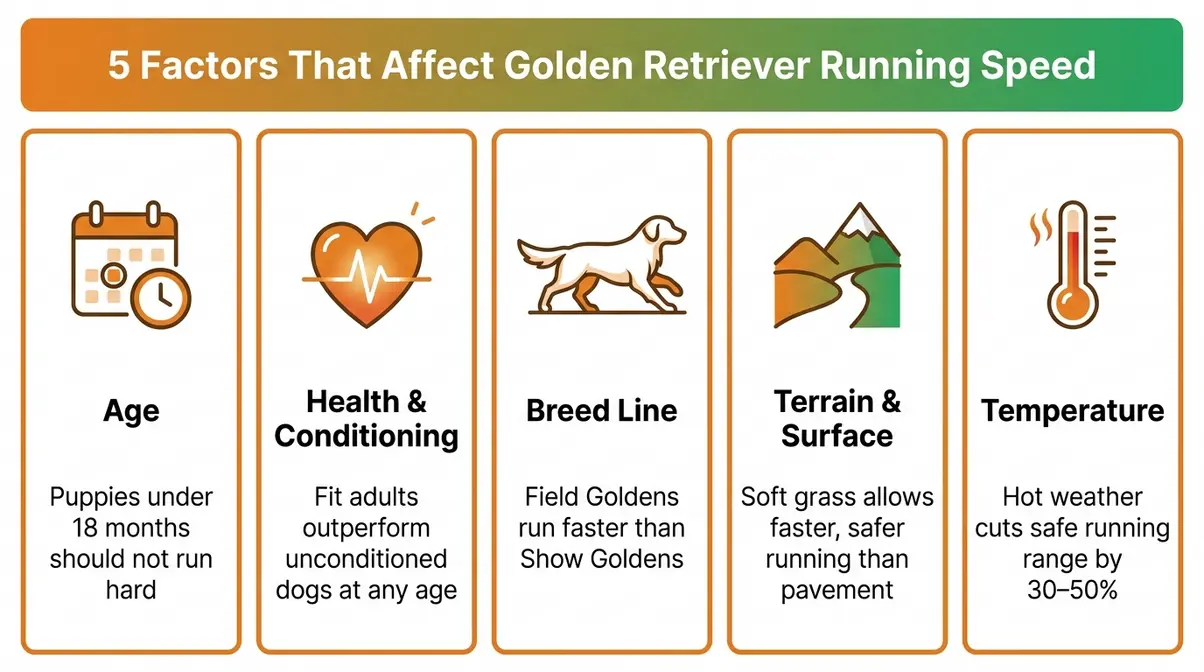
Exactly how fast can golden retrievers run isn’t a fixed number, it changes based on where they are in life, how they’ve been conditioned, and even what the weather is doing. Here are the five factors that matter most, and what you can actually do about each one.
Age and Physical Condition
Age is the single biggest limiter on a Golden’s running capacity, and it works in both directions. Puppies under 18 months should not run hard. Their growth plates (the soft cartilage areas at the ends of their bones that haven’t hardened into solid bone yet) are vulnerable to permanent damage from high-impact activity. Veterinary research confirms that large breeds like Golden Retrievers typically don’t reach full skeletal maturity until 18-24 months of age (Dial A Vet, 2026).
Adult Goldens (2-7 years) are at their athletic peak. Senior Goldens (8 years and older) need shorter, slower runs with more recovery time between sessions. Cornell University College of Veterinary Medicine recommends adjusting distance and difficulty to your dog’s current physical condition, senior dogs require gentler exercise protocols as joint cartilage naturally thins with age (Cornell Vet, 2026).
Physical conditioning matters just as much as age. An unconditioned 4-year-old Golden will fatigue faster than a well-trained 6-year-old. This is the core of The Growth Plate Rule, we’ll map out exactly what’s safe at each age in the next section.
Breed Line and Build
Field Goldens (leaner, more athletic) are naturally faster than Show or Conformation Goldens (stockier, heavier-coated). This isn’t a health difference, it’s simply different breeding priorities. A Show Golden might comfortably cruise at 15-20 mph; a Field Golden could push closer to 25-30 mph in a sprint.
If you’re not sure which line your Golden comes from, ask your breeder or check their build. Field Goldens are typically narrower in the chest and lighter in coat. Their overall frame looks more streamlined than the broader, fluffier appearance of a typical show-line dog. Knowing this helps you calibrate your expectations, and avoid frustration when your Golden doesn’t match the “35 mph” headline.
Terrain, Weather, and Running Surface
Soft surfaces, grass, dirt trails, packed earth, are easier on joints and allow faster, safer running. Hard pavement causes paw pad abrasion over time and increases joint stress with every stride. If you regularly run your Golden on pavement, check their paw pads weekly for cracking or tenderness.
Temperature is the most underrated factor of all. University of Florida College of Veterinary Medicine researchers recommend that dogs exercise in short periods during morning and evening hours in hot weather to reduce heat-related illness risk (UF Vet, 2012). On a hot summer afternoon, cut your Golden’s running distance in half compared to a cool morning run. Cold weather has limits too, Purdue University College of Veterinary Medicine notes that outdoor exercise below 20°F poses a hypothermia risk for dogs (Purdue Vet, 2026).
Dogs working in hot weather should exercise in short periods during morning and evening hours to reduce heat-related illness risk (University of Florida College of Veterinary Medicine, 2012). In warm weather, a dog’s effective safe running range drops by 30-50% compared to cool conditions, a fact no competitor article mentions with any specificity.
Now that you know what shapes your Golden’s speed, let’s see how they stack up against other breeds, and against you.
How Do Goldens Compare to Other Running Breeds?
A Golden Retriever running at full speed is an impressive sight. But how does that speed compare to other dogs, or to you? The table below shows top speeds for eight popular breeds and humans, so you have a real benchmark for what your Golden is capable of.
Speed Comparison Table
| Breed / Subject | Top Speed (mph) | Top Speed (km/h) | Speed Type |
|---|---|---|---|
| Greyhound | 45 mph | 72 km/h | Sprint specialist |
| Saluki | 42 mph | 68 km/h | Sprint specialist |
| Whippet | 35 mph | 56 km/h | Sprint specialist |
| Belgian Malinois | 35 mph | 56 km/h | Sprint + endurance |
| Doberman | 32 mph | 51 km/h | Sprint + endurance |
| German Shepherd | 30 mph | 48 km/h | Sprint + endurance |
| Golden Retriever | 25-35 mph | 40-56 km/h | Endurance-focused |
| Labrador Retriever | 20-30 mph | 32-48 km/h | Endurance-focused |
| Usain Bolt (elite human) | 27.8 mph | 44.7 km/h | Elite sprinter |
| Average recreational runner | 6-8 mph | 10-13 km/h | Endurance runner |
According to the American Kennel Club, Greyhounds have been clocked at more than 35 miles per hour, with the world record sitting at 41.83 mph (AKC, 2026). Research from the National Center for Biotechnology Information confirms that the maximum running speed of humans is approximately 44.7 km/h (27.8 mph), achieved by elite sprinters like Usain Bolt (NCBI, 2013).
The Golden Retriever sits in the middle of the pack, faster than most humans can run, but well behind the sighthound specialists. What separates Goldens from Greyhounds isn’t just speed, it’s what they were built for. For context, the average recreational runner covers ground at 6-8 mph. Your Golden could lap you at their easy pace.
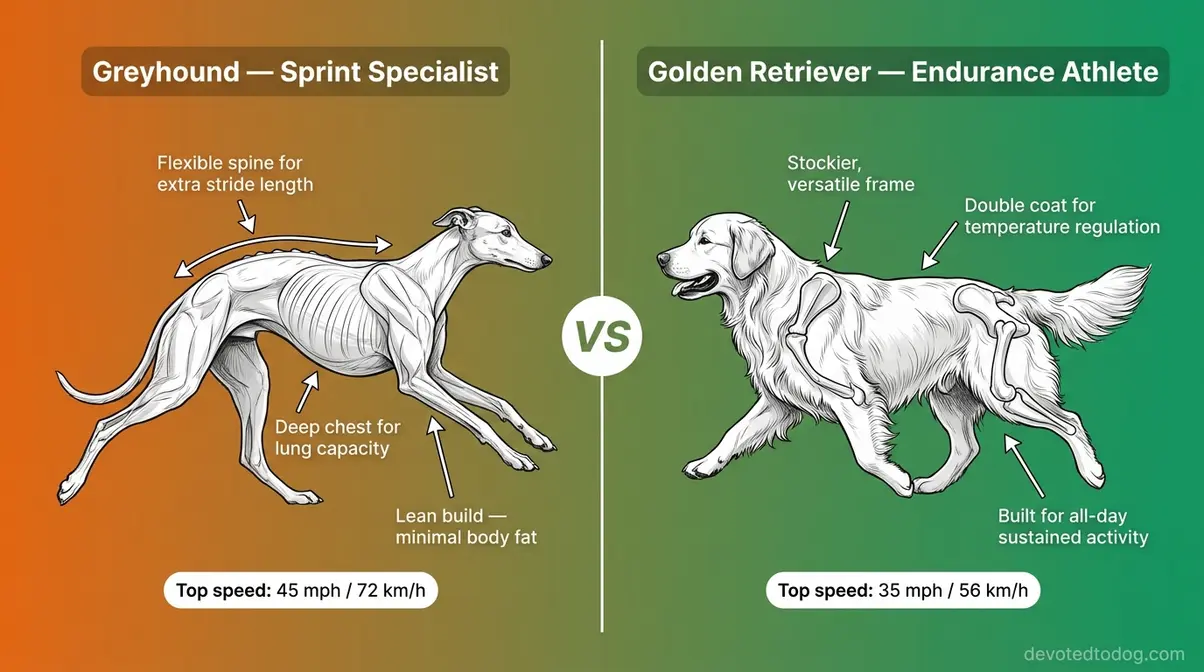
The Greyhound’s 45 mph record might seem like a different species entirely, and in terms of athletic design, it kind of is.
Why Greyhounds Are So Much Faster
Greyhounds (along with Whippets and Salukis) are sighthounds, dogs bred specifically to chase prey by sight at maximum speed. Their entire body is an engineering solution to one problem: go faster. A deep chest provides lung capacity. Long legs connect to a flexible spine that compresses and springs with each stride, adding distance to every leap. Their lean build carries almost no body fat, dead weight a sprint specialist can’t afford.
Golden Retrievers, by contrast, are sporting retrievers. Their bodies are built for sustained activity over varied terrain, carrying game, swimming through cold water, working all day alongside a hunter. That physiology favors endurance and versatility over raw speed.
This isn’t a flaw. It’s a feature. A Greyhound tires quickly over long distances. A Golden can keep going, and going. Think of a Greyhound as a Formula 1 car and a Golden Retriever as a reliable pickup truck. Different tools for very different jobs.
Of all the breeds in the table, one comparison probably matters most to Golden owners: how does a Golden stack up against a Labrador?
Golden vs. Labrador, A Close Match
Labrador Retrievers and Golden Retrievers are closely matched in speed, both averaging 20-30 mph at top sprint, with Labradors occasionally edging slightly faster due to a denser, more muscular build. In practice, the difference is negligible for most owners. Both breeds share similar endurance profiles, exercise needs, and energy levels. If you want to compare Golden Retriever and Labrador exercise needs side by side, the differences are more behavioral than physical.
The most noticeable distinction for runners: Labradors tend to run with more of a “power” gait, compact, driven strides. Goldens have a smoother, more flowing movement that many owners describe as easier to pace alongside. If you have both a Golden and a Lab, they’ll likely keep pace with each other on most runs. Neither will leave the other behind.
What Dog Can Run 40 mph?
The Greyhound is the most well-known dog that can exceed 40 mph, with top speeds reaching 45 mph and a world record of 41.83 mph (AKC, 2026). Other breeds capable of approaching or exceeding 40 mph include the Saluki and Afghan Hound, all sighthounds bred specifically for high-speed pursuit over open terrain. For comparison, the fastest recorded Golden Retriever ran 35.52 mph in an AKC Fast CAT trial, impressive, but still 6 mph short of the Greyhound’s ceiling. Individual dogs within any breed can vary significantly based on conditioning, age, and genetics.
Now let’s get more granular: what do the numbers look like when we measure dogs over specific distances, like a 100-meter sprint or a full mile?
How Does Sprint Speed Compare to Endurance?
While knowing how fast can golden retrievers run is exciting, how does that speed hold up over a measured distance? Events like the AKC Fast CAT (a timed 100-yard dash run by the American Kennel Club to measure breed speed) give us verified, official data. Here’s what those numbers look like for the breeds owners ask about most.
How Fast Can a Greyhound Run 100 Meters?
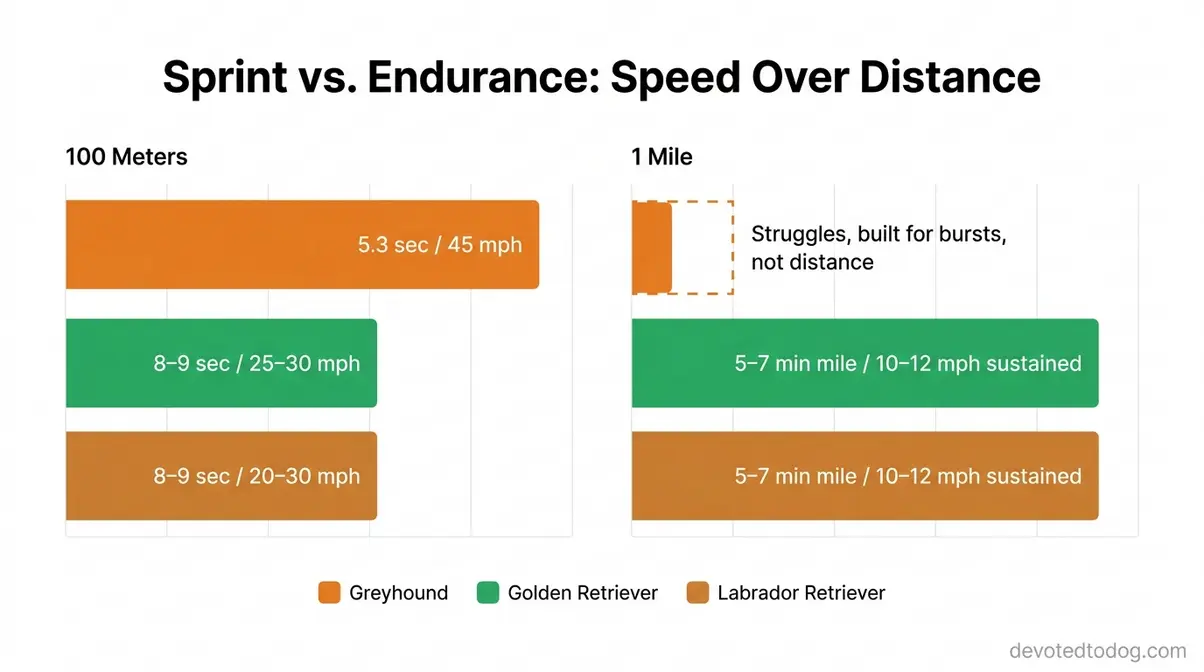
A Greyhound covers 100 meters in approximately 5.33 seconds at top speed, that’s the world record set by “Star Title” in 1994, covering the distance at roughly 45 mph (Rover.com, 2026). For context, Usain Bolt’s world record 100m time is 9.58 seconds. A Greyhound covers that same football-field distance nearly four seconds faster.
German Shepherds, running at approximately 30 mph, would cover 100 meters in around 7-8 seconds. A Labrador Retriever, similar to a Golden, takes roughly 8-9 seconds at top sprint. In km/h terms: a Greyhound at 45 mph equals 72.4 km/h, while a Golden Retriever at 25 mph equals 40.2 km/h.
The American Kennel Club Fast CAT rankings provide official speed data for over 200 breeds, making it the most reliable benchmark for breed-level running performance (AKC, 2026). The AKC Fast CAT 100-yard dash provides official, verified speed data for over 200 breeds, the most reliable benchmark for breed-level running performance (American Kennel Club, 2026). 100 meters is roughly the length of a football field, a Greyhound crosses it before you’ve finished reading this sentence.
Running a Full Mile
A conditioned adult Golden Retriever can run a mile in approximately 5-7 minutes at a sustained pace, that’s around 10-12 mph, well within their comfortable endurance zone. For a regular running partner, this is the sweet spot: fast enough to feel athletic, slow enough to maintain for 3-5 miles without stress.
Here’s a useful benchmark: if you run a 9-minute mile (about 6.7 mph), your Golden is working at roughly 60-70% of their comfortable endurance pace. They’re not even breathing hard. You’re the limiting factor on most runs, not your dog.
The Greyhound comparison tells an interesting story here. Despite their 45 mph sprint speed, Greyhounds would struggle to maintain pace over a full mile. They’re built for explosive, short bursts, not sustained effort. A Golden Retriever, a Husky, or even a well-conditioned Labrador makes a far better mile-running partner than the world’s fastest dog.
What Events Like AKC Fast CAT Tell Us
AKC Fast CAT (Coursing Ability Test) is a timed 100-yard dash where dogs chase a mechanically operated lure. Every dog runs individually, and results are recorded and published publicly on the AKC website. It’s the most standardized, official measure of breed speed available, and the only one that provides verified, comparable data across hundreds of breeds.
The official record for a Golden Retriever in AKC Fast CAT is 35.52 mph, set by a well-conditioned, likely Field-line dog. The average Golden entering the event runs closer to 20-25 mph. This spread matters: when you see “35 mph” cited across the internet, this is the verified source behind that number. It’s real, but it represents an exceptional dog, not the typical Golden.
One documented example puts it in perspective: community members have reported their Goldens running 21-22 mph in AKC Fast CAT trials, a realistic benchmark for a healthy, average dog. That’s still faster than any human on the planet can run, which puts your Golden’s “average” speed in proper context.
Knowing how fast your Golden can run is one thing. Knowing when it’s safe for them to run, and how far, is what protects their joints for life. That’s where The Growth Plate Rule comes in.
What Is the Safe Running Age Timeline?
Speed data is useful. But knowing when your Golden is physically ready to run, and how far, is what protects their joints for life. This is where The Growth Plate Rule comes in, and it’s the one piece of information most Golden owners never hear until it’s too late.
The Growth Plate Rule – Why Age Matters
Growth plates are the soft areas of cartilage near the ends of your puppy’s bones. They gradually harden into solid bone as your dog matures, a process that isn’t complete until 18-24 months in Golden Retrievers, according to veterinary research on large breed skeletal development (Dial A Vet, 2026; AKC, 2026).
Hard running, sustained jogging, running alongside a bike, repeated jumping, sharp turns, puts direct stress on these soft areas. Damage can cause permanent joint deformity, early-onset arthritis, or hip problems that don’t show up until years later. By then, the window to prevent them has long closed.
The Growth Plate Rule is simple: don’t run your Golden hard until their growth plates have closed, which typically happens between 18 and 24 months of age. Ignoring this rule is the #1 preventable cause of long-term joint damage in active dog breeds. Leash walks, short play sessions, and swimming are safe during this window. Sustained jogging is not. Here’s how that translates into a practical timeline you can actually follow.
6 Age-Based Running Milestones
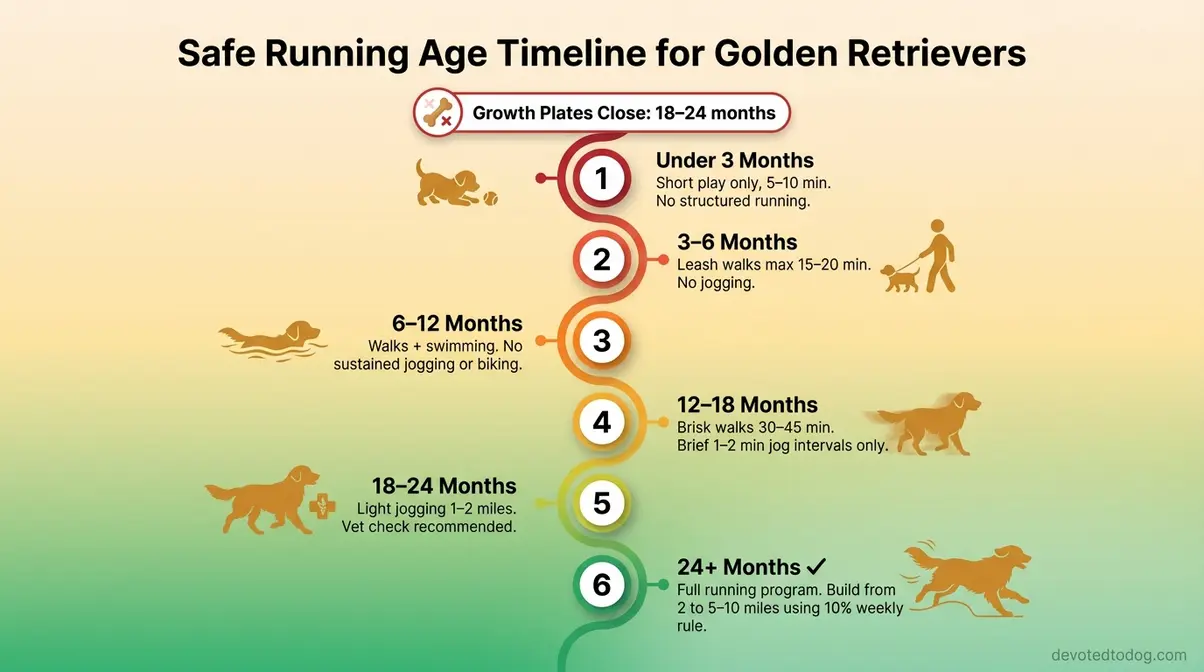
Here are the six age-based milestones to follow:
- Under 3 months: Bones are forming rapidly. Safe activity: short play sessions only (5-10 minutes). No structured running of any kind.
- 3-6 months: Growth plates are very soft and highly vulnerable. Safe activity: leash walks (15-20 minutes maximum), gentle play on soft surfaces. No jogging.
- 6-12 months: Still actively growing. Safe activity: longer leash walks (20-30 minutes), swimming, light play. Avoid sustained jogging or running alongside bikes entirely during this stage.
- 12-18 months: Near-adult size, but growth plates are still in the process of closing. Safe activity: brisk walks (30-45 minutes), very brief jog intervals (1-2 minutes maximum with recovery walks between). No sustained running.
- 18-24 months: Growth plates are closing but may not be fully hardened. Safe activity: light jogging (1-2 miles at an easy pace). A vet check is strongly recommended before starting any running routine at this stage.
- 24+ months: Growth plates are fully closed. Safe activity: a full running program, build from 2 miles to 5-10 miles over 8-12 weeks using the 10% weekly distance increase rule. Your Golden is now physically ready to be the running partner they were bred to be.
When to Start Running
Most Golden Retrievers are ready for a light jogging routine at 18 months, and a full running program at 24 months (2 years). Before that, stick to walks and swimming, both are excellent low-impact exercise that builds fitness without stressing growth plates.
The safest approach is to get vet clearance at the 18-month checkup before starting any running routine. Ask your vet specifically about hip and joint development, Golden Retrievers have a higher-than-average predisposition to hip dysplasia, and catching early irregularities before starting a running program matters.
One practical tip from experienced Golden owners: if your dog’s paws still look slightly large for their legs, a common puppy proportion, they’re probably still too young. Proportional paws typically indicate that skeletal development is closer to complete.
Before we get to the FAQ, let’s cover the most common mistakes owners make when running with their Goldens, because even knowing all of this, it’s easy to push too hard.
What Risks and Limitations Should Make You Slow Down?
Knowing your Golden’s speed and safe running timeline is valuable. Acting on that knowledge, especially when your dog is enthusiastically pulling ahead, is the harder part. Here’s what to watch for.
Common Running Mistakes
Most running-related injuries in Golden Retrievers are preventable. These four mistakes account for the majority of cases:
- Starting too young. Running with a puppy under 12 months is the most common, and most damaging, mistake. Growth plate stress at this age can cause permanent joint deformity. Follow the 6-milestone timeline above without exceptions.
- Ignoring heat. Running in temperatures above 75°F (24°C) without adequate water breaks risks heatstroke and paw pad burns on pavement. University of Florida veterinary researchers confirm that dogs should exercise in short periods during morning and evening hours in hot weather (UF Vet, 2012). Run early, carry water, and check the pavement temperature with your palm before starting.
- Increasing distance too fast. Adding more than 10% distance per week causes muscle strain and joint inflammation. The 10% rule isn’t arbitrary, it’s the threshold most canine sports medicine specialists use.
- Missing subtle fatigue signals. Slowing pace, excessive panting, lagging behind, these are your Golden’s version of waving a white flag. The problem: Golden Retrievers are people-pleasers. They will push past their physical limits to keep up with you. You have to watch for them, because they won’t stop on their own.
Signs Your Dog Needs Rest
Some days, the right call is simply: skip the run. Watch for these signals:
- Limping or favoring one leg, stop immediately, rest 48 hours, and see your vet if it continues beyond two days.
- Excessive panting that doesn’t slow within 5-10 minutes of stopping, this may indicate heat exhaustion. Move to shade, offer water, and monitor closely.
- Reluctance to start a run, Golden Retrievers are almost always eager to go. A dog that hesitates at the door may be signaling soreness or illness.
- Any lameness after a run, flag this for vet review before the next run. Don’t assume it will resolve on its own.
When to seek vet help: If limping persists beyond 48 hours, if your Golden is under 2 years and has been running regularly, or if you’re starting a structured training program, a pre-run vet clearance is the right move. This is especially true for the 18-month milestone, getting a hip and joint check before ramping up is the single most impactful preventive step you can take.
Golden Retriever Weaknesses
A primary weakness of the Golden Retriever is a higher-than-average predisposition to certain health conditions, particularly cancer, hip and elbow dysplasia, and skin allergies. Golden Retrievers also tend toward separation anxiety if left alone frequently, and their people-pleasing nature means they’ll often push past their physical limits to keep up with their owner, a trait that can lead to overexertion injuries if owners aren’t watchful. Research from the Morris Animal Foundation’s Golden Retriever Lifetime Study indicates that more than 60% of Golden Retrievers will develop cancer during their lifetime, one of the highest rates of any breed (Morris Animal Foundation, 2026). Regular vet checkups, a healthy diet, and age-appropriate exercise can help manage many of these risks.
Now, let’s answer the questions Golden owners ask most.
How fast does a Golden Retriever run?
An adult Golden Retriever can run at 20 to 30 mph (32-48 km/h) in short sprints, with field-bred working line Goldens at the higher end. The how fast does a golden retriever run answer depends on age (peak speed at 2-5 years), conditioning, and line (field vs show). For sustained running, golden retrievers can maintain 8-12 mph for 30-60 minutes if well-conditioned. So ‘how fast is a golden retriever’ has two answers: top speed (~30 mph) and cruising speed (~10 mph).
What is a Golden Retriever’s top speed?
Golden retriever top speed reaches 30 mph (48 km/h) for short bursts, typically over 50-100 yards. This is faster than the average human (~15 mph) but slower than racing breeds like Greyhounds (45 mph) or Whippets (35 mph). Field-line goldens with hunting drive often hit higher peaks than show-line goldens, with deeper chests and longer leg conformation. Most golden retrievers cannot sustain top speed beyond a minute, they’re built for endurance over sprinting.
Frequently Asked Questions
Do Golden Retrievers Have a High IQ?
Golden Retrievers are considered one of the most intelligent dog breeds, consistently ranking in the top five for obedience and working intelligence. They learn new commands in fewer than five repetitions and obey known commands on the first attempt more than 95% of the time, making them exceptionally trainable by any standard. This intelligence is a primary reason Goldens excel as service dogs, therapy dogs, and search-and-rescue animals across the world. Results do vary based on individual temperament and the quality of early socialization and training, a Golden raised with consistent positive reinforcement will outperform one that hasn’t had that foundation.
What Is the Happiest Dog Breed?
While happiness is difficult to measure objectively, the Labrador Retriever is most frequently cited as the happiest dog breed, known for its consistently friendly, outgoing, and eager-to-please temperament. Golden Retrievers are a close second, sharing many of the same cheerful traits, both breeds were developed as sporting companions with a natural affinity for human interaction and cooperative work. Other breeds known for their cheerful dispositions include the Bichon Frise, Beagle, and Pug, though breed personality rankings vary by source. “Happiness” in dogs is also heavily influenced by daily exercise, socialization, and the quality of the relationship between dog and owner.
If you’re wondering how fast can golden retrievers run, the answer is up to 35 mph in short bursts, with the AKC Fast CAT record standing at 35.52 mph for the breed. For most healthy adults, a comfortable running pace of 10-20 mph is realistic and sustainable for regular exercise. The key is pairing that speed data with age-appropriate conditioning, especially The Growth Plate Rule, to protect your dog’s joints for a lifetime of running together. At Devoted to Dog, our evaluation of Golden Retriever exercise science consistently shows that the owners who follow age-based conditioning protocols have dogs with fewer joint issues at age seven and beyond.
The Growth Plate Rule isn’t about slowing your Golden down, it’s about giving their joints the time they need to handle everything your Golden wants to do. Wait until 24 months, build gradually, and you’ll have a running partner for years. The short-burst speed that amazes everyone at the dog park is just the beginning of what a properly conditioned Golden can do alongside you.
Ready to build a safe running routine? Start with our complete guide to Golden Retriever exercise needs, it includes distance guidelines by age and a vet-approved conditioning schedule that takes your Golden from puppy walks to 5-mile runs safely.