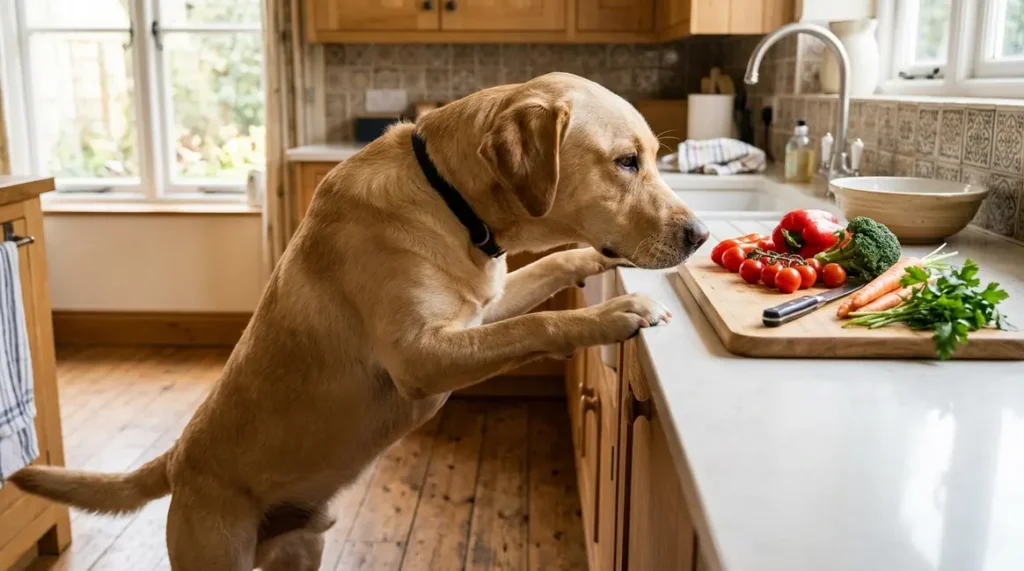
You turn your back for thirty seconds, and your dog is already on the counter.
It’s a frustration owners describe again and again:
“Nothing is safe on the table or counters. The second I leave, he goes to see what he can find in the kitchen.”
If that sounds familiar, you’ve probably already tried saying “no,” shooing your dog away, or raising your voice. Here’s why it hasn’t worked: counter surfing is a self-reinforcing behavior, meaning the food itself is the reward, no input from you required. According to VCA Animal Hospitals, a dog that finds food on the counter even occasionally will continue checking, because the behavior is reinforced by the find itself. Every crumb is a jackpot, and jackpots are hard to compete with.
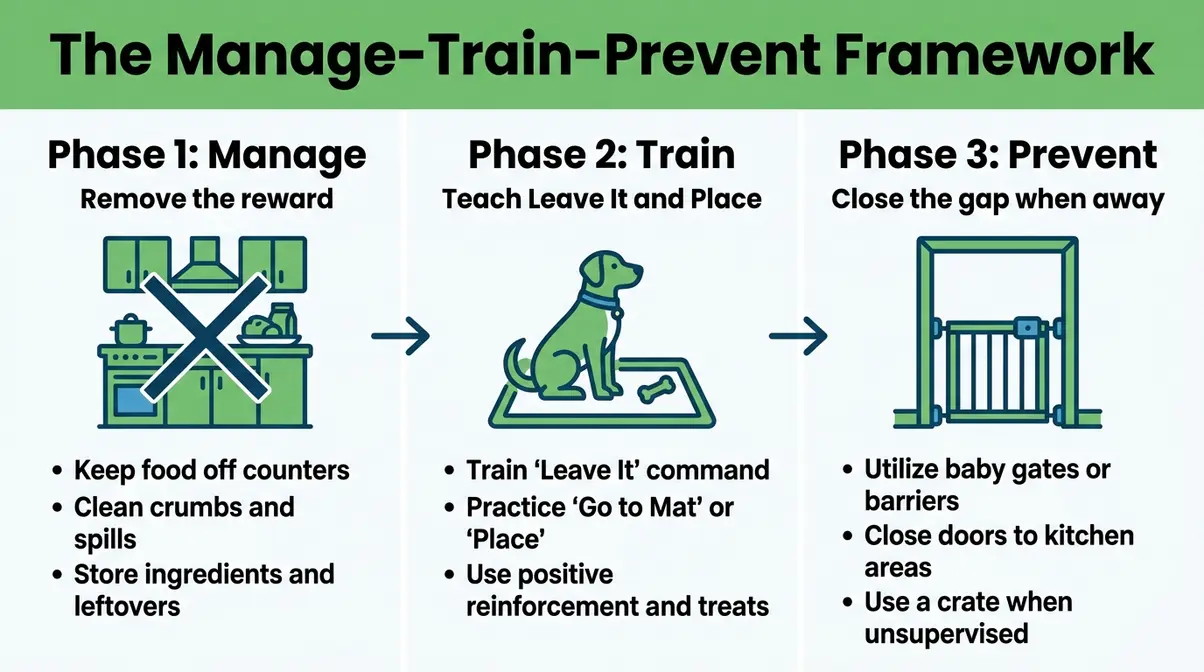
This is where most “just say no” approaches fail. In this guide, you’ll learn the Manage-Train-Prevent Framework: a three-phase approach to stopping counter surfing for good. Phase 1 removes the reward, Phase 2 teaches your dog what to do instead, and Phase 3 closes the gap when you’re not home. You’ll also find guidance on deterrent devices and what not to do.
Counter surfing is a self-reinforcing habit, and every food find makes it stronger. The Manage-Train-Prevent Framework stops it in three phases:
- Manage first: Remove all food from counters before training can work.
- Train alternatives: “Leave It” and “Place” give your dog something better to do.
- Prevent when absent: Crates, gates, and enrichment close the loop when you’re not watching.
- Avoid aversive methods: Booby traps and punishment make the problem worse, not better.
Written by Coral Drake · Reviewed by Brianna York, Former Veterinary Technician · Last updated July 29, 2026 · Sources accessed July 2026
Why Dogs Counter Surf (and Why It’s So Hard to Stop)
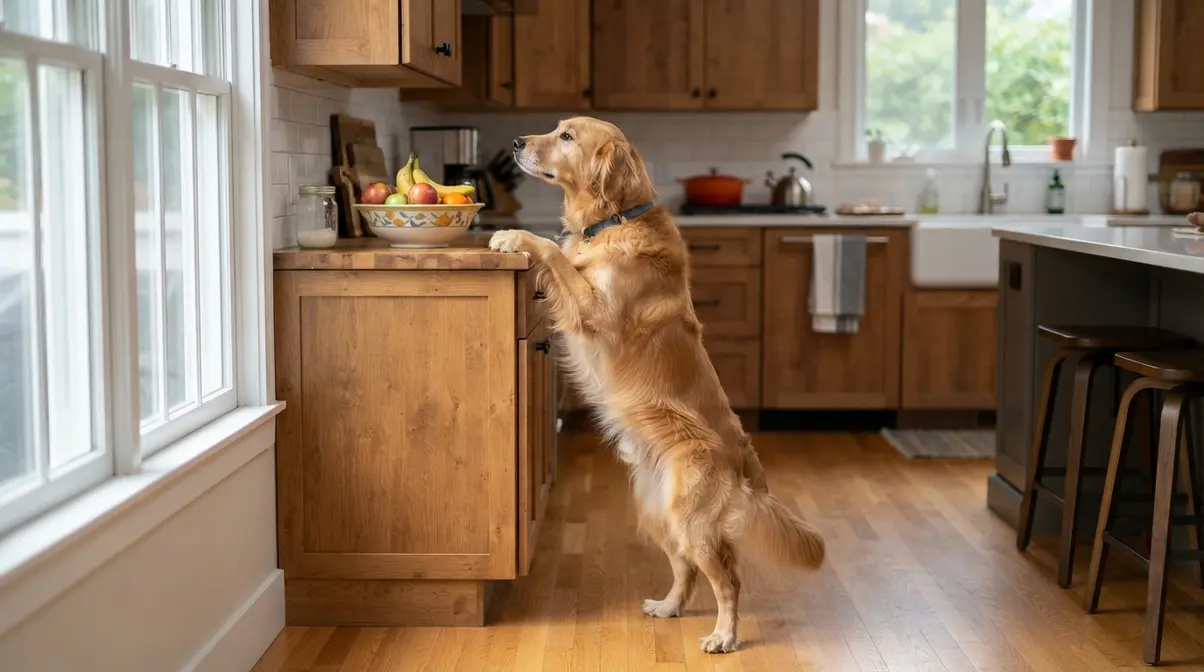
Your dog counter surfs because it works. The behavior is self-reinforcing: every food find, even a stray crumb, rewards the habit and makes the next attempt more likely. Understanding the mechanism behind this is the first step toward knowing how to stop counter surfing dogs for good.
Why Counter Surfing Is a Self-Rewarding Habit
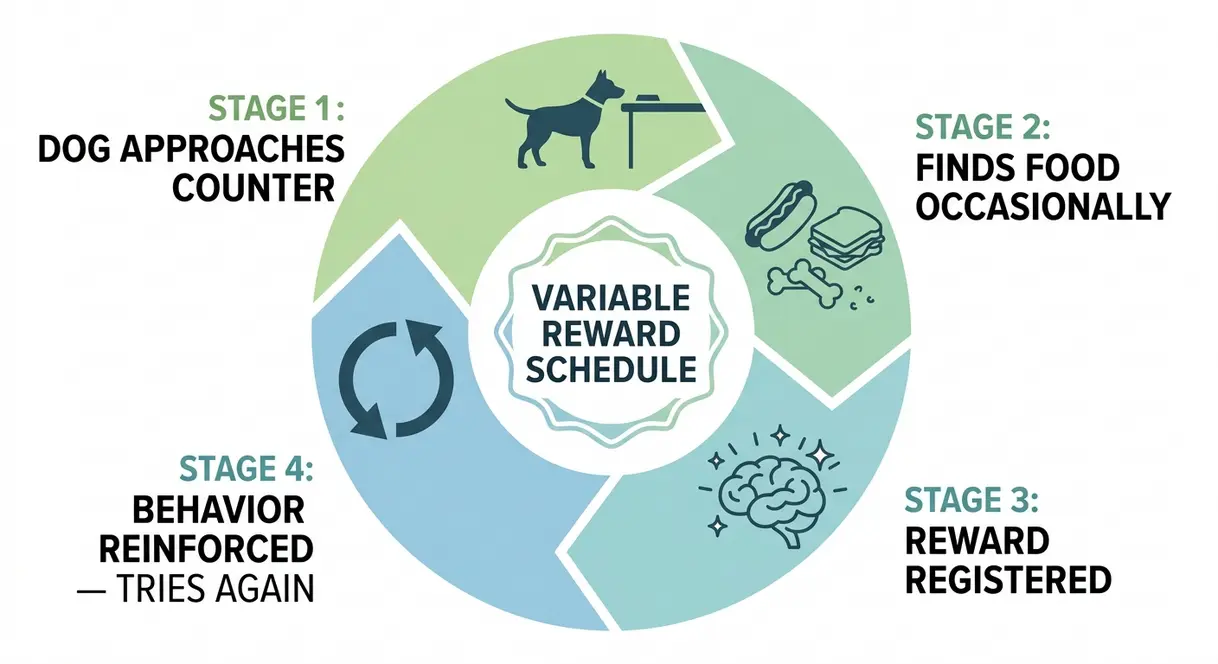
Self-reinforcing behavior is a habit the dog rewards itself for, without any input from you. The food on the counter is the reward. You don’t need to be present, and you don’t need to approve. According to VCA Animal Hospitals, counter surfing is reinforced because the dog is occasionally rewarded for its efforts by finding food, which encourages it to continue.
What makes this especially stubborn is the variable reward schedule. Finding food 1 in 5 times is actually more motivating than finding it every time. It’s the same psychological principle that keeps people at slot machines. A dog who found a chicken bone on the counter three weeks ago will still check daily. That single memory is enough to sustain hundreds of future attempts. This is why “he only gets something occasionally” is not a reason to relax management. It’s precisely why the behavior is so persistent.
Now that you understand why the habit is so sticky, here’s the good news: the same mechanism that creates it, the reward, is exactly what you’ll use to dismantle it.
Which Dogs Are Most Likely to Counter Surf?
Large breeds with a natural height advantage and high food drive top the list: Labrador Retrievers, Golden Retrievers, Beagles, Standard Poodles, and German Shepherds. Discussions in the r/OpenDogTraining community consistently name Labs and Goldens as the most commonly cited breeds. That said, any dog tall enough to reach, or motivated enough to try, can develop the habit.
Puppies and adolescent dogs under two years old are especially prone, thanks to lower impulse control and a high exploratory drive. A 4-month-old Labrador may already be reaching most kitchen counters before their owner has started any formal training.
Counter surfing is not a sign of a “bad dog.” It’s a sign of a smart, food-motivated dog who found an opportunity. Regardless of breed, the fix starts in the same place: your kitchen, not your training session.
This is why Phase 1 of the Manage-Train-Prevent Framework, removing the reward entirely, must come before any training. You can’t out-train a jackpot.
Step 1: Manage Your Environment First (Remove the Reward)
Before any training can work, you have to remove the reward. A dog that still finds food on the counter, even occasionally, has no reason to stop checking. The Humane Society of the United States confirms that the most effective approach is to keep counters clear of food and reward your dog for staying on the floor. This is Phase 1 of the Manage-Train-Prevent Framework, and it is non-negotiable.
- What You’ll Need:
- A baby gate or exercise pen
- Countertop storage containers with lids
- A pet-safe enzymatic cleaner or diluted white vinegar solution
- Consistent household rules, every family member must comply
Clear the Counters, Every Single Time
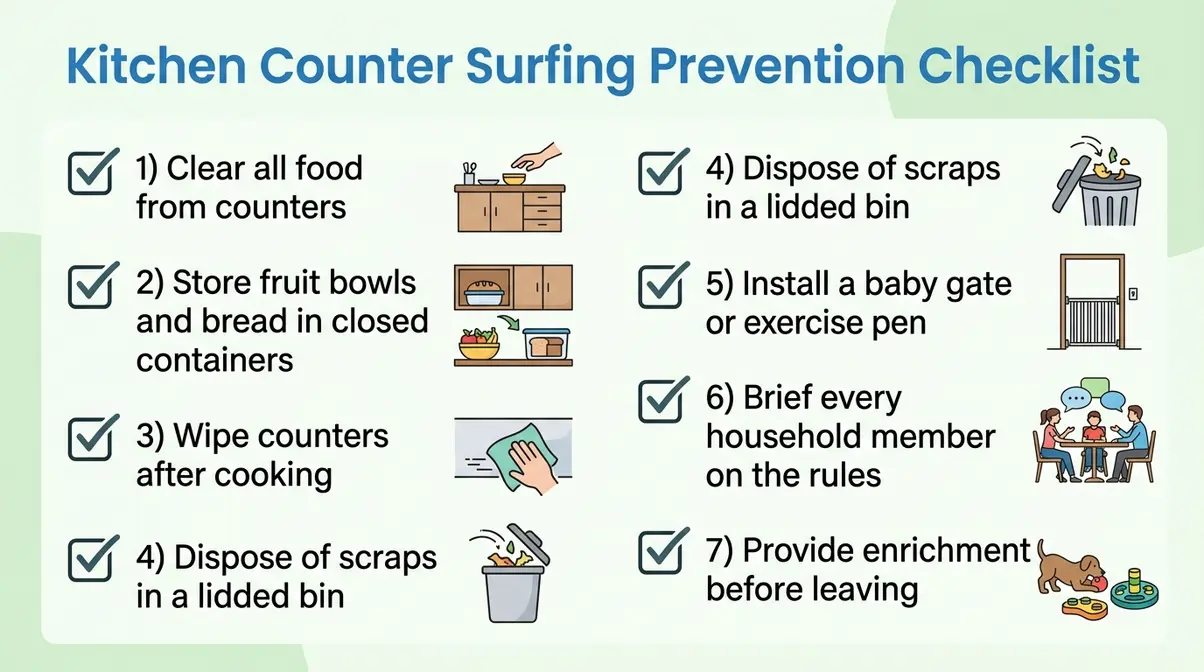
The rule is simple: nothing edible stays on the counter. Not just the obvious items. Fruit bowls, bread baskets, dish-drying racks with food residue, cutting boards, anything that smells like food. All of it needs to go. According to the Humane Society, keeping counters clear and rewarding floor-level behavior is the most effective foundation for stopping counter surfing.
The critical word is every. One forgotten piece of toast undoes the variable-reward-schedule reset you’ve been building. Because intermittent rewards are more powerful than consistent ones, a single lapse can re-energize the habit for days. Every family member must follow the same rule, no exceptions.
Use lidded containers and closed pantry doors as a long-term habit, not just during the training phase. If you’re cooking and need to step away, put food directly into the oven, fridge, or a lidded container. Never leave it “just for a minute” on the counter.
- Items to remove right away:
- Fruit bowls and bread baskets
- Defrosting or marinating meat
- Cutting boards with residue
- Dish racks near food scraps
- Anything left out “just temporarily”
Also worth noting: even the smell of food residue from cooking can trigger counter surfing. Wiping counters after cooking is as important as clearing them of visible food.
Clearing the counter removes the jackpot. The next step removes the opportunity entirely.
Block Kitchen Access When You Can’t Supervise
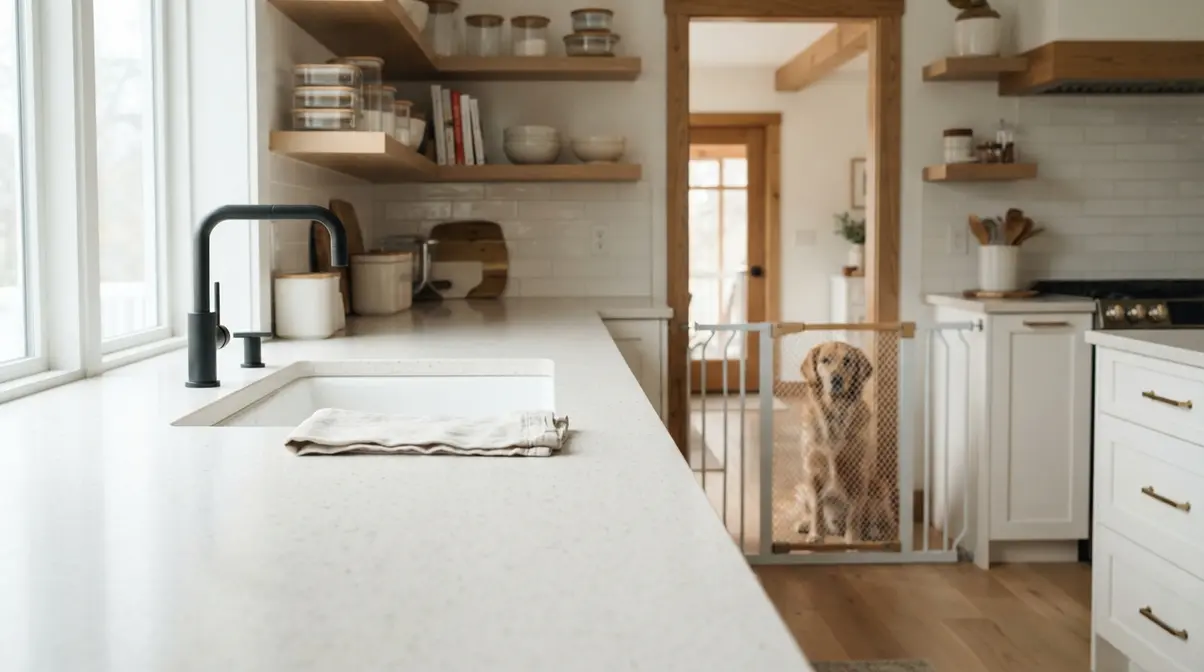
A dog that can’t reach the counter can’t practice the behavior. Baby gates, exercise pens, and closed doors are the most reliable management tools when you can’t actively supervise. This is not giving up. It’s the professional approach to stopping counter surfing dog training in its tracks.
Pressure-mounted gates work for most standard doorways. For open-plan homes, a freestanding exercise pen creates a kitchen perimeter without requiring a doorframe. During meal prep, putting your dog behind a baby gate in an adjacent room with interactive dog toys removes the temptation and gives them something appropriate to do.
These barriers are a management bridge, not a permanent solution. Once your dog reliably responds to “Leave It” and “Place,” gate use can be gradually reduced. For a complete strategy when you’re not home at all, the dedicated section below covers every scenario.
Clearing food and blocking access handles the visible triggers. But there’s one more management step most owners miss.
Remove Scent Triggers After Cooking
Research suggests that dogs’ sense of smell is dramatically more sensitive than humans’, by some estimates, tens of thousands of times more acute. Even a wiped-down counter can retain food odors that trigger counter surfing. A dog that specifically surfs the counter after you cook chicken is responding to scent, not visible food.
After cooking, wipe counters with a pet-safe cleaner or diluted white vinegar solution. Pay particular attention to the stovetop and areas near the cutting board. As the ASPCA notes, finding a tasty snack even once is enough to keep dogs checking back for more. And scent alone can be enough to trigger that impulse.
Dispose of food scraps in a lidded bin, and consider taking the trash out before leaving the house. An accessible trash can is essentially a counter surfing extension, same reward, different surface.
This scent-management step is one most guides skip entirely. It’s also one of the most common reasons management appears to be working but the dog keeps checking. The smell is still there, even when the food isn’t.
With the environment managed, your dog has no opportunity to practice the habit. Now it’s time to teach them what to do instead, Phase 2 of the Manage-Train-Prevent Framework.
Step 2: Train Alternative Behaviors (What to Do Instead)
According to Tufts University’s Cummings School of Veterinary Medicine, the most effective long-term solution combines two elements: ensuring nothing is on the counter for the dog to get, and teaching the dog an alternate, more rewarding behavior. Phase 2 of the Manage-Train-Prevent Framework delivers that second element, replacing counter surfing with something your dog actively wants to do.
- What You’ll Need:
- High-value treats, small and soft: chicken pieces, cheese, hot dog bits
- A designated mat or dog bed for “Place”
- A clicker (optional but helpful for precise timing)
- Patience. Most dogs learn “Leave It” in 3-5 sessions, “Place” in 5-10
Teaching “Leave It” for Counter Surfing
“Leave It” is the reactive tool in your kitchen toolkit. When your dog approaches the counter, you cue the behavior and they back off. Karen Pryor Clicker Training recommends a positive reinforcement progression that starts with low-value items and builds toward real counter-level distractions. Never skip steps in the progression.
- Hold a treat in your closed fist. Let the dog sniff and paw at it.
- The moment the dog backs away or stops trying, mark (“yes!” or click) and reward with a different treat from your other hand.
- Repeat until the dog backs away right away when you present the fist.
- Progress to placing a treat on the floor, covering it with your foot. Use the same mark-and-reward process.
- Gradually move to placing food on a low table or counter edge, cueing “Leave It” before the dog approaches.
The key mechanism: you’re marking the moment the dog disengages, then rewarding with something better from a separate source. Over time, “Leave It” becomes a reliable cue to back away from anything on a surface.
One important limitation: “Leave It” requires you to be present to cue it. That’s why it pairs best with “Place,” covered next. If your dog approaches the counter while you’re cooking, cue “Leave It” and right away redirect to their mat with “Place.”
Troubleshooting: If your dog is too excited to respond near the counter, go back to practicing in a low-distraction environment and build up gradually. You can also redirect to durable chew toys as an alternative reward during early sessions.
Once “Leave It” is solid, add “Place” to give your dog a proactive job in the kitchen, not just a reactive one.
Teaching “Place” (Go to Your Mat)
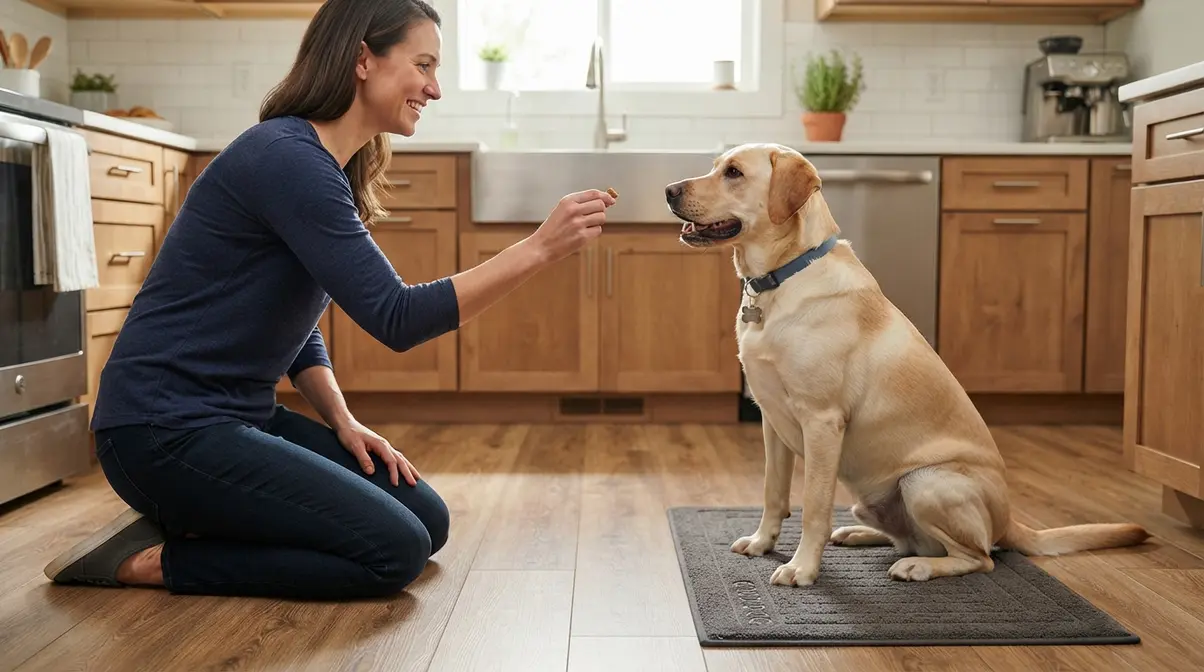
“Place” is the more powerful of the two commands for counter surfing scenarios. Rather than telling your dog what not to do, it gives them a specific location to go to. A dog on their mat physically cannot be on the counter. According to Victoria Stilwell’s Positively, teaching an alternative behavior is more effective long-term than punishment, and “Place” is one of the clearest alternatives you can teach.
- Set a mat or dog bed in a visible, consistent spot in or near the kitchen.
- Lure the dog onto the mat with a treat. Mark and reward the moment all four paws are on it.
- Add the cue “Place” as the dog moves toward the mat.
- Build duration: ask the dog to stay on the mat for 5 seconds, then 10, then 30, rewarding intermittently.
- Practice during meal prep: send the dog to “Place” before you start cooking, and reward them for staying there throughout.
Most dogs learn the foundation in 5-10 short sessions (5 minutes each). Labs and Goldens, high food-drive breeds, often pick this up quickly because the mat becomes strongly associated with treats. Over time, the mat becomes a conditioned reinforcer: the dog learns that mat = good things happen, and many will voluntarily go there when they see you cooking.
Keep the mat in the same spot every time. Consistency helps the dog generalize the behavior to the kitchen context, which is exactly where you need it.
Leave It and Place handle the moments you’re present. The third training pillar, capturing calm, builds the habit over time.
Rewarding Calm Kitchen Behavior
Capturing means rewarding the dog for naturally choosing the right behavior, no cue needed. Every time your dog is in the kitchen and keeps four paws on the floor, mark it and reward it. You’re not waiting for a failure to correct; you’re building a new default.
During the training phase, keep a treat pouch or a jar of treats accessible. Reward frequently at first, every 30-60 seconds of calm floor behavior, then fade to intermittent rewards as the behavior strengthens. The goal is to build a new default: “being in the kitchen = staying on the floor = good things happen.”
While you’re cooking, glance down every 30 seconds. If your dog is on the floor, quietly say “yes” and toss a treat to the floor, not the counter. This is intentional. You’re reinforcing floor-level behavior, not counter proximity. Puzzle toys as a preventative tool can also keep your dog occupied at floor level during longer cooking sessions, adding another layer of reinforcement for staying down.
Phases 1 and 2 cover the moments you’re home. But what about when you leave? That’s where most owners hit a wall, and where Phase 3 comes in.
How to Stop Counter Surfing When You’re Not Home
When you’re not home, training alone can’t stop counter surfing. The only guaranteed solution is management, preventing your dog from accessing the kitchen entirely. Every unsupervised counter-surfing success reinforces the habit and sets your training back. This is Phase 3 of the Manage-Train-Prevent Framework: the prevention layer.
Phase 3 isn’t about punishing your dog for being home alone. The goal is to prevent them from practicing the behavior when you can’t redirect it. Each successful counter surf when you’re away essentially re-trains the habit from scratch.
Crate Training as a Management Tool
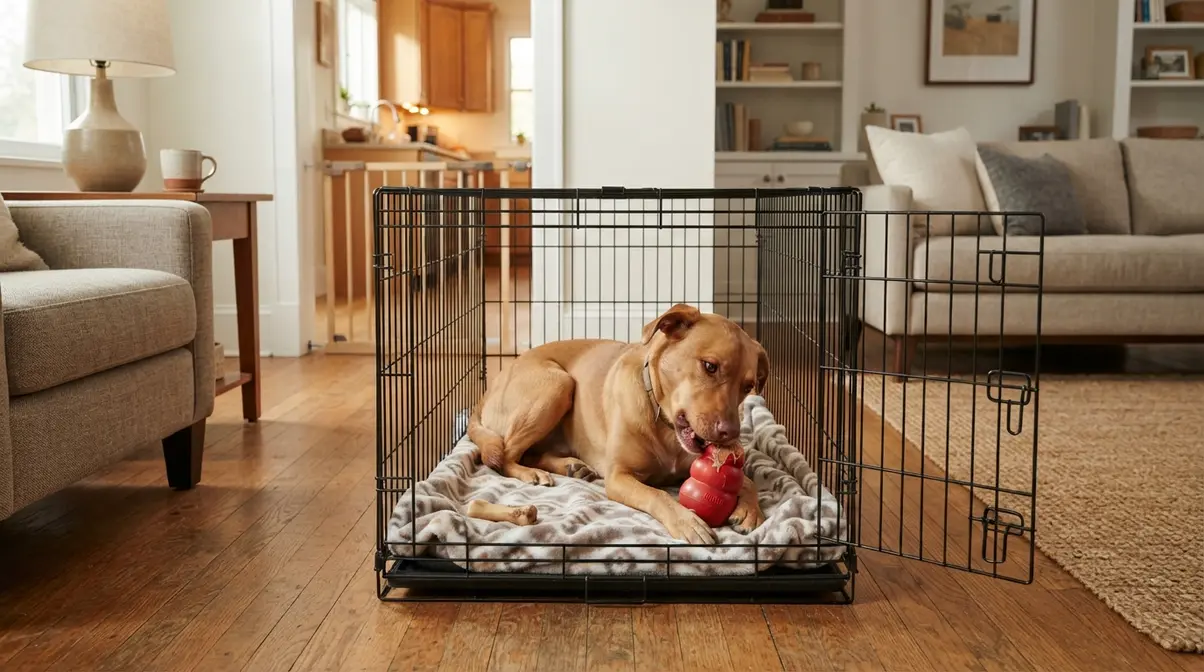
A properly introduced dog crate gives your dog a safe, comfortable space when unsupervised, and completely removes the opportunity to counter surf. Framing matters here: a crate is not a punishment. It’s a den, and most dogs, once properly introduced, are happy to settle in one.
Start with short durations, 15 to 30 minutes, with a stuffed Kong or chew toy inside. Gradually increase to the full duration of your absence. Never use the crate as punishment; that association undermines everything. Before leaving the house, give your dog a frozen stuffed Kong in their crate. This creates a positive association with crating and keeps them occupied during the highest-anxiety window: the first 30 minutes after departure.
For dogs whose counter surfing may be driven by separation anxiety, a standard crate can sometimes increase stress rather than reduce it. A covered, den-like crate or anxiety-specific enclosure may be more appropriate, see our guide to crates for dogs with anxiety for options suited to that scenario.
If your dog is crate-trained, you have a reliable solution. If not, or if you prefer not to crate, room confinement is the next best option.
Baby Gates and Room Confinement
A baby gate or closed door that blocks kitchen access is the simplest management solution for dogs who aren’t crate-trained. The dog can roam the rest of the house freely while the kitchen is off-limits. No access, no practice, no setback to your training progress.
For open-plan homes, a freestanding exercise pen or a pressure-mounted gate across the kitchen entrance works well. Before purchasing, measure the opening. Most standard gates fit 28-38 inch doorways, but wider openings need an extension kit or a freestanding pen instead.
Overnight counter surfing is best managed the same way. Dogs that surf the counter at night are often responding to lingering food smells from dinner prep or simply bored after the household goes quiet. A baby gate on the kitchen doorway is a simple overnight fix while training is in progress, low effort, high reliability.
This is a temporary management bridge. As your dog’s “Leave It” and “Place” become reliable, you can gradually increase their unsupervised freedom by leaving the gate open for short periods and monitoring the results.
Gates and crates handle the physical access problem. But a bored dog will find other ways to cause trouble, enrichment addresses the root cause.
Enrichment to Reduce Boredom-Driven Counter Surfing
Many dogs counter surf out of boredom, not just hunger. A dog that is mentally and physically tired has less motivation to explore the kitchen. As Virginia Tech’s veterinary medicine experts advise, all food and food waste should be secured to prevent counter surfing. But reducing the dog’s motivation to seek it out is equally important (Virginia Tech, 2023).
Before leaving the house, provide enrichment specifically timed for your departure:
- Frozen stuffed Kong, peanut butter and kibble, frozen overnight; keeps most dogs occupied for 20-30 minutes
- Snuffle mat, encourages nose work at floor level
- Puzzle feeder, mental effort that reduces arousal
- Long-lasting chew, bully stick, yak chew, or similar
These occupy your dog’s attention during the highest-risk period: the first 30 minutes after you leave, when exploratory drive peaks. Regular exercise before departures also reduces arousal levels. A tired dog is a less curious dog. This enrichment strategy applies to overnight management too. A dog given a long-lasting chew before bed is far less likely to investigate the kitchen at 2 a.m. Pairing enrichment with interactive dog toys gives you even more options for keeping your dog engaged at floor level.
The goal isn’t to confine your dog forever. It’s to prevent the habit from being practiced while training is in progress. As your dog’s “Leave It” and “Place” become reliable, you can gradually increase their unsupervised freedom. The strategies above work for adult dogs. But puppies present a unique challenge, lower impulse control, higher curiosity, and a body that’s growing into counter height faster than you might expect.
Puppies and Counter Surfing: Starting on the Right Paw
Stopping counter surfing in a puppy is far easier than breaking an established habit in an adult dog. But only if you start early. For puppies, Phase 1 (management) is even more critical because Phase 2 (training) takes longer to stick. The most common mistake is waiting until the dog is “old enough to train.” By then, the habit is already formed.
Why Puppies Are Especially Prone to Counter Surfing
Puppies have lower impulse control than adult dogs. Training consensus indicates that the brain regions governing self-control continue developing until around two years of age. They act on impulse more readily, and no amount of scolding changes that developmental reality.
Large-breed puppies grow into counter height faster than most owners expect. A Labrador or Golden Retriever puppy can reach most kitchen counters by 4-6 months of age, often before formal training has begun. It’s worth taking a moment to puppy-proof your home as soon as you bring a large-breed puppy home, not after the first counter surf.
Puppies are also in a high-curiosity developmental phase. They explore the world with their nose and mouth, and a counter that smells like last night’s dinner is irresistible. If you have a 4-month-old Lab who’s just started reaching the counter, don’t wait for a training milestone, start management right away. Clear counters and use gates from day one.
“How to stop your puppy from counter surfing” is one of the most common searches on this topic, which tells you something: this is an extremely common problem, not a sign of a poorly trained dog.
The good news: puppies are also the easiest dogs to train, because habits aren’t yet fully formed. Here’s how to adapt the Manage-Train-Prevent Framework for a young dog.
Puppy-Specific Training Adjustments
Training a puppy requires adjusting your expectations and your methods. The framework is the same. But the pace, the reward rate, and the session length all need to shift.
- Shorter sessions. Puppies have attention spans of roughly 3-5 minutes. Keep Leave It and Place sessions to 3 minutes maximum, 3-4 times per day. Short and frequent beats long and infrequent every time.
- Higher reward rate. Puppies need more frequent reinforcement than adult dogs to build a behavior. Reward every correct response initially; fade to intermittent rewards only after the behavior is reliably consistent.
- Simpler progressions. Start “Leave It” with very low-value items (kibble) and don’t rush to counter-level distractions. A puppy needs more repetitions at each level before progressing, pushing too fast leads to frustration for both of you.
- Stricter management. Because puppies have less impulse control, gates and crates should be used more consistently than with adult dogs. Every unsupervised counter-surfing success is more damaging to training progress in a puppy than in an adult.
A 10-week-old puppy can learn the foundation of “Leave It” in 3-minute sessions. By 6 months, with consistent practice, most puppies can hold a Leave It near the counter for 10-15 seconds. That’s real progress, and it compounds quickly.
For a complete guide to puppy-proofing your entire home, the puppy-proofing guide covers every room, not just the kitchen.
Whether you’re training a puppy or an adult dog, you may find that management and training alone aren’t enough in the early stages. That’s where deterrents can help, used correctly.
Counter Surfing Deterrents: Tools That Can Help
Several devices can help deter counter surfing, but none replace training. The three main categories are motion-activated air sprays, physical barriers, and scat mats, each with distinct use cases and trade-offs. Deterrents fit into Phase 1 of the Manage-Train-Prevent Framework: they make the counter less rewarding, but they don’t teach the dog what to do instead.
| Deterrent Type | How It Works | Best For | Caution |
|---|---|---|---|
| Motion-activated air spray | Detects movement; emits a burst of compressed air | Dogs startled by sudden noise or air | May generalize to kitchen fear in sensitive dogs |
| Baking sheet edge trick | Balanced on counter edge; falls with a clatter if disturbed | Low-cost, no-tech option | Requires setup each time; not suitable for all surfaces |
| Scat mat (static pulse) | Emits mild static when touched | Persistent counter surfers | Not recommended for anxious dogs; consult a trainer first |
| Baby gate / exercise pen | Physical barrier; blocks access entirely | All dogs; most reliable | Requires consistent use; not a training substitute |
Motion-Activated Deterrents
Motion-activated air spray cans, devices like SSSCAT and similar products, detect movement within a set radius and emit a burst of compressed air. The sudden noise and air burst startles the dog without causing physical harm. As a supplementary tool for dog counter surfing, these can reinforce the “counter is not rewarding” message during the management phase, particularly when you’re not present to monitor.
Placement matters: position the device at the edge of the counter, aimed toward the area your dog typically approaches. Most devices have roughly a 3-foot detection radius, so placement directly in the approach path gives the best coverage.
Two limitations are worth naming honestly. First, some dogs habituate to the device over time. The startle effect diminishes once the dog learns it’s predictable. Second, and more importantly, some dogs generalize their fear beyond the device itself, becoming reluctant to enter the kitchen at all. If your dog shows signs of generalized kitchen anxiety, reluctance to enter, cowering, avoiding food bowls placed near the area, discontinue use right away.
Some owners find these effective as a short-term bridge alongside broader training tools, but they work best when paired with active Phase 2 training rather than used as a standalone fix.
For owners who prefer a non-electronic option, a low-tech physical deterrent can work just as well.
Physical Barriers and Scat Mats
The baking sheet trick is exactly what it sounds like: balance a lightweight baking sheet on the counter edge so it falls with a clatter if the dog disturbs it. The noise startles without any device, battery, or recurring cost. Limitation: it requires setup every time you leave the kitchen, and it’s not suitable for all counter configurations or surface types.
Scat mats, static pulse mats placed on counter surfaces, emit a mild static when touched. They can be effective for persistent counter surfers who aren’t deterred by noise alone. However, the ASPCA advises that the primary solution is management to prevent the dog from being rewarded at all, and that aversive devices should be used with care. For dogs with existing anxiety, avoid static-based deterrents entirely. The risk of worsening anxiety outweighs any potential benefit.
If you’re considering a scat mat, consult a certified trainer first. And in the meantime, puzzle toys offer a positive alternative, something that occupies your dog’s attention at floor level rather than suppressing behavior from above.
Whether you use a device or not, the evidence is clear: deterrents work best when paired with training, not instead of it.
Why Deterrents Work Best Alongside Training
Deterrents suppress counter surfing in the short term by making the counter less rewarding. But suppression is not replacement. The dog hasn’t learned what to do instead, they’ve only learned that the counter is currently unpleasant. Remove the device, and the behavior typically returns.
Deterrent devices can reduce counter surfing opportunities, but without concurrent positive reinforcement training, the behavior typically returns when the device is removed. This is the most important thing to understand about any deterrent product.
The most effective use of deterrents is to deploy them during Phase 1 (management) to reinforce “the counter is not rewarding,” while simultaneously running Phase 2 (training) to build the alternative behavior. They’re complementary layers, not a replacement for the framework.
Once “Leave It” and “Place” are reliable, most owners find they no longer need deterrents at all. The trained behavior does the work the device was doing, except it generalizes to every environment, not just the one where the device was placed. Think of a deterrent as training wheels: useful during the learning phase, but the goal is to not need them permanently.
The most effective deterrent is one your dog never has the opportunity to test, which is why management (Phase 1) and training (Phase 2) remain the foundation. Deterrents are the safety net, not the solution. Speaking of what not to rely on, there are several common approaches to counter surfing that actively make the problem worse.
What NOT to Do: Common Mistakes That Make Counter Surfing Worse
Most guides tell you what to do. This section tells you what to stop doing, because some of the most common responses to counter surfing actively reinforce the problem. Building trust means being honest about what doesn’t work, even if you’ve already tried it.
Aversive Methods That Backfire
Three aversive methods come up repeatedly, and all three share the same fatal flaw: they teach the dog to avoid you, not the counter.
- Yelling, clapping, or physically removing the dog. These suppress the behavior in the moment but provide no information about what to do instead. The dog learns “don’t do this when the owner is watching”, which is why so many owners report “he only does it when I’m not home.” That’s not guilt. That’s successful avoidance learning.
- Booby traps (mousetraps under paper, stacked cans that fall). These can startle the dog effectively, but carry a real risk of fear generalization, fear of the kitchen, fear of certain sounds, or fear of the owner if they’re associated with the setup. Positive reinforcement trainers and behavioral science consensus indicate these are not recommended as a primary approach.
- Spray bottles. Widely used, rarely effective for counter surfing. Dogs habituate quickly, and the ones that don’t often become wary of the owner holding anything, not of the counter itself.
As Victoria Stilwell’s Positively explains, positive reinforcement is more effective long-term than aversive methods for counter surfing. Punishment suppresses counter surfing in the owner’s presence but leaves the behavior intact when the owner is absent. The dog learns to avoid punishment, not to avoid the counter.
Aversive methods are the most dramatic mistake. But there’s a quieter one that undermines even the best training plan.
Inconsistency: The Silent Saboteur
The variable reward schedule works against you the moment you become inconsistent. Allowing counter surfing “just once”, because you’re tired, because a guest doesn’t know the rules, because it seemed harmless, resets the reinforcement cycle. That single exception is enough to re-energize hundreds of future attempts.
All household members must follow the same rules. One family member who lets the dog “check” the counter undoes weeks of progress. The rule isn’t “mostly clear the counters.” It’s every surface, every time, with no exceptions.
It’s tempting to assume that occasional lapses won’t matter much. But the behavioral science on variable reinforcement schedules shows the opposite: intermittent rewards are more powerful, not less. Consistency isn’t just helpful here. It’s the mechanism.
With the full Manage-Train-Prevent Framework in place, most dogs show significant improvement within 2-4 weeks. Here are the questions dog owners ask most often.
Frequently Asked Questions About Counter Surfing
Why does my dog always counter surf?
Counter surfing is a self-reinforcing behavior. Your dog keeps doing it because it occasionally works. Every time your dog finds food on the counter, even just crumbs, it reinforces the habit and makes the next attempt more likely. The intermittent nature of the reward, finding food only sometimes, actually makes the behavior stronger, not weaker. This is the same psychological principle behind slot machines. Consistent management, keeping counters completely clear, is the essential first step to breaking the cycle.
How do I fix a counter surfing dog?
Fixing counter surfing requires two things working together: environmental management and alternative behavior training. First, remove all food from counters consistently so the dog stops being rewarded for checking. Then teach a specific alternative, “Leave It” or “Place”, so your dog has a clear job in the kitchen instead of an empty counter to investigate. Most dogs show significant improvement within 2-4 weeks of consistent management and daily training sessions.
How do I break my dog’s counter surfing habit?
Breaking the counter surfing habit starts with removing the reward entirely. Keep counters completely clear of food, including residue from cooking, and wipe surfaces after meal prep to eliminate scent triggers. Without the occasional food reward, the motivation to check the counter gradually fades. Pair this with training an alternative behavior like “Place” to replace the habit with something more rewarding, and you address both the motivation and the behavior simultaneously.
How do I stop my dog from counter surfing when I’m not home?
When you’re not home, management is the only guaranteed solution to counter surfing. Block kitchen access with a baby gate or closed door, or crate your dog with a stuffed Kong to keep them occupied. Ensure counters are completely clear before you leave, even one food find during your absence can reset weeks of training progress. As training becomes reliable, you can gradually increase your dog’s unsupervised freedom by leaving access open for short, monitored periods.
What device stops dogs from counter surfing?
Several devices can help deter counter surfing, though none replace training. Motion-activated air spray cans, which emit a burst of air when the dog approaches, are among the most commonly used options. Physical deterrents like a balanced baking sheet that clatters when disturbed offer a low-tech alternative. Scat mats (mild static pulse mats) can be effective but are not recommended for anxious dogs. All deterrents work best when used alongside positive reinforcement training, not instead of it, remove the device without the training foundation, and the behavior typically returns.
You Can Stop Counter Surfing, Here’s Where to Start
Counter surfing is one of the most frustrating dog behaviors to deal with. But it’s also one of the most solvable. For dog owners dealing with a persistent counter surfer, the Manage-Train-Prevent Framework provides a clear path: remove the reward first, teach an alternative behavior second, and close the gap with management when you’re not home. Research from VCA Animal Hospitals confirms that counter surfing is self-reinforcing, which means removing the reward is the non-negotiable first step, and no amount of training replaces it.
The Manage-Train-Prevent Framework works because it addresses all three failure points at once: the reward (management), the habit (training), and the unsupervised gap (prevention). That’s why “nothing is safe on the counter” eventually becomes “my dog doesn’t even look up anymore.” The framework doesn’t just suppress the behavior. It replaces it, and it closes the back door that punishment and deterrents leave wide open.
Start with Phase 1 today: clear your counters completely and set up a baby gate if needed. Then spend 5 minutes teaching “Leave It” with a handful of kibble. Most dogs show a response in the very first session. If your dog’s counter surfing is severe, persistent despite consistent management, or appears driven by anxiety, consider working with a certified professional dog trainer (CPDT-KA) for a personalized plan tailored to your dog’s specific drives and history.