

Written by Coral Drake · Last updated July 2026
You have seen the videos: a golden dog bounding through a yard, tail going, eyes soft and happy. You have probably already fallen a little bit in love. Then you read the forum threads. Fur on every surface. Four-figure vet bills. A dog that howls when left alone. The pros and cons of golden retrievers are real on both sides, and getting this decision wrong is not just inconvenient. It means a dog that suffers and an owner who feels overwhelmed. This guide gives you the honest picture so you can decide with confidence, not regret. It covers temperament, daily behavior, health risks, grooming, and the alone-time question that every working household needs to answer before bringing a puppy home.
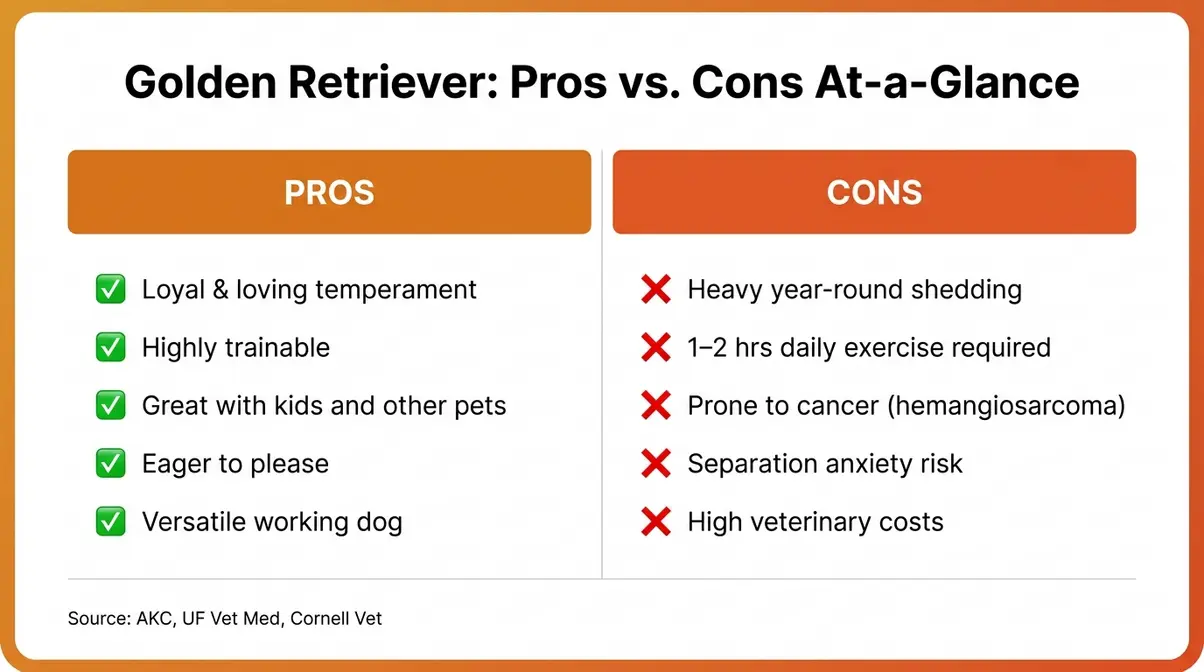
The pros and cons of golden retrievers follow a consistent pattern: extraordinary warmth and trainability on one side, demanding grooming and health needs on the other.
- Friendliness and trainability make them ideal for families and first-time owners
- Heavy shedding and high exercise needs require daily time investment
- Cancer risk is significant: fewer than 10% of dogs diagnosed with hemangiosarcoma survive beyond one year (University of Florida College of Veterinary Medicine, 2025)
- The Golden Tradeoff: their deep need for human connection is their greatest strength and their biggest vulnerability when left alone
What Are the Pros and Cons of Golden Retrievers?

The pros and cons of golden retrievers follow a clear pattern: exceptional warmth and trainability on one side, demanding grooming and health needs on the other. The American Kennel Club, or AKC, the official U.S. dog registry, and the Golden Retriever Club of America, or GRCA, the breed’s national parent club, both recognize Goldens as one of the most trainable and family-friendly breeds available. Knowing both sides before you commit is the difference between a joyful household and an overwhelmed one.
The Golden Retriever is a sporting breed, meaning it was bred to assist hunters in the field, originally developed in Scotland as a gundog in the 19th century. Today, adult Goldens weigh between 55 and 75 pounds and live an average of 10 to 12 years, according to the AKC. Golden Retrievers consistently rank among the top three most popular dog breeds in the United States (American Kennel Club, 2024).
What Makes Golden Retrievers Such a Joy to Own?

Golden Retrievers have an even temperament, which means they are reliably gentle and friendly across a wide range of situations: with strangers, children, other dogs, and other animals. They are also biddable, a term that means eager to please and follow direction, which is why they are used as guide dogs, search-and-rescue dogs, and therapy animals. This is not just a pleasant personality trait. It means you can teach house rules quickly, even as a first-time dog owner.
Across Golden Retriever owner communities, the same traits come up again and again:
loving, friendly, and super connected to their humans; beautiful and even-tempered; goofy and good-natured; biddable and trainable.
That warmth is genuine. Their social nature does come with one hidden irony: a Golden will greet a burglar as warmly as a guest. They are not guard dogs. For a deeper look at the breed’s history and personality, see our Golden Retriever breed overview.
For a first-hand look at life with a Golden, watch: “9 Things I Wish I Knew Before Getting My Golden Retriever” on YouTube.
That warmth and connection is real. But it comes with a cost, and the next section names it plainly.
What Are the Real Challenges of Owning a Golden Retriever?

When you weigh what are the pros and cons of golden retrievers, the challenges are just as predictable as the joys, which is actually good news. You can plan for them. The first reality check is shedding. Goldens shed year-round, not just in spring and fall. Picture fur tumbleweeds collecting under your couch, on your couch, and on every piece of dark clothing you own. Plan to vacuum several times per week and budget for professional grooming every 6 to 8 weeks.
The second challenge is exercise. This is a sporting breed that needs 1 to 2 hours of active exercise daily. A bored Golden does not sit quietly. It finds entertainment on its own, which usually means chewing furniture, raiding the trash, or inventing other creative problems. This is not a breed that adapts to a sedentary household.
The third challenge is financial. Health costs for a 55 to 75 pound dog with breed-specific health risks add up significantly. Food, grooming, routine vet visits, and potential specialist care are all real budget items. One additional note: dogs from backyard breeders, meaning dogs from parents who were not health-screened, carry a higher risk of inherited health problems. You can read more about common Golden Retriever behavior problems to understand what unscreened breeding can contribute.
The personality traits you just read about, and the challenges, are shaped significantly by how you train and manage your Golden day-to-day. That is where the next section picks up.
Are Golden Retrievers Easy to Train and Live With?

Picture a working household: two adults, 9-to-5 jobs, a Golden Retriever puppy at home alone. Golden Retrievers are highly trainable and eager to cooperate. That same people-orientation, the quality that makes them so rewarding to live with, becomes a real liability when the dog is left alone for long stretches. This is The Golden Tradeoff in its most practical form: their deep need for human connection is both their greatest strength and their biggest vulnerability. The good news is that this is manageable with the right plan.
Golden Retrievers are among the easiest breeds to train because they genuinely want to cooperate with their people. Positive reinforcement, meaning reward-based training using treats and praise, works especially well. Harsh tones or punishment-based methods cause anxiety in this sensitive breed and slow learning down. Consistency from a beginner owner produces excellent results.
Can You Leave a Golden Retriever Alone for 8 Hours?

An adult Golden Retriever can tolerate an occasional long day alone, but 8 hours every weekday is not appropriate without support systems in place. Puppies under 6 months should not be left alone for more than 2 to 3 hours. Separation anxiety is the clinical term for distress behavior, including vocalization, pacing, and destructive chewing, that a dog shows when left without its people. Separation anxiety, including vocalization, pacing, and destructive behavior when left alone, is one of the most common reasons dogs are surrendered to shelters (clinical signs of separation anxiety, PubMed Central, 2024). If your household is away 8 or more hours, plan for this before you bring a puppy home.
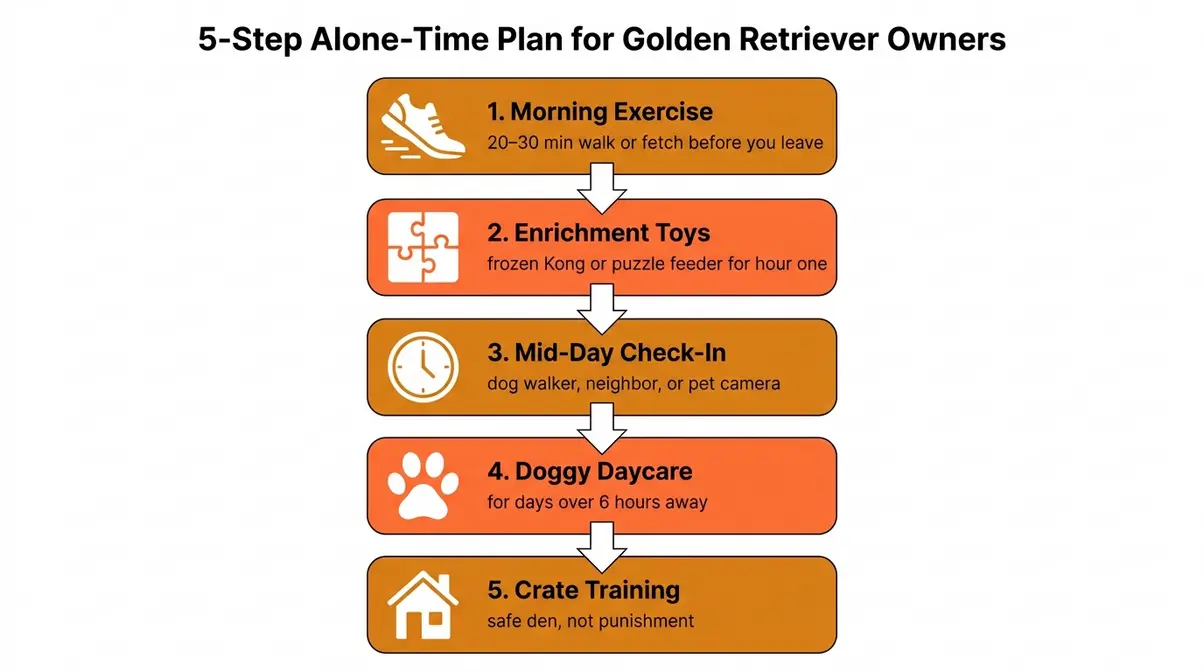
Here is a structured approach that works for working households. Call it The 5-Step Alone-Time Plan:
- Morning exercise: Walk or play fetch for 20 to 30 minutes before you leave. A tired Golden settles more easily.
- Enrichment toys: Leave a frozen Kong or puzzle feeder to occupy the first hour of alone time.
- Mid-day check-in: A neighbor, dog walker, or pet camera check at the halfway point makes a meaningful difference.
- Doggy daycare: For days over 6 hours, daycare prevents boredom and loneliness more reliably than any toy.
- Crate training: A crate used as a safe den, not as punishment, reduces anxiety and prevents destructive behavior while you are away.
For a deeper guide on this topic, see managing Golden Retriever separation anxiety.
Beyond the alone-time question, you will also want to plan for the breed’s physical energy. A tired Golden is a well-behaved Golden.
How Do You Manage a Golden Retriever’s Energy and Mouthiness?
Golden Retrievers need 1 to 2 hours of active exercise daily. A walk around the block does not meet this requirement. Think fetch, swimming, hiking, or off-leash running. Under-exercised Goldens become destructive. If your lifestyle does not include daily active exercise, plan for a dog walker or daycare before you commit to the breed.
The second behavioral trait that surprises new owners is mouthiness. “Mouthy” means that Golden Retrievers carry objects, mouth hands gently, and chew. This is not aggression. Goldens were bred to carry game birds in their mouths without damaging them, so this soft-mouth instinct is deeply bred in. It responds well to redirection: teach “drop it” and “leave it” early, and always provide appropriate chew toys. Most owners find this trait endearing once they understand it.
Golden Retrievers are sensitive dogs. They do not respond well to yelling or physical correction. Effective Golden Retriever puppy training relies on positive reinforcement, and a consistent beginner owner can achieve excellent results. Their trainability means the investment in early training pays off quickly.
You can manage the energy and the mouthiness with training and routine. The health risks are harder to train away, and that is where the honest conversation gets more serious.
What Health and Grooming Challenges Should You Expect?

Golden Retrievers are predisposed to serious health conditions, most notably cancer, which affects a significant portion of the breed over their lifetime. Understanding these risks before you bring a dog home allows you to choose a reputable breeder, plan for veterinary costs, and recognize early-warning signs that could save your dog’s life.
Hip dysplasia and other bone and joint problems are also common in this breed. Goldens are large dogs with active lifestyles, and joint deterioration can become a significant quality-of-life issue in older dogs. Responsible breeders screen breeding pairs for hips, elbows, eyes, and heart using OFA or PennHIP certifications. Asking for those certifications before purchasing a puppy is one of the most important steps you can take.
What Is the Silent Killer in Golden Retrievers?
Hemangiosarcoma is an aggressive cancer of the blood vessel walls that can grow internally without obvious symptoms. It is sometimes called the “silent killer” in Golden Retrievers because tumors typically develop on the spleen, heart, or liver and remain invisible until they rupture. By the time a dog shows symptoms, the disease is usually advanced.
The data is sobering. University of Florida veterinary research reports that only 10% of Golden Retrievers diagnosed with hemangiosarcoma survive beyond one year (University of Florida College of Veterinary Medicine, 2025). The Cornell University genetic predisposition data confirms that Golden Retrievers have a genetic predisposition to splenic hemangiosarcoma, and fewer than 10% of diagnosed dogs survive one year post-diagnosis (Cornell University College of Veterinary Medicine). Fewer than 10% of Golden Retrievers diagnosed with hemangiosarcoma survive beyond one year (University of Florida College of Veterinary Medicine, 2025).
Two early-warning signs every Golden owner should know:
- Sudden weakness, collapse, or pale gums in a senior Golden may indicate internal bleeding from a ruptured tumor. This is a veterinary emergency.
- Unexplained weight loss, reduced appetite, or a visibly distended abdomen in a dog over 8 years old warrants an immediate vet visit.
Regular wellness check-ups for Goldens over 7 years old are critical. Ask your vet about abdominal ultrasounds for senior dogs. Catching a splenic mass before rupture can extend survival time significantly. For more on what to monitor across your dog’s life, see common Golden Retriever health issues.
Buying from a health-screened breeder reduces, though cannot eliminate, the risk of inherited cancers. It is one of the most meaningful decisions you will make.
Cancer is the most serious health risk, but daily grooming and coat care are the most visible and time-consuming ongoing challenge for most Golden owners.
What Do You Need to Know About Grooming and Shedding?

Golden Retrievers have a dense double coat: a soft undercoat and a water-resistant outer layer. This coat sheds year-round, with heavier shedding twice per year during seasonal coat blows. A realistic grooming schedule includes daily brushing during heavy shed periods, weekly brushing at minimum, vacuuming multiple times per week, and professional grooming every 6 to 8 weeks.
Many new owners consider shaving their Golden to reduce shedding. This does not work, and it causes real harm. Veterinarians and professional groomers warn that shaving a double-coated breed like a Golden Retriever significantly increases the shaving risks for double-coated dogs (Merryfield Academy). The double coat also regulates body temperature; shaving it disrupts natural insulation and can actually make your dog hotter in summer, not cooler. A deshedding treatment from a professional groomer, such as a Furminator treatment, is a safer and more effective alternative.
Goldens are also highly food-motivated, which is wonderful for training and a genuine risk for obesity. Overfeeding worsens bone and joint problems that are already a breed concern. Portion control and regular weigh-ins at the vet make a real difference over a dog’s lifetime. For practical help with the coat, see our guide on managing Golden Retriever shedding.
Does It Matter Whether You Get a Male or Female Golden Retriever?
Both male and female Golden Retrievers share the same core temperament: friendly, trainable, and deeply people-oriented. The differences are real but secondary to that shared character.
Male Goldens are typically larger, weighing between 65 and 75 pounds, and many owners describe them as staying playful and exuberant longer into adulthood. Female Goldens are typically smaller, between 55 and 65 pounds, and may reach emotional maturity a bit earlier. Neither sex is definitively easier to train or more affectionate; individual personality varies more than sex does.
One area where sex makes a meaningful clinical difference is spay and neuter timing. A UC Davis study on neutering and health risks found that spay and neuter timing is associated with different cancer risks in male and female Golden Retrievers. Early spay or neuter, particularly before 12 months of age, was linked to higher rates of certain joint disorders and cancers in this breed specifically. This is worth a dedicated conversation with your vet before scheduling surgery. The practical implication: ask your vet about waiting until your Golden is at least 12 to 18 months old before making that decision.
For a detailed comparison of temperament, size, and health differences by sex, see differences between male and female Golden Retrievers.
Frequently Asked Questions
What Is the Downside of a Golden Retriever?
The primary downsides of owning a Golden Retriever are heavy year-round shedding, a daily exercise requirement of 1 to 2 hours, and a significant predisposition to serious health conditions including cancer and hip dysplasia. They are also prone to separation anxiety when left alone for long periods. These are predictable, manageable challenges for prepared owners, but they require real time and financial commitment.
What I Wish I Knew Before Getting a Golden Retriever?
Most Golden Retriever owners say they underestimated two things: the sheer volume of shedding and the emotional and financial weight of the breed’s health risks. Goldens are also mouthy, meaning they carry objects and mouth hands gently as a breed instinct, not aggression. Veterinary costs, especially in senior years, can reach several thousand dollars for cancer treatment or joint surgery. Starting with a health-screened breeder and a realistic budget makes the experience far less stressful. That single preparation step filters out the highest-risk scenarios before a puppy ever comes home.
What Is the Silent Killer in Golden Retrievers?
The “silent killer” in Golden Retrievers is hemangiosarcoma, an aggressive cancer of the blood vessel walls. Tumors typically grow on the spleen, heart, or liver without obvious symptoms until they rupture internally. By the time a dog shows signs, the disease is usually advanced. Fewer than 10% of diagnosed dogs survive beyond one year, making regular senior wellness check-ups especially important for dogs over 7 years old.
Can a Golden Retriever Be Left Alone for 8 Hours?
Leaving a Golden Retriever alone for 8 hours every weekday is not recommended without support systems in place. As highly social dogs, they can develop separation anxiety, which causes destructive behavior and significant distress. Adult Goldens may tolerate occasional long days, but puppies under 6 months should not be left alone for more than 2 to 3 hours. A dog walker, daycare, or mid-day check-in helps considerably and is worth planning before you bring a dog home.
Is a Golden Retriever the Right Dog for You?
For families and first-time owners, the pros and cons of golden retrievers follow a consistent pattern: extraordinary companionship paired with extraordinary commitment. Fewer than 10% of Golden Retrievers diagnosed with hemangiosarcoma survive beyond one year (University of Florida College of Veterinary Medicine, 2025), which is a sobering reminder that this breed’s health demands are real. The best path forward combines a health-screened breeder, a daily exercise plan, and a realistic budget for veterinary care. Devotedtodog.com’s editorial team, reviewed by Brianna York, Vet Tech, recommends treating these three elements as non-negotiable before you commit.
This is where The Golden Tradeoff becomes the most useful lens. The same qualities that make Goldens extraordinary, their deep human connection, their eager-to-please nature, their gentle temperament, are the same qualities that create their most significant demands. They need you. That is both the gift and the responsibility.
If you are ready for that commitment, start by finding a breeder who provides OFA health certifications for both parents. That single step filters out the highest-risk scenarios before a puppy ever comes home. Learn more about Golden Retrievers to continue building your knowledge before you decide.
➤ Golden Retrievers give you everything they have, and they ask for the same in return: daily time, consistent care, and a household that plans ahead for their health and emotional needs.