
Your Golden Retriever’s belly is growing, she’s sleeping more than usual, and she keeps disappearing into quiet corners of the house. If you’re wondering whether she might be pregnant, you’re not alone, and you’ve come to the right place.
A golden retriever pregnancy lasts approximately 63 days, and without a clear roadmap, those nine weeks can feel deeply uncertain. Missing key signs or skipping vet check-ups at the wrong moment can put both your dog and her puppies at risk. By the end of this guide, you’ll know exactly what to watch for each week, what care she needs, and when to call your vet, so you can feel confident and prepared every step of the way.
We’ll walk through early pregnancy signs, the full week-by-week timeline, nutrition and whelping preparation, potential complications, and the most common questions Golden Retriever owners ask. Before diving in, save your vet’s phone number and the nearest emergency animal hospital contact. You’ll also want to start gathering whelping supplies by week 6, we cover everything you need in the care section below.
range 57-71 days
9-Week Watch
AKC standard
12-24 hr warning
⚕️ Medical Disclaimer: This article is for informational purposes only and does not constitute veterinary medical advice. Always consult a licensed veterinarian for guidance specific to your dog’s health, pregnancy, and whelping needs.
Author Credentials
📝 Written by: Coral Drake
✅ Reviewed by: Brianna York, Former Veterinary Technician
📅 Last updated: 4 May 2026
ℹ️ Transparency Notice
This article covers Golden Retriever pregnancy and gestation based on veterinary obstetrics references and breeder records. All medical claims have been reviewed for accuracy by our editorial team.
How Do You Tell If Your Golden Retriever Is Pregnant?
Related Golden Retriever guides: Golden Labrador vs Golden Retriever: Which Fits Your Family?; Old Golden Retriever Care: 2026 Complete Guide; Golden Retriever Cost: Full 2026 Price Breakdown Guide.

The most common early signs of golden retriever pregnancy include nipple enlargement, reduced appetite, and increased lethargy, typically appearing within the first two to three weeks after conception. Vets can confirm pregnancy via ultrasound as early as day 21, according to LSU’s School of Veterinary Medicine. Knowing what to look for, and when to see your vet, is the first step in The 9-Week Watch framework.
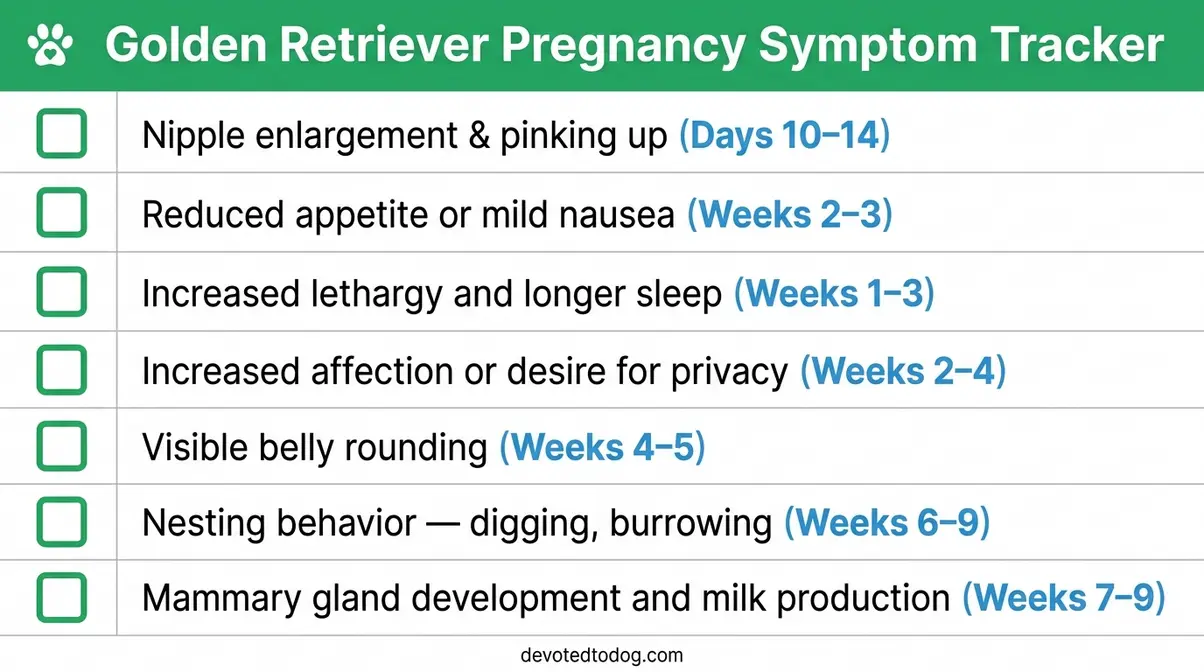
Here’s a quick checklist of the most common signs to watch for:
- Nipple enlargement and “pinking up” (days 10-14)
- Reduced appetite or mild nausea (weeks 2-3)
- Increased lethargy and longer sleep periods (weeks 1-3)
- Increased affection or desire for privacy (weeks 2-4)
- Visible belly rounding (weeks 4-5)
- Nesting behavior, digging, burrowing, seeking dark spaces (weeks 6-9)
- Mammary gland development and milk production (weeks 7-9)
One critical distinction no competitor guide mentions: some of these signs, including nipple swelling and nesting, can also occur in a pseudopregnancy (a hormonal condition that mimics pregnancy symptoms without actual conception). Only a vet can confirm a real pregnancy via ultrasound. If you notice these signs but your dog has not mated, mention this to your vet at your first appointment.
Early Signs of Pregnancy (Days 1-21)
Golden retriever pregnancy symptoms in the first three weeks are subtle, many owners miss them entirely. Understanding what’s happening early helps you act quickly and confidently.
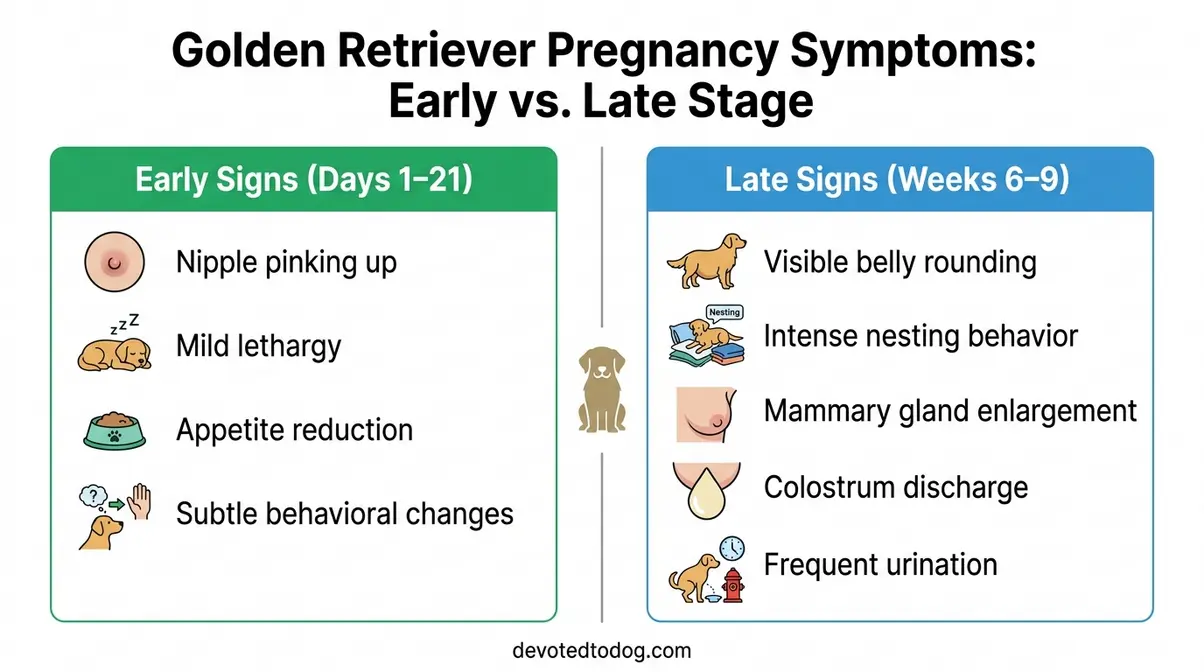
Nipple changes are among the earliest and most reliable indicators. The nipples become slightly larger and pinker, a process breeders call “pinking up.” This happens because the body begins preparing milk ducts as early as days 10-14. Even before the belly shows any change, the nipples are already responding to hormonal shifts.
Appetite changes vary from dog to dog. Some pregnant Golden Retrievers eat noticeably less in weeks 1-3 due to a nausea-like response similar to morning sickness in humans. Others maintain their usual appetite. If your dog refuses food for more than 48 hours, contact your vet, this warrants a check-up regardless of pregnancy status.
Lethargy and increased sleep are common and normal. She may seem less enthusiastic about her usual walks or play sessions. Her body is redirecting significant energy toward embryo development, and rest supports that process. Behavioral shifts also vary: some Goldens become more affectionate and clingy, while others prefer more privacy. Both responses are normal.
According to UC Davis veterinary guidelines, the normal canine gestation period is 56-58 days from the first day of diestrus, with visible physical changes beginning in the first trimester. These early signs can be easy to overlook, which is why many owners don’t notice anything until weeks 3 or 4. Here’s what to watch for as the pregnancy becomes more visible. For a deeper look at recognizing these changes, see golden retriever pregnancy signs and symptoms.
Mid-to-Late Pregnancy Physical Changes
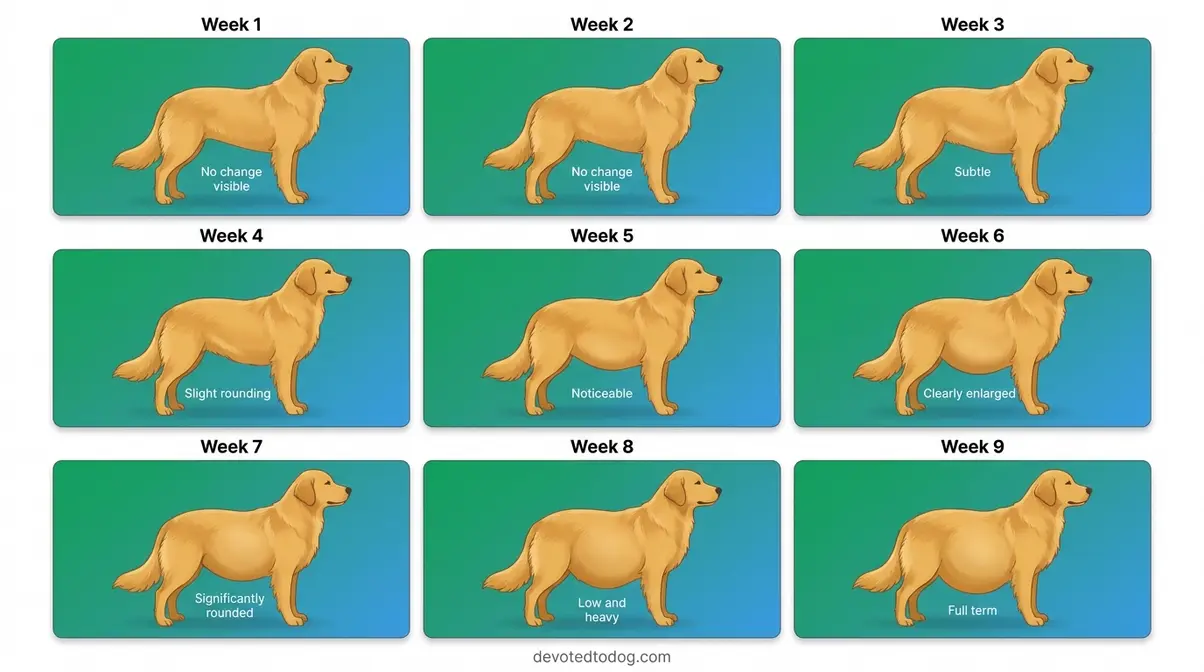
Golden retriever pregnancy becomes visually unmistakable from week 4 onwards. The belly growth that owners notice, and search for, begins here and intensifies right through to birth.
Visible belly enlargement is the most obvious change. By weeks 6-7, the abdomen is clearly rounded and noticeably larger. One thing to keep in mind: Golden Retrievers have a thick double coat that can mask early belly changes. Rather than just looking, gently feel the abdomen from weeks 4-5 to notice the change in firmness and size.
Nipple and mammary gland development continues throughout mid-pregnancy. The nipples become significantly larger and may darken further. The mammary glands, the tissue surrounding the nipples, will feel firmer and fuller to the touch. From around week 7, you may notice a clear or slightly milky discharge. This is colostrum (the first milk produced after birth, rich in antibodies that protect newborn puppies) beginning to form.
Nesting behavior is one of the most distinctive signs of late pregnancy. She may begin seeking out quiet, dark spaces, rearranging blankets, or digging at her bedding. As owners commonly describe it:
“Females will drop in temperature before they have their puppies and will also start nesting (digging, burrowing, staying in dark, hidden areas).”
This instinctive drive to find a safe birth space is completely normal. You may also notice increased urination and thirst as the growing uterus puts pressure on the bladder, this is a normal consequence of the expanding pregnancy.
Vet Confirmation: Palpation & Scans
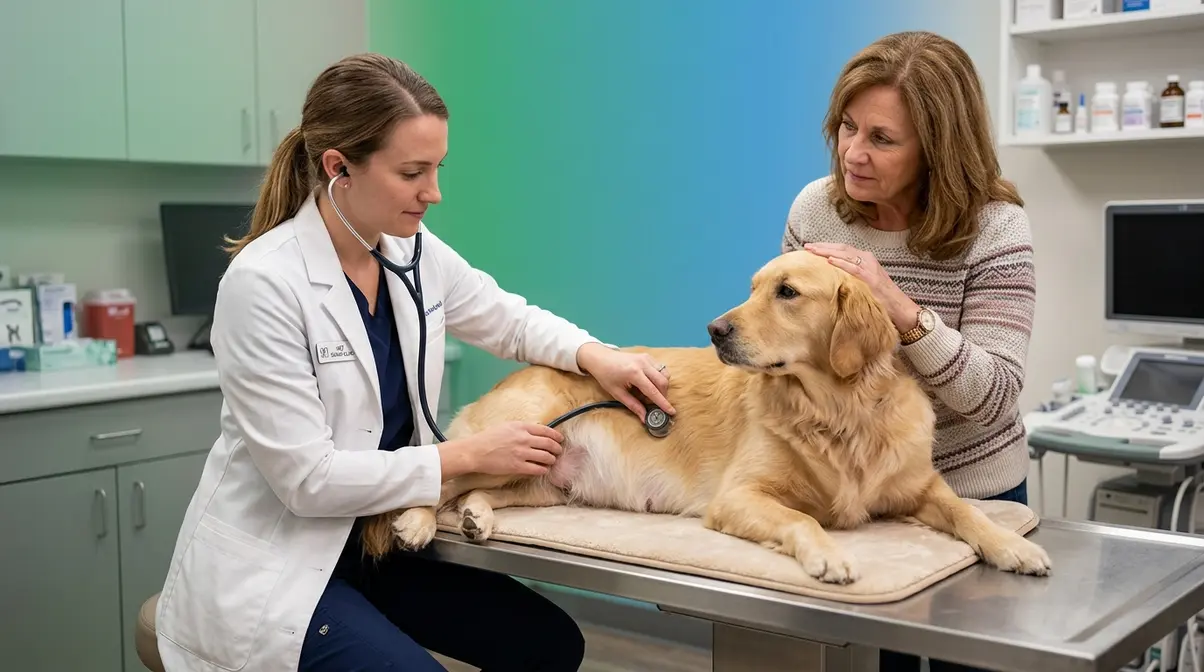
Physical signs give you strong clues, but only a veterinarian can confirm a pregnancy with certainty. Vets use three main diagnostic methods, each with a specific timing window. A golden retriever pregnancy scan (ultrasound) can confirm pregnancy from around day 21 and detect heartbeats a few days later, making it the most reliable early diagnostic tool.
- Palpation (gentle abdominal examination): A vet can feel the embryos as small, firm shapes, sometimes described as “walnut-sized”, between days 21 and 31. Palpation means gently pressing on the abdomen to feel for developing puppies. According to LSU veterinary guidance on feeling puppies, between day 21 and day 31, puppies can be felt as these distinctive shapes when the uterus is gently palpated. After day 31, the gestational sacs merge and palpation becomes less accurate.
- Ultrasound: Can confirm pregnancy from around day 21, and detects heartbeats (confirming viable pregnancies) a few days later. This is the most common and recommended method for first confirmation. Note that ultrasound cannot reliably count the total number of puppies.
- X-ray: Recommended from week 7 (day 45+) when puppy skeletons have calcified (hardened) enough to be visible. X-rays provide an accurate puppy count, which is critical information for whelping, so you know when all puppies have been delivered.
A note on pseudopregnancy: Some symptoms, including nipple swelling and nesting, can occur without actual pregnancy due to hormonal changes. Only a veterinarian can confirm the difference. If you’re unsure, book a vet appointment rather than waiting.
When can you feel the puppies?
You can sometimes feel puppies in a dog’s belly around day 21 to 31 of pregnancy, when a vet can detect embryos as small, firm shapes during a gentle abdominal exam called palpation. By weeks 7-9, movement may be visible from the outside as the puppies grow larger and more active. Attempting to feel puppies at home is not recommended, always leave palpation to a veterinarian to avoid stressing the uterus.
What Happens Each Week of the 63-Day Timeline?
A Golden Retriever pregnancy lasts approximately 63 days, roughly nine weeks, though this can range from 57 to 71 days when measured from breeding dates, according to research from LSU’s School of Veterinary Medicine. Using The 9-Week Watch, our week-by-week framework for tracking Golden Retriever pregnancy milestones, owner actions, and vet appointments, you can track what’s happening each week, what to observe in your dog, and what actions to take. Consider keeping a simple notebook or phone calendar to log weekly observations; small changes become meaningful patterns over time.
Purdue University’s dog pregnancy guide confirms that dogs are pregnant for approximately 63 days, and radiographs can be used to determine how many puppies to expect before whelping begins. LSU research on gestation variability further notes that when using breeding dates to measure gestation, the timeline can vary significantly from 57 to 71 days.
Golden Retrievers are pregnant for approximately 63 days, though gestation measured from breeding dates can range from 57 to 71 days, making veterinary confirmation of the due date essential.
Weeks 1-2: Fertilization & Implantation
What’s happening with the puppies: After mating, fertilized eggs (called zygotes) travel from the fallopian tubes toward the uterus. By the end of week 2, the embryos, early-stage developing puppies before organs form, begin attaching to the uterine wall. This process is called implantation. No external signs are visible at this stage; the changes are entirely internal.
What’s happening with the mother: Virtually nothing you can see. She looks and behaves normally. A very small number of dogs show subtle appetite shifts, but this is not a reliable indicator at this stage.
The 9-Week Watch, Weeks 1-2 owner action: If mating was planned, note the mating date in your calendar, this is Day 1. Avoid unnecessary stress, rough play, or any medications without vet approval (some common dewormers and flea treatments are not safe during early pregnancy). Book a vet appointment for around day 21-25 for first palpation or ultrasound confirmation.
An important note on timing: according to UC Davis veterinary guidelines, the gestation period is officially counted from the first day of diestrus (the reproductive phase that follows ovulation), not necessarily from the mating date. This is why the total range appears wide, two dogs mated on the same day can have different due dates depending on when ovulation occurred.
Week 3: Early Embryo Development
What’s happening with the puppies: The embryos implant firmly into the uterine wall, and organ development begins in earnest. By day 21, each embryo is approximately the size of a blueberry. This is a critical developmental window, the foundations of the nervous system, heart, and major organs are forming.
What’s happening with the mother: Some Golden Retrievers show the first subtle behavioral signs this week, slight lethargy, mild appetite reduction, or increased affection. These changes are easy to miss and easy to mistake for a passing mood shift. Trust your instincts if something feels different about her energy level.
The 9-Week Watch, Week 3 owner action: Book or attend your first vet appointment this week. A skilled vet can palpate the uterus for embryos from approximately day 21-25. Ultrasound is also available from around day 21 and, a few days later, can detect heartbeats, confirming not just pregnancy, but the viability of the embryos. According to Purdue University’s dog pregnancy guide, veterinary confirmation via ultrasound early in the process is strongly recommended.
Weeks 4 and 5 bring the most dramatic visible changes of the pregnancy, this is when most owners first realize something is different.
Weeks 4-5: Rapid Growth Begins
What’s happening with the puppies: The embryos are now called fetuses, developing puppies after organs begin forming, typically from weeks 3-4. By days 28-30, they have distinct features including limb buds and developing spinal cords. By week 5, each fetus is approximately the size of a grape. Week 4 is also the last reliable window for palpation (approximately days 21-31).
What’s happening with the mother: The abdomen begins to visibly round out. Nipples become noticeably larger and may darken further. Appetite typically increases significantly, she may start eating 25-50% more than usual. This is completely normal and reflects the puppies’ growing nutritional demands.
The 9-Week Watch, Weeks 4-5 owner action: Confirm the pregnancy with a second vet visit if not already done. Begin transitioning to a high-quality puppy food or a food formulated for pregnant and nursing dogs, but only with your vet’s specific guidance. Avoid vigorous exercise; short, gentle walks are ideal. Reduce rough play and jumping entirely.
The infographic below shows how rapidly the puppies grow between weeks 3 and 9.
In weeks 6 and 7, the puppies develop recognizable features, and your Golden Retriever’s belly will leave no doubt that puppies are on the way.
Weeks 6-7: Puppies Take Shape
What’s happening with the puppies: Fetuses develop fur, claws, and individual features during this phase. By week 7, the puppy skeletons begin to calcify (harden), which is why X-rays become accurate from approximately day 45. Individual puppies are now clearly distinguishable on ultrasound, and you may even be able to see movement from the outside of the abdomen.
What’s happening with the mother: Her belly is now significantly enlarged and visibly rounded, there’s no mistaking it. She may show intensifying nesting behavior, seeking quiet and dark spaces, rearranging blankets, or digging at her bedding. Her mammary glands will feel noticeably firmer. She may also become less tolerant of other pets or children approaching her belly, respect this boundary.
The 9-Week Watch, Weeks 6-7 owner action: Schedule an X-ray with your vet between days 45-55. This provides an accurate puppy count, knowing how many puppies to expect is critical for whelping, because you need to be certain all puppies have been delivered. Mark this on your golden retriever pregnancy calendar and begin setting up the whelping box (covered in detail in the care section below).
The complete 9-Week Watch timeline infographic above shows all key milestones at a glance.
Weeks 8-9: Final Countdown to Birth
Golden retriever pregnancy length reaches its end during these final two weeks, and they are the most critical. The puppies are fully formed and gaining weight rapidly. According to a peer-reviewed study on Golden Retriever birth weights published in PubMed (2022), most Golden Retriever puppies weigh up to 630 grams at birth (95th percentile).
What’s happening with the mother: Nesting behavior intensifies dramatically. She may refuse food in the 24 hours before labor begins. Her abdomen may “drop” slightly as the puppies shift into birthing position. The mammary glands may begin leaking colostrum, the first milk, rich in antibodies, as early as a week before delivery.
The 9-Week Watch, Weeks 8-9 owner action: Begin taking her rectal temperature twice daily from day 56. Her normal temperature is 101-102.5°F (38.3-39.2°C). When her temperature drops below 99°F (37.2°C), labor typically begins within 12-24 hours. Have your whelping box ready, your vet’s number posted visibly, and a digital rectal thermometer on hand at all times.
A rectal temperature drop below 99°F (37.2°C) in a pregnant Golden Retriever typically signals that labor will begin within 12 to 24 hours, making daily temperature monitoring from week 8 an essential owner responsibility.
How Do You Care for a Pregnant Golden Retriever?
Knowing the timeline is only half the equation. The other half is knowing how to care for your Golden Retriever throughout those 63 days, starting with what she eats. The 9-Week Watch framework pairs care actions with each week of pregnancy. In this section, we cover the care actions for the full nine weeks, from nutrition and exercise through whelping box setup and the critical signs of labor.
Feeding a Pregnant Golden Retriever
Golden retriever pregnancy care begins at the food bowl. Nutrition needs shift significantly across the three phases of pregnancy, and getting this right supports both the mother and her developing puppies.
Phase 1, Early pregnancy (weeks 1-5): Maintain her regular adult food and keep portions the same. Do NOT add calcium supplements without vet guidance, excess calcium in early pregnancy actually suppresses the body’s own calcium regulation, which increases the risk of eclampsia after birth. According to the Merck Veterinary Manual, supplementation with oral calcium during pregnancy may predispose the animal to eclampsia during peak lactation. This is counterintuitive but important.
Phase 2, Mid-to-late pregnancy (weeks 5-9): Switch to a high-quality puppy food or a food specifically formulated for pregnant and nursing dogs. Puppy food has higher calorie density, protein, and appropriate calcium levels for fetal development. Transition gradually over 5-7 days to avoid digestive upset. Per the American Kennel Club pregnancy care guidelines, transitioning pregnant dogs to puppy food in the final weeks supports fetal development and prepares the body for nursing.
Phase 3, Final weeks (weeks 7-9): As the uterus expands, she may struggle to eat large meals comfortably. Switch to smaller, more frequent meals, 3-4 times daily instead of 2. Her total food intake may increase by 25-50% by week 9.
Foods to avoid entirely: Raw fish, raw eggs, xylitol, grapes, raisins, onions, and any unprescribed supplements or medications. Ask your vet to recommend a specific food brand or formulation at the week 3-4 appointment.
Exercise and Rest: Safe Activity Levels
Appropriate exercise maintains healthy circulation and prevents excessive weight gain, but overexertion can stress the uterus and increase the risk of complications. Balance is everything.
- Weeks 1-4: Continue regular walks at her normal pace. Avoid rough play, jumping, or any activity with a risk of abdominal impact.
- Weeks 5-7: Reduce intensity. Shorter, slower walks of 20-30 minutes, twice daily. No running, agility training, or off-leash dog park visits where other dogs might collide with her belly.
- Weeks 8-9: Very gentle activity only, short sniff walks of 10-15 minutes. She will naturally slow down on her own. Don’t force exercise she resists.
She knows her limits better than you might expect. Follow her lead in these final weeks, and consult your veterinarian before making any changes to her activity level.
Vet Check-Up Schedule During Pregnancy
The golden retriever pregnancy timeline aligns naturally with a 3-4 visit vet schedule. Each appointment has a specific purpose, knowing what to expect at each one helps you come prepared with the right questions.
- Visit 1 (Week 3-4): Confirm pregnancy via palpation or ultrasound. Discuss nutrition transition and review any current medications. Ask about safe deworming options for pregnant dogs.
- Visit 2 (Week 5-6): Health check for the mother. Discuss whelping preparation and get a rough puppy count estimate if not already completed.
- Visit 3 (Week 7): X-ray for accurate puppy count. Discuss the signs of labor and get clear guidance on when to call the emergency vet. Ask for the after-hours contact number.
- Visit 4 (Week 8-9, optional): Final pre-whelping check. Confirm puppy positioning. Discuss C-section risk if your dog has a history of complications or previous surgical deliveries.
If your dog has had a previous C-section or is a first-time mother with underlying health issues, your vet may recommend more frequent check-ins. Always follow their specific guidance over any general timeline.
How to Set Up a Whelping Box
A whelping box is a safe, enclosed space where your dog will give birth and nurse her puppies. It keeps puppies contained, protects them from being accidentally crushed, and gives the mother a sense of security during a vulnerable time. Set it up by week 6 so she can explore and accept it before labor begins, forcing her into an unfamiliar space during active labor adds unnecessary stress.
Size for a Golden Retriever: Approximately 4 feet × 4 feet, large enough for her to lie fully stretched out with room for a large litter around her.
- Materials you’ll need:
- Waterproof lining (plastic sheeting or a tarp as the base)
- Washable fleece blankets or towels (have 4-6 sets for frequent changes)
- A heat lamp positioned safely above one corner (not directly over the whole box)
- Digital thermometer
- Clean scissors and clean string (for cord emergencies, only under vet guidance)
- Puppy milk replacer as backup
Step 1: Choose the Right Room
Choose a quiet, draft-free, low-traffic room, ideally one she already uses comfortably.
Step 2: Protect the Flooring
Lay waterproof sheeting across the full base of the box to protect flooring.
Step 3: Add Washable Bedding
Cover with a layer of clean fleece or towels, washable materials are essential.
Step 4: Install Pig Rails (Critical)
Attach a 3-4 inch ledge running along the inside perimeter of all four walls. This prevents the mother from accidentally rolling onto and crushing a puppy against the wall, a common cause of newborn puppy loss. This step is non-negotiable for a large breed like a Golden Retriever.
Step 5: Position the Heat Lamp
Position the heat lamp safely above one corner at a height that keeps that corner at approximately 85-90°F for newborns, while the rest of the box remains cooler so the mother can regulate her temperature.
Step 6: Introduce the Mother
Place the box in its final location and let her investigate it freely. Put a worn item of your clothing inside to associate the space with comfort.
Step 7: Prepare Backup Bedding
Prepare a second set of clean bedding nearby for immediate replacement after birth.
Step 8: Ensure Accessibility
Keep the whelping area accessible to you but away from household foot traffic.
According to the Cornell University veterinary whelping guide, preparing a quiet, enclosed whelping space before labor begins is recommended to reduce maternal stress.
Signs of Labor: The Final 24 Hours
With the whelping box ready, you need to know exactly what signs to watch for in those final hours before the puppies arrive. The temperature drop is your clearest signal.
The temperature drop, your most reliable indicator: When rectal temperature drops below 99°F (37.2°C), active labor typically begins within 12-24 hours. Cornell’s Riney Canine Health Center notes that behavior changes including restlessness, panting, and nesting can begin 24-36 hours before active labor begins. As owners who have been through this commonly describe:
“Females will drop in temperature before they have their puppies and will also start nesting (digging, burrowing, staying in dark, hidden areas).”
Stage 1 of labor (6-12 hours): Restlessness, panting, shivering, refusing food, and frequent urination. She is having contractions, but no puppies are visible yet. Nesting behavior intensifies sharply. This stage is entirely normal, your role is to stay calm and nearby.
Stage 2, Active delivery: Visible straining followed by a puppy born approximately every 30-60 minutes. Each puppy arrives in a thin amniotic sac. The mother will typically break the sac and clean the puppy, stimulating breathing. If she does not break the sac within 2 minutes, gently tear it open near the puppy’s face.
Stage 3, Placenta delivery: A placenta follows each puppy. Count them carefully, there should be one per puppy. A retained placenta can cause serious uterine infection.
- When to call the vet immediately:
- Strong straining for 20-30 minutes without a puppy being born, or more than 2 hours between puppies
- Green or black discharge before the first puppy is born (note: some green discharge is normal during delivery, but not before the first puppy)
- Mother appears completely exhausted and stops pushing while puppies remain
- A puppy appears visibly stuck in the birth canal
- You know more puppies remain based on your X-ray count, but she has stopped laboring
What comes out first during dog labor?
The first puppy is typically delivered head-first or tail-first, both presentations are normal in dogs, inside a thin amniotic sac. The mother will break the sac and clean the puppy, stimulating breathing through licking. A placenta follows each puppy and should be carefully counted. If the mother does not break the sac within 2 minutes, gently tear it open near the puppy’s face. Count every placenta, one per puppy is expected.
What Pregnancy Complications Should You Watch For?
Most Golden Retriever pregnancies proceed without major complications. However, The 9-Week Watch framework includes a complication awareness layer: knowing what can go wrong is as important as knowing what’s normal. The two conditions below are rare but serious, and recognizing them early can save your dog’s life. Read this section once, know the signs, and hope you never need it.
Eclampsia: The Silent Danger
Eclampsia, also called milk fever or puerperal tetany, is a dangerous drop in blood calcium caused by the demands of milk production. It is often called a silent killer because symptoms can appear suddenly, escalate rapidly, and are easy to mistake for other conditions.
Eclampsia typically occurs in the first 2-3 weeks after birth during peak lactation, not during the pregnancy itself. However, preparing for it starts during pregnancy, specifically by avoiding calcium supplementation before birth. According to the Merck Veterinary Manual, supplementation with oral calcium during pregnancy may predispose the animal to eclampsia during peak lactation, because excessive calcium intake suppresses the parathyroid gland’s ability to regulate calcium independently. When the demand suddenly spikes during nursing, the body cannot compensate.
Why Golden Retrievers are at elevated risk: Large-breed dogs nursing large litters face very high calcium demands from milk production. The combination of a large body and a large litter is a known risk factor.
- Symptoms to watch for:
- Muscle tremors or visible shaking
- Staggering or loss of coordination
- Fever, panting and hot to the touch
- Glazed or unfocused eyes
- Inability to stand
What to do: This is a veterinary emergency. Do not attempt home treatment. Call your vet or emergency animal hospital immediately. According to VCA Animal Hospitals, treatment involves intravenous calcium gluconate administered slowly while monitoring heart rate, a procedure that requires professional veterinary care. Do NOT give calcium supplements without direct vet instruction, even if you believe eclampsia is occurring.
Eclampsia in nursing dogs is a veterinary emergency, symptoms including muscle tremors, staggering, and panting require immediate vet treatment, as the condition can be life-threatening without prompt veterinary treatment.
Dystocia: When Labor Doesn’t Progress
Dystocia is the medical term for difficult or obstructed labor. It occurs when a puppy is too large to pass through the birth canal, is positioned incorrectly, or when the mother’s contractions are insufficient to deliver the puppy.
According to Cornell University’s College of Veterinary Medicine, dystocia is a serious obstetric emergency that may require medical management or surgical intervention. Large breeds with large litter sizes have a higher statistical risk of at least one puppy presenting in a difficult position. First-time mothers may also experience weaker or less effective contractions.
- Symptoms that signal dystocia:
- Strong straining for 20-30 minutes without a puppy being born, or more than 2 hours between puppies
- Green or black discharge before the first puppy arrives
- A puppy visibly stuck in the birth canal
- The mother is visibly exhausted and has stopped pushing, but puppies remain based on your X-ray count
What to do: Call your vet immediately. An emergency C-section may be required. Medical management of dystocia has a success rate of only 20-40% according to DVM360 veterinary proceedings, which is why prompt action matters. Do NOT attempt to manually pull a puppy. This can cause serious injury to both mother and puppy.
According to the PDSA whelping and labor guide, giving birth to a litter of puppies typically takes several hours and should never take longer than 24 hours, and you should contact your vet if she has been straining with strong contractions for 20-30 minutes without producing a puppy.
Reassurance: Most Golden Retriever births proceed without intervention. Knowing these signs means you’ll act quickly if needed, and that speed is exactly what makes the difference.
What Are Litter Size and Breeding Age Expectations?

With complications covered, let’s answer the two questions almost every Golden Retriever owner asks first: how many puppies should I expect, and when is a dog old enough to safely have a litter?
Expected Litter Size for Goldens
The average Golden Retriever litter size is 8 puppies, according to American Kennel Club litter size statistics. Litters can range from as few as 1 puppy to as many as 12, though both extremes are uncommon. “The average Golden Retriever litter size is 8 puppies, according to American Kennel Club data, though a first litter is typically smaller than later litters.”
For their first litter, Golden Retrievers typically have a smaller litter than in later pregnancies, according to the AKC. This is common across large breeds: first-time mothers tend to have smaller litters as their bodies are less experienced with the demands of pregnancy and delivery.
- Several factors influence litter size:
- Mother’s age, peak fertility occurs between 2-5 years
- Overall health and body condition
- Genetics, some bloodlines consistently produce larger or smaller litters
- Whether this is a first or subsequent litter
At birth, most Golden Retriever puppies weigh up to 630 grams (95th percentile), based on a peer-reviewed study on Golden Retriever birth weights published in PubMed (2022). Knowing the expected litter size matters practically: you need enough whelping supplies, heat lamp coverage, and colostrum backup for the maximum number of puppies your X-ray indicated.
Safe Breeding Age for Goldens
Golden retriever pregnancy age is one of the most important factors in a healthy outcome, for both the mother and her puppies.
Most veterinary and breed organizations recommend waiting until a female Golden Retriever is at least 2 years old before her first litter. At 2 years, OFA (Orthopedic Foundation for Animals, which provides health certifications for breeding dogs) health testing, covering hips, elbows, heart, and eyes, can be completed and certified. Breeding before these tests are done means passing on potentially heritable conditions unknowingly.
Why not younger: Dogs under 18-24 months are still physically and emotionally maturing. Early breeding can stunt development, increase dystocia risk due to an immature pelvis, and compromise the mother’s long-term health and temperament.
Optimal age range: 2-5 years is considered the prime breeding window. Fertility declines after age 5, and the risk of complications, including difficult labor and smaller litter viability, increases significantly after age 7.
Upper limit: Most reputable breeders and the AKC recommend retiring females from breeding by age 7-8 at the latest, and only after a thorough health evaluation by a reproductive veterinarian.
This section is for informational purposes only. All breeding decisions should be made in partnership with a reproductive veterinarian who knows your individual dog’s health history.
Golden Retriever Pregnancy FAQs
How long is the pregnancy period?
A Golden Retriever is pregnant for approximately 63 days, or about nine weeks. Counted from the breeding date, it can range from 57 to 71 days, according to LSU’s School of Veterinary Medicine, because the breeding date does not always match conception. A veterinarian can provide a more precise due date using ultrasound or progesterone testing. Most owners use the mating date as a rough starting point while tracking the pregnancy week by week.
How many puppies can they have at once?
A Golden Retriever’s average litter size is 8 puppies, based on AKC data, though litters range from 1 to 12. First-time mothers typically have a smaller litter than in later pregnancies. Litter size is influenced by the mother’s age, health, and genetics. An X-ray in week 7 provides the most accurate pre-birth puppy count and is the recommended method for whelping preparation.
How many puppies in a first litter?
In their first litter, Golden Retrievers typically have fewer puppies than in later litters, according to the AKC, whose average for the breed is 8. This pattern is common across large breeds: first-time mothers tend to have smaller litters as their bodies are less experienced with pregnancy. Subsequent litters often increase in size up to or near the breed average of 8.
What do dogs do right before birth?
In the 12 to 24 hours before giving birth, a dog shows clear signs of impending labor. Her rectal temperature drops below 99°F (37.2°C), according to Cornell Vet guidelines, which is the most reliable single indicator. She becomes restless, pants, shivers, and refuses food. Nesting behavior intensifies, she may dig, burrow, and seek out dark, hidden spaces to prepare a safe birth area, sometimes becoming unusually clingy or withdrawing entirely.
Can I touch my dog during birth?
Yes, gentle reassurance is appropriate during labor, per veterinary best practices, but avoid interfering with the birth process unless a puppy needs help. You can gently stroke your dog, speak calmly, and offer water between deliveries. Do not attempt to pull puppies out unless specifically directed by a vet. If a puppy is born in an intact amniotic sac and the mother does not break it within 2 minutes, gently tear the sac open near the puppy’s face to allow breathing.
What is the silent killer in Goldens?
In the context of pregnancy, eclampsia (also called milk fever) is often called a silent killer in nursing dogs, according to the Merck Veterinary Manual. It is a dangerous drop in blood calcium caused by the demands of milk production, typically occurring in the first 2-3 weeks after birth. Symptoms include muscle tremors, staggering, and panting. Eclampsia is a veterinary emergency, seek immediate care if these signs appear, as the condition can be life-threatening without prompt veterinary treatment.
How long is a Golden Retriever pregnant?
A Golden Retriever is pregnant for 63 days on average, with a range of 57 to 71 days when counted from the breeding date. The golden retriever gestation period is consistent with all dog breeds (canine pregnancy is 63 days, not the 9 months humans expect). How long is a golden retriever pregnant from breeding to birth: count 63 days from the date of mating, or 56-58 days from the first day of diestrus. Pregnancy can be confirmed via abdominal ultrasound from around day 21 or X-ray at 45+ days.
How many puppies does a Golden Retriever have?
A typical Golden Retriever litter has 4 to 12 puppies, with 8 being the average, according to the AKC. First-time mothers (primiparous) often have smaller litters than experienced dams. Litter size depends on the dam’s age, weight, breeding timing, and genetics. Females typically have 8-10 nipples, capable of nursing 8-10 puppies simultaneously. If you breed a Golden, ask the vet for a count via X-ray at 45+ days.
How Do You Put It All Together?
For Golden Retriever owners navigating a 63-day pregnancy, preparation is everything. Golden Retrievers carry an average litter of 8 puppies over approximately 63 days, and owners who track each week with The 9-Week Watch framework are better equipped to spot early signs, prepare the whelping box, and recognize the warning signs that require immediate veterinary attention. The best outcomes combine weekly monitoring, vet-confirmed milestones, and a well-prepared whelping space (Cornell University College of Veterinary Medicine).
The 9-Week Watch gives you one clear “watch item” per week, and that structure is what transforms anxiety into confidence. When you know what to look for at each stage, you’re not guessing. You’re observing with purpose. Whether this is your dog’s first litter or you’re simply supporting her through an unexpected pregnancy, the framework brings you back to the same reliable rhythm: observe, act, and check in with your vet.
Bookmark this guide and share it with anyone else caring for your dog during the pregnancy. Your most important next step: call your vet today to schedule a week 3-4 confirmation appointment. The earlier you confirm the pregnancy, the sooner you can begin the care protocol that gives your Golden Retriever and her puppies the best possible start.