
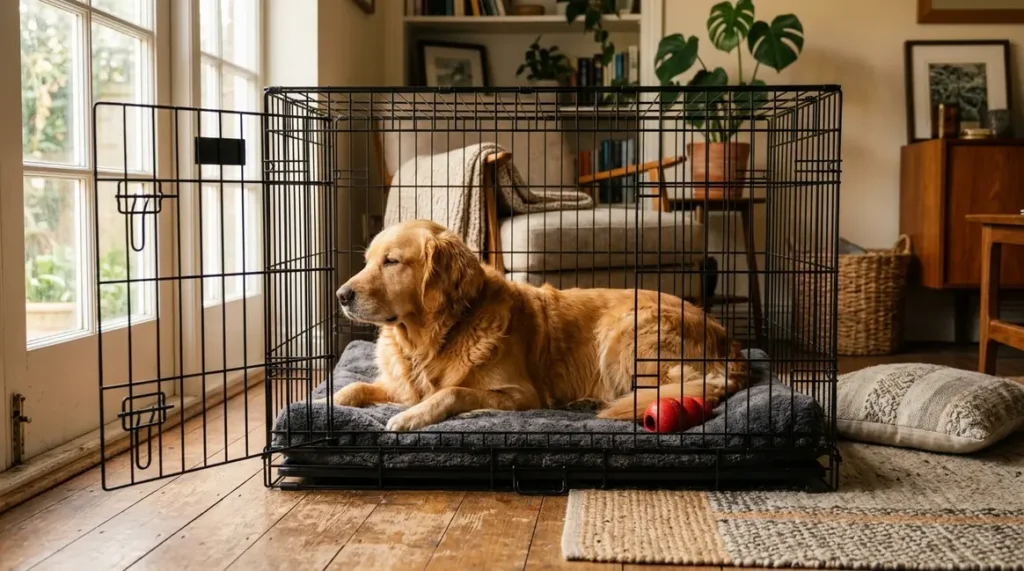
⚠️ Medical Disclaimer: The guidelines in this article are general recommendations. Always consult your veterinarian for advice specific to your dog’s age, breed, and health status.
How long can a dog stay in a crate? As a general guideline, an adult dog can stay in a crate about 4-6 hours during the day, and most can sleep through the night in one. Puppies need shorter stretches, roughly one hour per month of age plus one (a 3-month-old, about 4 hours). Senior dogs usually do best with about 2-4 hours in the daytime. The daytime limits come from Maddie’s Fund, and your vet can tell you what suits your own dog. Raising a Golden? See our Golden Retriever guide, and compare crates in our best dog crates picks.
You’ve set up the crate. You’ve watched the YouTube videos. And still, every morning when you leave for work, there’s this nagging question you can’t shake: Am I leaving my dog in there too long?
“How long can you leave a dog in their crate when you’re not home before it becomes dangerous for them physically and/or mentally?”
It’s one of the most common questions responsible owners ask, and the anxiety behind it is real. Get it wrong, and you risk muscle stiffness, bladder problems, and the kind of psychological distress that takes months to undo. Get it right, and the crate becomes your dog’s favorite spot in the house.
So, how long can a dog be in a crate? This 5-step guide covers safe limits by age, crate setup, and a full workday schedule so you can act on this today.
Most adult dogs can safely stay in a crate for 4-6 hours during the day, according to Maddie’s Fund and America’s VetDogs, and many can sleep through the night in one.
- Puppies: 1 hour per month of age + 1 (e.g., a 3-month-old = max 4 hours)
- Adult dogs: 4-6 hours daytime max; most sleep through the night comfortably
- Senior dogs: shorter daytime windows (roughly 2-4 hours) to protect aging joints and bladder
- The Crate Comfort Threshold: safe crating isn’t just about the clock. Age, enrichment quality, and daily freedom time all determine whether crating helps or harms
- Red flag: a dog crated all day and night without breaks risks depression and anxiety (Citizens for Animal Protection), plus physical problems like muscle stiffness
What You’ll Need Before You Start Crating
The time limits in this guide only work when the crate itself is right for your dog. A crate that’s too large undermines house-training; one that’s too small causes physical discomfort. Both will push your dog past their Crate Comfort Threshold faster than the clock will.
Estimated time: 2-3 weeks for full crate training progression (Steps 1-5).
Before you apply any crating schedule, confirm three things:
- Sizing: the “stand, turn, lie down” rule. Your dog should be able to stand at full height, turn around completely, and lie down stretched out. That’s the minimum. A crate should be just big enough for your dog to do all three comfortably, which is the widely accepted standard. Going larger is fine for adult dogs, but for puppies in house-training, a crate that’s too roomy gives them space to use one corner as a bathroom.
- Type: match the crate to your situation. Wire crates offer ventilation and visibility, which suits social dogs who want to see the room. Plastic crates feel more den-like and travel well. Soft-sided crates are lightweight but designed for light use only; they’re not suitable for dogs who chew or try to escape. For more on choosing the right crate for your dog, the full guide covers every type in detail.
- Disclaimer. These guidelines are general. Your veterinarian knows your dog’s specific health history and should be your first call if you have concerns about crating duration.
The AKC also advises owners to limit crate time based on age and daily activity level, and to never leave dogs crated all day. That principle applies from the very first day you bring the crate home.
Once your crate is the right size and type, you’re ready for Step 1.
Step 1: Know the Safe Crating Time Limits for Your Dog’s Age

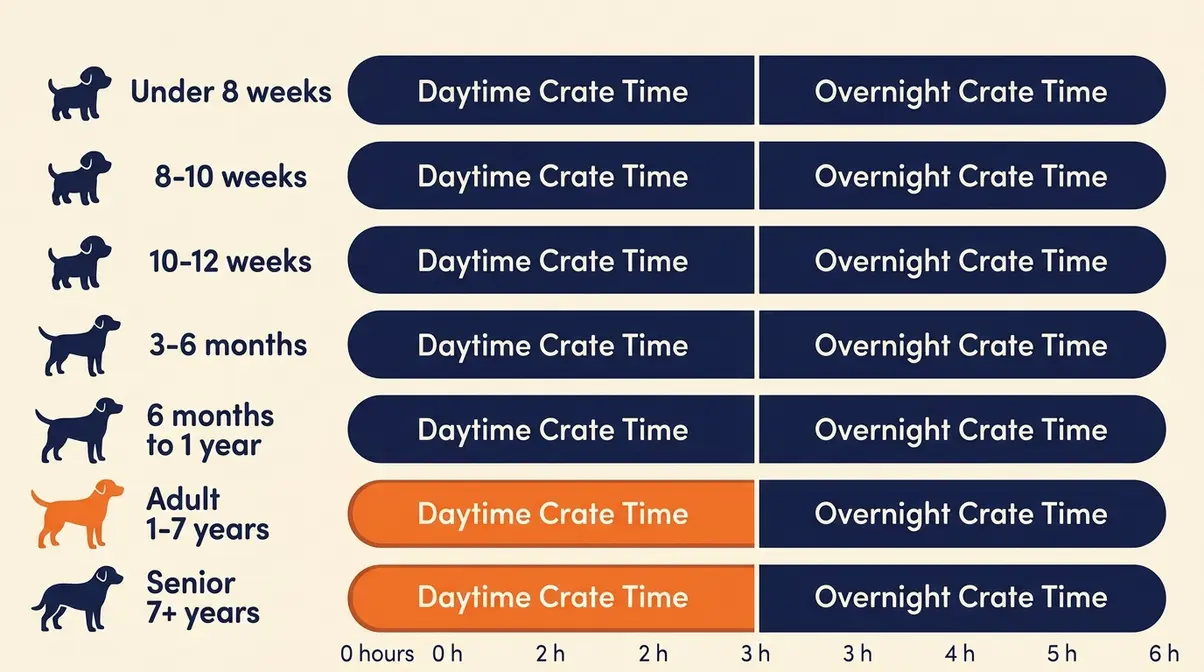
How long can a dog stay in a crate? The honest answer is that it depends on three factors: your dog’s age (the most critical), the quality of enrichment inside the crate, and how much free time they get outside it each day. Together, these three factors define The Crate Comfort Threshold, the point at which crate time shifts from beneficial den rest to harmful confinement. According to Maddie’s Fund, adult dogs should not be confined for more than 4-6 hours at a time during the day; puppies under 12 weeks should only be confined for 1-3 hours.
| Dog Age | Max Daytime Crate Time | Max Overnight Crate Time | Rule of Thumb |
|---|---|---|---|
| Under 8 weeks | 1 hour | Not recommended | Too young for extended crating |
| 8-10 weeks | 1-2 hours | 3-4 hours (with night waking) | Months of age + 1 |
| 10-12 weeks | 2-3 hours | 4-5 hours | Months of age + 1 |
| 3-6 months | 3-4 hours | 5-6 hours | Months of age + 1 |
| 6 months-1 year | 4-5 hours | 6-8 hours | Approaching adult limits |
| Adult (1-7 years) | 4-6 hours | Through the night | Never exceed 8 hrs/24-hr period |
| Senior (7+ years) | 2-4 hours | 6-7 hours | Shorter windows; monitor health |
Daytime limits reflect Maddie’s Fund and America’s VetDogs; overnight figures are general guidance for a dog sleeping through the night.
How Long Can a Puppy Be in a Crate?
The most reliable rule of thumb for puppies is simple: one hour per month of age, plus one. A 2-month-old puppy can hold it for roughly 3 hours. A 3-month-old tops out at 4 hours. A 5-month-old is approaching 6 hours, close to adult limits.
The reason isn’t arbitrary. Bladder control develops gradually in puppies. A young dog physically cannot hold their bladder beyond their age-based limit, no matter how well trained they are. Forcing them to try doesn’t build discipline; it builds distress and can contribute to what trainers call learned incontinence, where the puppy simply gives up trying to hold it.
The overnight picture is a little different. Puppies can often handle slightly longer stretches at night because metabolism slows during sleep. That said, puppies under 10 weeks may still need a middle-of-the-night potty break, so set an alarm rather than hoping for the best.
For daytime crating, never treat the crate as a substitute for supervision. Puppies need frequent play breaks, socialization, and human contact. Maddie’s Fund confirms that puppies under 12 weeks should only be confined for 1-3 hours at a time, far shorter than the 4-6 hour adult limit. On the water question: always include a clip-on water bowl during daytime crating for puppies, and remove it overnight to reduce accidents.
A concrete example: a 3-month-old puppy should not be crated more than 4 hours at a stretch during the day. By 5 months, that ceiling rises to 6 hours. For help creating a realistic daily schedule for a puppy, a dedicated schedule guide can take the guesswork out of the day.
Adult dogs have more bladder control and emotional resilience, but they still have firm limits.
How Long Can an Adult Dog Be in a Crate?
How long can you keep a dog in a crate as an adult? The consensus across Maddie’s Fund, America’s VetDogs, and PAWS lands at the same number: 4-6 hours during the day is the safe maximum. This aligns with a dog’s natural need for movement, bathroom breaks, and social contact, not just bladder capacity.
The AKC advises owners to limit crate time based on age and daily activity level, and to never leave dogs crated all day.
Overnight is a different situation. Most adult dogs can sleep 7-9 hours in a crate because their metabolism slows and you are present in the home. They are not facing the social isolation they would during an 8-hour workday absence. The crate feels more like a den at night than a cage.
What matters most is the 8-hours-per-24-hour-period ceiling. A dog crated from 10 PM to 6 AM (8 hours overnight) should have at least 4-6 hours of genuine free time before any additional crating. Stacking overnight crating directly against a full workday stretch is where the harm accumulates.
Senior dogs need even more consideration. Their aging bodies and health conditions change the equation significantly.
How Long Can a Senior Dog Be in a Crate?
How long can a dog be left in a crate once they reach their senior years? For most dogs, that’s 7+ years, though large breeds age faster, with some considered senior at 5 or 6. The general guidance: keep daytime crating shorter, often around 2-4 hours, with overnight usually fine if the dog is comfortable.
The reason for the shorter window is physiological. Senior dogs commonly develop arthritis, reduced bladder control, and cognitive changes. Extended confinement on a hard surface worsens joint stiffness, and holding their bladder for very long stretches can cause real discomfort. America’s VetDogs recommends that a crate not be used for more than six hours during the day for an adult dog; for seniors, many owners keep that window shorter still.
When to reconsider crating altogether: if your senior dog has been diagnosed with cognitive dysfunction syndrome, severe arthritis, or incontinence, talk to your veterinarian about alternatives. Baby gates and a dog-proofed room can provide safe confinement without the physical stress of a crate. For a dog with hip dysplasia or another joint condition, ask your vet how long a stretch in the crate is comfortable.
Knowing the time limits is only half the equation. Step 2 covers how to make every minute inside the crate as comfortable as possible.
Step 2: Set Up Your Dog’s Crate for Comfort and Safety
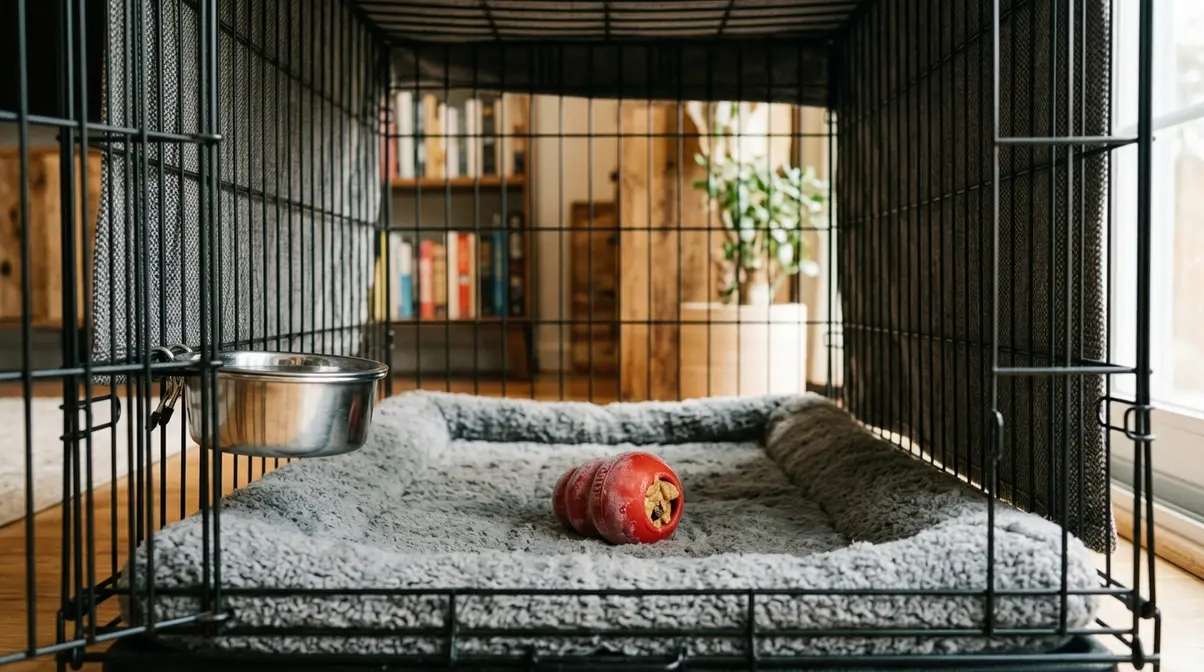
Picture two dogs, both crated for 4 hours. One is in a bare wire box, no bedding, no toys, no water. The other has a chew-proof mat, a frozen Kong, and a clip-on water bowl. Same duration, completely different experience. That difference is exactly what The Crate Comfort Threshold is about: enrichment quality is the second factor that determines whether crating helps or harms your dog.
Citizens for Animal Protection warns that “a dog who’s crated all day and night doesn’t get enough exercise or human interaction and can become depressed or anxious,” and that effect starts building well before a full day.
What to Put in a Dog Crate During the Day
The best items for a daytime crating session fall into three categories:
- Bedding: A chew-proof orthopedic mat or crate pad is the safest choice. Loose blankets work for adult dogs who don’t chew, but they’re an ingestion risk for puppies or aggressive chewers. For seniors, extra cushioning actively supports aging joints.
- Enrichment: A frozen Kong stuffed with peanut butter or kibble is the gold standard: it keeps most dogs occupied for 20-30 minutes and reduces early-crating anxiety. Using puzzle toys for mental enrichment extends that engagement further. Durable chews like bully sticks or Nylabones give dogs an outlet for their chewing instinct during the remaining time.
- Water: Include a clip-on water bowl or lick mat for any daytime session over 2 hours. Remove it overnight if you’re house-training a puppy to reduce accidents.
Citizens for Animal Protection notes that dogs can become depressed or anxious without adequate enrichment and human interaction during crating.
A complete 4-hour daytime setup looks like this: chew-proof mat + frozen Kong (prepared the night before and frozen solid) + clip-on water bowl. That combination meets The Crate Comfort Threshold for most adult dogs. Once the crate is set up, the next step is making sure your dog actually wants to go in.
What NOT to Put in a Dog Crate
Three items should never go into a crate:
- Loose fabric or blankets (for chewers). Ingested fabric can cause intestinal blockages, a surgical emergency. If your dog chews their bedding, switch to a chew-proof alternative. For guidance on finding a durable and comfortable dog bed, a dedicated guide covers the safest options.
- Collars and harnesses. A flat collar can catch on wire crate bars and cause strangulation. This is one of the most common preventable crating accidents. Remove every collar, every time, before closing the crate door.
- Toys with small parts or squeakers. Unsupervised dogs can chew through squeaky toys in minutes, and the parts become choking hazards. Stick to durable rubber or nylon toys rated for unsupervised use.
With the right setup in place, you’re ready to introduce your dog to the crate, and that introduction matters more than most owners realize.
Step 3: Introduce the Crate Using Positive Association
The single biggest mistake owners make is using the crate as a time-out. Here’s why that backfires: a dog that associates the crate with punishment hits their Crate Comfort Threshold much faster; the fear response kicks in before the clock even becomes relevant. Maddie’s Fund recommends that the crate be introduced gradually as a positive space, never used for punishment.

Follow this sequence:
- Place the crate in a social area with the door open. No pressure, no luring. Let your dog investigate on their own terms. Put a treat just inside the entrance and walk away.
- Toss treats inside without closing the door. Repeat this throughout the day. The goal is simple: crate = good things appear. Use your chosen cue word (“crate,” “kennel,” or “place”) each time your dog steps inside.
- Feed meals at the crate entrance, then inside. Move the food bowl progressively further into the crate over 3-5 days. A dog that eats inside the crate is a dog that trusts it.
- Begin closing the door for 1-2 minutes while you stay in the room. Sit nearby, stay calm, and open the door before any distress starts. Gradually extend to 5 minutes, then 10.
Maddie’s Fund makes the same point: the crate should stay a safe, positive space and never be used for punishment, so a dog associates it with rest rather than fear.
Checkpoint: Your dog should now enter the crate voluntarily and remain calm with the door closed for 1-2 minutes. If not, slow down and don’t move to Step 4 yet.
Step 4: Build Up Crating Time Gradually
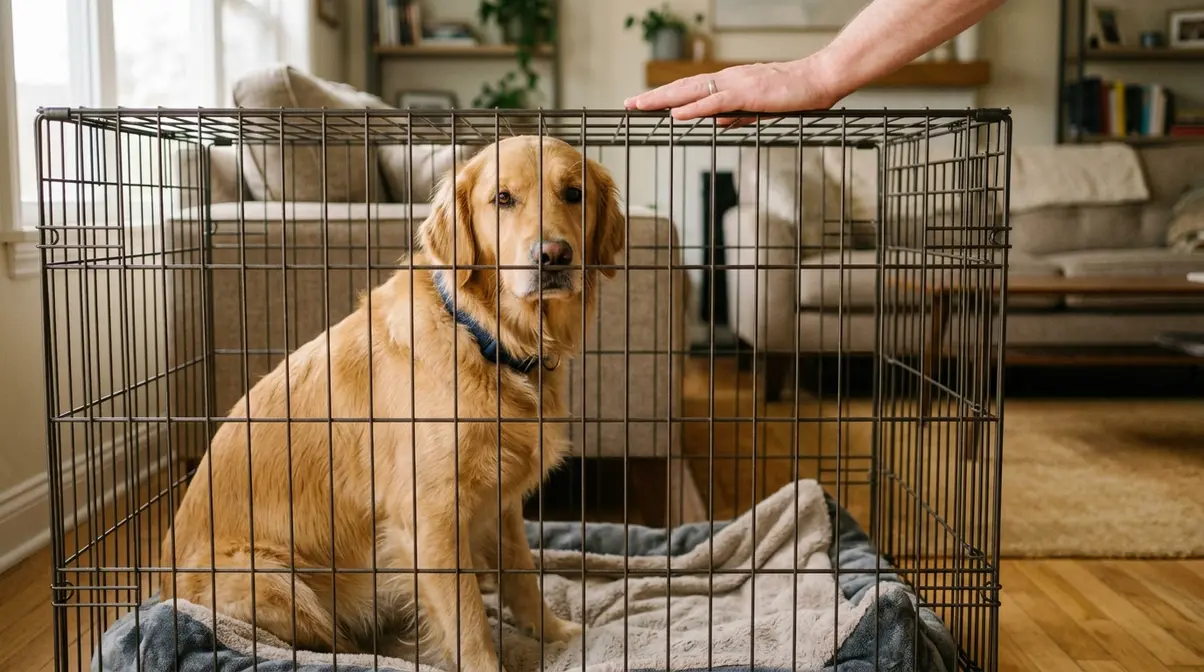
The most common reason crate training fails is moving too fast. Jumping from 5-minute sessions to a 4-hour workday stretch is like asking someone to run a marathon after a single training run. The progression matters as much as the destination.
PAWS advises that a dog should not be left alone in a crate for more than four to five hours at a time during the day, and reaching that target safely takes a deliberate build-up. Here’s a concrete 2-week schedule:
- Week 1:
- Day 1-2: 5 minutes (you in the room)
- Day 3-4: 15 minutes (briefly leave the room)
- Day 5-6: 30 minutes (brief errand or another room)
- Day 7: 1 hour (leave the house for a short trip)
- Week 2:
- Day 8-9: 2 hours
- Day 10-11: 3 hours
- Day 12-14: 4 hours
Two important notes on this schedule. First, exercise before each session makes a measurable difference. A dog that’s had a 20-minute walk is primed for rest; a dog that’s been idle is primed for frustration. A tired dog settles more easily, so a walk beforehand sets up calmer confinement. Second, if your dog regresses (suddenly barking or showing distress at a duration they handled before), drop back one step, not to zero. Regression is normal and temporary.
For a broader view of how training goals change with a dog’s age, the training guide covers the full developmental arc.
Checkpoint: Your dog can now stay in the crate for 3-4 hours without distress. You’re ready to apply this to a real workday schedule in Step 5.
Step 5: Manage Crating During a Full Workday
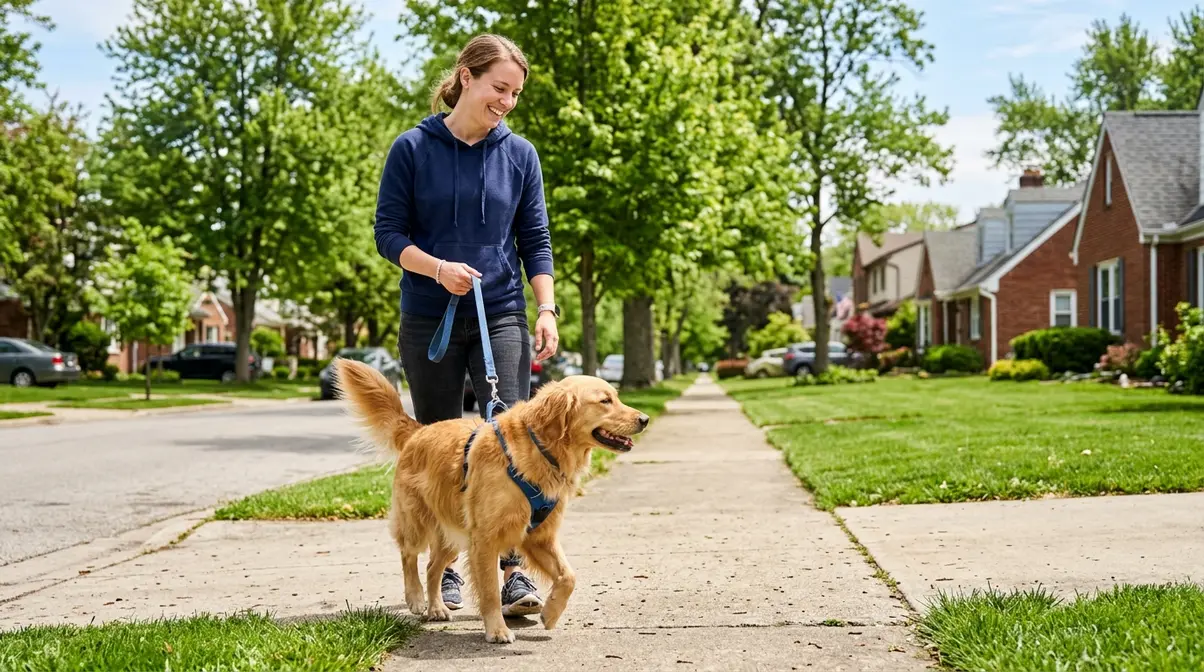
Yes, you can crate a dog while at work, but a standard 8-hour workday exceeds the 4-6 hour daytime limit for all adult dogs. The solution isn’t to stop crating; it’s to build a midday break into the schedule. PAWS is clear that a dog should not be left in a crate for more than four to five hours at a time during the day, making that midday break non-negotiable for full-time workers.
This also connects to the third factor in The Crate Comfort Threshold: the daily freedom ratio. A dog that spends 10 hours in a crate and 2 hours free is not thriving, even if the crating is technically split. Aim for a rough 50/50 split between crated time and free time across the waking day.
Sample Workday Crating Schedule
| Time | Activity | Notes |
|---|---|---|
| 7:00 AM | Morning walk + breakfast | At least 20-30 minutes of exercise before crating |
| 7:30 AM | Into crate | Frozen Kong provided |
| 12:00 PM | Midday break | 30-minute walk + potty + brief play |
| 12:30 PM | Back into crate | Second Kong or chew provided |
| 5:30 PM | Released from crate | Evening walk + dinner |
Total daytime crating with this schedule: approximately 9.5 hours with a 30-minute break in the middle. That’s still at the upper limit; a longer midday break of 45-60 minutes is better if your schedule allows it. For puppies under 6 months, a single midday break is not enough, so consider doggy daycare or a second midday visit.
If a midday break isn’t possible every day, these options can fill the gap.
Midday Break Options
Not everyone can come home at lunch. Here’s what works:
- Dog walker: The most flexible option. A 30-minute midday walk covers both the exercise and the bathroom need. Many services offer GPS tracking and photo updates.
- Doggy daycare: Ideal for social dogs. Your dog spends the day with other dogs and comes home tired. More expensive, but eliminates the crating concern entirely for the day.
- Trusted neighbor or family member: A free option if available. Even a 20-minute backyard visit counts. Give them a key and a simple checklist.
- Lunch-break return: If you work within 15-20 minutes of home, a lunch-break visit is a real option. Thirty minutes is enough for a walk, a potty break, and a quick meal.
Checkpoint: You have a workday schedule with a midday break built in. Your dog should not be crated for more than 4-6 hours in any single stretch.
Verify Your Results: Signs the Crating Schedule Is Working
A crating schedule is working when your dog enters the crate voluntarily, settles within 5-10 minutes, and appears calm and relaxed on release. Warning signs include continuous whining, excessive panting, bar-chewing, or whale eye (whites of the eyes visible). If you see any warning signs, reduce crating duration and return to Step 3 to rebuild positive associations.
A crating schedule that’s working produces specific, observable signs. Refer to the illustrated guide below; it shows exactly what crate comfort and crate stress look like side by side.
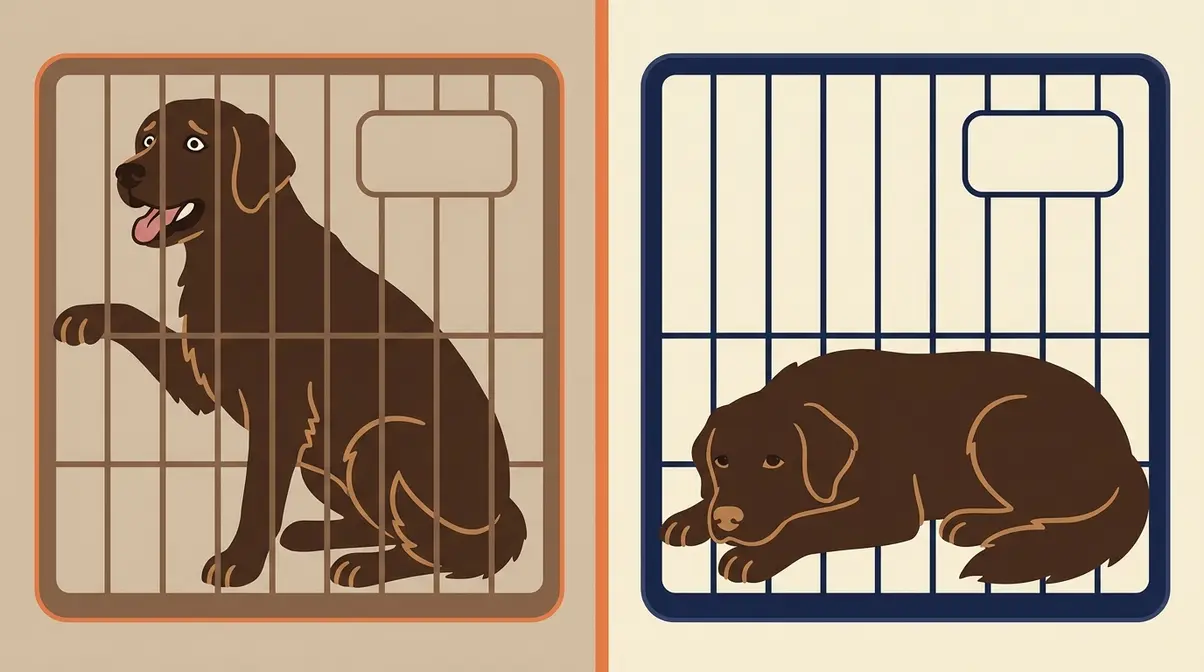
A 2019 review in the journal Applied Animal Behaviour Science found that dogs show an initial rise in cortisol, a stress hormone, when moved into kennels or confined spaces, which makes behavioral monitoring essential during crate training. That initial spike is normal; persistent elevation is the warning sign.
- ✅ Signs the schedule is working:
- Enters the crate voluntarily without coaxing
- Settles quickly (within 5-10 minutes) and stops vocalizing
- Appears calm and relaxed on release, not frantic or over-excited
- Eats, drinks, and plays normally after crating
- ⚠️ Early warning signs of distress:
- Excessive panting or drooling inside the crate
- Continuous whining or barking that doesn’t stop after 10-15 minutes
- Whale eye, whites of the eyes visible, a recognized stress signal
- Bar-chewing or persistent scratching at the door
If you see any warning signs, go back to Step 3 and slow the progression down.
When Crating Goes Wrong: Risks of Over-Crating
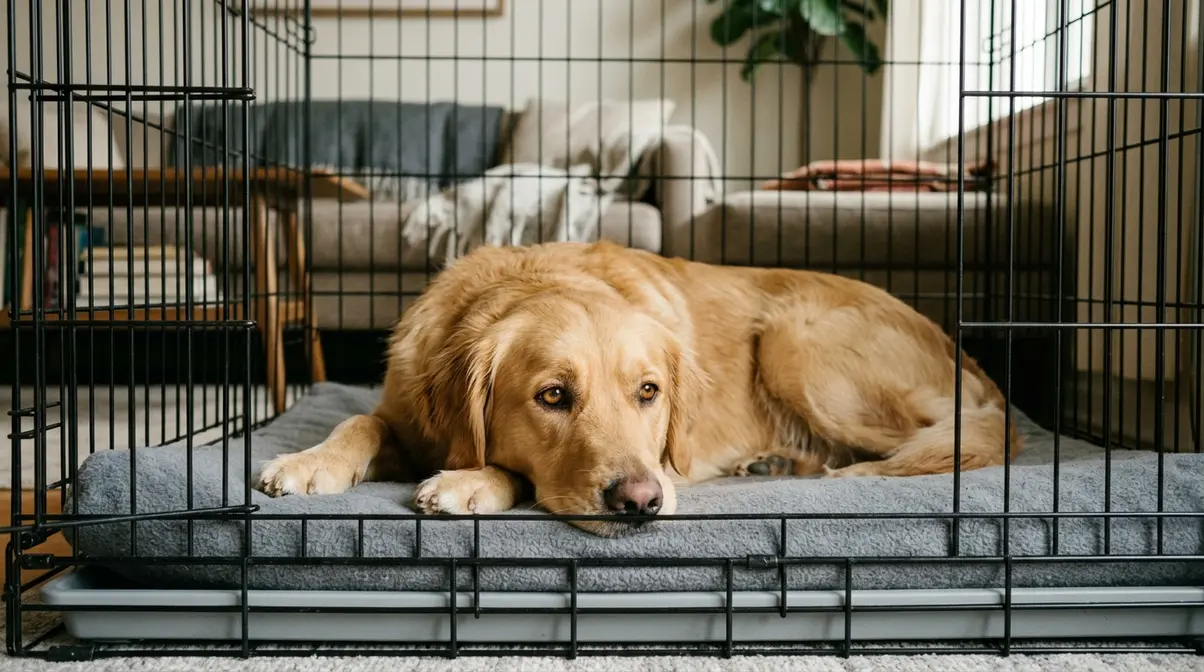
Crating is not inherently cruel. But over-crating, consistently exceeding The Crate Comfort Threshold, causes real, documented harm. The distinction matters: ethical crating means appropriate duration, quality enrichment, and daily freedom. Over-crating means ignoring those limits, day after day, until the damage shows.
A Psychology Today piece on whether crating is ethical points to a 1999 study by Beerda and colleagues, in which dogs confined to crates for six weeks showed heightened stress, along with hormonal and immunological changes linked to poor welfare. That is not a warning about the crate itself; it is a warning about what happens when the guidelines are ignored.
Physical Effects of Over-Crating
What happens if a dog is crated too long? The physical consequences are concrete. Dogs confined without movement develop muscle stiffness and, over long periods, can lose muscle condition. For large breeds and seniors, this compounds with existing joint vulnerability; a dog that already has hip dysplasia can stiffen faster under chronic confinement.
The bladder and bowel effects are equally serious. Forcing a dog to hold their bladder beyond their natural capacity means real discomfort and can lead to accidents. In puppies, it can contribute to learned incontinence, where the puppy stops trying to hold it because it has learned it cannot succeed. That same 2019 review in Applied Animal Behaviour Science found that dogs show an initial rise in cortisol in confined spaces, and it linked chronic confinement to behavioral and physical welfare concerns.
Beyond the bladder, chronic over-crating denies dogs the cardiovascular exercise, weight management, and immune function benefits that physical activity provides. These aren’t abstract risks; they’re the kind that show up in vet bills.
The physical effects are serious, but the psychological effects can be just as damaging.
What Is Caged Dog Syndrome? Symptoms to Watch For
Caged dog syndrome is an informal term for the behavioral and psychological deterioration that results from chronic over-crating. It’s not a clinical diagnosis, but it describes a pattern of distress that can follow chronic confinement. If your dog shows these signs, talk to your vet.
The five key symptoms are:
- Excessive bar-chewing or scratching at the crate door
- Constant whining or barking when crated
- Withdrawal and depression outside the crate (the dog seems flat, disengaged, or fearful)
- Aggression or fearfulness near the crate
- Self-harm behaviors: excessive licking, hair pulling, or flank-sucking
The psychological mechanism behind these symptoms is straightforward. Chronic confinement denies dogs the social interaction, exercise, and environmental stimulation they need to function normally. Over time, this can produce a state often described as learned helplessness, in which the dog stops trying to signal distress because nothing changes. A dog that was once calm in the crate but now barks for the entire duration isn’t failing at training. It’s showing an early symptom of caged dog syndrome.
As that Psychology Today discussion puts it, long periods locked in a confined space can take a serious psychological toll on a dog.
Key finding: In a 1999 study by Beerda and colleagues, cited by Psychology Today, dogs kept in crates for six weeks showed heightened stress along with hormonal and immunological changes linked to poor welfare. Source: Psychology Today, November 2022.
For owners already seeing these signs, understanding the link between crating and separation anxiety is a critical next step, and knowing about escape-proof crate options can prevent injury during that process.
The risks above are entirely preventable by following the guidelines in Steps 1-5. If you’re already seeing warning signs, the Troubleshooting section below has specific fixes.
Troubleshooting Common Crating Problems
Is your dog barking, trying to escape, or having accidents in the crate? Most crating problems trace back to one of three causes: duration too long, introduction too fast, or enrichment too low. Each has a specific fix, and knowing which one applies saves you weeks of frustration.
As Citizens for Animal Protection notes, dogs left crated without enough exercise or interaction can become depressed or anxious, and that same dynamic drives most of the troubleshooting issues below. Dogs crated all day and night without enrichment are at the highest risk of developing the behavioral problems described in this section.
Problem: My Dog Barks or Whines in the Crate
Problem: Your dog barks or whines continuously when crated, even after weeks of training.
Cause: There are two distinct causes here, and they need different responses. Extinction barking is normal protest during early training; the dog has learned that barking used to get a response, and it takes time for that behavior to fade. It typically decreases over several days if you don’t reinforce it. Distress barking is different: continuous, escalating, accompanied by panting or escape attempts. This signals that the duration is too long or the introduction moved too fast.
Fix: For extinction barking, wait it out. Opening the door rewards the barking and extends the behavior. For distress barking, immediately shorten the duration and return to Step 3. Distress barking is a welfare signal, not a training problem to push through.
Escape attempts are a more serious signal. Here’s what they mean and how to respond.
Problem: My Dog Tries to Escape the Crate
Problem: Your dog scratches, chews the bars, or forces the crate door.
Cause: Escape attempts indicate a high-stress response. Usually, one of two things is happening: the crating duration has exceeded your dog’s Crate Comfort Threshold, or the crate carries a negative association, often because it was used as punishment at some point. A dog attempting to escape is not being difficult. It’s communicating genuine distress.
Fix: Shorten the duration immediately. Reassess the introduction process using the steps in Step 3. If your dog is injuring themselves on the crate bars or door, consider an upgrade; guidance on safer crate alternatives covers options designed for dogs who try to escape. If the behavior persists after a reset, consult a certified professional dog trainer or veterinarian, because some escape responses are rooted in separation anxiety that needs individualized support.
Accidents in the crate are usually a sizing or timing problem, and they’re easier to fix than you might think.
Problem: My Dog Has Accidents in the Crate
Problem: Your dog urinates or defecates in the crate, even after several weeks of training.
Cause: Two causes account for the majority of crate accidents. First, the crate is too large: your dog has enough room to use one corner as a bathroom while sleeping in another. Second, the duration exceeds your dog’s bladder capacity, which is especially common in puppies whose bladder control is still developing.
Fix: Use a crate divider panel to reduce the available space to just enough for standing, turning, and lying down. Shorten the crating duration and increase the frequency of potty breaks. If accidents appear suddenly in a dog who was previously reliable, ask your vet to check for a medical cause; sudden accidents in a house-trained dog are not a training failure.
If problems persist after applying these fixes, consult a certified professional dog trainer or your veterinarian, since some dogs need individualized behavioral support.
Frequently Asked Questions About Dog Crating
What Happens If a Dog Is Crated Too Long?
Excessive crating causes both physical and psychological harm to dogs. Physically, a dog confined beyond their safe limit develops muscle stiffness, joint problems, and may experience bladder issues from holding too long. Psychologically, chronic over-crating leads to anxiety, depression, and destructive behaviors, a pattern sometimes called caged dog syndrome. These effects are preventable by following age-appropriate time limits and providing regular breaks.
Is It Okay to Crate a Dog While at Work?
Yes, you can crate a dog while at work, but not for a full 8-hour stretch without a break. Adult dogs should not be crated for more than 4-6 hours at a time during the day, so a midday break for exercise and a bathroom trip is essential. A dog walker, doggy daycare, or a trusted neighbor can provide that break. Puppies under 6 months need more frequent breaks and are not suited to full-day crating.
Is It Okay to Keep a Dog in a Crate All Day?
No, keeping a dog in a crate all day is not safe or ethical. Adult dogs should not be crated for more than 8 hours in any 24-hour period, and never for that long in a single daytime stretch without a break. A dog crated all day without exercise or social interaction risks developing anxiety, depression, and physical health problems. A midday break of at least 30-60 minutes is the minimum for any full-time working owner.
Is It Cruel to Crate a Dog at Night?
No, crating a dog at night is not cruel when done correctly. Most adult dogs can comfortably sleep 7-9 hours overnight in a crate because their metabolism slows and they are not socially isolated; you are present in the home. For puppies, overnight crating is a key part of house-training, though very young puppies may need a middle-of-the-night potty break. The crate should always be a comfortable, den-like space, never used as punishment.
What Are the Symptoms of Caged Dog Syndrome?
Caged dog syndrome describes the behavioral and psychological deterioration caused by chronic over-crating. Key symptoms include excessive bar-chewing or scratching at the crate door, constant whining or barking, withdrawal and depression outside the crate, and aggression or fearfulness near the crate. In severe cases, dogs may engage in self-harm behaviors like excessive licking or hair pulling. These symptoms signal that crating time needs to be reduced right away. If they continue, talk to your vet.
Is It Abuse to Leave a Dog in a Crate All Day?
Leaving a dog in a crate all day, every day, without adequate breaks crosses into harmful territory, and many animal-welfare experts consider it a serious welfare concern. A dog crated for 10-12 hours daily without exercise, social interaction, or enrichment suffers real physical and psychological harm. Responsible crating means following age-appropriate time limits, providing enrichment, and ensuring substantial free time outside the crate each day. If your schedule makes this impossible, a dog walker or daycare is not optional; it’s necessary.
What to Put in a Dog Crate During the Day?
The best items for a dog crate during the day are a chew-proof bed or mat, a frozen Kong or puzzle feeder, and a clip-on water bowl. A frozen Kong stuffed with peanut butter or kibble keeps a dog mentally occupied for 20-30 minutes and reduces anxiety during the initial crating period. Avoid loose blankets for dogs who chew, collars (strangulation risk on wire bars), and toys with small parts. The goal is a crate that feels like a comfortable den, not an empty box.
The Bottom Line
For most dog owners, the answer to “how long can a dog be in a crate” comes down to one rule: adult dogs can safely stay in a crate for about 4-6 hours during the day, according to Maddie’s Fund and America’s VetDogs, and most can sleep through the night in one. Puppies need far shorter windows, roughly one hour per month of age, plus one. The best approach combines age-appropriate limits, quality enrichment, and a midday break for full-time workers.
The Crate Comfort Threshold is worth keeping in mind beyond the numbers. Safe crating isn’t just about the clock; it’s about age, enrichment quality, and daily freedom ratio working together. You’re not harming your dog by crating them. You’re only harming them if you consistently exceed their Crate Comfort Threshold. That’s a distinction worth holding onto every morning when you close that crate door.
Start with Step 1 today: check your dog’s age against the time-limits table, and then assess what’s in their crate. If you’re working full-time, build a midday break into your schedule this week; even a 30-minute lunch-break walk makes a measurable difference. Your dog doesn’t need a perfect schedule; they need a consistent, thoughtful one.
➤ The safest crate is one your dog chooses to enter. Build that trust through age-appropriate limits, quality enrichment, and consistent breaks, and crating becomes a gift rather than a burden.