
You come home to a shredded couch cushion. Or a gnawed chair leg. Or the corner of your favorite rug, reduced to strings. You’ve tried redirecting, you’ve tried saying “no,” and somehow the chewing is getting worse, not better.
It’s a story Golden Retriever owners tell constantly, some version of this:
What started as cute puppy nibbling doesn’t fade with age. By 8 months the chewing has gotten worse, not better, and the “he’ll grow out of it” hope is wearing thin.
Sound familiar? This is one of the most common experiences Golden Retriever owners describe, and it captures exactly why generic advice falls short. Tips like “just give them a toy” ignore the real question: why is your dog chewing in the first place? A 4-month-old teething puppy and a 10-month-old adolescent burning off pent-up energy need completely different responses.
By the end of this guide, you’ll know exactly why your Golden is chewing, what developmental stage they’re in, and the specific steps to redirect the behavior for good. We’ll walk through the causes by age, a practical diagnostic framework, step-by-step training, and when to involve a vet.
Key Takeaways: What to Do Right Now
Golden Retriever destructive chewing peaks between 6 and 18 months but is manageable with the right approach for your dog’s age.
1. Diagnose before you fix: Use the Chewing Diagnosis Framework, identify Age → Trigger → Cause before choosing a solution.
2. Redirect, don’t punish: Punishment increases anxiety, which worsens chewing; redirection to appropriate toys works.
3. Adolescents need more: A 6–18 month Golden needs 1–2 hours of exercise daily to reduce destructive behavior.
4. Protect your home today: Puppy-proof, rotate chew toys, and use deterrent sprays on off-limits items.
5. Know when it’s medical: Sudden, frantic, or self-directed chewing warrants a vet visit, not just a training plan.
Written by Coral Drake · Reviewed by Brianna York, Former Veterinary Technician · Last updated July 29, 2026 · Sources accessed July 2026
Why Are Golden Retrievers So Prone to Destructive Chewing?

Golden Retrievers are prone to destructive chewing because they were bred to carry and retrieve: their oral drive is a feature, not a flaw. When that drive lacks an appropriate outlet (the right toys, enough exercise, mental stimulation), it redirects to your furniture. Understanding this distinction changes how you approach the problem entirely.
The Breed’s Natural Oral Drive
The AKC Golden Retriever breed profile describes Goldens as friendly, intelligent, and devoted sporting dogs bred for retrieving, with a natural oral drive that defines the breed’s working purpose. That “soft mouth,” the very trait that made them exceptional hunting companions capable of carrying game without damaging it, is the same trait that makes them compulsive chewers when under-stimulated.
Golden Retriever chewing behavior, in other words, isn’t a character flaw. It’s a deeply wired instinct. A Golden left alone for four hours without exercise or enrichment will almost always find something to chew. Not out of spite, but because chewing is genuinely self-soothing for this breed. The oral sensitivity that made them ideal retrievers creates a dog that needs to carry and mouth things throughout the day.
It also helps to know you’re not alone. Golden Retrievers consistently rank among the most popular breeds in the U.S. according to the AKC. And their combination of high energy, sharp intelligence, and oral drive makes them moderate-to-aggressive chewers compared to lower-energy breeds. Understanding these instincts starts from the earliest developmental milestones and carries through the dog’s entire first two years.
Golden Retrievers were selectively bred for retrieving, which gives them a natural oral drive; chewing becomes their default behavior when they lack appropriate outlets. This reframe, from “bad dog” to “mismanaged instinct”, is where every effective solution begins.
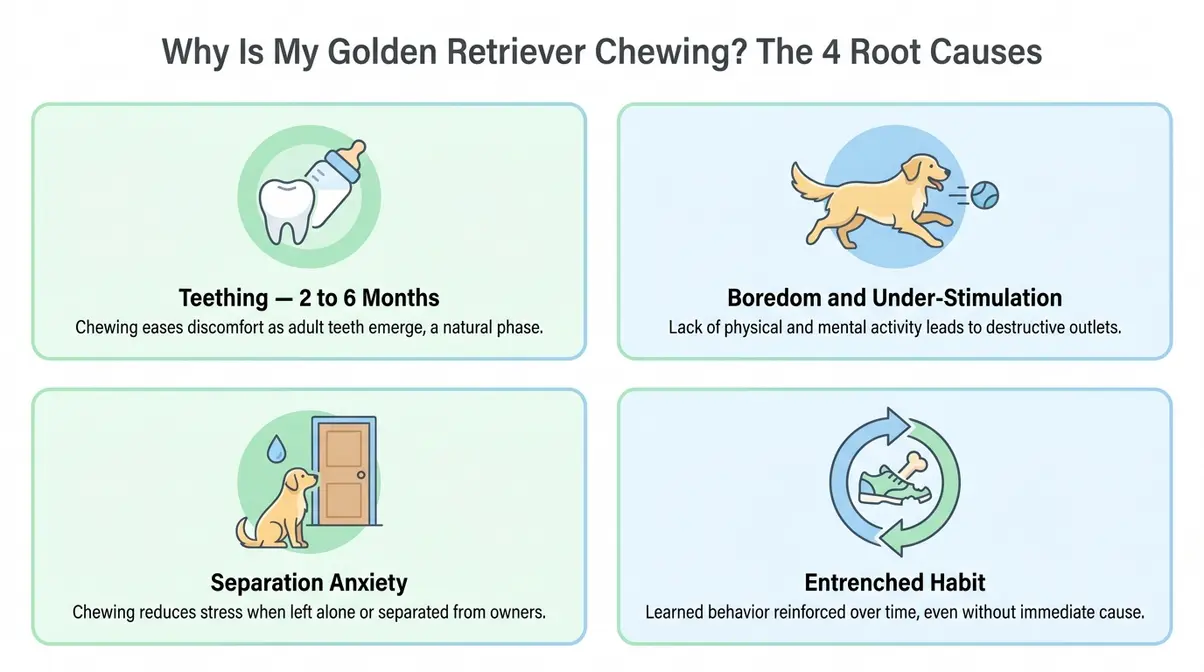
The Four Root Causes of Destructive Chewing

Breed instinct explains why Golden Retrievers chew. But the specific cause of destructive chewing in your Golden right now matters just as much for choosing the right fix. The ASPCA identifies boredom and lack of exercise as primary causes of destructive chewing in dogs. And for Golden Retrievers, four distinct triggers cover the vast majority of cases.
1. Teething (2–6 months)
Puppy teeth give way to 42 adult teeth, and chewing relieves the discomfort of erupting gums. This is the most predictable and time-limited cause. It ends when the adult teeth are fully in.
2. Boredom and under-stimulation (any age, peaks 6–18 months)
A Golden needs significant daily exercise and mental engagement. Without it, chewing becomes self-entertainment. What it looks like: your dog chews during the day, after meals, or whenever they have nothing structured to do.
3. Separation anxiety
Chewing that occurs exclusively when the owner is away, accompanied by other signs (pacing, whining, house soiling), points to anxiety rather than boredom. These two causes look similar but require different interventions. A dog that chews only when left alone for more than two hours is almost certainly anxious, not simply bored.
4. Habit and reinforcement
Chewing that was tolerated as a puppy (“it’s cute”) can become entrenched behavior by adolescence if never redirected. The dog learned that chewing is acceptable, or that it earns attention, even negative attention.
Knowing which cause applies to your dog is the first step. That’s where the age of your Golden becomes the most useful diagnostic tool.
Golden Retriever Chewing by Age: What’s Normal at Each Stage
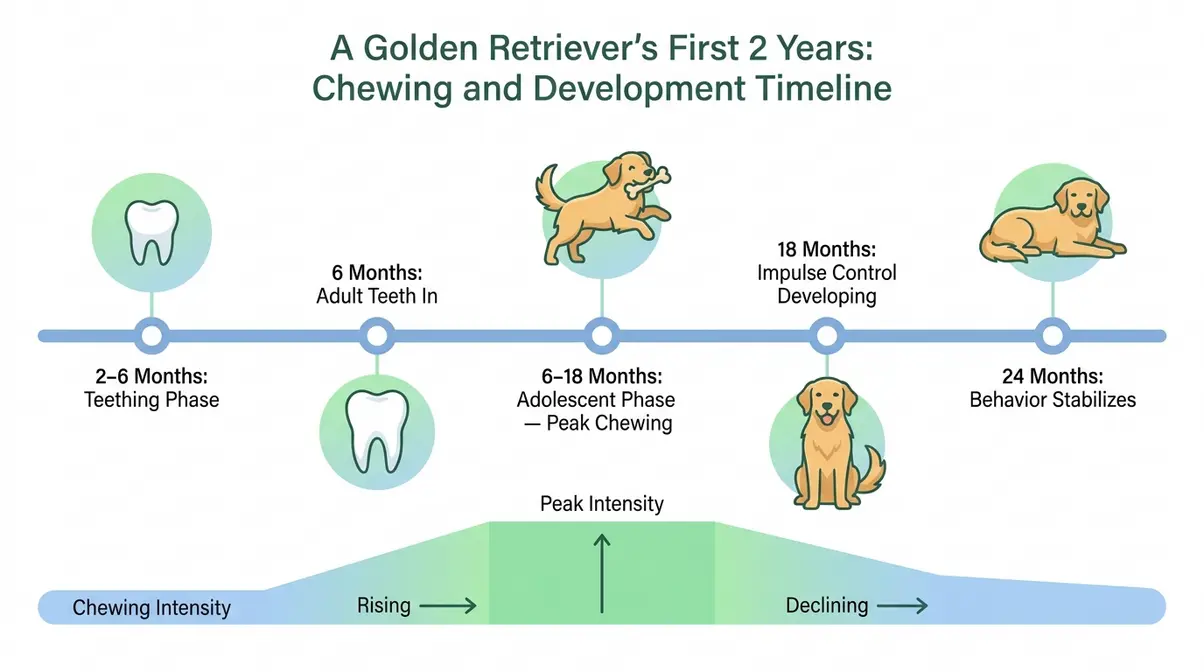
Golden Retrievers typically chew most destructively between 6 and 18 months, during the adolescent phase. Puppies chew due to teething; adolescents chew from energy and boredom; adults who still chew destructively are usually dealing with anxiety or an entrenched habit. Knowing which stage your dog is in changes everything about how you respond.
Puppy Phase (2–6 Months): Teething and Exploration

Between 2 and 6 months, Golden Retriever puppy chewing is almost entirely driven by teething. Puppies lose their 28 baby teeth and grow 42 adult teeth during this window, and chewing relieves the discomfort of erupting teeth. The ASPCA confirms teething as a primary cause of chewing in young puppies, and it’s entirely normal and expected at this stage.
What normal teething chewing looks like: mouthing hands, gnawing furniture edges, chewing soft items. It’s exploratory and relatively gentle compared to what comes next. Your puppy isn’t being destructive on purpose. They’re managing genuine physical discomfort.
The most effective response is providing better alternatives and managing access. Cold chew toys are especially helpful: frozen Kongs, chilled rubber toys, and even frozen carrots soothe inflamed gums. Rotate 3–4 toys to maintain interest; novelty matters even at this age. Nylabones and rubber chews are appropriate for young puppies; rawhide and hard bones carry splintering risks and are best avoided. Puppy-proofing is the most important management tool at this stage: restricting access to high-risk rooms buys you time while training takes hold. More on that in the home protection section below.
The reassurance most owners need: this phase ends. By 6 months, most adult teeth are fully in and teething-driven chewing decreases noticeably. What comes next, though, is a different challenge entirely.
Adolescent Phase (6–18 Months): The Hardest Stage
By 6 months, the adult teeth are fully in. The problem is that your Golden now has adult chewing power without adult impulse control. Energy levels peak. Boundary testing increases. This is the “naughty adolescent” phase owners describe across every Golden Retriever forum, and it’s the answer to the question what is the hardest age with a golden retriever.
The adolescent phase, roughly 6 to 18 months, is the stretch owners most often describe as the hardest: dogs have their full adult teeth but not yet the impulse control to resist using them.
The primary driver of Golden Retriever adolescent chewing at this stage is under-stimulation. According to VCA Hospitals on destructive chewing, adolescent dogs with excess energy and insufficient outlets are among the most common presentations for destructive chewing. A 6–18 month Golden needs 1–2 hours of vigorous exercise daily, plus mental enrichment sessions. Without it, destructive chewing is the predictable outlet.
This is also when most owners make the mistake of punishment. Scolding an adolescent Golden for chewing increases anxiety, and anxiety is itself a cause of chewing. You end up in a cycle that makes things worse.
In Golden Retriever communities, owners of 6–12 month dogs describe this stretch the same way: the puppy they could once scoop up now outweighs the furniture it’s demolishing, and gentle mouthing has turned into genuine destruction almost overnight. The behavior escalates because the dog is bigger, stronger, and more capable of real damage, while the owner’s responses (scolding, redirecting inconsistently) haven’t changed.
Five specific management techniques for adolescent chewing:
- Increase daily exercise to 1–2 hours, fetch, swimming, and structured off-leash play, not just leash walks
- Add 2–3 mental enrichment sessions daily A Kong stuffed with frozen food, sniff walks where the dog leads freely, or 5–10 minute basic obedience training sessions
- Rotate 4–6 appropriate chew toys weekly, put three out, swap in two new ones each week to maintain novelty
- Use crate or confinement when unsupervised: not as punishment, but as management that prevents rehearsal of the unwanted behavior
- Apply deterrent spray to furniture and baseboards A management bridge while the redirection habit forms (see Step 4 in the next section)
Will they outgrow it? Yes. Most Goldens settle noticeably by 18–24 months. But only if the behavior is actively managed and redirected during this window. Waiting it out without intervention tends to produce an adult dog with an entrenched chewing habit, which is a much harder problem to solve.
For most Goldens, the worst of the chewing is behind them by 18 months. But only if the habits formed now are the right ones.
Adult Phase (18+ Months): When Chewing Becomes a Habit
An adult Golden (18+ months) that still chews destructively is almost never teething. The two most likely causes are an entrenched habit formed during adolescence that was never redirected, or separation anxiety.
Habit-based chewing develops when a dog learns, through inconsistent responses, that chewing is acceptable or self-rewarding. Once the behavior is reinforced, it sticks. The solution is consistent redirection combined with management, as outlined in the next section.
Anxiety-based chewing looks different: it occurs specifically when the owner is absent, often accompanied by destructive behavior near exits, vocalization, or house soiling. A 2-year-old Golden that only chews when left alone for more than two hours is showing classic separation anxiety signs, not boredom. Owners in Golden communities often report the same telltale pattern: the house stays intact while someone’s home, but a chewed door frame or window sill greets them after even a short errand. These two causes require different approaches. And anxiety-based chewing in adult dogs is a signal to involve a professional rather than simply intensifying training. See the veterinary section for more on that distinction.
Whether your Golden is 4 months or 4 years, the next step is the same: apply the right solution for the right cause.
The Chewing Diagnosis Framework: Age → Trigger → Cause
Before choosing a solution, run your dog through three questions: (1) How old is your Golden? (2) When and where does the chewing happen? (3) What’s the most likely cause given those answers?
The Chewing Diagnosis Framework is a simple three-step check that prevents the most common mistake owners make, applying the right solution to the wrong problem.
| Age | Trigger (When/Where It Happens) | Most Likely Cause |
|---|---|---|
| 2–6 months | Anytime, especially on soft/textured items | Teething, adult teeth erupting |
| 6–18 months | When bored, after meals, during downtime | Boredom/under-stimulation; energy surplus |
| 6–18 months | Only when left alone; near exits | Separation anxiety |
| 18+ months | Persistent, any time | Entrenched habit or anxiety |
Once you’ve diagnosed the cause, the training steps in the next section will make much more sense.
How to Stop Golden Retriever Destructive Chewing: 5 Training Steps That Work
To stop destructive chewing in a Golden Retriever, consistently redirect to appropriate chew toys, increase daily exercise to 1–2 hours, address the root cause (boredom vs. anxiety), use deterrent sprays on off-limits items, and manage the environment with crate training when unsupervised. These five steps work together, applying only one rarely produces lasting results.
Here’s a quick overview before diving into each step:
- Redirect to an appropriate chew toy right away.
- Rotate 4–6 chew toys weekly to maintain novelty.
- Increase daily exercise to 1–2 hours of vigorous activity.
- Apply deterrent spray to off-limits surfaces.
- Use crate confinement when unsupervised.
Positive reinforcement (redirecting your dog to an appropriate chew toy and rewarding the correct behavior) works better than punishment, according to the ASPCA.
Each step below connects back to the Chewing Diagnosis Framework. Note which cause each step primarily addresses. That’s where to focus your energy first.
Step 1, Redirect, Don’t Punish
Primary cause addressed: all four, but especially habit and boredom.
When you catch your Golden chewing something off-limits, calmly say “no” once, remove the item, and right away offer an appropriate chew toy. When they take the toy, praise them. This is positive reinforcement redirection; the ASPCA redirection guidance recommends it as the most effective response to destructive chewing.
Why punishment fails: scolding, yelling, or physical correction more than two seconds after the behavior is ineffective because dogs don’t connect delayed punishment to the specific action. Worse, it increases anxiety, which is itself a cause of chewing. The most common error owners make is finding a chewed item and scolding the dog after the fact. This teaches nothing and actively worsens the problem over time.
The “catch them in the act” rule matters here. Redirection only works in the moment. If you find a chewed item after the fact, clean it up and improve your management strategy, don’t punish. Practically: keep a chew toy in every room so you always have a redirect option within arm’s reach.
Redirection only works if you have the right toys available. And the right toys depend on your dog’s chewing intensity.
Step 2, Build a Chew Toy Rotation
Primary cause addressed: boredom and under-stimulation.
A single chew toy loses novelty within days. A rotation strategy solves this: keep 3 toys accessible at a time, and swap in 2 new ones each week. Novelty maintains interest in ways that a permanent toy collection simply doesn’t.
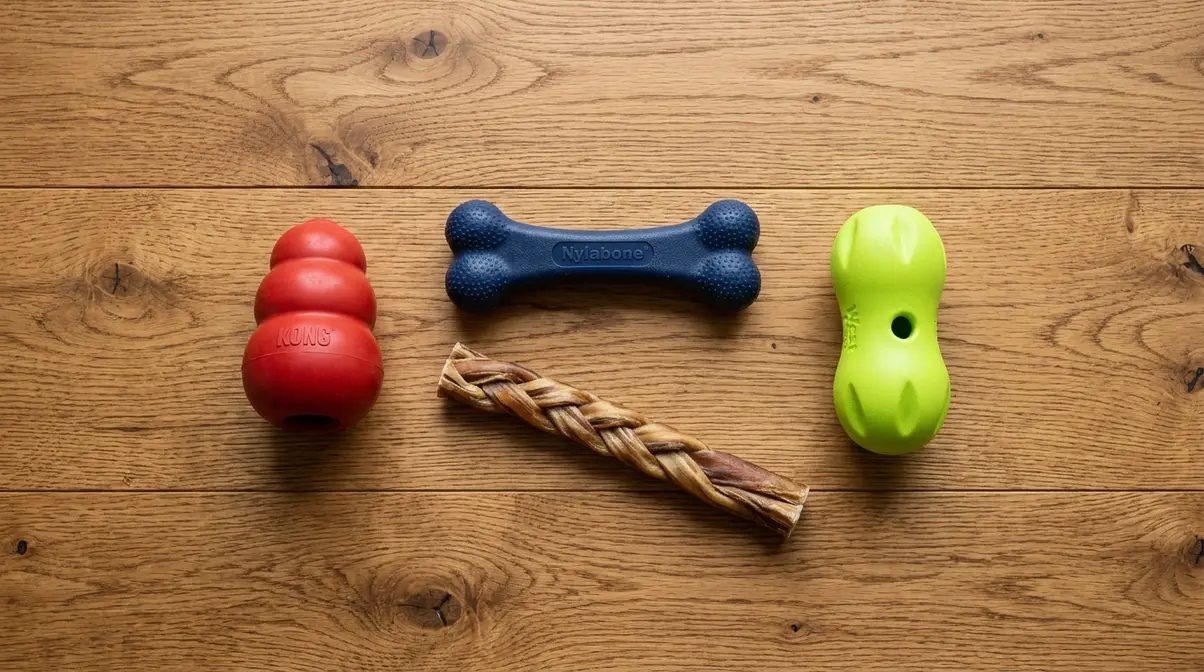
Choosing the right chew toys for Golden Retrievers means matching the toy’s durability to the dog’s chewing intensity. For Golden Retrievers, moderate-to-heavy chewers, a good rotation includes three types:
- Rubber chews (Kong Classic, West Paw Zogoflex), durable, stuffable, appropriate for unsupervised use
- Nylon chews (Nylabone), satisfies the gnawing urge for power chewers
- Natural chews (bully sticks, antlers with supervision), high-value, long-lasting engagement
Avoid rawhide (choking and digestive risk) and any toy with small detachable parts. Stuffed frozen Kongs deserve special mention for adolescent Goldens: freeze a Kong stuffed with peanut butter and kibble the night before, and it provides 30–60 minutes of calm, focused chewing in the morning before you leave for work.
For power chewers who destroy standard toys quickly, see our guide to indestructible dog toys for power chewers. It covers which materials and constructions hold up to heavy Golden chewing.
The right toys address the symptom of chewing. To reduce how often it happens, you need to address the cause. And for most adolescent Goldens, that means more exercise and mental stimulation.
Step 3, Address the Root Cause: Exercise, Enrichment, and Anxiety
Primary cause addressed: boredom (exercise + enrichment) and anxiety (vet referral).
Exercise: Golden Retriever breed standards classify them as sporting dogs requiring significant daily exercise (AKC). For adolescents (6–18 months), that means 1–2 hours of vigorous activity, fetch, swimming, off-leash running, or structured play, not just a leash walk. Under-exercised Goldens chew; well-exercised Goldens sleep.
Mental enrichment: Physical exercise alone isn’t enough for an intelligent breed. Add 2–3 mental enrichment sessions daily:
- Sniff walks, let the dog lead and sniff freely; 20 minutes tires a Golden faster than a 30-minute run
- Puzzle feeders and interactive puzzle toys for mental enrichment, feed meals through them rather than from a bowl
- Basic obedience training (5–10 minutes), “sit,” “stay,” “find it” games with hidden kibble
Anxiety-specific: If the chewing is anxiety-driven (occurring only when alone, accompanied by pacing or house soiling), exercise and toys won’t fully solve it. The Cornell Riney Canine Health Center on anxiety advises owners to schedule a vet visit for anxiety-driven behaviors rather than relying on over-the-counter remedies. A 10-month-old Golden that chews only when left alone for 3+ hours likely needs a combination of increased pre-departure exercise, a stuffed Kong, and potentially a professional consultation, not simply more training repetitions.
When you can’t supervise your Golden directly, deterrents and confinement become your most reliable management tools.
Step 4, Use Deterrent Sprays Strategically
Primary cause addressed: habit and boredom, management bridge while training takes effect.
Bitter apple spray and similar deterrents make surfaces unappealing to chew. Apply to furniture legs, baseboards, and cables. Not to the dog. Reapply every 2–3 days; effectiveness fades as the scent dissipates. Always test on a small hidden area first. Some sprays can discolor certain fabrics or finishes.
Deterrents work best as a management tool alongside training, not as a standalone fix. They reduce access to off-limits items while you build the redirection habit, but they don’t address the root cause. A dog redirected away from the couch by bitter spray still needs somewhere appropriate to chew.
Deterrents protect your furniture; crate training protects your dog.
Step 5, Crate Training and Confinement Management
Primary cause addressed: all, prevents unsupervised rehearsal of the chewing behavior.
A crate is not punishment. It’s a safe space that prevents destructive chewing when you can’t supervise. Introduce it gradually with positive associations: meals inside the crate, treats tossed in throughout the day, favorite toys left inside. The goal is a dog that chooses the crate voluntarily.
For adolescent Goldens, crate time during the day should not exceed four hours. Longer confinement increases frustration and can worsen anxiety, the opposite of what you’re trying to achieve. Inside the crate, use chew-resistant bedding: standard beds are destroyed quickly by power chewers.
Crate training is a management strategy, not a solution in itself. The training steps above still need to happen. The crate simply prevents damage while they take effect.
Training and management reduce chewing. But protecting your home in the meantime requires a few immediate steps.
Protecting Your Home Right Now: Immediate Prevention Strategies

While training takes weeks to show consistent results, home management can prevent damage today. If your diagnosis pointed to nighttime boredom or alone-time anxiety, the strategies in this section are your first line of defense.
Many owners report that the most damage occurs in the first 30 minutes after leaving. A pre-departure routine combining exercise, a stuffed Kong, and crate confinement addresses this window directly. That’s the single most important insight for anyone dealing with daytime chewing damage.
Puppy-Proofing Room by Room
Golden Retriever puppy-proofing isn’t about making your home impenetrable. It’s about eliminating the highest-risk targets first. Focus on hazards that can cause injury or illness, not just furniture damage.
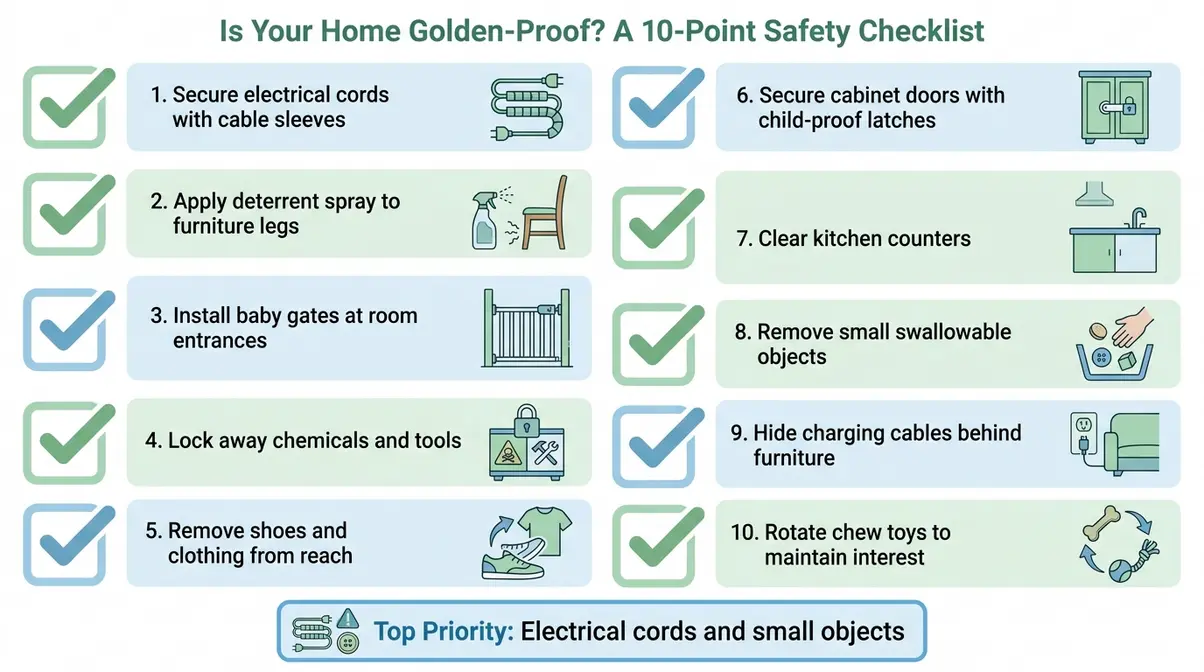
Priority puppy-proofing checklist by room:
- Living room: Secure or hide electrical cords using cable management sleeves or PVC conduit rather than simple cord bundlers. Apply deterrent spray to furniture legs. Remove low-lying decorative items, books, and remote controls.
- Kitchen: Keep counters clear; secure cabinet doors with child-proof latches; remove dish towels from reach. The kitchen floor is often full of dropped food items that reward exploratory sniffing-and-chewing.
- Bedroom: Keep shoes and clothing in closed closets, shoes are especially attractive to adolescent Goldens. Secure charging cables along baseboards or behind furniture.
- Garage and utility areas: Lock away chemicals, tools, and small objects. These are ingestion hazards, not just chewing hazards. A swallowed object can cause intestinal obstruction requiring emergency surgery.
The two most dangerous targets are electrical cords (electrocution risk) and small swallowable objects (intestinal obstruction). Prioritize these above furniture protection every time.
A baby gate restricting access to high-risk rooms is the single most effective puppy-proofing tool for the first 6–12 months. For a room-by-room walkthrough, see our complete puppy-proofing guide for Golden Retrievers.
Puppy-proofing handles the daytime. But many owners find nighttime and alone-time chewing the hardest to manage.
Managing Chewing at Night and When Left Alone
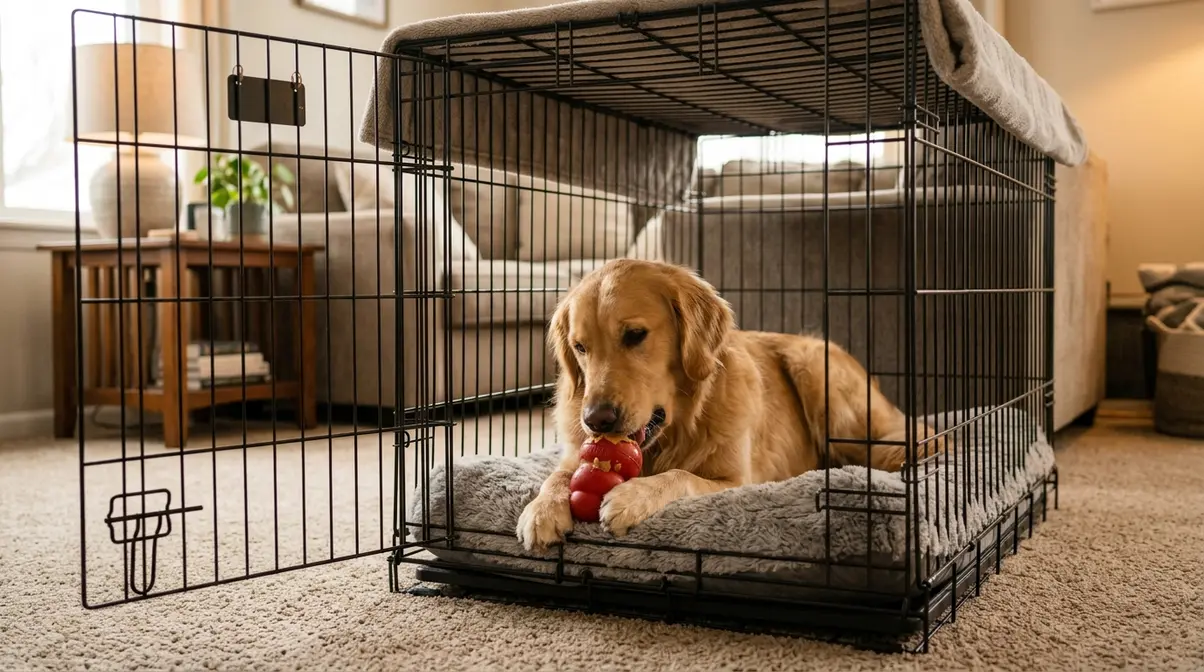
Nighttime chewing is almost always driven by one of two causes: residual energy (the dog wasn’t sufficiently tired at bedtime) or anxiety (the dog is unsettled by the quiet and dark). The fix differs by cause, run it through the framework before assuming either.
Pre-departure routine for daytime alone time:
- 20–30 minutes of vigorous exercise before leaving, a tired Golden is a calm Golden
- Provide a stuffed frozen Kong in the crate, occupies the high-risk first 30 minutes
- Leave a worn item of clothing, familiar scent reduces anxiety-driven restlessness
- Use white noise or a radio, reduces environmental triggers (traffic sounds, doorbells) that can spike anxiety
For nighttime: a crate or confined sleeping area with appropriate chews eliminates the opportunity for destructive chewing while you sleep. A 30-minute fetch session before bed can noticeably reduce nighttime chewing for most adolescent Goldens. If your diagnosis pointed to anxiety (chewing only when alone), the pre-departure routine is especially important. The Kong and exercise combination addresses both the energy surplus and the anxiety window simultaneously.
Beyond management, knowing which chews are safe, and which to avoid, protects your dog’s health as much as your furniture.
Safe vs. Unsafe Chews: What to Give (and What to Avoid)
Even “safe” chews require supervision for power chewers, replace any chew that breaks into pieces small enough to swallow. The table below covers the most common options.
| Safe Chews | Avoid |
|---|---|
| Rubber toys (Kong, West Paw Zogoflex) | Rawhide (choking and digestive risk) |
| Nylon chews (Nylabone) | Cooked bones (splinter risk) |
| Bully sticks (supervised) | Toys with small detachable parts |
| Frozen carrots (puppies) | Anything smaller than the dog’s mouth |
| Antlers (supervised, monitor for cracking) | Rope toys for heavy chewers (fiber ingestion risk) |
Kong and Nylabone are widely used by trainers and owners for their durability and stuffability. They hold up to Golden-level chewing better than most alternatives. The key principle: if a chew breaks into sharp or swallowable pieces, remove it right away.
Most chewing is behavioral. But sometimes it signals something that needs a vet’s attention.
When to Call the Vet: Is It Behavior or a Health Problem?

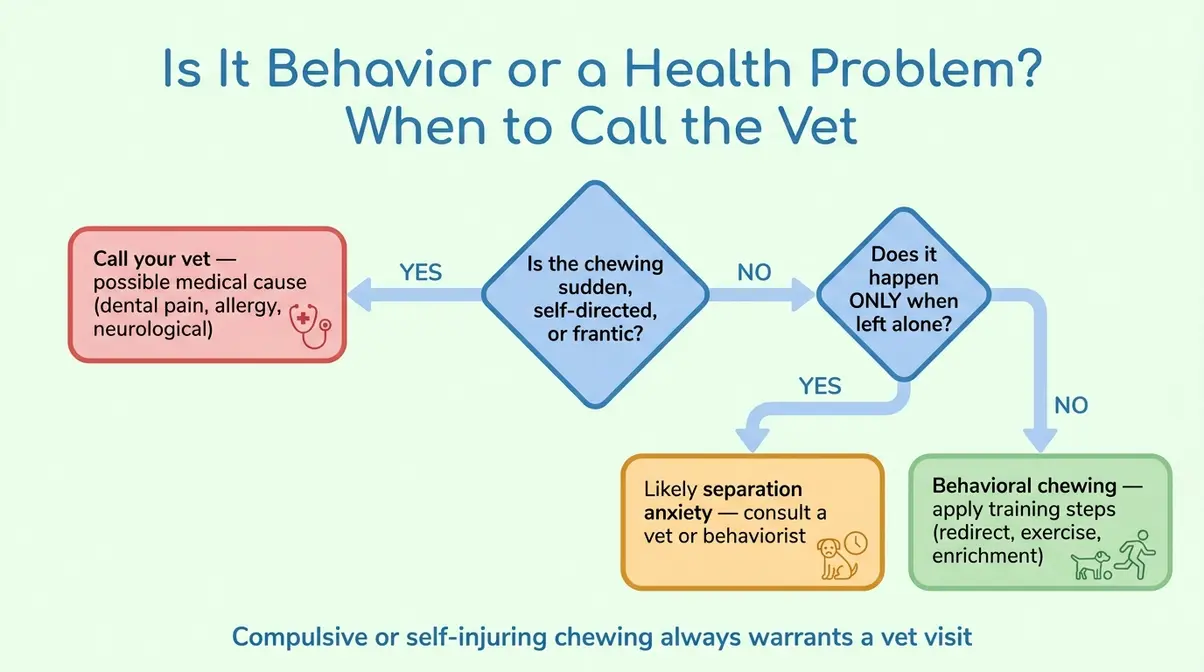
Most Golden Retriever destructive chewing is behavioral and fully manageable at home. But certain patterns fall outside what training can address. And missing them has real consequences. If the framework can’t identify a clear behavioral trigger, that’s a signal to involve a professional.
Signs the Chewing Has a Medical Cause
Call your veterinarian if you observe any of the following:
- Sudden onset of destructive chewing in an adult dog with no change in routine. This warrants evaluation to rule out pain, dental disease, or neurological causes
- Self-directed chewing (paws, tail, or skin), may indicate allergies, pain, or an anxiety disorder
- Frantic or compulsive chewing that the dog cannot be redirected from, a qualitatively different behavior from normal chewing
- Chewing accompanied by other behavioral changes, aggression, lethargy, or appetite loss alongside chewing is not a training problem
- Chewing that causes self-injury, any wound from self-directed chewing requires immediate veterinary attention
Dental pain is an underdiagnosed cause of chewing in adult dogs. A dog with a cracked tooth or gum disease may chew to relieve discomfort. A dental exam can rule this out quickly. The Cornell Riney Canine Health Center advises scheduling a vet visit for anxiety-driven behaviors rather than using over-the-counter remedies, noting that professional evaluation produces better outcomes than self-managed interventions.
For persistent or severe behavioral chewing that doesn’t respond to training, a veterinary behaviorist offers the next level of support.
When to Consult a Veterinary Behaviorist
A board-certified veterinary behaviorist (Diplomate ACVB) specializes in diagnosing and treating behavioral disorders, including severe separation anxiety and compulsive chewing. They differ from a dog trainer in a critical way: they can prescribe medication alongside behavioral modification, which is often necessary for anxiety-driven chewing that hasn’t responded to training alone.
Consider a referral if:
- Chewing is accompanied by aggression or self-injury
- Anxiety-driven chewing hasn’t improved after 4–6 weeks of consistent training
- The dog’s quality of life is noticeably impaired by the behavior
The American College of Veterinary Behaviorists (ACVB) maintains a directory of board-certified specialists at acvb.org, searching by location connects you with a credentialed professional rather than a general trainer.
As your Golden ages, broader health screening becomes part of the routine too. Our guide to Golden Retriever lifespan and health covers what to watch for as the years add up.
Frequently Asked Questions About Golden Retriever Destructive Chewing
How do I get my golden retriever to stop chewing everything?
To stop destructive chewing in a Golden Retriever, consistently redirect to appropriate chew toys the moment you catch them chewing something off-limits. Increase daily exercise to 1–2 hours for adolescents, add mental enrichment (puzzle feeders, training sessions), and use crate confinement when unsupervised. Apply deterrent spray to furniture and baseboards. Punishment after the fact is ineffective and increases anxiety, redirection and management are the proven approach, according to the ASPCA.
Are golden retrievers prone to chewing?
Yes, Golden Retrievers are prone to chewing more than many breeds. Bred as sporting retrievers, they have a natural oral drive and high energy levels that make chewing a default self-soothing behavior when under-stimulated. This tendency peaks between 6 and 18 months but can persist into adulthood without consistent training. With appropriate outlets and management, most Goldens become manageable chewers by age 2–3.
What is the hardest age with a golden retriever?
The hardest age for most Golden Retriever owners is the adolescent phase, roughly 6 to 18 months. At this stage, dogs have their full adult teeth and peak energy but limited impulse control, making destructive chewing, boundary testing, and selective hearing common. Consistent exercise (1–2 hours daily), mental enrichment, and positive reinforcement training during this window make a significant difference in long-term behavior.
What causes destructive chewing in Golden Retrievers?
The four primary causes of destructive chewing in Golden Retrievers are: teething (2–6 months, as adult teeth erupt), boredom from insufficient exercise or mental stimulation, separation anxiety when left alone, and entrenched habit from unchanneled puppy chewing. The ASPCA identifies lack of physical and mental exercise as the most common driver in adolescent and adult dogs. Identifying the specific cause determines the most effective solution.
Start Using the Chewing Diagnosis Framework Today
Golden Retriever destructive chewing is one of the most common, and most manageable, challenges the breed presents. The behavior peaks during the adolescent phase (6–18 months) but responds well to consistent redirection, adequate exercise, and the right chew outlets. According to the ASPCA, boredom and lack of exercise are the primary drivers, which means the solution is almost always within the owner’s control. The Chewing Diagnosis Framework (Age → Trigger → Cause) gives you the starting point every time.
Most owners who struggle with chewing are applying the right solution to the wrong cause. A teething puppy needs cold chew toys; a naughty adolescent needs exercise and enrichment; an anxious adult needs a vet conversation. Running your dog through the framework before reaching for a deterrent spray or a new toy saves weeks of frustration and prevents the cycle of punishment that makes the behavior worse, not better.
Start this week: identify your Golden’s current stage, audit their daily exercise and enrichment, and set up a chew toy rotation. If the chewing is severe, sudden, or self-directed, book a vet appointment rather than waiting. For product help, see our guides to indestructible dog toys for power chewers and interactive puzzle toys for mental enrichment to build out your management toolkit.