
A mini goldendoodle (also spelled mini golden doodle) is a Golden Retriever and Miniature Poodle cross that typically stands 14 to 17 inches at the shoulder and weighs 26 to 35 lb as an adult, according to the Goldendoodle Association of North America (GANA).
Key Takeaways
– Height and weight: over 14 to under 17 inches, typically 26 to 35 lb (GANA Miniature tier). Breeders who do not follow GANA often advertise anything from 15 to 40 lb as “mini.”
– Lifespan: no study has measured Goldendoodles specifically. The median for UK crossbred dogs is 12.0 years (McMillan et al. 2024).
– Health testing: GANA requires OFA hips, elbows, cardiac and patellas, a CAER eye exam every two years, and a seven-test DNA panel on both parents.
– Grooming: daily brushing at home; professional grooming typically costs $75 to $200 per visit (GANA).
– Price: breeders commonly advertise $2,000 to $5,000; no verified market data exists.
– Coat: F1B coats are usually curlier and lower-shedding than F1, but no dog is truly hypoallergenic.
You probably searched “mini goldendoodle” because you want a smallish, friendly dog that (hopefully) will not trigger your allergies. Before you pay thousands for a puppy, know one thing: “mini” means nothing official.
The American Kennel Club (AKC) does not recognize the Goldendoodle as a breed, so there is no AKC breed standard. Every breeder decides for themselves what counts as mini, which is why you will find dogs labeled “mini” that weigh anywhere from 15 to 40 pounds.
This guide explains why those numbers conflict, how to predict what your specific puppy will weigh, which health tests to demand before paying a deposit, what grooming and ownership really cost, and how to tell whether a mini goldendoodle fits your household.
What Is a Mini Goldendoodle?
A mini goldendoodle is a cross between a Golden Retriever and a Miniature (or sometimes Toy) Poodle. The goal is a dog with the Golden’s gentle temperament and the Poodle’s lower-shedding coat, at a smaller size than a standard Goldendoodle.
The Goldendoodle Association of North America (GANA) is a breeder association, not a kennel club, but it is the closest thing this cross has to a standard-setter. GANA defines four size tiers by height at the shoulder and publishes health-testing rules for its member breeders. The “Miniature” tier is what most buyers picture when they say “mini.”
Most breeders do not use GANA’s system. They set their own definitions, which is why the numbers vary so widely across websites and listings.
How Big Do Mini Goldendoodles Get?
This is the question that trips up most buyers. The short answer: it depends on which Poodle is the parent, which generation the puppy is, and what the parents actually weigh as adults.
The GANA size ladder
GANA defines size by height at the withers (the top of the shoulder), not weight. Weight is approximate because it fluctuates.
| GANA tier | Height at shoulder | Typical weight |
|---|---|---|
| Petite | Below 14 inches | 25 lb or less |
| Miniature | Over 14 to under 17 inches | 26–35 lb |
| Medium | Over 17 to under 21 inches | 36–50 lb |
| Standard | Over 21 inches | 51 lb or more |
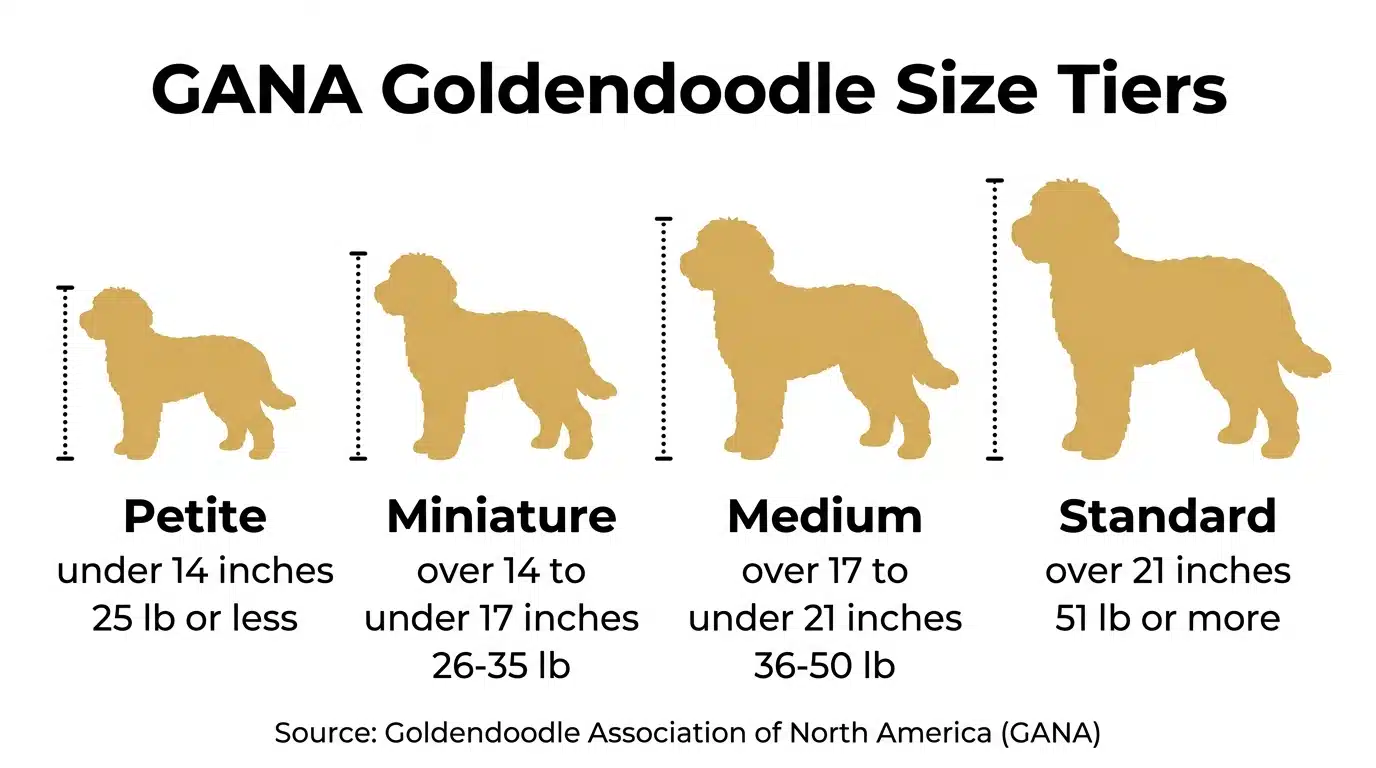
Source: Goldendoodle Association of North America
Most breeders advertise dogs as “mini” without distinguishing between the Petite and Miniature tiers. That is why you see advertised weights as low as 15 lb and as high as 35 to 40 lb for dogs all called “mini.”
Why the Poodle parent matters more than the Golden
Golden Retrievers are uniformly large: under the AKC standard, males weigh 65 to 75 lb and females 55 to 65 lb. The only reliable way to shrink the offspring is a smaller Poodle. A Standard Poodle (over 15 inches) produces a much larger puppy than a Miniature Poodle (over 10 up to 15 inches), so the Miniature Poodle’s size sets the floor on how small a “mini” can be.
For the full growth chart and when Goldendoodles reach adult size, see our Goldendoodle size chart.
Petite, Micro, Toy, Mini: What the Size Labels Mean
You will see several terms: petite goldendoodle, micro mini goldendoodle, teacup goldendoodle, toy goldendoodle. Here is what each actually means.
- Miniature / Mini: GANA-defined, over 14 to under 17 inches, roughly 26 to 35 lb.
- Petite: GANA-defined, below 14 inches, 25 lb or less. Usually bred from a Toy Poodle parent (under 10 inches at the shoulder).
- Toy goldendoodle, micro mini, teacup: none of these are GANA classifications. They are marketing terms with no standard definition. If a breeder uses them, ask for the parents’ verified adult weights and heights before you trust any size claim.
If this is your first doodle: the size tiers are not just marketing. They reflect real differences in exercise needs, space and grooming cost. A 15-lb Petite and a 35-lb Miniature are meaningfully different dogs to live with, even though both get called “mini.”
F1, F1B, F2: How Does Generation Affect Shedding and Allergies?
Generation affects the coat more than almost any other variable.
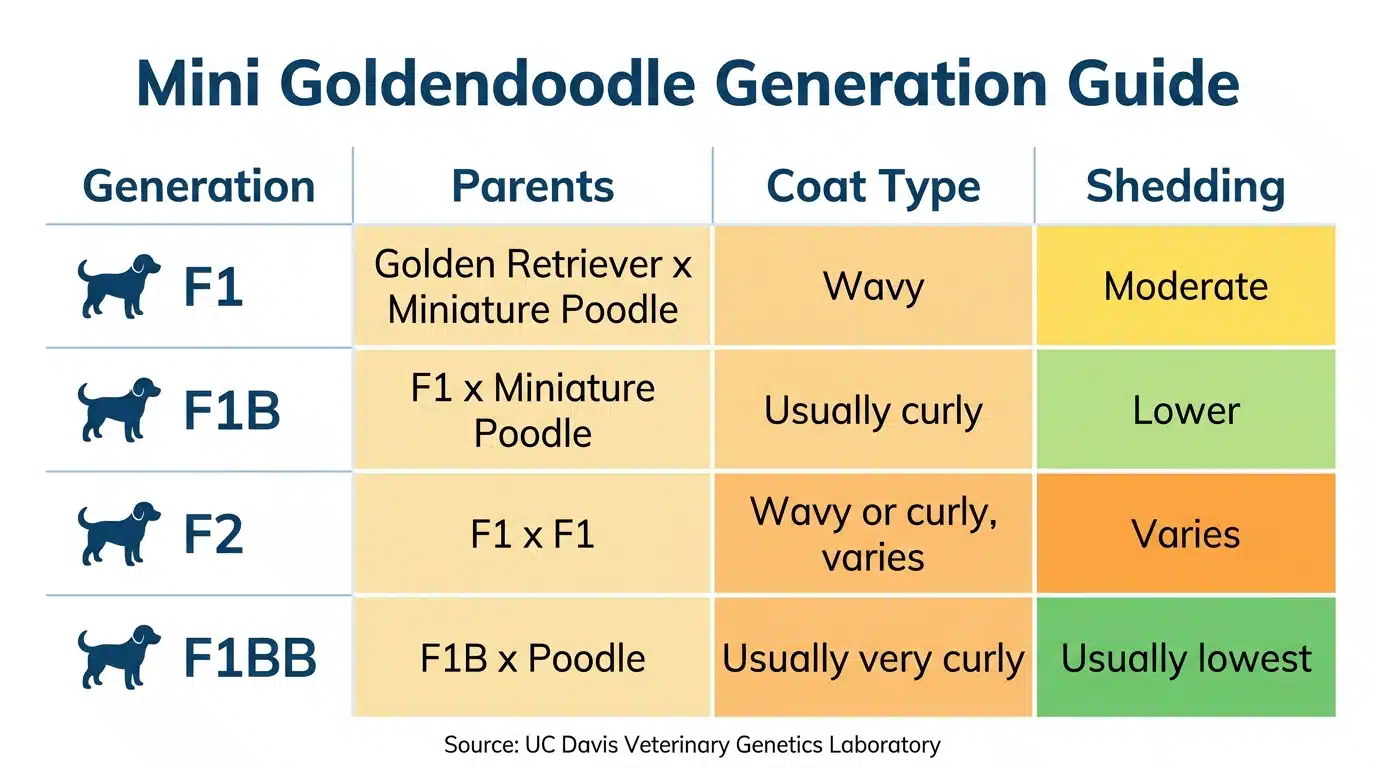
| Generation | Cross | Typical coat | Shedding tendency |
|---|---|---|---|
| F1 | Golden Retriever × Poodle | Wavy (mix of both) | Moderate |
| F1B | F1 Goldendoodle × Poodle (75% Poodle) | Curlier | Lower |
| F2 | F1 × F1 | Varies widely | Unpredictable |
| F1BB | F1B × Poodle (87.5% Poodle) | Usually curliest | Usually lowest |
Two genes do most of the work. According to the UC Davis Veterinary Genetics Laboratory, variants in MC5R and RSPO2 (the “furnishings” gene behind the longer facial hair of low-shed coats) affect how much a dog sheds, and combinations of these variants lower overall shedding (UC Davis VGL). For how coat types play out across the breed, see our Goldendoodle coat types guide.
On the “hypoallergenic” claim: no dog is truly hypoallergenic. A 2012 study in the Journal of Allergy and Clinical Immunology states it in its title: “Can f 1 levels in hair and homes of different dog breeds: Lack of evidence to describe any dog breed as hypoallergenic” (Vredegoor et al. 2012, doi:10.1016/j.jaci.2012.05.013). A curlier F1B may shed less than a wavy F1, which can mean less loose hair and dander around the house, but there are no guarantees, and coat type varies even within one litter.
The mechanism: F1B puppies are 75% Poodle, so the odds of inheriting the furnishing variant are higher. Odds are not a certainty. A DNA panel from a lab such as Embark or UC Davis tells you whether a specific puppy carries those variants, which is more reliable than going by the generation label.
If someone in your home has allergies, ask the breeder for the puppy’s DNA coat results, and spend time with the puppy’s parents in person before committing.
Mini Goldendoodle Health and Lifespan
Mini goldendoodles are generally healthy dogs, but they can inherit conditions from both parent breeds. Responsible breeders screen for each of these before breeding.
Conditions to know
- Hip and elbow dysplasia. A joint that forms incorrectly as the dog grows. Both parent breeds are affected, which is why GANA requires OFA hip and elbow results on both parents.
- Subvalvular aortic stenosis (SAS). A narrowing below the aortic valve. The Golden Retriever Club of America calls it “the most common congenital heart disease in Golden Retrievers” (GRCA). GANA requires an OFA Basic Cardiac clearance for this reason.
- Progressive retinal atrophy (PRA). Inherited forms of gradual vision loss. Golden Retrievers carry their own PRA variants (GR-PRA1 and GR-PRA2), and both breeds can carry PRCD-PRA; all three are on GANA’s required DNA panel.
- Patellar luxation. A kneecap that slips out of place. The American College of Veterinary Surgeons reports it in 7% of puppies and lists the Miniature Poodle among the small breeds most affected (ACVS), so it matters more in a mini than in a standard Goldendoodle.
- von Willebrand disease Type 1. An inherited bleeding disorder, also on GANA’s DNA panel.
- Ear infections. Floppy ears and a dense, curly coat trap moisture. Check ears weekly and dry them after baths and swims.
Cancer and lifespan
A Nationwide pet-insurance analysis of 1.61 million dogs (2015 to 2021) found that Goldendoodles were almost half as likely as all other insured dogs to have a cancer claim (Nationwide gives the figure as 47.4%), and that Golden Retrievers and Standard Poodles are 3.8 times more likely to have a cancer claim than Goldendoodles (Nationwide). These are insurance claims, not diagnoses in the general population, and the study says nothing about lifespan.
Lifespan: no peer-reviewed study has measured Goldendoodle lifespan. The best available estimate is the median for crossbred dogs in the UK, 12.0 years (McMillan et al. 2024, Scientific Reports). Any specific number on a breeder’s website is not sourced. For more, see how long Goldendoodles live.
This article does not provide veterinary advice. Consult a licensed veterinarian for your dog’s specific health needs.
Which Health Tests Should a Breeder Show You?
GANA’s health standards apply to its member breeders and to dogs born on or after July 31, 2024. Use them as your checklist for any breeder, member or not (GANA Health Standards).
Physical clearances on both parents:
– Hips: OFA or eVet evaluation scoring Fair, Good or Excellent
– Elbows: OFA rating of Normal
– Heart: OFA Basic Cardiac clearance, at one year of age or older
– Eyes: CAER exam, repeated every two years for the dog’s breeding life
– Patellas: permanent OFA patella clearance
DNA panel on both parents:
– PRCD-PRA (progressive rod-cone degeneration)
– vWD Type 1 (von Willebrand disease)
– NEWS (neonatal encephalopathy with seizures)
– GR-PRA1 and GR-PRA2 (Golden Retriever PRA variants)
– ICH1 (ichthyosis)
– DM (degenerative myelopathy)
You can verify any OFA clearance yourself by searching the dog’s registered name at ofa.org. A reputable breeder shares the sire’s and dam’s registered names readily. One who will not is a red flag.
Mini Goldendoodle Grooming
This is where many new owners get caught off guard, especially with curly-coated F1Bs.
- Brushing: GANA recommends brushing daily with a slicker brush followed by a metal comb (GANA Grooming FAQ). Mats form fast in curly coats and pull on the skin if left.
- First haircut: usually at 4 to 6 months of age (GANA).
- Professional grooming: GANA puts the typical price at $75 to $200 per appointment. A matted coat costs more and is harder on your dog, so home brushing directly lowers your grooming bills.
- Bathing: when dirty, with a gentle dog shampoo.
- Nails and ears: trim nails regularly; check ears weekly for redness, odor or debris.
Grooming is a recurring cost for the dog’s whole life. Budget for it before you buy.
Is a Mini Goldendoodle Right for You?
Mini goldendoodles tend to be social, playful and eager to please. They inherit the Golden’s affectionate nature and the Poodle’s intelligence, which makes them responsive to positive-reinforcement training. That intelligence has a catch: a bored mini goldendoodle can become destructive, so plan for daily walks, play and mental work such as training sessions or puzzle feeders.
Separation anxiety is the most under-discussed challenge. Mini goldendoodles bond closely with their people, which is lovely when you are home and a problem when you are not. If you work away from home full-time, plan for a dog walker or daycare from day one, and practice short, calm departures early. A crate introduced with positive associations can become a comfort spot rather than a punishment.
Apartments: they can do well in smaller homes as long as they get consistent daily exercise. They are not couch dogs.
Families with children: usually a good fit; they tend to be patient and playful. Supervise young children around any dog.
First-time owners: a reasonable choice if you go in with accurate expectations about grooming and their need for company.
Allergy sufferers: see the shedding section above. Generation and DNA coat results matter more than the “mini” label.
Calmer households and retirees: their size is easier to handle than a standard Goldendoodle, provided their exercise needs are met.
Individual temperament varies by breeder, bloodline and socialization. No breed guide can guarantee a specific dog’s personality.
How Much Does a Mini Goldendoodle Cost?
Purchase price: breeders commonly advertise $2,000 to $5,000 (Dogster, September 2026; Love of Puppies, October 2025; PremierPups, 2026). These are commercial sources; no verified market-pricing data for Goldendoodles is public.
Size, coat color, generation and breeder reputation all move the price. A breeder who completes GANA’s full testing has real costs (OFA evaluations, a cardiologist’s exam, CAER exams, DNA panels), so an unusually low price often means some of that testing was skipped. Ask for the certificates either way.
Ongoing costs to budget for:
– professional grooming, typically $75 to $200 per visit (GANA)
– veterinary care: first-year vaccines and exams, then yearly wellness visits
– food, sized to a 26 to 35 lb dog
– supplies: crate, leash, bed, brushes and toys
– pet insurance, if you choose it
– daycare or a dog walker, if you are away for long hours
Grooming is the cost new owners most often underestimate, because it recurs every few weeks for the dog’s whole life.
How Do You Find a Reputable Mini Goldendoodle Breeder?
Buying from the wrong source has consequences beyond your own household. In a Shelter Animals Count survey of 314 organizations across 45 states, more than 60% said they receive doodles and other intentional mixed breeds. Nearly 60% reported surrenders from owners who paid a lot for their dog and can no longer afford to keep it, and 54% reported receiving leftover puppies from breeders who could not sell them (Shelter Animals Count).
Five things to verify before you pay a deposit
- The parents’ verified adult weights and heights, and the generation. If the Poodle parent is 20 lb, the puppies will likely be larger than from a 12-lb Miniature Poodle.
- A written size guarantee. If the puppy grows past the guaranteed adult weight, what is the remedy? A breeder who will not put it in writing is not confident in their size claims.
- OFA and CAER certificates for both parents, including the Basic Cardiac clearance. Verify them yourself at ofa.org.
- The full DNA panel report (for example from Embark or Wisdom Panel), not just “our dogs are tested.” It should cover every condition in the checklist above.
- A written health guarantee and a return policy. A good breeder takes a dog back if your circumstances change and answers health questions for the dog’s lifetime.
Red flags:
– will not share OFA registration numbers or registered names
– no waitlist and puppies always available
– several different “doodle” crosses on offer at once
– sends puppies home younger than eight weeks
– cannot tell you both parents’ weights and generations
GANA keeps a directory of member breeders who have agreed to its health-testing and ethics standards. That is one starting point.
Ready to start your search? Use our Goldendoodle breeders guide to find breeders by state.
Frequently Asked Questions
How big does a mini goldendoodle get?
By GANA’s Miniature tier, over 14 to under 17 inches tall and typically 26 to 35 lb. Breeders who do not follow GANA’s system advertise anything from 15 to 40 lb as “mini.” The best way to predict your puppy’s adult size is to ask for the verified adult weights of both parents, and of the Poodle-side grandparents for F1B litters.
Are mini goldendoodles hypoallergenic?
No dog breed is confirmed hypoallergenic. A 2012 study in the Journal of Allergy and Clinical Immunology found no evidence to describe any dog breed as hypoallergenic. F1B mini goldendoodles with the furnishing variant tend to shed less, which may reduce allergen exposure, but it is not a guarantee. Ask for the specific puppy’s DNA coat results.
How much does a mini goldendoodle cost?
Breeders commonly advertise $2,000 to $5,000. On top of that, budget for grooming ($75 to $200 per professional visit, per GANA), veterinary care, food, supplies and optional insurance.
What are the disadvantages of a mini goldendoodle?
Size unpredictability (there is no single standard for “mini”), grooming cost and time, a need for daily exercise and mental work, a tendency toward separation anxiety, and allergy claims that may not hold for every dog or every person.
How long do mini goldendoodles live?
No study has measured it for Goldendoodles specifically. The median lifespan for UK crossbred dogs is 12.0 years (McMillan et al. 2024), which is the best available reference point.
Is it better to get a boy or girl mini goldendoodle?
No meaningful difference in temperament or health has been documented between the sexes in this cross. The individual dog and its breeder matter more than sex.
Want the full size breakdown? Our Goldendoodle size chart covers every tier with growth curves and the factors that affect them.