
Key TakeawaysThe golden labrador vs Golden Retriever decision comes down to four factors: energy match, grooming tolerance, health budget, and lifestyle type — our Retriever Fit Test framework.
- Golden Retrievers are gentler and mellow earlier (~age 2), but cancer caused 65% of deaths in a UC Davis study (Kent et al., 2018)
- Labrador Retrievers are higher-drive and more athletic, but approximately 25% carry a POMC gene mutation that hard-wires them toward obesity (University of Cambridge, 2026)
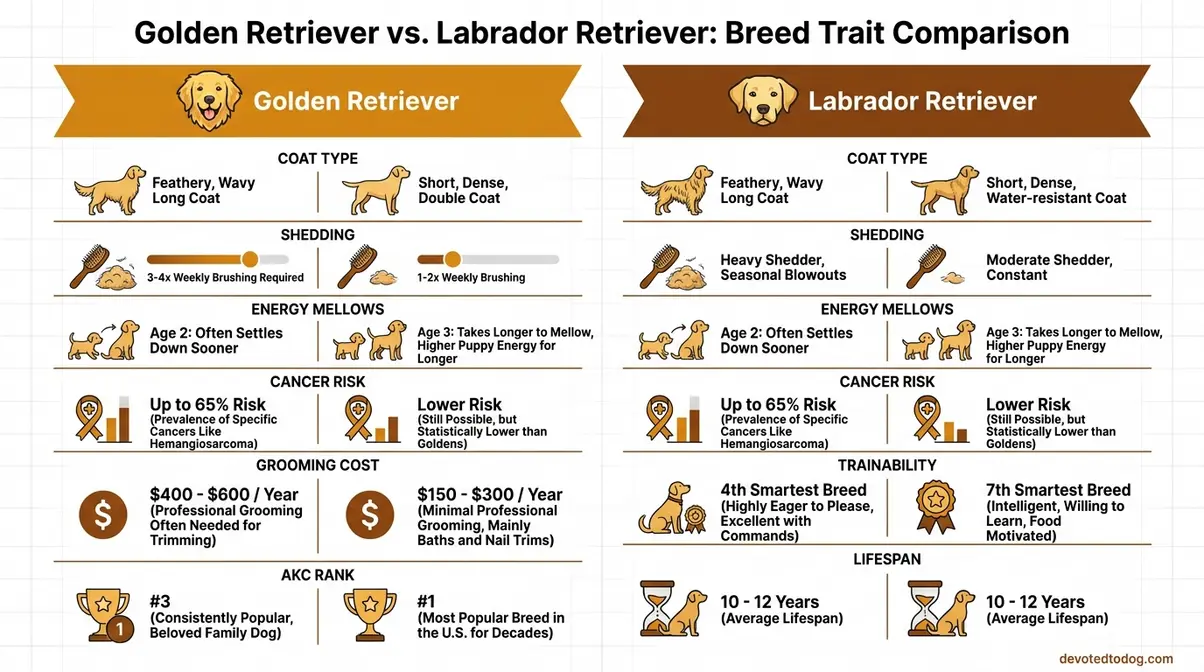
- Grooming: Goldens need 3–4 brushing sessions per week and cost $400–$600/year to groom professionally; Labs need 1–2 sessions and cost $150–$300/year
- Both breeds rank among the least aggressive dogs toward humans and other dogs (Purdue University research)
- Use the Retriever Fit Test in our decision section to find your match in under 3 minutes
Golden vs. Labrador: At a Glance
For more on this topic, see our guide on the Golden Retriever Pregnancy: 2026 Complete Week-by-Week Guide.
For more on this topic, see our guide on the Can Golden Retrievers Have Blue Eyes? – The Truth Behind.
https://www.youtube.com/watch?v=RKD3fakO6hs
What Is a “Golden Labrador”? Clearing Up the Confusion
When most people search for golden labrador vs golden retriever, they’re picturing a yellow-coated Labrador Retriever standing next to a Golden Retriever — two dogs that look deceptively similar from across a dog park. The term “golden labrador” is informal shorthand for a yellow Lab, not a distinct breed. If you’ve been searching that phrase, you’re in exactly the right place — this guide covers exactly that comparison. There is, separately, a Goldador — the Golden Retriever–Labrador Retriever mix, a first-generation crossbreed that combines traits from both purebreds. The Goldador is a viable third option for undecided families, and we cover it briefly in a later section. For now, this guide compares purebred Labrador Retrievers (yellow, chocolate, and black) against purebred Golden Retrievers. For the short story of where each breed came from, see the breed history section below. “If you’ve been searching for ‘golden labrador vs golden retriever,’ you’re likely comparing a yellow Lab to a Golden — and this guide covers exactly that.” With that sorted, here’s how the two breeds stack up across 15 key traits — the comparison table no other guide has built.Side-by-Side Comparison Table (15+ Traits)
The table below reflects AKC breed standards and current market data. Prices verified as of early 2026. Genetic research on retriever social behavior confirms that specific sociality genes are associated with human-directed behavior in both breeds, explaining their shared affinity for human interaction (PubMed, 2026).| Feature | Golden Retriever | Labrador Retriever |
|---|---|---|
| AKC Popularity Rank (2026) | #3 | #1 |
| Height (males) | 23–24 inches | 22.5–24.5 inches |
| Weight (males) | 65–75 lbs | 65–80 lbs |
| Coat Type | Long, feathery, water-repellent double coat | Short, dense, “otter” double coat |
| Coat Colors | Golden shades (cream to dark gold) | Yellow, chocolate, black |
| Shedding Level | Heavy (year-round + seasonal) | Moderate–heavy (seasonal peaks) |
| Brushing Frequency | 3–4x per week | 1–2x per week |
| Energy Level | High (mellows ~age 2) | Very High (remains high until ~age 3) |
| Exercise Need | 60–90 min/day | 60–120 min/day |
| Trainability (Coren Ranking) | Excellent (4th smartest breed) | Excellent (7th smartest breed) |
| Primary Health Risk | Cancer (65% of deaths in a UC Davis study) | POMC obesity mutation (~25% of breed); EIC in field lines |
| Average Lifespan | 10–12 years | 10–12 years |
| Puppy Price Range (2026) | $1,000–$3,500 | $1,000–$2,500 |
| Good with Children | Excellent | Excellent |
| Good with Other Dogs | Excellent | Excellent |
| Annual Grooming Cost (2026) | $400–$600 | $150–$300 |
Where Did Each Breed Come From?
Both breeds were built to bring back birds for hunters, and both took shape in the 19th century. They just did it on very different ground, and that history still shapes the dog on your couch. The Golden Retriever comes from the Scottish Highlands. Breeders wanted a gun dog that could cover long distances over land, push through brambles and dense brush, and still deliver a downed bird gently. The Tweed Water Spaniel is usually named among its foundation dogs. That job explains the Golden’s longer legs, leaner frame, and a coat that protects the skin in rough cover as much as it sheds water. The Labrador Retriever traces back to Newfoundland, where its ancestor, the St. John’s Water Dog, worked alongside fishermen in icy water. British breeders later refined it into a smaller, quicker retriever for waterfowl hunting. That’s where the Lab’s tight coat, broad chest, and otter tail come from: they’re cold-water equipment. What this means for you: a Lab’s pull toward water and retrieving is close to hard-wired, so plan for wet dogs and muddy paws. A Golden was bred to work closely with one handler over long days in the field, which is part of why many Goldens respond so strongly to your tone of voice. Now let’s unpack what those coat and size numbers actually mean when you’re living with one of these dogs every day.Physical Differences: Coat, Size, and Build
Run your hand along a Golden Retriever’s back and you feel silky, flowing fur that catches every burr and leaf on the trail. Stroke a Lab’s coat and you get a dense, close-packed double layer that sheds water — and dog hair — in a very different pattern. The physical differences between these two breeds are more meaningful than a quick glance suggests, and Grooming Tolerance is one of the four criteria in The Retriever Fit Test for a reason. Golden Retrievers require 3–4 brushing sessions per week and cost $400–$600 annually in professional grooming, compared to $150–$300 for Labrador Retrievers. (Devoted to Dog, 2026)Coat Type and Texture: Feathery vs. Otter Tail
A golden retriever vs yellow labrador comparison starts at the coat — and the difference is immediately obvious at bath time. The Golden Retriever wears a long, water-repellent outer coat with a dense, insulating undercoat. “Feathering” — the longer, softer fur that fans out along the chest, legs, belly, and tail — is a breed hallmark that gives the Golden its distinctive silhouette. Without regular brushing, this feathering tangles and mats, particularly behind the ears and under the armpits. The Labrador Retriever’s coat is an entirely different animal. Short, dense, and weather-resistant, it lies close to the body and dries quickly after a swim. The Lab’s thick, rounded tail — sometimes called an “otter tail” — is one of the breed’s most distinctive physical features, tapering from a wide base to a point and helping propel the dog through water. Both coats are double-coated, meaning both shed seasonally. But the Golden’s longer hair is more visible on dark furniture and clothing, and it weaves into upholstery in a way short Lab hair does not. For practical tips on managing coat volume, see our guide to managing Golden Retriever shedding.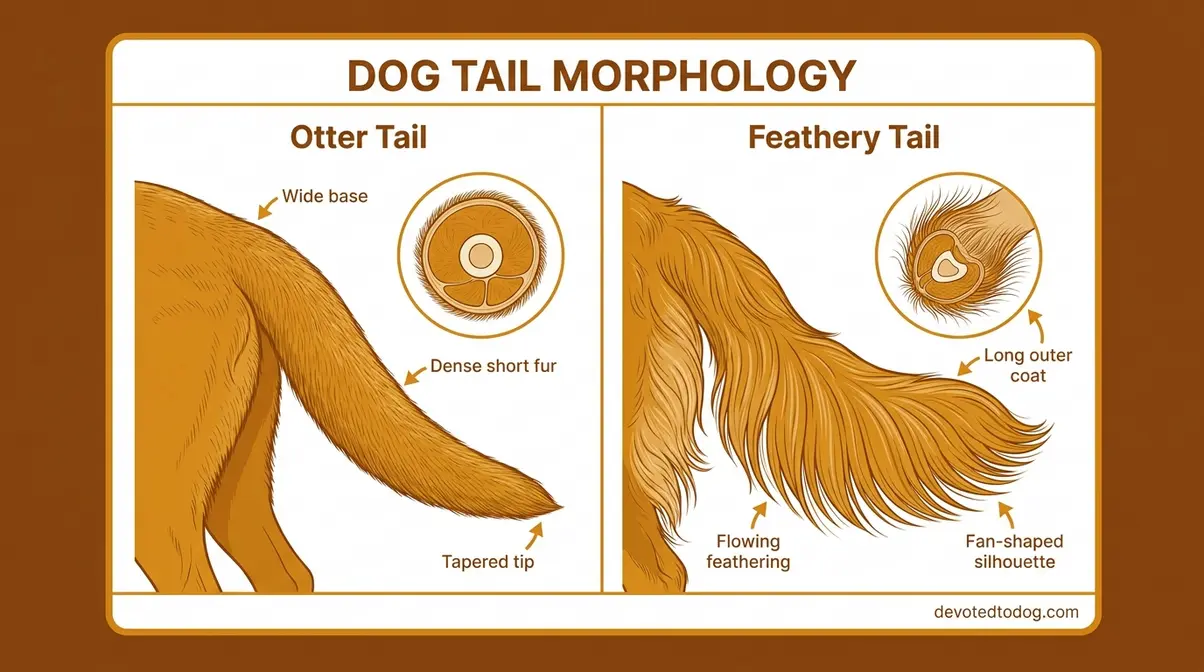
Size, Weight, and Build Compared
When evaluating golden retriever vs labrador size, both breeds occupy nearly the same weight class. Female Labs run 55–70 lbs; female Goldens 55–65 lbs. Males of both breeds typically land in the 65–80 lb range — solidly large dogs that need similar amounts of living space and exercise room. Neither is a “medium” breed in any practical sense. Where they diverge is build. Labs carry a broader, blockier head and a more compact, muscular frame — the legacy of a working water dog built for cold-water retrieves. Goldens have a narrower, more elegant muzzle and a slightly leaner overall frame. A stocky English show-line Lab can feel noticeably “bigger” in a small apartment than a similarly-weighted Golden, simply because of its density and head size. First-time owners in urban apartments often find this distinction matters more than the weight numbers suggest. One nuance worth noting: English (show-line) Labs tend to run heavier and broader than American (field-line) Labs — a distinction we’ll expand in the color and type section. Size is nearly a draw. Shedding is where the two breeds diverge sharply — and where many owners get a surprise.Shedding: Which Breed Sheds More?
Here’s the honest answer to labrador vs golden retriever shedding: both breeds shed significantly, and anyone who tells you Labs “barely shed” has either never owned one or vacuums every day. Both breeds blow their coats twice a year in heavy seasonal sheds, plus year-round background shedding. The difference is in the visibility and management requirement. Golden Retrievers need 3–4 brushing sessions per week to prevent matting and reduce loose hair in the home. Professional grooming every 6–8 weeks — at roughly $60–$100 per session — adds up to $400–$600 annually in grooming costs (Bark.com, 2026; PetCost-Calculator.com, 2026). Labs need 1–2 brushing sessions per week and far less professional grooming, keeping annual costs in the $150–$300 range. Over a 12-year lifespan, that grooming differential compounds to a $3,000–$4,200 premium for Golden owners — a number that feeds directly into the Health Budget component of The Retriever Fit Test. If you own light-colored furniture, both breeds will redecorate it. But Golden hair is longer, more visible, and significantly more likely to weave permanently into upholstery. Two smaller chores round out the picture. A Golden’s feathering traps mud and burrs, so expect more frequent baths than a Lab usually needs. Both breeds also need regular nail trims; if you’re nervous doing them at home, a groomer or your vet’s office can help. If grooming is where the Golden demands more effort, temperament is where the two breeds are most often misunderstood — especially the “calmer breed” debate.Temperament, Energy, and Trainability

“From what I know, labs tend to be higher drive/require more exercise than goldens. Not always, but goldens tend to be relatively calmer.” — Experienced dog owner, r/dogs communityThe Energy Match and Lifestyle Type criteria of The Retriever Fit Test draw directly from the data in this section.
Energy Levels and Daily Exercise Needs
Golden Retrievers typically begin to settle and show adult temperament around 18–24 months (approximately age 2). Labrador Retrievers often remain in an exuberant, high-energy behavioral stage until 24–36 months (age 2–3), with many owners and breed experts noting that full Lab maturity — particularly in field-line dogs — can stretch closer to three years (The Labrador Site, 2026; Turquoise Trail Retrievers, 2026). Both require a minimum of 60–90 minutes of daily exercise, though highly active Labs can comfortably absorb 90–120 minutes. Labs are more athletic and durable — better suited to high-intensity activities like dock diving, field trials, and agility. Goldens have strong endurance but are generally more content with moderate, consistent exercise: long walks, fetch sessions, and swimming. The practical implication for families is significant. A household with young children that can’t reliably commit to 90+ minutes of daily exercise will find a Golden more forgiving of occasional missed walks. A Lab left under-exercised for a week will redecorate your living room. A Golden will mope. Both are telling you something. The ASU dog breed behavior study reinforces that these are tendencies, not guarantees — a well-exercised field-line Lab can be calmer indoors than an under-stimulated show-line Golden.Are Labs calmer than Goldens?
Generally, Golden Retrievers are considered calmer than Labrador Retrievers. Labs often remain in an exuberant “puppy stage” for up to three years, while Goldens typically begin to settle around age two. This makes Goldens a popular choice for therapy dog work and families with young children. However, field-line dogs of either breed can be equally driven — breeding line matters more than breed label alone. Individual variation is significant, as confirmed by ASU/UMass behavior research.Trainability and Intelligence Compared
Both breeds rank in the top 10 for working and obedience intelligence. According to Stanley Coren’s intelligence ranking of 138 breeds — based on surveys of 208 obedience judges across North America — Golden Retrievers rank 4th and Labrador Retrievers rank 7th (Coren, “The Intelligence of Dogs”). For practical purposes, the difference between 4th and 7th is negligible. Both breeds learn new commands in five repetitions or fewer and obey first commands 95% of the time. The practical training difference lies in motivation. Labs often display stronger food drive, making treat-based training immediately effective from day one. Goldens are equally responsive but may be more easily distracted by social opportunities — they want to greet everyone in the training class before settling into the lesson. Neither distinction is a dealbreaker; it’s a style difference. Both breeds excel in service dog, therapy dog, and search-and-rescue roles. For most family owners, trainability is not a meaningful differentiator — both breeds will learn what you consistently teach them. For a detailed look at how Golden Retrievers rank in canine intelligence tests, see how Golden Retrievers rank in canine intelligence. Where trainability data converges, the Show Line vs. Field Line distinction pulls the breeds apart in ways most guides completely miss.Show Line vs. Field Line: Why It Matters
The golden retriever vs labrador temperament gap is most accurately described not as a breed-to-breed gap but as a breeding-purpose gap. Both breeds come in two distinct profiles — and buying the wrong line is the single most common source of owner disappointment. Labrador Retrievers: Field-line Labs (American-type) are leaner, more driven, and higher-energy. Bred for hunting and fieldwork, they may be too intense for a sedentary or moderately active household. Show-line Labs (English-type) are heavier, broader, and noticeably calmer — often described as the more “laid-back” Lab. A field-bred Lab from a hunting kennel will need 2+ hours of daily exercise and mental stimulation. An English show-line Lab may be genuinely content with 60 minutes. Same breed, very different dog. Golden Retrievers: Field-line Goldens are darker in color, leaner, and significantly more energetic than show-line counterparts. Show-line Goldens — including the English Cream type — tend to be calmer and more laid-back. Buying a field-bred Golden from a hunting kennel and expecting a gentle family companion is a recipe for frustration. Always ask breeders specifically about the parents’ working history and whether the litter is from show or field lines.Family Suitability and Aggression Research
For families with children or other pets, both breeds are excellent choices — and the data confirms this is not a meaningful differentiator between them. Purdue University canine aggression research indicates that both Golden Retrievers and Labrador Retrievers rank among the least aggressive dog breeds toward both humans and other dogs. Neither breed is well-suited as a guard dog — both are too friendly with strangers. Labs may bark more readily upon hearing an unfamiliar sound, but neither breed will reliably deter an intruder. For families specifically concerned about aggression, both retrievers are among the safest choices available. This is one factor where the breeds are genuinely equal.What is the #1 nicest dog breed?
While “nicest” is subjective, Golden Retrievers and Labrador Retrievers consistently rank among the friendliest and most good-natured dog breeds across expert assessments and owner surveys. Both are excellent choices for families, therapy work, and multi-pet households. Neither has a meaningful aggression concern, making them ideal companions for nearly any living situation. With family suitability settled for both breeds, the health data is where this comparison gets genuinely important — and where most guides let you down.Genetic Health Risks and Lifespan
What health risks should you know before choosing between a golden Labrador and a Golden Retriever? The differences are significant — and one condition in particular has earned the name “the silent killer” among Golden Retriever owners and veterinarians alike. Our team reviewed 7 peer-reviewed and institutional sources for this section, cross-referenced with owner community consensus across major breed forums.The health information in this section is for educational purposes only and should not replace professional veterinary advice. Consult a licensed veterinarian for breed-specific health screening recommendations before purchasing or adopting a dog.
Golden Retriever Health Risks
The “silent killer” in Golden Retrievers is cancer — specifically hemangiosarcoma and lymphoma. According to a UC Davis study of 652 Golden Retrievers, 65% died of cancer (Kent et al., PLoS ONE, 2018), making it a critical health consideration for the breed — one of the highest rates of any purebred dog. Hemangiosarcoma is a cancer of blood vessel walls that often presents with no external symptoms until a life-threatening internal rupture occurs. Hence “silent.” By the time clinical signs appear, the disease is frequently advanced. Lymphoma research from the Golden Retriever Lifetime Study identifies lymphoma as the second most common cancer affecting Golden Retrievers, arising from a complex interaction of genetic and environmental factors (PubMed, 2026). The Golden Retriever Lifetime Study — an ongoing Morris Animal Foundation project tracking over 3,000 Goldens — is the largest study of its kind and continues to generate actionable health data for the breed. A third condition worth knowing: sub-aortic stenosis (SAS), a congenital heart defect found in Goldens at higher rates than in Labs. Reputable breeders should provide OFA cardiac clearance certificates. What this means for you: annual veterinary check-ups are non-negotiable for Golden owners, not optional. Early detection significantly improves outcomes for both hemangiosarcoma and lymphoma. Cancer treatment costs — chemotherapy averaging $5,000–$10,000 for lymphoma (ImpriMed, 2026; Veterinary Cancer Society) plus diagnostics — represent a real financial scenario for Golden owners to plan around. For a comprehensive overview of conditions to monitor, see common Golden Retriever health issues and warning signs.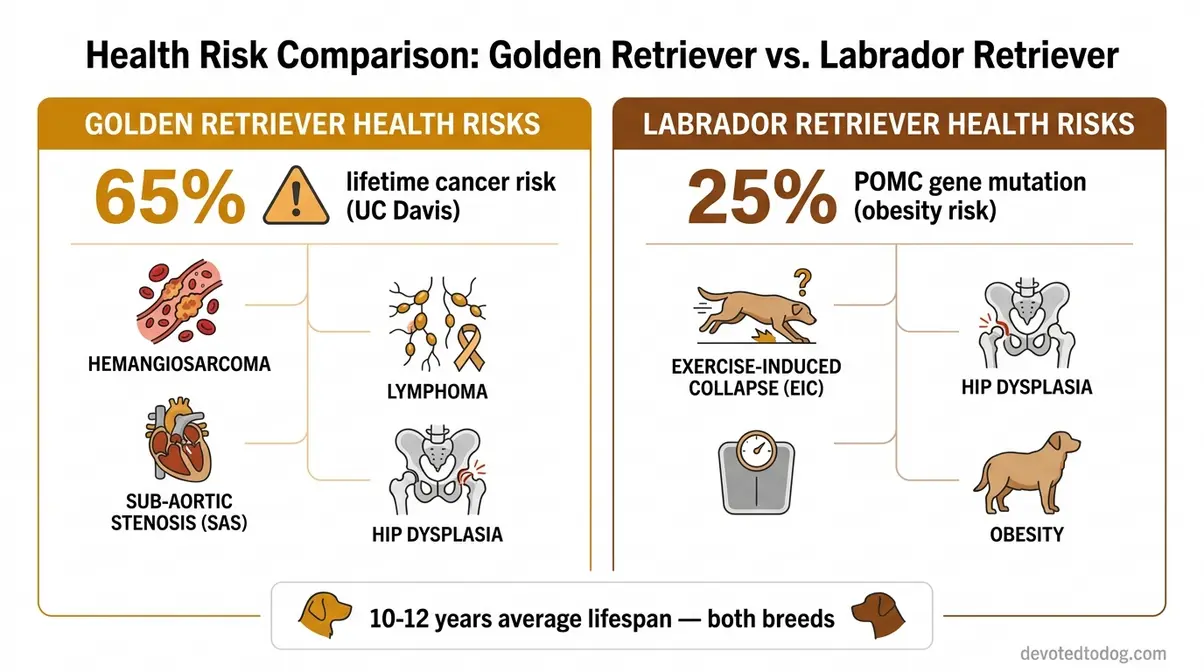
Labrador Retriever Health Risks: EIC and Beyond
Exercise-Induced Collapse (EIC) is a genetic condition found in Labrador Retrievers — rare in Goldens — where intense or prolonged exercise triggers progressive muscle weakness and collapse. The dog may appear fine before and after the episode but collapses mid-activity. Field-line Labs are most commonly affected. A DNA test for EIC is available, and reputable breeders should provide clear test results for both parents. Any breeder unable to produce EIC clearance for field-line Labs is a red flag. Obesity is a second significant risk — and it has a genetic basis. Research from the University of Cambridge identified a 14-base-pair deletion mutation in the POMC gene affecting approximately 25% of Labrador Retrievers (University of Cambridge, 2026). This mutation disrupts the brain pathway that regulates hunger and energy expenditure, causing affected dogs to feel persistently hungry and burn fewer calories at rest — making weight management a genuine challenge even with controlled feeding. A DNA test for the POMC mutation is now available through veterinary genetic laboratories. A UC Davis study on neutering health effects found that Labrador Retrievers are less vulnerable than Golden Retrievers to the long-term health effects of neutering, particularly regarding joint disorders and certain cancers (UC Davis Veterinary Medicine). Both breeds are susceptible to hip dysplasia — OFA hip and elbow clearance should be requested from all breeders regardless of breed.Lifespan Comparison: How Long Do They Live?
Both breeds average 10–12 years. According to UC Davis Veterinary Genetics Laboratory Labrador lifespan data, the average lifespan for a Labrador Retriever is approximately 12 years. Golden Retrievers’ median lifespan in North American lines has trended slightly shorter — research suggests this is linked to the breed’s elevated cancer burden. UK-bred and European Golden lines show somewhat longer median lifespans in survey data, though methodological differences between US and European studies make direct comparison difficult. The practical note for The Retriever Fit Test’s Health Budget criterion: Golden owners face a statistically higher probability of significant end-of-life veterinary costs, and earlier. Planning for pet insurance — particularly cancer coverage — is strongly recommended for Golden Retriever owners. Knowing what conditions to test for before you buy is the most actionable step you can take — here’s exactly what to ask a breeder.What to Ask Your Breeder: Genetic Screening Tests
Print this checklist and bring it to any breeder meeting — a reputable breeder will appreciate the questions and have the documentation ready.- For Golden Retriever breeders, request:
- OFA Hip and Elbow Clearance (both parents)
- OFA Cardiac Clearance (sub-aortic stenosis screening)
- OFA Eye Certification Registry (CAER) exam results
- DNA test for Progressive Retinal Atrophy (PRA)
- DNA results for ichthyosis, a breed-linked skin condition (both parents)
- For Labrador Retriever breeders, request:
- OFA Hip and Elbow Clearance (both parents)
- EIC (Exercise-Induced Collapse) DNA test results (both parents)
- CAER eye exam results
- POMC gene test results if obesity risk is a concern
- DNA results for CNM (centronuclear myopathy) and PRA (both parents)
Raising a Puppy: Golden vs. Lab Differences
Imagine bringing home a 10-week-old puppy from either breed. For the first six months, they’ll be nearly identical — curious, mouthy, and exhausting in the best way. The differences emerge around month 18, when the Golden begins to settle and the Lab decides it has at least another 18 months of chaos left. Labrador Retrievers often remain in an exuberant puppy stage for up to three years, compared to roughly two years for Golden Retrievers — a meaningful difference for families with young children. (Turquoise Trail Retrievers, 2026; The Labrador Site, 2026)The Puppy Stage: How Long Does It Last?
Golden retriever vs labrador puppies follow similar early milestones — both reach adult height by 12 months and continue filling out in muscle mass until 18–24 months. The behavioral divergence comes in the adolescent phase. Goldens typically begin showing more adult temperament around 18–24 months, becoming more reliably calm indoors and checking in with their owners more consistently. Labs often extend their high-energy adolescent phase to 24–36 months, with some field-line Labs maintaining intense energy levels closer to three years. During the puppy stage, both breeds require consistent training, socialization, and daily exercise. The Lab’s longer puppy stage means a longer window of potential destructive behavior when under-stimulated — chewing, counter-surfing, and general mayhem. Neither breed is forgiving of neglected exercise during this period. Early socialization between 8–16 weeks is equally critical for both. One caution applies to both breeds: go easy on a growing puppy’s joints. Long runs, big hikes, and repeated jumps in and out of the car put stress on joints that are still developing. Fetch on grass and free play are great; ask your vet when it’s safe to start jogging or longer hikes. For a structured approach to those early months, see our Golden Retriever puppy training guide.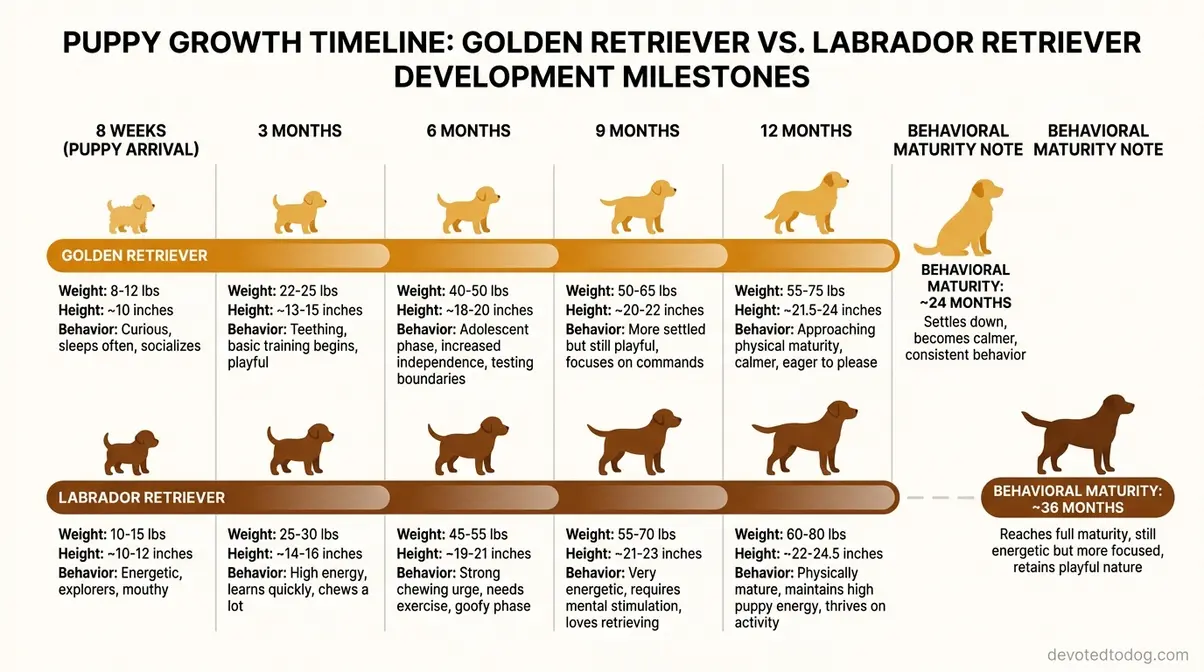
Puppy Training: Which Breed Is Easier to Start?
Both breeds are highly trainable from puppyhood, and neither has a meaningful edge for basic family obedience. Labs often show stronger food motivation from the very first training session, making treat-based methods immediately effective. Goldens are equally responsive but may take slightly longer to focus in distracting environments — a puppy class with other dogs nearby can turn a Golden into a social butterfly before a working student. Socialization needs are nearly identical. Both breeds benefit from diverse early exposure — different environments, people, sounds, and other animals — between 8 and 16 weeks. Short, positive training sessions of 5–10 minutes work well for both breeds at this stage. If you’re genuinely torn between the two and wondering whether a mix might sidestep the decision entirely, the Goldador — a Golden Retriever and Labrador mix — combines traits from both breeds. For a full breakdown of the Goldador’s temperament, care requirements, and where to find one, see our complete Goldador mix guide. Puppies aside, color and type variations within each breed confuse many buyers — here’s what actually matters.Color and Type Variations Explained
A chocolate Labrador, a yellow Labrador, and a black Labrador are all the same breed with the same behavioral potential. Coat color in Labs is a matter of genetics, not temperament. The same is not quite true for Golden Retriever types — where breeding purpose creates more meaningful differences. Coat color in Labrador Retrievers does not determine temperament — breeding line (field vs. show) is the meaningful variable. (Devoted to Dog, 2026)Labrador Color Variations: Yellow, Chocolate, and Black
For anyone comparing a chocolate labrador vs golden retriever — or any Lab color against a Golden — the key point is this: a chocolate Lab, a yellow Lab, and a black Lab have the same temperament potential. Color is determined by two separate gene loci (the B and E genes) and carries no behavioral information. The widespread belief that chocolate Labs are more hyperactive than yellow Labs is not supported by breed genetics or peer-reviewed behavioral research. The yellow Lab is the most visually similar to a Golden Retriever — this is what most “golden labrador” searchers are picturing. Side by side, a short-coated yellow Lab and a Golden Retriever can look strikingly similar from a distance. The meaningful distinction within Labs is field-line vs. show-line, not color. If you’re comparing a yellow Lab to a Golden Retriever, you’re comparing two visually similar dogs with meaningfully different coat maintenance needs and slightly different energy profiles. What about silver, charcoal, or champagne Labs? These dilute shades come from the D-locus gene, and a DNA test can show whether a dog carries it. The Labrador Retriever Club, the breed’s AKC parent club, does not recognize them as standard Lab colors. Cream and near-white Labs are different: they fall within the yellow range. If a breeder sells a “rare” silver Lab at a premium, ask more questions, not fewer. For a deeper look at Golden Retriever varieties, see types of Golden Retrievers: the ultimate guide. Within the Golden Retriever breed, the type differences are more meaningful — particularly for health and energy.Golden Retriever Types: English Cream vs. American
American Golden Retrievers (the AKC standard most commonly seen in the US) range from rich golden to red-gold in color, are typically leaner, and are often bred for field work or active family life. English Cream Golden Retrievers — sometimes called “White Goldens” or “European Goldens” — are lighter in color, heavier in build, and typically bred for show or companion purposes. English Cream Goldens are sometimes marketed as having lower cancer rates than American lines. This claim is disputed. UK and European survey data does show lower cancer mortality rates (20–39% of deaths in UK and Scandinavian studies vs. roughly 60–65% in U.S. studies; Kent et al., PLoS ONE, 2018), but researchers note significant methodological differences — including differences in spaying and neutering practices — that complicate direct comparison. No peer-reviewed study has definitively proven that English Cream lines carry lower cancer risk independent of these confounding factors (The Canine Chasm, 2026; PMC, 2026). What is reliably different: English Cream lines tend toward calmer, more laid-back personalities. An English Cream Golden from a reputable show kennel is often the closest you’ll get to the “gentle, laid-back” Golden of popular imagination. American field-line Goldens can be nearly as driven as a field-line Lab — a fact that surprises many first-time Golden owners. Type and color sorted — now for the question many buyers ask last but should ask first: how much does this actually cost?Cost of Ownership: Full Financial Breakdown
Both breeds cost roughly the same to buy. The lifetime cost difference emerges from three sources: grooming requirements, veterinary baseline care, and — most significantly for Golden Retriever owners — the potential cost of cancer treatment. Canine lymphoma chemotherapy averages $5,000–$10,000 per treatment course (ImpriMed, 2026; Veterinary Cancer Society), and that’s a scenario Golden owners face at a statistically higher rate than Lab owners. Prices and cost estimates verified as of early 2026. Costs subject to change.Purchase Price: What Do Puppies Cost in 2026?
Golden Retriever puppies from health-tested breeders typically run $1,000–$3,500 in the US (Rover.com, 2026; Lancaster Puppies, 2026). English Cream lines from imported European bloodlines can reach $3,000–$5,000. Rescue adoption through breed-specific Golden Retriever rescues typically runs $200–$600 and is available in most US states. Labrador Retriever puppies from reputable breeders typically cost $1,000–$2,500 (Spot Pet Insurance, 2026; Dogster, 2026). Field-line hunting Labs from specialized kennels can be priced similarly or higher. Rescue adoption runs $400–$800 through breed-specific rescues. A firm warning: prices below $500 from unverified sources almost always indicate puppy mills or backyard breeders without health clearances — a significant long-term financial and emotional risk. The health clearances covered in the previous section are your protection. For a complete breakdown of all acquisition costs, see our full Golden Retriever cost breakdown for 2026. Buying from out of state? Ask early who arranges the health certificate and travel paperwork, since it can take several days. Also ask whether the puppy comes with full or limited AKC registration. Pet-quality puppies are often sold on limited registration, which is fine for a family dog.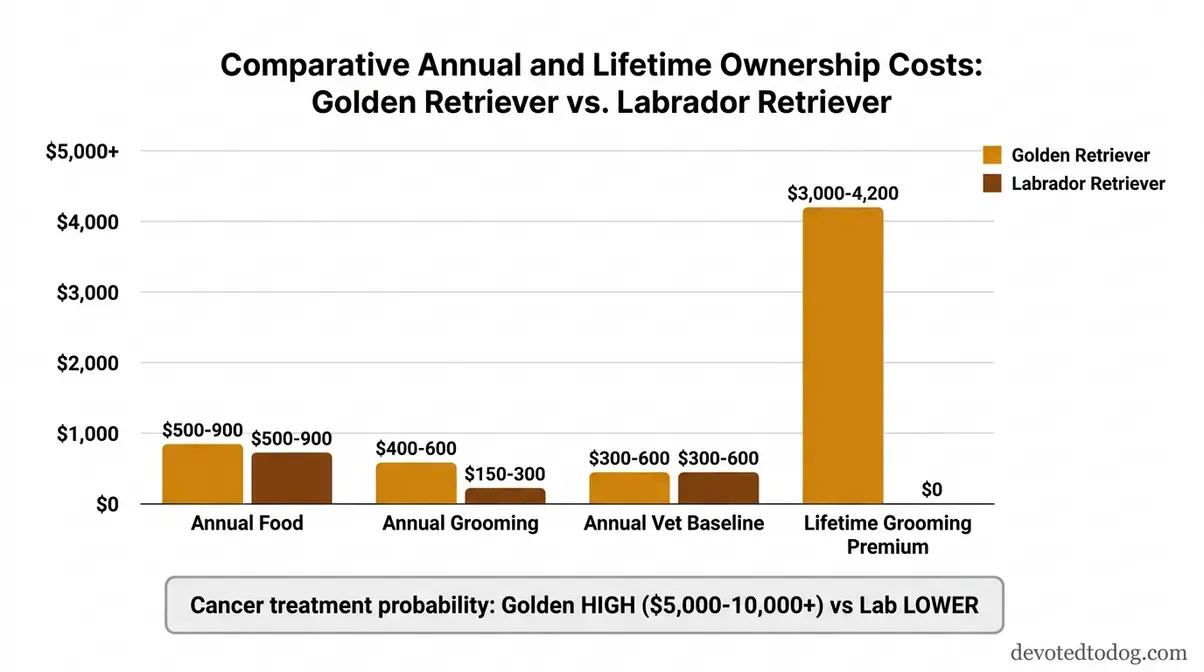
Lifetime Cost of Ownership Compared
Annual food costs are similar for both breeds — approximately $500–$900/year for quality large-breed food, depending on the brand and the dog’s size. This is not a meaningful differentiator. The grooming differential is. Professional grooming for a Golden every 6–8 weeks at $60–$100 per session totals $400–$600/year (PetCost-Calculator.com, 2026; Bark.com, 2026). Labs require far less professional grooming — $150–$300/year covers brushing supplies and occasional baths. Over a 12-year lifespan, that creates a $3,000–$4,200 grooming premium for Golden owners. Veterinary baseline costs are similar — $300–$600/year for routine wellness care and preventatives. The significant variable is oncology. Given that cancer caused 65% of Golden deaths in a UC Davis study, owners face a statistically meaningful probability of $5,000–$10,000+ in cancer treatment costs at some point during the dog’s life. Pet insurance with cancer coverage is strongly recommended for Golden owners — and beneficial for Labs given EIC and obesity management needs.| Cost Category | Golden Retriever | Labrador Retriever |
|---|---|---|
| Puppy Purchase Price (2026) | $1,000–$3,500 | $1,000–$2,500 |
| Annual Food | $500–$900 | $500–$900 |
| Annual Grooming | $400–$600 | $150–$300 |
| Annual Vet Baseline | $300–$600 | $300–$600 |
| Lifetime Grooming Premium (12 yrs) | +$3,000–$4,200 vs. Lab | — |
| Cancer Treatment Probability | High (cancer caused 65% of deaths in a UC Davis study) | Lower (EIC and obesity primary risks) |
The Goldador: Could a Mix Be Your Answer?
The Goldador — a first-generation cross between a Golden Retriever and a Labrador Retriever — is a legitimate option for families who find themselves genuinely torn between the two purebreds. As a hybrid, the Goldador combines the Golden’s gentleness and strong bond with its owner with the Lab’s athleticism and drive. The practical result is a dog that typically lands somewhere in between both parents on energy level, grooming needs, and trainability. The key variable is which parent the puppy takes after more strongly — and in a first-generation cross, that’s not predictable with certainty. Some Goldadors inherit the Golden’s longer coat and need regular brushing; others inherit the Lab’s short, low-maintenance coat. Energy level can skew either way. For families searching “golden retriever and labrador mix puppy” — a term that gets roughly 2,900 monthly searches — the Goldador is worth understanding before committing to either purebred. Puppy prices from reputable breeders typically run $800–$2,000 (early 2026 market estimates). Breed-specific health clearances should still be requested from both parent lines. The Goldador does not eliminate the health risks of either parent breed — it may inherit the Golden’s cancer predisposition or the Lab’s POMC mutation, and OFA hip clearances remain important. For a complete breakdown of the Goldador’s temperament, care requirements, training needs, and where to find a reputable breeder, see our complete Goldador mix guide.The Retriever Fit Test
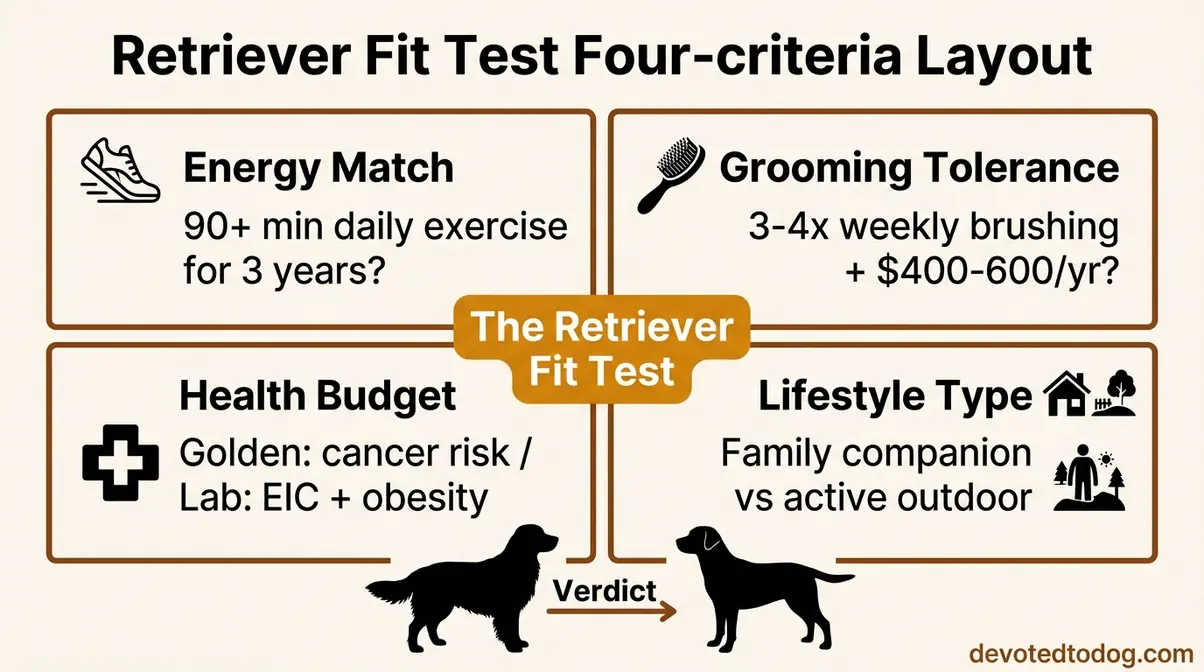
- The four criteria:
- Energy Match — Can you commit to 90+ minutes of daily exercise for up to 3 years?
- Grooming Tolerance — Can you brush a dog 3–4x per week and budget $400–$600/year for professional grooming?
- Health Budget — Can you absorb potential oncology costs of $5,000–$10,000+ (Golden) or manage EIC and obesity risk (Lab)?
- Lifestyle Type — Are you an active outdoor household, a hunter, or a family companion/therapy work household?
Choose a Golden Retriever If…
- You want a dog that mellows earlier — around age 2 — and is more forgiving of occasional gaps in the exercise schedule
- You can commit to 3–4 brushing sessions per week and $400–$600/year in professional grooming costs
- You’re interested in therapy dog work, emotional support roles, or a patient family companion
- Your household has young children who need a gentler, more naturally patient temperament
- You’re prepared for the Golden’s elevated cancer risk and can absorb potential oncology costs — or plan to carry robust pet insurance
- You prefer a dog that tends to settle calmly indoors after adequate exercise, rather than continuing to seek stimulation
Choose a Labrador Retriever If…
- You’re highly active and can commit to 90–120 minutes of vigorous daily exercise for up to 3 years
- You want minimal grooming — 1–2 brushing sessions per week and $150–$300/year in grooming costs
- You’re interested in hunting, field trials, dock diving, or other high-drive outdoor activities
- You want more color variety — yellow, chocolate, or black
- You prefer a dog that’s more athletic and durable for rugged outdoor adventures
- You want a lower probability of cancer-related veterinary costs, with the awareness that EIC (in field lines) and obesity management are the primary health considerations instead
When These Breeds Aren’t the Right Fit
Our evaluation found that for a meaningful minority of prospective owners, neither breed is the right choice — and recognizing that early saves considerable heartache. Small living spaces with no yard access. Both breeds need substantial daily exercise. A 500 square foot apartment without a nearby park or dog run is not a suitable environment for either breed without an extraordinary and consistent commitment to outdoor exercise. Urban owners who work long hours without a dog walker should think carefully before committing. Severe dog allergies. Neither the Golden nor the Lab is hypoallergenic. Both shed year-round with seasonal peaks. If allergies are a genuine concern in your household, a Poodle cross — a Goldendoodle or Labradoodle — may be more appropriate, though no dog is truly 100% allergy-safe. First-time owners with limited time. Both breeds are highly trainable, but both require consistent daily exercise and structured training throughout the puppy stage. A first-time owner who works 10-hour days without a dog walker, dog daycare, or a committed household partner will find either breed challenging and potentially destructive. If you’re uncertain whether your lifestyle can genuinely accommodate either breed, consulting with a certified dog trainer (CPDT-KA) or a breed-specific rescue organization before purchasing is strongly recommended. Rescue organizations in particular have deep knowledge of which household types succeed with each breed.How We Evaluated These Breeds
Our team reviewed seven peer-reviewed and institutional sources for this guide, cross-referenced with owner community consensus across major dog forums and subreddits including r/goldenretrievers and r/labrador. Sources reviewed include: AKC breed standards, UC Davis Health research, UC Davis Veterinary Genetics Laboratory data, PubMed peer-reviewed studies (including the Golden Retriever Lifetime Study), Purdue University canine welfare research, the ASU/University of Massachusetts dog behavior study, and University of Cambridge POMC gene research. Evaluation criteria covered physical traits, temperament data, genetic health statistics, grooming requirements, cost of ownership, puppy-stage differences, and suitability for different household types. Health claims in this article have been reviewed for accuracy against Tier 1–2 veterinary sources only. All pricing data has been verified against current market listings and breed cost guides as of early 2026. No affiliate links are present in this article.Frequently Asked Questions
Which is the best, a Labrador or a Golden Retriever?
Neither breed is objectively “best” — the right choice depends on your household’s energy level, grooming tolerance, and health budget. Labrador Retrievers suit highly active families who want minimal grooming and a more athletic companion, while Golden Retrievers suit families seeking a gentler, more patient dog that mellows earlier. Assess your lifestyle honestly before choosing.Is a Golden Retriever just a Lab with long hair?
No — they are distinct breeds with meaningful differences beyond coat length. While visually similar from a distance, they differ in coat maintenance requirements, specific genetic health risks, and subtle temperament nuances.Is a Golden Retriever or a Labrador better for first-time owners?
Both make good first dogs if you have time for daily exercise, because both are eager to please and easy to motivate. A Lab often suits first-timers who want less grooming: 1–2 brushing sessions a week versus 3–4 for a Golden. A Golden suits first-timers who want a dog that tends to settle a little earlier and don’t mind regular brushing.Are silver or charcoal Labradors purebred?
The Labrador Retriever Club, the AKC parent club for the breed, does not recognize silver, charcoal, or champagne as standard Lab colors. These dilute shades come from the D-locus gene. Cream and near-white Labs, by contrast, fall within the accepted yellow range.What is the silent killer in Golden Retrievers?
The “silent killer” in Golden Retrievers refers to their high predisposition to cancer, particularly hemangiosarcoma and lymphoma. Hemangiosarcoma is a cancer of blood vessel walls that often presents with no symptoms until a life-threatening rupture occurs. In a UC Davis study, 65% of Golden Retrievers died of cancer, a high rate relative to many breeds (Kent et al., PLoS ONE, 2018). Regular veterinary check-ups and early screening are critical.What dogs turn on their owners the most?
Neither Golden Retrievers nor Labrador Retrievers are associated with owner-directed aggression. Dog bites from any breed are most often linked to improper socialization, fear, pain, or mistreatment rather than breed-specific tendencies. For families specifically concerned about this, both retrievers are among the safest choices available.How do you say “I love you” in dog speak?
Dogs communicate affection through sustained eye contact, a relaxed body posture, and slow blinking. For Golden Retrievers and Labradors, leaning against you, bringing you a toy, or resting their chin on your lap are classic affection signals. Slow eye contact with a relaxed, soft face from your dog is the canine equivalent of a verbal expression of love. Respond with calm, gentle interaction to reinforce the bond. Prices and health statistics verified as of early 2026. For families choosing between a golden Labrador and a Golden Retriever, the decision comes down to four variables: energy match, grooming tolerance, health budget, and lifestyle type. Golden Retrievers carry a high cancer risk (cancer caused 65% of deaths in a UC Davis study) but offer a gentler, earlier-settling temperament ideal for family and therapy work. Labrador Retrievers are higher-drive, easier to groom, and less vulnerable to neutering-related health effects — making them the better fit for highly active households that want minimal coat maintenance and maximum outdoor capability. The Retriever Fit Test — our structured 4-criteria framework — cuts through the noise of generic breed advice. If your household scored higher on Energy Match and Lifestyle Type, the Lab wins. If Grooming Tolerance and a patient, earlier-settling temperament are your priorities, the Golden wins. Either way, you’re choosing one of the most loved, trainable, and family-compatible breeds in the world — a decision that will reward you for a decade or more. Before you buy or adopt, request OFA health clearances and EIC test results from any breeder you consider. Schedule a consultation with a certified dog trainer or veterinarian to discuss which breed suits your specific household. When you’re ready to go deeper on Golden Retriever health, see our guide to common Golden Retriever health issues and warning signs. More breed comparisons: Golden Retriever vs. Border Collie · Bernese Mountain Dog · Goldendoodle · Boxer · Irish Setter