

The scene repeats in thousands of Golden homes. You reach down to pet your puppy, and instead of leaning in, he wraps his mouth around your fingers. The stronger he gets, the more it hurts. You know he is not trying to hurt you. But you have started keeping a toy within reach just so you can pet your own dog.
If you’re living that right now, you’re not alone and nothing is wrong with your dog.
Golden retriever mouthing and nibbling is one of the most misunderstood puppy behaviors new owners face. It’s not aggression. It’s not a character flaw. It’s instinct, deeply wired into a breed that was literally designed to use its mouth gently. The frustration is real, but the behavior is solvable.
By the end of this guide, you’ll understand exactly why your Golden does this, when it peaks, and the five techniques that actually move them along the Soft Mouth Spectrum toward gentle, controlled contact. We’ll cover a month-by-month timeline, the specific mistakes that undo progress, and exactly when to call in a professional.
Golden retriever mouthing and nibbling is a normal, breed-specific behavior rooted in their “soft mouth” retriever instinct. But it can be trained into gentle, controlled contact.
- It’s not aggression: Most puppy mouthing is play, exploration, or teething discomfort. Not a warning sign. Understanding this distinction is the first step toward effective training.
- Peak biting occurs at 8–16 weeks (the “carpet shark phase”) and again during adolescence (6–18 months), two distinct stages that require different training responses.
- Bite inhibition training works: Redirection, the “ouch” method, and consistent time-outs are the three most evidence-backed techniques for reducing mouthing behavior.
- The Soft Mouth Spectrum: Training doesn’t flip a switch. It moves your puppy through stages, from hard mouthing → soft mouthing → gentle contact → no contact, with each stage requiring a different response.
- With consistency, most Golden Retrievers significantly reduce biting by 6–12 months of age as teething completes and impulse control develops.
Written by Coral Drake · Reviewed by Brianna York, Former Veterinary Technician · Last updated July 29, 2026 · Sources accessed July 2026
Why Is Your Golden Retriever So Mouthy?

Golden Retrievers are naturally mouthy because they were bred as retrievers with a “soft mouth” instinct, and puppies use mouthing to explore, play, and soothe teething discomfort. This is normal for teething puppies, exactly what the AKC notes when describing nipping at fingers and toes: it’s completely normal behavior that can be trained away. Understanding the root cause is the first step to addressing it without frustration.
This section exists because most owners arrive here asking the wrong question. Instead of “how do I stop this?” the more useful question is “why is this happening?”, because the answer changes everything about how you respond.
The Soft Mouth Spectrum is the framework this guide uses: bite inhibition training doesn’t flip a switch. It moves your puppy along a spectrum from hard mouthing → soft mouthing → gentle contact → no contact, with each stage requiring a different response. Before you can use the Spectrum, you need to understand the forces driving your puppy’s mouth toward your hands in the first place.
The “Soft Mouth” Instinct: It’s in Their DNA
Soft mouth refers to a Golden Retriever’s genetically inherited ability to carry objects, including game birds, without crushing or puncturing them. This trait wasn’t accidental. Lord Tweedmouth developed the breed in the Scottish Highlands starting in the 1860s, selectively breeding dogs that could retrieve waterfowl intact. That 150-year selective pressure produced a dog whose default mode of interacting with the world is gentle, mouthing contact.
Golden Retrievers were selectively bred to carry game without damaging it. Their mouthy behavior is the same instinct expressed in a domestic context. This reframe matters: the behavior you’re trying to manage isn’t a flaw to eliminate. It’s the breed’s history of having a soft mouth expressing itself in your living room.
Cobbing is the gentle, corn-cob nibbling motion Goldens use on hands and arms. It is a specific expression of this instinct. When your puppy wraps their mouth around your wrist and nibbles in that rhythmic, almost meditative way, they’re not testing you. They’re doing what their DNA was built to do. It’s affectionate, not aggressive.
Worth noting: this expressive, gentle nature is part of why the Golden Retriever consistently ranks as one of the most popular dog breeds in the United States. Their mouthy tendencies come with the territory of a breed people love deeply.
Teething, Exploration, and Overstimulation
Three immediate triggers drive most mouthing episodes: teething discomfort, sensory exploration, and overstimulation.
Puppies begin losing their baby teeth around 12–16 weeks, and the discomfort drives them to chew and mouth anything available, including your fingers. This is the peak of the “carpet shark phase,” and the urgency behind the nibbling makes complete sense when you realize the puppy’s gums genuinely hurt.
Beyond teething, puppies use their mouths the way human toddlers use their hands. Mouthing is how they gather information about texture, temperature, and pressure. Every new object, including your hand, gets investigated this way.
The third trigger is overstimulation. Many mouthing episodes escalate during petting or play because the puppy becomes excited and loses impulse control. Watch for the pre-escalation signs: dilated pupils, a slightly stiffer body posture, and rapid tail wagging. These cues appear just before “constantly nibbles” becomes something closer to out of control nipping. Recognizing them lets you redirect or end the session before the behavior escalates.
Is It Play Mouthing or Aggression? How to Tell the Difference

This question stops nearly every new Golden Retriever owner cold, and it deserves a direct answer.
Distinguishing normal mouthing from aggression is something the ASPCA addresses directly: while most puppy mouthing is normal behavior, some puppies may bite out of fear or frustration, which can signal potential problems. The key is reading the whole body, not just the mouth.
| Normal Play Mouthing | Seek Professional Guidance |
|---|---|
| Loose, wiggly body | Stiff, rigid posture |
| Soft, relaxed eyes | Hard stare or whale eye |
| Stops when you disengage | Continues or escalates when you stop |
| High-pitched play growl | Low, sustained growl |
| Easily redirected to a toy | Ignores redirection |
| Mouthing is opportunistic | Targeted, repeated biting of a specific person |
Normal play mouthing has a loose, almost goofy quality. The puppy’s body wiggles, their eyes are soft, and the moment you stop engaging, they stop too. Out of control nipping that doesn’t pause when you disengage is a different signal entirely.
One specific red flag worth naming: resource guarding (growling or snapping when approached near food, toys, or resting spots) is distinct from play mouthing and should always be addressed with a certified professional dog trainer (CPDT-KA). It doesn’t resolve on its own with the techniques in this guide.
If the behaviors in the right column describe what you’re seeing, consult a CPDT-KA certified trainer. That’s the appropriate professional for this concern, not a general obedience class.
Knowing the cause is reassuring, but what most owners really want to know is: when does this phase end? The answer depends on your puppy’s age.
When Does Golden Retriever Biting Get Better? A Month-by-Month Timeline

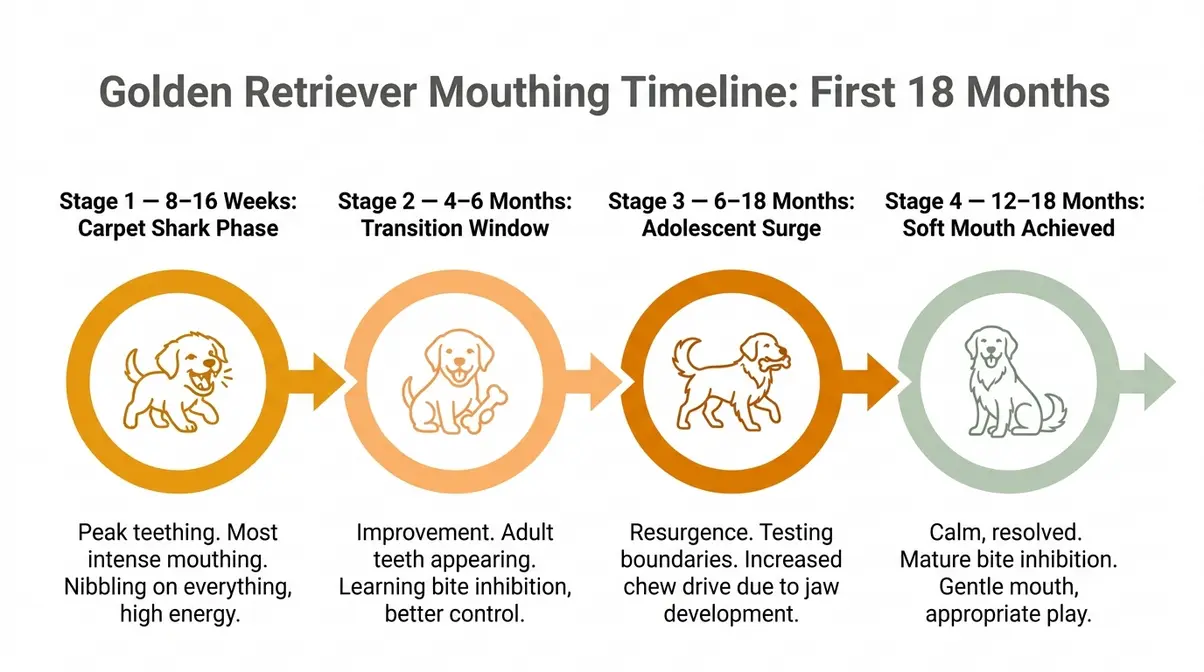
With consistent training, most Golden Retrievers significantly reduce biting between 6 and 12 months. The behavior peaks at two distinct stages: the teething phase (8–16 weeks) and the adolescent surge (6–18 months). Understanding both helps owners stay consistent when it feels like the problem is getting worse, not better. Knowing where your puppy sits on the Soft Mouth Spectrum helps you choose the right technique from the five-technique section below for their current stage.
The Carpet Shark Phase: 8–16 Weeks
Age range: 8–16 weeks. This is the period that Golden Retriever owner communities have accurately named the “carpet shark phase”, and if you’re in it right now, the name probably feels exactly right. At this stage, Golden Retrievers are most bitey: baby teeth are at their sharpest, teething discomfort is highest, and puppies have essentially zero bite inhibition. The AKC confirms that normal for teething puppies includes nipping at fingers and toes. This is expected behavior at this developmental window.
Every interaction is an opportunity to mouth. Petting, walking, greetings, even quiet moments on the couch. A 10-week-old Golden approaches all of it with their mouth first. This isn’t a sign of a difficult dog. It’s a sign of a dog in the most exploratory, sensation-seeking phase of their development.
The reassuring part: this is also the most trainable window. Puppies at this age are highly receptive to social feedback, which means the “ouch” method and redirection land with real impact. Their social learning is at its peak, and the habits formed now carry forward. Review the earliest developmental milestones for a newborn puppy for broader context on what’s happening biologically during these first weeks.
The good news: most puppies move through this phase by 4–6 months. The less good news: a second wave is coming.
The Transition Window: 4–6 Months
Age range: 4–6 months. Between four and six months, most Golden Retriever owners notice a genuine improvement in mouthing frequency. Baby teeth have fallen out, adult teeth are coming in, and early bite inhibition training is beginning to take hold. The carpet shark phase fades, and for a few weeks it can feel like the problem is solved.
It isn’t, or at least not yet. This transition window is a critical moment to reinforce training rather than relax it. The habits built here determine how the adolescent surge is managed. Puppies in this window are still forming their understanding of what’s acceptable, and consistency now pays dividends later.
The most common mistake during this period: owners ease up on training because the biting has improved. When the adolescent surge arrives, that lapse in consistency makes the resurgence feel like a regression, and a confusing one at that. Keep applying the same rules, the same verbal markers, and the same consequences during this window. Think of it as maintenance, not graduation.
Then, somewhere between 6 and 18 months, the biting often comes back: harder, more persistent, and more confusing for owners who thought they’d solved it.
The Adolescent Surge: 6–18 Months
Age range: 6–18 months. The adolescent surge catches most Golden Retriever owners off guard. They’ve navigated the carpet shark phase, they’ve seen improvement, and then, somewhere around 7 or 8 months, the out-of-control nipping is back. The dog is larger, faster, and more jaw-strong than at 10 weeks, and the mouthing during greetings or play can now leave real marks.
Three forces drive this resurgence: hormonal changes, increased jaw strength, and boundary-testing behavior. The adolescent Golden isn’t reverting; they’re going through a developmental phase analogous to human teenage years, testing where the limits actually are. This is the stage where adult mouthing habits are formed, which is exactly why staying consistent matters most.
Play biting in adult dogs is addressed directly by the ASPCA, which notes that mouthing can be a common behavior in adult dogs as well as puppies, often occurring during play or when seeking attention. That’s the adolescent surge in action.
The same five core techniques apply here. They just need to be applied more consistently and with more patience than during the teething phase. Review understanding the different life stages of a Golden Retriever for broader context on what’s happening hormonally during this period.
What Is the Hardest Stage of a Golden Retriever?

Most owners find the adolescent period (6–18 months) the hardest stage for biting. The dog is larger and stronger, the biting is more physically painful, and the apparent regression after the transition window improvement can feel like a training failure. The teething phase (8–16 weeks) is the most intense in terms of frequency, but the adolescent surge is the most challenging in terms of physical impact and owner frustration. Both stages are temporary with consistent training.
Knowing the timeline is reassuring. But the timeline only improves with consistent training. Here are the five techniques that actually move your Golden along the Soft Mouth Spectrum.
How to Stop Golden Retriever Mouthing: 5 Proven Techniques

There are five evidence-backed techniques for stopping Golden Retriever mouthing, and they work best when applied consistently across every household member. According to UC Davis Veterinary Medicine, key training strategies for mouthy puppies include redirecting attention to an acceptable object, rewarding acceptable behavior, and avoiding rough play. These five techniques map directly to the Soft Mouth Spectrum: Steps 1–3 address the hard-mouthing end, while Steps 4–5 support the transition toward no-contact.
- The five techniques at a glance:
- Redirect to an appropriate chew toy
- Use the “ouch” method to teach bite inhibition
- Time-outs and removing attention
- Teach “Leave It” and “Off” commands
- Manage energy and overstimulation before it starts
Step 1: Redirect to an Appropriate Chew Toy
Redirecting their biting onto appropriate chew toys is the first-line response to any mouthing episode. It works because it satisfies the puppy’s need to mouth while teaching them what is and isn’t acceptable. It doesn’t suppress the instinct. It channels it.
Managing Mouthy Behaviors is covered in detail by Ohio State University College of Veterinary Medicine, which recommends providing appropriate chew outlets, including frozen food-stuffed Kongs, Nylabones, and durable stuffed toys, to manage mouthing behavior.
- 4-step redirection sequence:
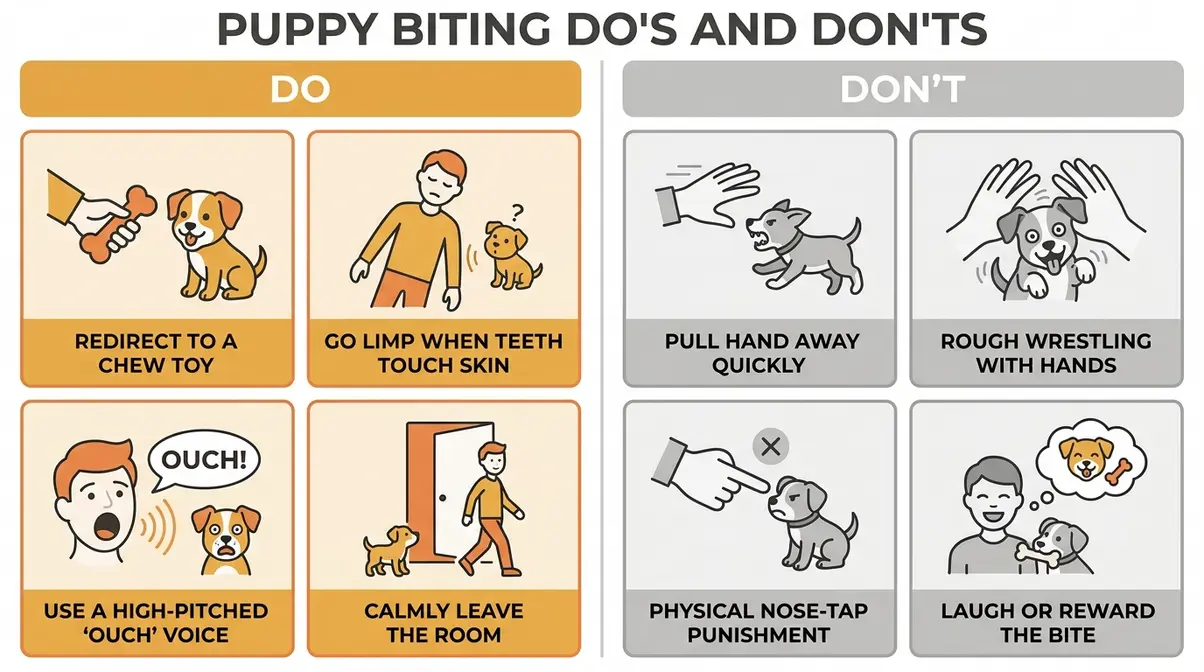
- The moment teeth touch skin, calmly say “toy” or “get your toy.”
- Immediately offer a durable chew toy within reach.
- When the puppy takes the toy, praise calmly, a quiet “yes” or “good.”
- If the puppy ignores the toy and returns to mouthing, move to Step 3 (time-out).
One practical note: keep a chew toy in every room so redirection is always possible within two seconds. Frozen Kongs deserve a specific mention here. The cold temperature soothes gum discomfort during the teething phase, making them particularly effective at 8–16 weeks.
Redirection works best when the puppy is calm. When they’re already escalated, you need a communication signal they understand. That’s where the “ouch” method comes in.
Step 2: Use the “Ouch” Method to Teach Bite Inhibition
Picture a 12-week-old Golden mid-play, biting a littermate too hard. The other puppy yelps sharply and stops playing. The biter pauses, startled. That social feedback, the yelp that ends the fun, is exactly what the “ouch” method replicates.
Bite inhibition is the ability to control the force of a bite. Expert tips on puppy mouthing from the AKC recommend saying “ouch!” or “yip!” in a high-pitched voice whenever your puppy bites, as a technique to help teach bite inhibition. The goal isn’t to eliminate mouthing immediately; it’s to teach the puppy to control force, moving them along the Soft Mouth Spectrum one interaction at a time.
- 4-step ouch method sequence:
- When teeth touch skin with any pressure, say “ouch!” in a high-pitched voice.
- Go limp immediately, stop all movement and interaction for 10–30 seconds.
- Resume play calmly.
- If biting continues, escalate to a time-out (Step 3).
The most common application error: saying “ouch” in a low, stern voice. The high-pitched yelp is essential because it mimics puppy communication. A deep “no” sounds like a bark; it can actually excite rather than interrupt.
One important nuance most guides skip: some puppies become more aroused by the yelp, not less. If your puppy escalates after the “ouch,” skip straight to silent withdrawal (Step 3). The goal is a soft mouth; any method that reliably moves toward that end is the right one for your dog.
If the yelp method excites your puppy rather than stopping them, the time-out is your most powerful tool.
Step 3: Time-Outs and Removing Attention
Does your puppy seem to mouth more intensely the more you react? That’s not coincidence. Puppies mouth because it produces a response, and any response, even a frustrated one, is socially rewarding.
The guide from UC Davis Veterinary Medicine identifies redirecting attention to an acceptable object and rewarding acceptable behavior as the core strategies for nipping puppies. The time-out is the logical complement: it removes the social reward entirely.
- 4-step time-out sequence:
- When biting continues after the “ouch” signal, calmly say “too bad” or “done.”
- Stand up, turn away, and leave the room for 30–60 seconds.
- Return and resume interaction as if nothing happened.
- If biting resumes immediately, repeat. Consistency across repetitions is what teaches the rule.
Two practical alternatives for puppies who follow you out of the room: a baby gate that briefly separates you, or a short leash tether that prevents following. These aren’t punishments; they’re physical versions of the same message: biting ends the fun.
This is not punishment. It’s information. The puppy learns “biting = no more play” through repetition, not fear or pain.
Time-outs address the immediate behavior. Commands address the underlying impulse, and two commands are particularly effective.
Step 4: Teach “Leave It” and “Off” Commands
“Leave it” and “off” are the proactive tools in your training kit: the difference between preventing a mouthing episode and responding to one.
“Leave it” teaches your Golden to disengage from something before making contact. It’s most useful during greetings and petting sessions, where mouthing is most likely to start. “Off” teaches the puppy to remove their mouth from skin or clothing on command, useful mid-episode when redirection hasn’t landed.
- “Leave It” training sequence:
- Hold a treat in a closed fist at the puppy’s nose level.
- Wait. The puppy will nose, lick, and possibly mouth the fist.
- The moment the puppy backs off or looks away, say “leave it” and reward with your other hand.
- Gradually generalize: practice with your open hand, then your wrist, then during petting.
The AKC notes that training bite inhibition alongside redirecting attention and burning off excess energy forms the core approach to stopping puppy biting. “Leave it” is one of the most versatile commands a Golden can learn. It applies to mouthing, food stealing, and leash reactivity. The investment in teaching it pays off across multiple behavior areas, not just this one.
During the adolescent surge, practice “leave it” for two minutes before every petting session. Proactive training prevents the episode rather than responding to it.
Commands give you a verbal tool. But the most underrated technique for reducing mouthing has nothing to do with training: it’s about energy.
Step 5: Manage Energy and Overstimulation Before It Starts

Most mouthing episodes don’t start from nowhere. They escalate, and that escalation almost always follows a period of high-energy play or prolonged excitement. A puppy who is overtired or overstimulated has lost the impulse control needed to keep their mouth soft.
- 3-strategy energy management approach:
- Schedule a 10–15 minute structured play session before any petting or cuddle time, let the puppy burn physical energy first.
- Use a sniff walk (nose-to-ground exploration, letting the puppy lead) to tire them mentally. Mental exercise depletes energy more efficiently than physical exercise alone.
- Watch for the pre-escalation cues covered earlier (dilated pupils, stiffening body) and end the session before mouthing starts.
The AKC identifies burning off excess energy as one of the core methods for stopping puppy biting. Mental exercise through puzzle feeders, sniff walks, and short training sessions is particularly effective. A 10-minute training session tires a puppy more than a 30-minute run.
The “settle” exercise adds another layer: before petting begins, ask your puppy to lie on a mat for 30–60 seconds. This resets their arousal level and signals that calm behavior precedes the reward of attention.
These five techniques are proven. But even with the right tools, there are five specific mistakes that can undo weeks of progress.
5 Mistakes That Make Golden Retriever Mouthing Worse
Even with the right techniques in place, five specific mistakes can reset a puppy’s position on the Soft Mouth Spectrum and undo weeks of progress. The most common is also the least obvious: inconsistency across household members. Each mistake below works against training by sending a conflicting signal. The puppy learns from patterns, not individual corrections.
Rough Play That Teaches Biting Is Fun
The scenario is familiar: owner gets on the floor, wrestles with the puppy using their hands, plays “chase the fingers.” It’s fun, and the puppy loves it. But it’s quietly dismantling every bit of bite inhibition training you’ve done.
The problem is that puppies cannot distinguish between “biting hands during wrestling” (apparently allowed) and “biting hands during petting” (not allowed). The rule, from the puppy’s perspective, is that hands are for biting. When the context changes and you expect a different response, the puppy has no framework for why the rule shifted.
The fix is straightforward: all hand-based rough play stops. Use toys as the intermediary for every play interaction involving biting. One nuance worth preserving: tug-of-war is acceptable if the puppy reliably releases on the “drop it” command. The game isn’t the problem. Hands as biting targets are.
Inconsistent Rules Across the Household

Inconsistent responses across household members are one of the most common reasons bite inhibition training fails; puppies learn rules from patterns, not individual corrections.
In practice, inconsistency looks like this: one person applies the “ouch” method every time. Another laughs when the puppy nibbles their fingers; a third pushes the puppy away (which the puppy reads as an invitation to play). Three different responses to the same behavior teach the puppy that the rule is person-dependent, and a person-dependent rule isn’t a rule at all.
The solution is a five-minute household meeting. Agree on one verbal marker (“ouch” or “too bad”) and one consequence (time-out, turning away). Everyone applies it, every time, without exception. This same principle applies broadly: consistent rules about puppy-proofing your home to prevent destructive chewing follow the same logic. Inconsistency in any area of boundaries creates confusion about all of them.
Pulling Your Hand Away Quickly
When teeth touch skin, the instinctive response is to yank your hand away. It’s fast. It’s reflexive, and it makes the mouthing worse.
The quick movement triggers the puppy’s prey drive. The retreating hand becomes a moving target, exactly the kind of stimulus that activates a dog’s chase instinct, and out of control nipping can follow within seconds. What felt like a mouthing episode becomes a lunge-and-bite sequence.
The expert tips on puppy mouthing from the AKC point toward techniques that avoid triggering the puppy’s natural instincts to chase and bite moving objects. The counter-intuitive correction: when teeth touch skin, go limp and still. Don’t pull away. Say “ouch” and wait. The stillness removes the prey-drive trigger and gives the “ouch” signal a chance to land.
Two More Mistakes to Avoid:
- Using physical punishment: pushing, tapping the nose, or scruffing the puppy does not teach bite inhibition. It teaches fear, which can increase aggression risk. The ASPCA is explicit that fear-based responses to mouthing can create more serious behavioral problems down the line.
- Giving up too soon: bite inhibition training requires 4–8 weeks of consistent application. Most owners see improvement within two weeks but stop before the behavior is fully trained, then conclude that “nothing works.”
Most mouthing cases resolve with consistent application of these techniques. But there are specific situations where professional guidance is the right call.
When Should You Call a Professional Dog Trainer?
The five techniques in this guide resolve the vast majority of Golden Retriever mouthing cases. But there are specific situations where professional guidance is not optional. Recognizing them is a sign of responsible ownership, not failure.
Red flags that warrant a CPDT-KA certified trainer:
- Biting that draws blood and the puppy does not back off when you yelp or disengage
- Growling that is low, sustained, and accompanied by a hard stare or stiff body (distinct from the high-pitched play growl during tug or chase)
- Resource guarding: growling or snapping when approached near food, toys, or resting spots
- Biting that is targeted at a specific person (especially a child) and escalating in frequency or intensity
If your Golden Retriever’s biting is accompanied by stiff body language, a hard stare, or growling that doesn’t stop when you disengage, consult a CPDT-KA certified trainer. These are signs of fear or frustration, not play.
As the ASPCA notes when distinguishing normal mouthing from aggression, while most puppy mouthing is normal behavior, some puppies may bite out of fear or frustration, which can signal potential problems with future aggression. A CPDT-KA certified trainer, not just a general obedience class, has the specific credentials to assess and address fear-based or frustration-based biting. Find a certified trainer through the Certification Council for Professional Dog Trainers (CCPDT).
Frequently Asked Questions
Why is my Golden Retriever so mouthy?
Golden Retrievers are naturally mouthy because they were bred as retrievers with a “soft mouth” instinct, the same trait that made them excellent hunting dogs for over 150 years. Puppies also use mouthing to explore their environment, soothe teething discomfort, and communicate during play. This behavior is completely normal and not a sign of aggression. It typically peaks between 8–16 weeks and again during adolescence around 6–9 months. With consistent bite inhibition training, it becomes manageable and eventually transitions to gentle, controlled contact.
At what age do golden retrievers stop biting?
Most Golden Retrievers significantly reduce biting between 6 and 12 months of age as teething completes and impulse control develops. The instinct to be mouthy may persist into adulthood, but the painful, hard biting of puppyhood typically subsides after the teething phase ends. Consistent bite inhibition training accelerates this timeline. Some dogs experience a resurgence during adolescence before settling into gentler contact; patience and consistency across both stages are the deciding factors.
What is the hardest stage of a Golden Retriever?
Most owners find the adolescent period (6–18 months) the most challenging stage for Golden Retriever biting, because the dog is larger, stronger, and more persistent than during early puppyhood. The teething phase (8–16 weeks), often called the “carpet shark phase”, is the most intense in frequency. During adolescence, hormonal changes and boundary-testing combine with increased jaw strength to make mouthing more physically impactful. Consistent training during both stages is essential. The behavior does improve with time and effort.
Why is my puppy biting me aggressively and growling?
Most puppy growling during play is normal. A high-pitched play growl during tug or chase is not aggression. However, a low, sustained growl accompanied by a stiff body, hard stare, or snapping that doesn’t stop when you disengage can signal fear, frustration, or resource guarding. These are distinct from play mouthing and warrant prompt attention. If the behavior is targeted, escalating, or accompanied by those red flags, consult a CPDT-KA certified trainer rather than attempting to address it with standard bite inhibition techniques alone.
At what age are golden retrievers most bitey?
Golden Retrievers are typically most bitey between 8 and 16 weeks: the peak teething window, when baby teeth are sharpest and bite inhibition hasn’t yet been learned. This is the “carpet shark phase” most new owners find overwhelming. A second wave of intense mouthing often occurs during adolescence, around 6–9 months, as the dog tests boundaries with increased strength. Both phases respond well to consistent redirection, the “ouch” method, and time-outs applied every single time.
What to Do Starting Today
For Golden Retriever owners, golden retriever mouthing and nibbling is a normal, breed-rooted behavior that peaks at two distinct stages: the carpet shark phase (8–16 weeks) and the adolescent surge (6–18 months). With consistent application of bite inhibition techniques, most dogs move along the Soft Mouth Spectrum toward gentle, controlled contact by 6–12 months. At devotedtodog.com, the five-technique framework in this guide is designed to work at every stage of that progression.
The Soft Mouth Spectrum is the key reframe: training isn’t a switch you flip. It’s a graduated progression that every Golden moves through. The nibbling that’s getting stronger and more painful as your dog grows isn’t permanent. It’s a stage. The techniques in this guide address every point on that Spectrum, from the frantic carpet shark phase through the frustrating adolescent surge.
Start with Step 1 today. Keep a chew toy in every room. Apply the same response, the same verbal marker, the same consequence, every time, from every household member. Give it two consistent weeks before evaluating progress. For readers who want to explore further, our guide to exploring a popular Golden Retriever mix like the Goldendoodle covers what to expect from one of the most popular Golden crosses, or comparing the Golden Retriever to similar breeds like the Labrador can help you understand how breed differences affect training approaches.