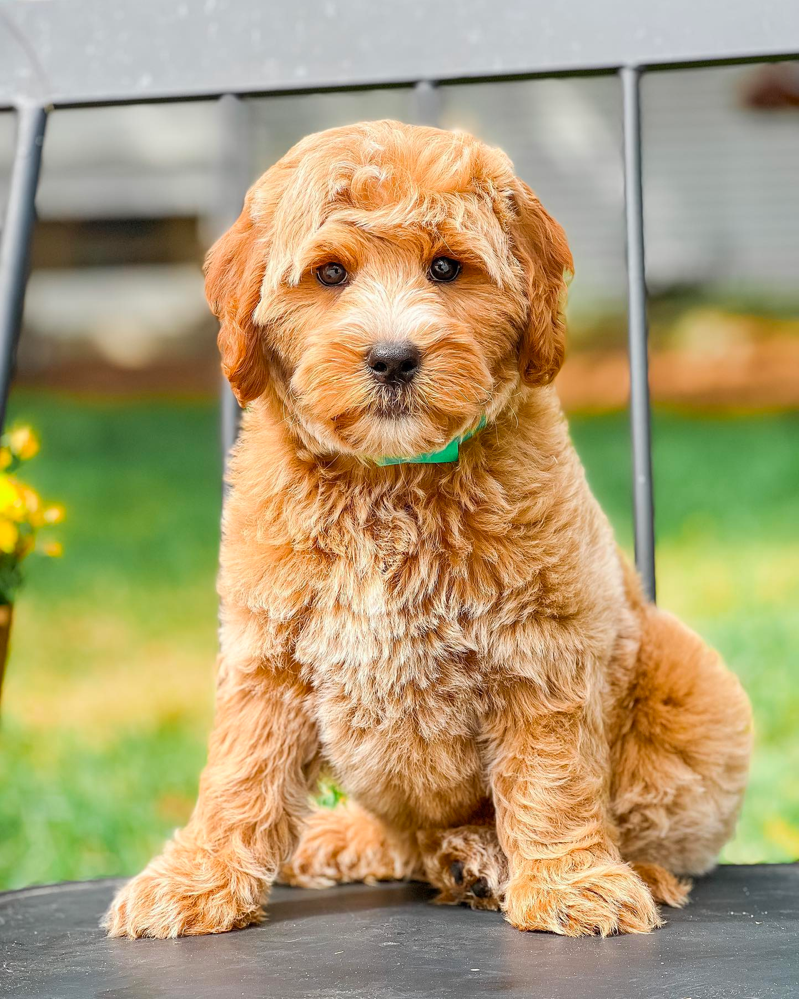
The breed’s round face and soft, cream-colored coat make it one of the most searched dog breeds in the country — but search interest has dropped 34% over the past year as more buyers discover the grooming and training commitment behind that teddy bear look. If you’re considering one for your family, you deserve the full picture before you contact a breeder.
Most websites selling these dogs describe them as low-shedding, calm, and easy to love — all true. What they skip is the daily brushing, the $90–$150+ professional grooming appointments every 6–8 weeks, and the 60–90 minutes of exercise your dog will need every single day (HomeGuide, 2026). By the end of this guide, you’ll know exactly what this doodle is, how it compares to other types, and whether it’s the right dog for your life — not just your Instagram feed. We’ll cover breed characteristics, size options, coat genetics, generations, real ownership costs, and how to find a reputable breeder.
Key Takeaways: English Goldendoodle at a Glance
This designer dog — a cross between an English Cream Golden Retriever and a Poodle — is calmer and stockier than its American counterpart, but requires professional grooming every 6–8 weeks to prevent painful coat matting.
- Calmer temperament: English lines are generally less excitable than American-bred doodles, though individual results vary more by training than by lineage
- “Teddy Bear” is a look, not a breed: It describes a rounder face achieved through selective breeding and grooming — not a recognized breed standard (Smith College, 2026)
- “English Cream” is partly marketing: The Golden Retriever Club of America (GRCA) notes it refers to coat color, not a health or temperament advantage
- The Hidden Ownership Tax: Expect $780–$1,300+/year in grooming costs alone — plan this budget before you buy (HomeGuide, 2026; QC Pet Studies, 2026)
- Sizes range widely: From 15-lb Petite to 65+ lb Standard — choose based on your living space and exercise capacity
Contents
- What Is an English Goldendoodle?
- Size Guide: Petite to Standard
- Coat Colors and the Teddy Bear Look
- Generations: F1, F1B, F2, and Beyond
- The Real Cost of Ownership
- Finding a Reputable Breeder
- Is This Breed Right for You?
- Frequently Asked Questions
- What is the difference between a Goldendoodle and an English Goldendoodle?
- How often should you bathe a Goldendoodle?
- What do I wish I knew before getting a Goldendoodle?
- Do you brush a Goldendoodle before or after a bath?
- Are English Goldendoodles good for allergy sufferers?
- How big does a full-grown English Goldendoodle get?
- What is the lifespan of an English Goldendoodle?
- Do English Goldendoodles bark a lot?
- Before Bringing Your Puppy Home
What Is an English Goldendoodle?

This designer dog is a crossbreed combining an English Cream Golden Retriever with a Poodle — designed to capture the Golden’s gentle temperament and the Poodle’s low-shedding coat. Academic research formally classifies the doodle as a mixed-breed dog; terms like “English Goldendoodle” are descriptive labels used by breeders, not recognized breed standards (Smith College research, 2026). Understanding this distinction helps you evaluate the breed honestly — and protects you from paying a premium for marketing language rather than a meaningfully different dog.
This section is where The Hidden Ownership Tax begins to show its face: the gap between the idealized teddy bear image and the real daily commitment behind it. We’ll define that concept fully in the ownership section — for now, just know that the breed’s charm is genuine, and so are its demands.
What Makes Them “English”?
The dog gets its name from the English Cream Golden Retriever — a European conformation line of the Golden Retriever breed recognized for its pale, cream-colored coat. “English” does not mean a separate species or a different breed. Think of it like two regional varieties of the same apple — similar fruit, different growing conditions, slightly different flavor and appearance.
“Conformation” simply means how the dog is built — the shape of its bones, head, and body. The English Cream Golden Retriever was bred to a different physical standard than the American Golden Retriever. That structural difference carries forward into the doodle offspring, giving them a blockier, wider head with a shorter muzzle and a stockier, heavier-boned frame compared to the more slender, angular American variety.
Smith College research on veterinary records confirms that the doodle is formally classified as a mixed-breed dog — “Teddy Bear” refers to a grooming style, not a recognized breed standard (2026). This matters because some breeders use these terms to justify premium pricing. Knowing what’s marketing and what’s structural helps you ask better questions. For a broader introduction to the breed, see our English Goldendoodle 101 overview.
The European parentage affects more than looks — it shapes head structure, coat color, and temperament differences that set this doodle apart from its American counterpart. That comparison is where the picture gets really interesting.
English vs. American Goldendoodle
The American Goldendoodle, bred from American-line Golden Retrievers and typically carrying higher energy levels, is the variety most people picture when they hear the breed name. The English version has a distinctly different physical profile. Here’s what that looks like in practice:
| Feature | English Goldendoodle | American Goldendoodle |
|---|---|---|
| Parent Golden Retriever | English Cream (European line) | American Golden Retriever |
| Head Shape | Blockier, wider, shorter muzzle | Slimmer, longer muzzle |
| Build | Stockier, heavier bone | More slender, athletic |
| Common Coat Colors | Cream, white, light apricot | Gold, red, dark apricot |
| Energy Level | Moderate (varies by individual) | Moderate-High (varies) |
| Temperament Claim | Marketed as calmer | Marketed as more energetic |
| Scientific Backing | No peer-reviewed advantage confirmed | No peer-reviewed advantage confirmed |
Coat color differences come down to genetics. The intensity gene variant in English Cream Golden Retrievers causes extreme dilution of phaeomelanin (the pigment responsible for yellow and red tones), producing the cream-to-white coat typical of European lines, according to the UC Davis Veterinary Genetics Lab (current). American lines more commonly express gold, red, and dark apricot because the intensity gene variant is less common in their lineage.
On temperament, the Golden Retriever Club of America states clearly that “English Cream” is a marketing term — and there is no scientific evidence that lighter-colored dogs have better health or calmer temperaments (current). The biggest practical difference most owners notice is coat color and head shape, not temperament, which varies more by individual dog and training than by lineage.
For a broader comparison, see how Goldendoodles compare to purebred Golden Retrievers.

Temperament and Family Compatibility
These dogs are consistently described as eager to please, social, and intelligent — traits inherited from both parent breeds. They tend to form strong bonds with their families and can develop separation anxiety (distress behaviors like barking, chewing, or accidents when left alone) if left without company for long periods. User consensus across doodle communities indicates that this bond is one of the breed’s most endearing qualities — and one of its most demanding.
They are generally good with children and other pets when properly socialized from puppyhood. Socialization means exposing your puppy to different people, environments, sounds, and animals during the first 3–16 weeks of life. Why this matters: if you miss this developmental window, behavioral correction becomes significantly harder and more time-consuming. Enrolling in structured puppy programs — what many owners call “Doodle Prep School” — during the first eight weeks at home can make a measurable difference.
Adults need 60–90 minutes of physical activity per day, according to multiple breed-informed sources (Goldoodle.com, current; Crockett Doodles, current). Failing to meet this need is one of the leading causes of destructive behavior.
Which is the calmest doodle breed?
Among popular varieties, the English cross and the Bernedoodle are most frequently cited as calmer options. However, there is no doodle breed that is universally calm without consistent daily exercise and training. “Calm” is earned, not guaranteed by lineage. Temperament is one piece of the puzzle. The other is size — and with this breed, the range is surprisingly wide.
Size Guide: Petite to Standard

These dogs come in four size categories — Petite, Mini (Miniature), Medium, and Standard — with adult weights ranging from under 25 lbs to over 65 lbs. Size is determined primarily by which Poodle variety (the Poodle, the curly-coated parent breed that contributes the low-shedding coat) was used in breeding: Toy, Miniature, or Standard. Choosing the wrong size for your living space is one of the most common and preventable first-time owner mistakes — so this decision deserves careful thought before you fall in love with a puppy photo.

Petite and Mini Sizes
The Petite size is produced by crossing with a Toy Poodle, weighing under 25 lbs at adulthood. Height typically falls around 12–16 inches at the shoulder. Petites are a reasonable fit for apartment living, provided you commit to at least 30–45 minutes of daily exercise — a smaller body does not mean lower energy. Think of a Petite as roughly the size of a Cavalier King Charles Spaniel: compact, but still an active dog that needs real daily movement.
The Mini size — also called the miniature doodle — is a Miniature Poodle cross, typically reaching 25–35 lbs and 16–20 inches at the shoulder. This is the most popular size category. A 25-lb Mini is roughly the same size as a Cocker Spaniel, which helps visualize the space and exercise commitment involved. Minis suit smaller homes with a yard or owners who can commit to regular outdoor time.
One term worth knowing: “micro mini” is a marketing label some breeders use for a very small Petite. There is no standardized definition — it typically refers to the smallest end of the Petite range. If a breeder uses this term, ask for specific parent weights rather than accepting the label at face value. For a complete breakdown of every size option across all varieties, see the full Goldendoodle size guide with all varieties.
If a smaller dog doesn’t fit your lifestyle, the Medium and Standard sizes offer more presence — and more exercise demands.
Medium and Standard Sizes
The Medium size typically results from a smaller Standard Poodle cross. Adult weight falls in the 35–50 lb range, with a height of approximately 18–22 inches. This is a popular middle-ground for families who want a substantial, huggable dog without the full footprint of a Standard. Many owners describe it as the “Goldilocks” size — large enough to feel like a real companion, manageable enough for a moderately sized home.
The Standard size — the largest variety, typically 50–65+ lbs — is a Standard Poodle cross standing 22–26 inches tall. A 55-lb Standard is similar in size to a Labrador Retriever: plan your space, car, and exercise routine accordingly. This size genuinely requires a home with outdoor access. Exercise requirements increase significantly at this weight, and the grooming time and cost scale up with the dog.
You may also see the term “Olde English Goldendoodle” used by some breeders to describe Standard-size dogs with a particularly stocky, blocky build. This is not a standardized category — its meaning varies by breeder.
Whatever size you choose, the next question is always: how big will my puppy actually get?
How Big Will They Get?
These dogs typically reach their full adult size between 12–18 months of age. Larger Standard varieties may continue filling out in muscle and frame until closer to 24 months. The most reliable predictor of your puppy’s adult size is the weight of both parents — not the breeder’s size category label.
F1 (first-generation) crosses can show more size variability than F1B or multigen litters because the Poodle and Golden Retriever size genes blend unpredictably in the first generation. Two puppies from the same F1 litter can have noticeably different adult sizes. If a breeder cannot tell you the exact weight of both parent dogs, that is a meaningful red flag.
The terms “olde english” and “micro mini” appear frequently in breeder listings. Neither has a standardized definition recognized by any breed organization. When you see these labels, ask the breeder specifically: How much does each parent weigh? What is the expected adult weight range for this litter? Specific numbers protect you far better than marketing terms.
Size is one decision. Color and coat appearance is another — and this is where the “English Cream” and “Teddy Bear” labels come in.
Coat Colors and the Teddy Bear Look
The English Cream coat — a pale cream or white color inherited from the European Golden Retriever parent — is the color most buyers picture first. But the full color range is wider than most people expect, and the genetics behind it are worth understanding before you pay a premium for a specific shade. This section explains what “English Cream” and “Teddy Bear” actually mean — and what the science says about both.
What “Cream” Really Means
The pale cream coat seen in this breed is caused by a genetic variant called the intensity gene — sometimes called the phaeomelanin dilution gene. Think of coat color genes like a dimmer switch: the intensity gene turns down the volume on yellow and red pigments, producing coats that range from pale gold to near-white cream. According to the UC Davis Veterinary Genetics Lab, this intensity gene variant causes extreme dilution of phaeomelanin (the pigment responsible for yellow and red tones), producing the cream-to-white coat (current).
The Golden Retriever Club of America explicitly states that “English Cream” is a marketing term used by breeders to differentiate lighter-colored dogs, often at a premium price — and there is no scientific evidence that cream-coated dogs are healthier or calmer than their golden-coated counterparts (current). This is one of the most important facts for first-time owners to understand before shopping.
Coat color in puppies is also not fully predictable. Even cream-colored parents can produce apricot or golden offspring depending on the Poodle parent’s genetics. Puppies from the same litter can vary noticeably in shade. If a breeder charges significantly more for a “cream” puppy than a golden one, ask them specifically what justifies the premium — because the science doesn’t support a health or temperament difference.
For more on this topic, see the full guide to Goldendoodle colors and patterns.
The coat color is one aesthetic choice. The other — and arguably more popular — is the “Teddy Bear” look.
What is a teddy bear golden?
The Teddy Bear look is not a separate breed, a generation, or a size category. It is a descriptive term for a specific facial appearance. Academically, “Teddy Bear” refers to a grooming style applied to round-faced dogs — not a breed standard — per Smith College research on canine breed classification in veterinary records (2026). This distinction matters because some breeders charge a premium for “Teddy Bear” puppies when the term has no formal definition anywhere.
The look is defined by four physical traits: (1) a rounder, wider face, (2) a shorter, broader muzzle, (3) large, forward-facing eyes, and (4) a fuller coat around the face. These traits are more common in European lines than American ones because the English Cream Golden Retriever parent already has a blockier head structure — the doodle inherits that foundation.
The teddy bear appearance can also be enhanced through grooming — specifically the “Teddy Bear cut,” which trims the body short while leaving the face round and full. When you see a photo that makes you say “look like this?” — that’s almost always the Teddy Bear look, achieved through a combination of breed genetics and a skilled groomer’s scissors.
For a deeper dive into coat types and how they relate to grooming styles, see Goldendoodle coat types and grooming styles explained.

Beyond cream and Teddy Bear, these dogs come in a wider color range than most buyers expect.
Apricot, Red, and White Coats
These dogs are not limited to cream. Depending on the Poodle parent’s genetics, they can appear in a full spectrum of colors. White coats are essentially the palest expression of the cream coat — not a separate color category. The intensity gene is simply expressed at its maximum dilution, producing a coat that reads as white rather than ivory.
- Common coat colors:
- Cream
- White
- Apricot
- Red
- Chocolate (dark brown)
- Black
- Parti (two-tone patches)
- Phantom (two-tone with specific patterning)
An apricot or white dog is no different in temperament, health, or intelligence from a cream one. Coat color does not affect any of those qualities — the only thing it affects is appearance. Choose based on your preference, not on claims that one color is inherently healthier or calmer.
Now that you know what they look like, let’s talk about the genetics behind the coat — because understanding generations (F1, F1B, F2) directly affects shedding, allergies, and grooming difficulty.
Generations: F1, F1B, F2, and Beyond
Generation labels — F1, F1B, F2, and multigen — describe the specific parent pairing used in breeding, which directly affects coat type, shedding level, and allergy-friendliness. The higher the Poodle percentage, the curlier and less-shedding the coat tends to be. Why this matters: if anyone in your household has allergies, the generation you choose could make the difference between a manageable situation and a miserable one.

F1 Generation: The 50/50 Mix
The F1 generation is a first-generation cross — “F1” stands for “first filial generation,” meaning one purebred English Cream Golden Retriever parent and one purebred Poodle parent. The result is approximately 50% Poodle genetics and 50% Golden Retriever genetics. Think of it as the first time these two breeds meet.
Coat outcome in F1 doodles is the most variable of all generations. Some puppies in the same litter may have wavy, low-shedding coats; others may have straighter, moderate-shedding coats. This is because the curl gene from the Poodle parent is passed to roughly 50% of F1 offspring — meaning coat type is genuinely a roll of the dice. According to UC Davis VGL curl research, dogs with an N/C1 or N/C2 curl genotype transmit the curl allele to 50% of their offspring, which explains coat variability in F1 litters (current).
F1 crosses are sometimes described as “minimal to low shedders” — but this is not guaranteed. They are generally not the first recommended choice for people with significant dog allergies. If you’re unsure about allergies, an F1 is a gamble. If allergies are a serious concern, read the F1B section before deciding.
For families with allergy concerns, the F1B Goldendoodle — the higher-Poodle generation — is usually the recommended starting point.
F1B: Best for Allergies?
An F1B cross is a backcross — one F1 parent bred back to a purebred Poodle. The “B” stands for “backcross.” The result is approximately 75% Poodle genetics and 25% Golden Retriever genetics. Think of it as adding more of one ingredient back into the mix.
Because of the higher Poodle percentage, F1B doodles are more consistently curly and lower-shedding than F1s. The curl gene is more reliably expressed, making them a better option for households where mild to moderate dog allergies are a concern. Many owners describe their dog as a “stunning F1B” — they get the teddy bear look and a coat that doesn’t carpet the sofa.
One important caveat: no dog is truly “hypoallergenic.” Allergies are typically triggered by proteins in dog saliva and dander — not by the coat itself. F1B doodles produce less airborne dander because their curlier coat traps loose hair rather than releasing it, but allergy sufferers should spend time with the specific dog before committing to a purchase. Spending an hour with the puppy in an enclosed space is a better test than any breeder’s assurance.
Beyond F1 and F1B, there are F2 and multigeneration doodles — each with their own trade-offs. For a detailed look at what comes after F1B, see F2B Goldendoodle — what comes after F1B.
F2, F2B, and Multigen Labels
Once you move past F1 and F1B, the generation labels multiply quickly. Here’s a plain-English breakdown:
- F2 = F1 × F1 (two first-generation doodles bred together). Coat outcome is even more variable than F1. Less commonly bred for this reason.
- F2B = F1 × F1B (or F2 × Poodle backcross). Higher Poodle percentage than F2; more predictable coats.
- Multigen (Multigeneration) = any cross beyond F2. These are the most consistent in coat type and shedding because breeders have selected for specific traits across multiple generations. Often the most expensive.
| Generation | Parent Pairing | Approx. Poodle % | Coat Predictability |
|---|---|---|---|
| F1 | GR × Poodle | 50% | Low |
| F1B | F1 × Poodle | 75% | Medium-High |
| F2 | F1 × F1 | 50% | Very Low |
| F2B | F1 × F1B | ~62.5% | Medium |
| Multigen | Multigen × Multigen | Varies | High |
The F2 and F2B labels appear frequently in breeder listings, but the coat variability of F2 in particular makes it a less reliable choice for allergy-sensitive households. Multigen doodles offer the most predictable coats — and command the highest prices to match.
Once you understand the generation, you’ll start to see why grooming requirements vary so much — and why the Hidden Ownership Tax hits some owners harder than they expected.
The Real Cost of Ownership

“Any tips and insights on this breed is helpful.” — First-time owner
That quote, shared across doodle communities, captures exactly where most first-time buyers find themselves: hopeful, a little anxious, and genuinely seeking guidance before committing. This section is the honest answer to that question — covering the grooming reality, exercise demands, and the behavioral patterns that lead to rehoming when owners aren’t prepared.
Preventing Coat Matting
These dogs are highly prone to matting — tangled, compressed clumps of fur that can press against the skin, causing pain, skin infections, and in severe cases requiring a full shave-down. This happens because their curly or wavy fur traps loose hair instead of shedding it.
The coat looks beautiful precisely because it holds everything in — which is also what makes it a daily maintenance commitment.
The #1 rule every first-time owner must know: always brush BEFORE bathing. Water causes existing tangles to tighten into mats — sometimes permanently. Grooming professionals consistently report this as the most common mistake first-time doodle owners make. The American Kennel Club states that the Poodle coat requires daily brushing to the skin to prevent severe matting — a primary reason professional groomers charge more for doodle mixes (current).
Pre-bath brushing protocol — 8 steps:
Step 1: Start with a completely dry coat
Never attempt to brush a wet dog, as water locks tangles into place.
Step 2: Use a slicker brush
Work through the coat in sections using a flat brush with fine, short wire bristles.
Step 3: Begin at the tips of the hair
Work gently toward the skin. Dragging forcefully from root to tip creates more tangles.
Step 4: Target friction zones
Pay extra attention behind the ears, armpits, collar area, and between the legs, as these areas mat the fastest.
Step 5: Use a metal comb
Follow the slicker brush to confirm no tangles remain. The comb catches what the brush misses.
Step 6: Bathe with dog-specific shampoo
Only proceed to this step once the coat is fully de-tangled and brushed out.
Step 7: Blow-dry completely
Air-drying a doodle coat can cause new mats to form as the hair dries in contact with itself.
Step 8: Brush again after drying
Perform a final brush while the coat is still warm and pliable to ensure a smooth finish.
Professional grooming frequency: every 6–8 weeks (Little Paws Iowa, cited per industry consensus). For a Standard size, professional grooming sessions typically run $90–$150+ per appointment in 2026 (QC Pet Studies, 2026; HomeGuide, 2026). At that frequency, annual grooming costs fall between $780 and $1,300+ — and that’s before home brushing supplies, shampoo, or any emergency de-matting appointments. For why Goldendoodles shed and grooming needs, that context helps frame the whole picture.

Grooming is the most visible cost. The less visible one — and the one most tied to behavioral problems — is exercise.
Why do groomers charge extra?
Groomers charge more for doodles because their thick, curly coats are extremely prone to matting, which requires significant extra time, skill, and specialized tools to address safely. The American Kennel Club notes that the Poodle coat requires daily brushing to the skin to prevent severe matting — a standard that most doodle owners don’t maintain consistently at home. A heavily matted coat can add 1–2 hours to a grooming appointment. The large size of many doodles and the complexity of the desired cut also contribute to higher prices compared to shorter-coated breeds.
Exercise and Mental Stimulation
Adults need 60–90 minutes of physical activity per day, split across two or three sessions (Goldoodle.com, current; Crockett Doodles, current). A 20-minute morning walk is not sufficient for a Standard or Medium-sized dog. This is not a breed that self-regulates energy — an under-exercised dog will find its own outlets, and those outlets typically involve your furniture, shoes, or garden.
Beyond physical exercise, these are highly intelligent dogs. The Poodle ranks as the #2 most intelligent breed by obedience and working intelligence — and that intelligence carries into the doodle. Puppies and adults need daily mental stimulation: puzzle feeders, structured training sessions, scent games, and varied fetch commands all count. Mental fatigue from a 15-minute training session can tire a dog more effectively than a longer aimless walk.
Training basics should start on Day 1. They are highly trainable but also sensitive to tone and inconsistency — sharp corrections or punishment-based methods can increase anxiety in this breed. Positive reinforcement (reward-based training, where desired behaviors are consistently rewarded) is the approach supported by current veterinary behavioral guidance. Many new owners find structured puppy programs — what the doodle community calls “Doodle Prep School” — helpful for establishing routines in the first 8 weeks.
Daily exercise framework (structured example):
Step 1: Morning Routine
Dedicate 20–30 minutes to a brisk walk or a structured play session to burn off overnight energy.
Step 2: Midday Engagement
Provide 10–15 minutes of mental stimulation using a puzzle feeder, a short training session, or a scent game.
Step 3: Evening Activity
Finish the day with 30–45 minutes of walking, fetch, or off-leash park time to ensure they sleep soundly.
For a step-by-step guide to potty training your Goldendoodle puppy, pairing house training with this exercise routine from day one produces the best results.
When owners underestimate these grooming and exercise demands, the consequences can be serious — and increasingly, they’re showing up in shelter statistics.
Why Are So Many Doodles Being Rehomed?
In a 2021 report, The New York Times highlighted that unpredictable genetics in doodle crossbreeds often lead to severe behavioral issues and high-maintenance coats, contributing to a significant increase in doodles being surrendered to animal shelters (The New York Times). While breed-specific surrender data remains limited, HumanePro’s analysis of Shelter Animals Count data notes that large and medium-sized designer dogs face declining adoption rates as shelters fill with dogs that didn’t match owner expectations (HumanePro, 2026).
- The most common reasons for rehoming follow a consistent pattern:
- Grooming costs and time were significantly underestimated before purchase
- Exercise needs went unmet, leading to destructive behavior that owners couldn’t manage
- Separation anxiety emerged when owners returned to office work after the pandemic
- Allergies weren’t resolved by the “hypoallergenic” coat as hoped
The solution is preparation, not perfection. Owners who research thoroughly before buying, establish grooming routines from week one, and commit to daily exercise rarely face rehoming situations. This is what we call The Hidden Ownership Tax — the cumulative gap between the idealized teddy bear image and the real daily cost in time, money, and effort of grooming, training, and exercising. It’s avoidable with the right preparation.
You now have the full picture of what ownership actually involves. The next question is: where do you find one?
Finding a Reputable Breeder

Finding a reputable breeder starts with knowing what “reputable” actually means — beyond a professional-looking website and cute puppy photos. The foundation is health testing: both parent dogs should have OFA (Orthopedic Foundation for Animals) hip and elbow certification, plus a CAER (Companion Animal Eye Registry) eye exam. Ask to see the certificates, not just the breeder’s word. A transparent puppy socialization program and willingness to answer detailed questions are equally important markers.
- Red flags to watch for:
- No health testing documentation available for parent dogs
- No in-person visits or video calls with the puppy and its environment allowed
- Multiple breeds available simultaneously (a common signal of puppy mill operations)
- Pressure to reserve quickly or pay a deposit before your questions are answered
On pricing: Puppies from reputable breeders typically range from $2,000–$4,000+ depending on size, generation, and location, based on current market data (Lancaster Puppies, 2026; Moss Creek Goldendoodles, current). Trained or pre-socialized puppies from premium breeders can exceed this range significantly. Budget for first-year veterinary costs, grooming, supplies, and training on top of the puppy price — the total first-year investment often runs $5,000–$8,000+.
For our complete guide to finding reputable breeders — including a curated list of Top 11 English Goldendoodle Breeders in the USA — that resource covers everything this summary outlines in full detail. For a detailed walkthrough of how to vet any breeder, see how to find a reputable Goldendoodle breeder.
Is This Breed Right for You?
This doodle is genuinely wonderful for the right owner. However, no competitor page will tell you when it’s the wrong choice — and that honesty is what helps real families avoid real regret. This section is the balanced perspective that E-E-A-T demands and that first-time buyers deserve.
Common New Owner Mistakes
Common pain points reported by first-time owners follow predictable patterns. Knowing them in advance is the simplest way to avoid them.
Mistake 1: Skipping the pre-bath brush.
The scenario: an owner bathes a slightly tangled dog, water tightens the tangles into mats, and the next grooming appointment becomes an emergency de-matting or full shave-down. The fix is simple — complete the full 8-step brushing protocol before every bath, every time. No exceptions.
Mistake 2: Underestimating the first year’s full cost.
The scenario: the puppy purchase price of $2,500–$3,500 feels like the big expense. Then come first-year vet visits, grooming every 6–8 weeks, training classes, supplies, and potentially doggy daycare — easily totaling $5,000–$8,000+ in year one. The fix: build a complete first-year budget before you contact any breeder. Knowing the real number upfront prevents the financial stress that contributes to rehoming.
Mistake 3: Choosing size based on appearance, not lifestyle.
The scenario: an apartment owner falls in love with a Standard size look, brings the puppy home, and discovers that 55 lbs of under-exercised dog in a one-bedroom apartment produces destructive behavior within weeks. The fix: match the size to your actual square footage, yard access, and honest daily exercise capacity — not to the photo that made your heart melt.
When It Isn’t the Right Fit
Some situations genuinely call for a different breed — and knowing this before you buy protects both you and the dog.
Severe dog allergies: Even F1B doodles are not guaranteed allergy-safe. If your household includes someone with significant dog allergies, spend meaningful time with the specific puppy before committing. Consider a purebred Standard Poodle — the actual low-allergen parent breed — as an alternative. Poodles carry all the intelligence and low-shedding coat without the coat unpredictability of a cross.
Long work hours without support: These dogs are prone to separation anxiety and are not suited to being left alone for 8+ hours daily without structured support like a dog walker or daycare. If your schedule doesn’t allow for midday breaks or you can’t budget for daycare, this breed will struggle — and so will you.
Preference for a low-maintenance coat: If daily brushing feels like too much, consider a Labradoodle with a flatter, more manageable coat, or a purebred Golden Retriever — which sheds more but is significantly easier and cheaper to maintain. The teddy bear look comes with a teddy bear grooming bill.
Frequently Asked Questions
What is the difference between a Goldendoodle and an English Goldendoodle?
The English variety is bred from a European Golden Retriever, producing a stockier build and a blockier head. The American version tends toward a slimmer build and a darker gold coat. Ultimately, individual temperament varies more by training than by lineage.
How often should you bathe a Goldendoodle?
These dogs should be bathed every four to eight weeks, depending on their activity level and coat condition. Over-bathing strips natural oils from the skin, causing dryness and irritation. The most critical rule is to brush the coat completely before bathing, as water tightens existing tangles into permanent mats. Consult your groomer to establish the ideal schedule for your specific dog.
What do I wish I knew before getting a Goldendoodle?
Most owners wish they had fully understood the intense grooming commitment required for this breed. Daily brushing and professional grooming every six to eight weeks are non-negotiable. You should expect a realistic annual cost of $1,000 per year in grooming alone (HomeGuide). Their high intelligence also means they need consistent mental stimulation to prevent destructive behavior. Planning your budget and daily routine before buying prevents most common regrets.
Do you brush a Goldendoodle before or after a bath?
You must always brush your dog completely before bathing them. Water causes existing tangles to tighten into severe mats that can be impossible to brush out without causing pain. Skipping this pre-bath brush is the most common grooming mistake first-time owners make.
Are English Goldendoodles good for allergy sufferers?
While no dog is completely hypoallergenic, F1B and multigenerational doodles are generally excellent choices for allergy sufferers. Their curlier coats trap dander rather than releasing it into the air. However, you should always spend time with a specific puppy before committing to ensure your allergies aren’t triggered.
How big does a full-grown English Goldendoodle get?
Adult size depends entirely on the Poodle parent used in the breeding process. Petite varieties stay under 25 pounds, while Standard sizes can exceed 65 pounds. They typically reach their full adult height and weight between 12 and 18 months of age. Always ask the breeder for the exact weights of both parents to get the most accurate estimate.
What is the lifespan of an English Goldendoodle?
A healthy doodle typically lives between 10 and 15 years. Smaller varieties like the Petite and Mini tend to live slightly longer than the Standard size. Providing a high-quality diet, regular veterinary care, and daily exercise will help maximize your dog’s lifespan.
Do English Goldendoodles bark a lot?
They are generally moderate barkers who will alert you to strangers but aren’t considered excessively vocal. However, they can develop nuisance barking habits if they are bored or under-exercised. Separation anxiety is another common trigger for excessive vocalization in this breed. Consistent training and providing 60 to 90 minutes of daily activity usually prevents problem barking.
Before Bringing Your Puppy Home
For families who want a gentle, family-friendly dog with an iconic teddy bear appearance, this breed delivers — but only when owners go in with their eyes open. Professional grooming every 6–8 weeks and 60–90 minutes of daily exercise are non-negotiable commitments. The breed’s calmer temperament relative to its American counterpart is a genuine trait, but “calm” is not the same as “low-maintenance.” The Hidden Ownership Tax is real — and it’s avoidable with the right preparation from the start.
The Hidden Ownership Tax framework is your decision-making tool: add up the real annual costs — grooming ($780–$1,300+), training, veterinary care, and daycare if needed — before you fall in love with a puppy photo. Owners who do this math first almost never face the regret and rehoming situations that make headlines. Preparation is what separates a frustrating experience from a genuinely life-changing one, and devotedtodog.com’s guides are built to give you that preparation at every step.
Start by reading our curated guide to Top 11 English Goldendoodle Breeders in the USA — then practice the 8-step brushing protocol on a friend’s doodle before your puppy arrives. The owners who thrive with this breed are the ones who prepared like they were bringing home a toddler: with a plan, a budget, and a realistic picture of what every day actually looks like.