
“My four-month-old golden retriever is out of control and I don’t know what to do?”
If that sounds like you right now, you’re not doing anything wrong. You’ve just hit what we call The 16-Week Threshold, the point at which a Golden Retriever puppy’s teething, growth acceleration, and emerging independence arrive simultaneously, making 4 months feel like the hardest stretch even when development is perfectly normal.
The owners who struggle most at this stage are the ones who wait for things to calm down on their own. They don’t. But they do get better, fast, with the right information. In this guide, you’ll learn exactly what weight your 4 month old golden retriever should be (in both pounds and kilograms), how much to feed them, and 8 proven strategies to survive the velociraptor biting phase.
We’ll cover growth milestones, feeding amounts, exercise limits, training priorities, and the warning signs that actually warrant a vet visit.
females 20-25 lbs
5-min × 4mo
AKC standard
enforced naps
How Do Growth, Weight, and Size Look at 16 Weeks?
For owners tracking earlier developmental stages, see our guide on the 3-month-old Golden Retriever.

A 4 month old golden retriever typically weighs between 20 and 30 pounds (9-14 kg), depending on sex. Males average 25-30 lbs and females 20-25 lbs at this mark (Pawlicy Growth Data). The range is genuinely wide because Golden Retriever size is heavily influenced by bloodline genetics, so a 22 lb female and a 30 lb male can both be perfectly on track. Physically, your puppy is deep in the “gangly stage,” with long legs, oversized paws, and a narrow chest, because bone structure is outpacing muscle development at this age.
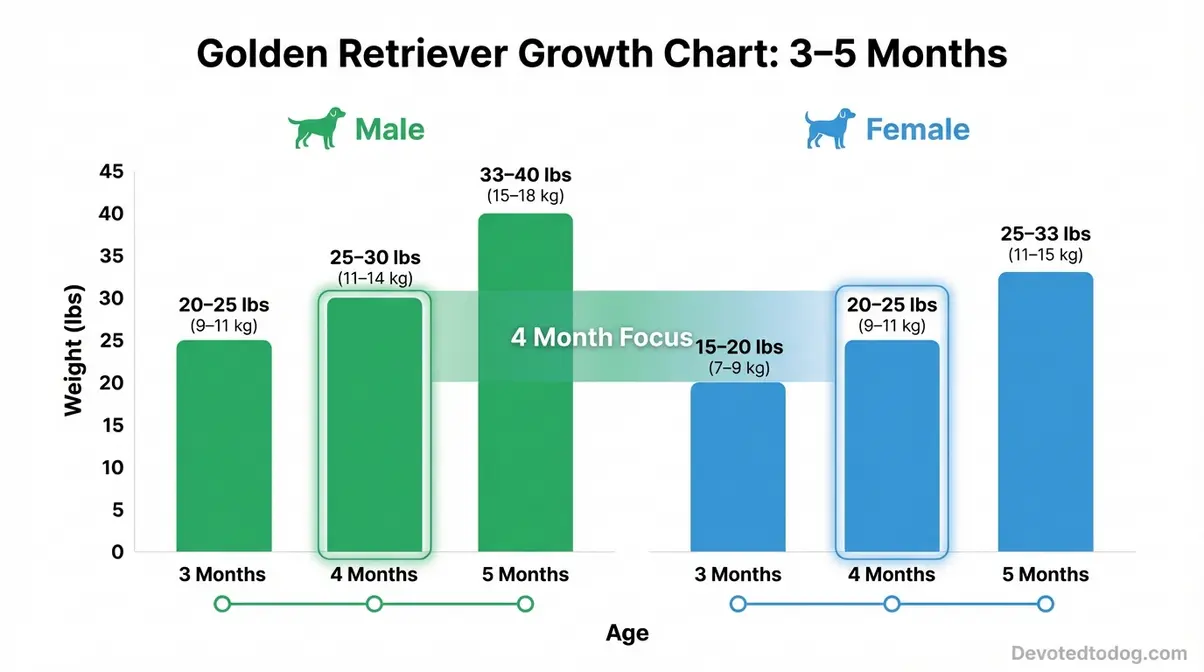
Caption: Male and female Golden Retrievers diverge noticeably in weight by 4 months. This chart shows the healthy range for each sex in both lbs and kg.
How Much Should a 4 Month Old Golden Retriever Weigh?
A healthy 4-month-old male Golden Retriever typically weighs 25-30 lbs (11-14 kg), while females average 20-25 lbs (9-11 kg) at the same age (Pawlicy Growth Data). According to official AKC Golden Retriever weight standards, adult males reach 65-75 lbs and females 55-65 lbs, meaning your 4-month-old is carrying roughly 35-45% of their final adult weight right now (AKC).
The table below shows the growth context across three months to help you understand the full month-by-month growth timeline:
| Age | Male (lbs) | Female (lbs) | Male (kg) | Female (kg) |
|---|---|---|---|---|
| 3 months | 20-25 | 15-20 | 9-11 | 7-9 |
| 4 months | 25-30 | 20-25 | 11-14 | 9-11 |
| 5 months | 33-40 | 25-33 | 15-18 | 11-15 |
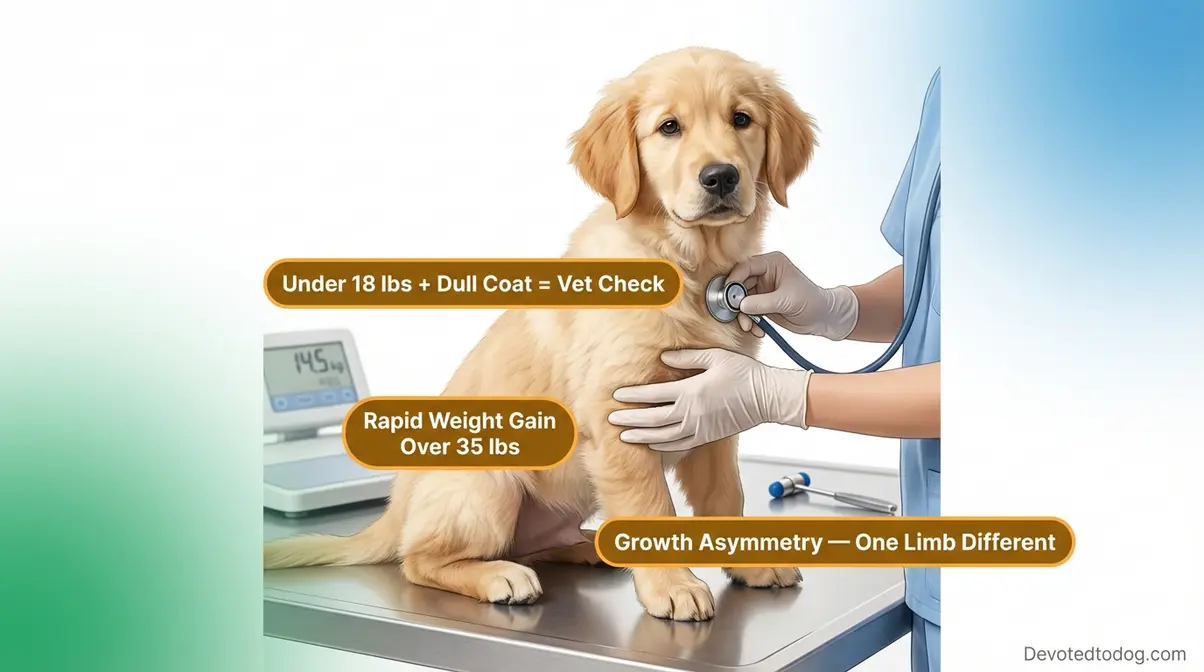
If your puppy sits consistently below 18 lbs with a dull coat and low energy, a vet check is warranted to rule out parasites or nutritional deficiencies. A puppy consistently above 35 lbs with rapid weight gain deserves a conversation with your vet about portion control and thyroid function. Neither extreme is automatically dangerous, but both benefit from professional eyes. Always consult your veterinarian if you’re concerned about your puppy’s weight trajectory.
The range is wide for a biological reason: show-line Golden Retrievers are built stockier, field-line dogs run leaner and more athletic, and individual genetics create meaningful variation even within the same litter.
Male vs. Female: Understanding the Size Difference
Males run 3-7 lbs heavier than females at 4 months, and that gap only widens as both sexes approach adulthood. This is normal, expected, and not a sign that your female is underfed or your male is overweight. Both are developing on track.
One myth worth addressing: the idea that females are calmer than males at this age. At 4 months, individual temperament matters far more than sex. Both males and females hit the velociraptor phase equally hard. Biting, zooming, and boundary-testing are not genetically male behaviors. If you’re comparing your puppy to a friend’s and finding a size discrepancy, you’re likely comparing different sexes or different lineages.
English Cream males often appear stockier at 4 months; field-line dogs of either sex tend to look leaner and more athletic. You can discover the unique traits of English Cream Golden Retrievers to understand those lineage-specific differences in more detail. Neither build is wrong. They simply reflect different breeding priorities.
What Does a 4 Month Old Golden Retriever Look Like?
Most Goldens at 4 months are actively shedding their soft puppy fluff and showing the first signs of adult coat development. Look for early “feathering,” which includes silky, slightly longer hairs appearing along the back of the legs, the underbelly, and the edges of the ears. The body coat itself may look patchy or sparse during this transition; owners in the community call this the “scant coat” stage, and it’s completely normal.
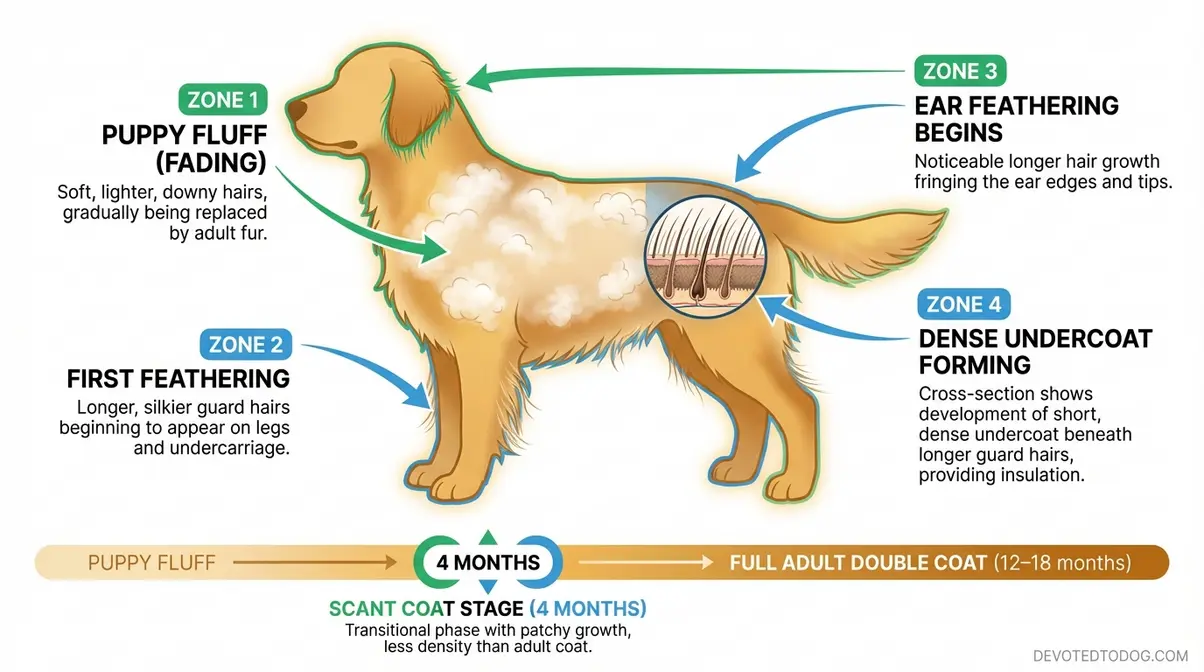
Caption: The scant coat phase looks alarming but is simply the puppy fluff giving way to the denser adult double coat. Feathering appears first on ears, legs, and underbelly.
The double coat, the dense undercoat that begins replacing puppy fuzz around this age, won’t fully come in until 12-18 months. According to USDA guidelines for aging puppies by teeth, a puppy with erupting adult teeth alongside remaining milk premolars is confirmed to be approximately 3-4 months old (USDA-APHIS). That is exactly the developmental window you’re in.
The body looks disproportionate right now, and that’s by design. Big paws, long legs, and a relatively narrow chest are the hallmarks of the gangly stage. Muscle development catches up considerably by 12-18 months.
What Is the Velociraptor Phase (Biting and Behavior)?

If you’ve started calling your puppy a velociraptor, you’ve named it accurately. At 4 months, a Golden Retriever puppy’s mouthing behavior peaks precisely when adult teeth are erupting through inflamed gums, and the urgency to bite something, anything, is involuntary. According to the AKC puppy teething timeline, puppies begin actively shedding baby teeth as permanent adult teeth erupt between 3 and 4 months of age (AKC). This is the heart of The 16-Week Threshold: the biting peaks precisely when teething discomfort is highest and adolescent boundary-testing begins. It’s manageable, but only with the right redirection approach, not punishment.
Why Your Puppy Won’t Stop Biting (It’s Not Bad Behavior)
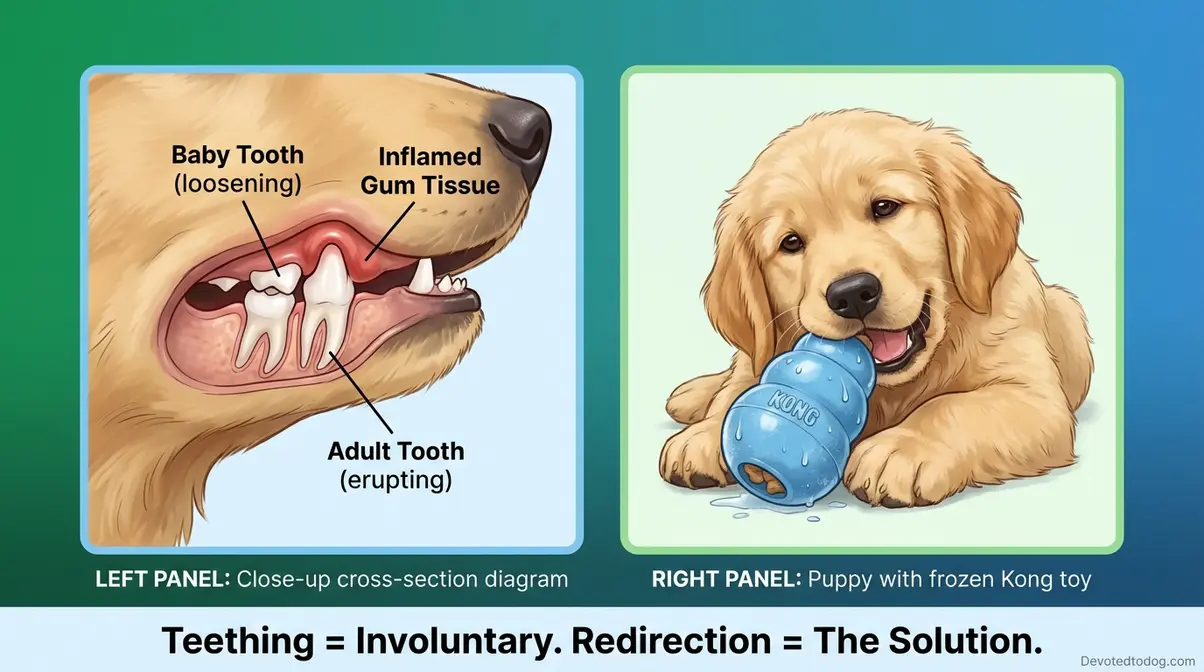
Adult teeth erupt between 3-4 months, causing genuine gum pain and an urgent need to chew. This is involuntary, not defiance. Golden Retrievers add a layer of genetic complexity here: they were bred as retrievers with a “soft mouth” for carrying game without damaging it. That instinct is already present at 4 months, but teething amplifies the mouthing drive significantly, so the biting can feel more intense in this breed than in others.
At 16 weeks, your puppy is simultaneously testing social boundaries for the first time. They’re learning what happens when they bite a person, another dog, or a table leg, and your consistent response is the lesson they’re taking in. Combined with teething discomfort, this creates the velociraptor stage: high-frequency, high-intensity mouthing that’s entirely developmental, not a training failure.
“Golden Retriever puppies begin shedding baby teeth and erupting permanent adult teeth between 3 and 4 months of age, a process that drives the intense mouthing behavior owners call the ‘velociraptor stage'” (AKC).
8 Redirection Strategies That Actually Work
User consensus across Golden Retriever owner communities consistently identifies these eight approaches as the most effective, moving from immediate relief to longer-term management:
- Frozen Kong or chew toy, When your puppy bites during play, redirect immediately to a Kong filled with kibble and frozen. The cold actively relieves gum inflammation from erupting teeth, making this a redirection and a teething remedy simultaneously.
- Yelp + freeze, When bite pressure is genuinely too hard, let out a short, sharp “yelp” and go completely still for 3 seconds. This mimics the natural puppy-to-puppy bite inhibition signal. It’s how littermates taught your puppy that biting too hard ends the fun.
- Reverse timeout, When redirecting fails and the biting escalates, you leave the room for 30 seconds, not the puppy. Removing your attention entirely is the clearest consequence a puppy understands. Putting the puppy in a separate room loses the immediacy.
- Pre-empt with a toy, Before your puppy greets you, have a tug toy ready. Give them something acceptable to bite before they decide to bite you. Prevention beats correction every time.
- Enforce a nap, Overtiredness is the single most underestimated biting trigger. When biting escalates to a frenzy, crate your puppy rather than continuing to redirect. Don’t try to train through exhaustion. It doesn’t work.
- Chilled carrot or wet washcloth, Cold vegetables and frozen, damp cloths soothe erupting teeth. These are teething-specific tools, not just chew redirects. Always supervise.
- Commercial chews, not hard raw marrow bones, Rubber chews (Benebone, Nylabone Puppy) are purpose-designed for puppy teeth. Hard raw marrow bones carry a real tooth fracture risk for puppies under 6 months, whose adult teeth are still fully erupting and setting (Kinship). Softer raw options like chicken necks, supervised and appropriately sized, carry lower fracture risk, but always consult your vet before introducing any bone-based chew.
- Management over correction, Baby gates, drag leads, and tethering reduce biting opportunities before they become biting events. A puppy who can’t reach you can’t bite you. Architectural management is a training tool, not a failure.
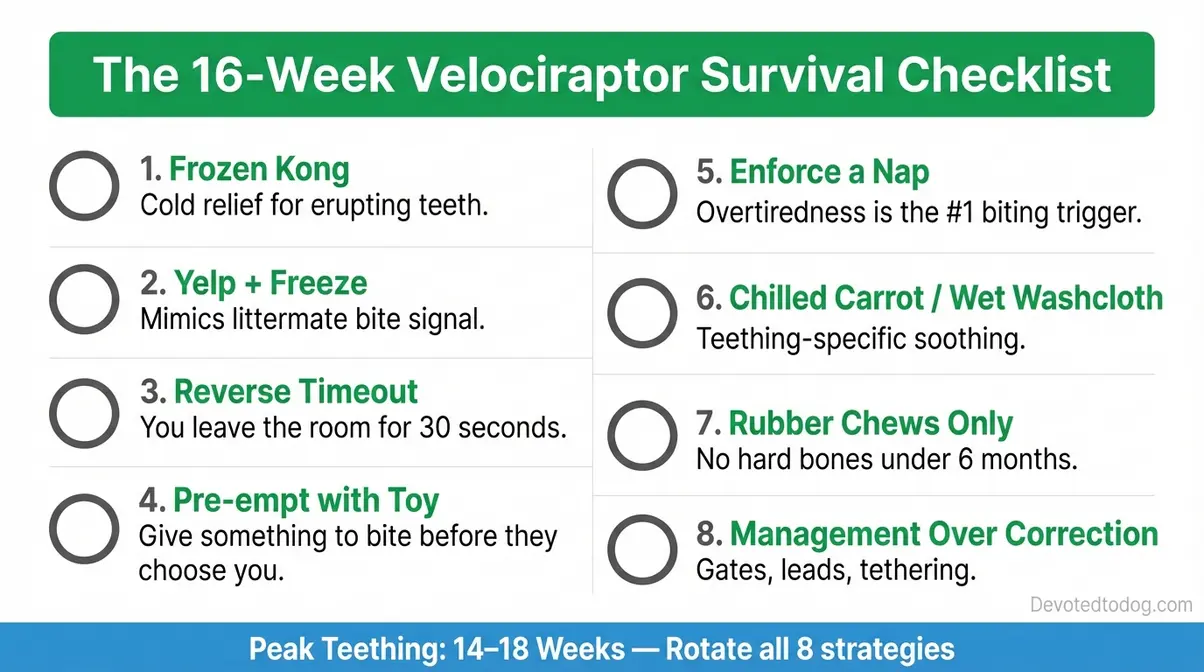
Caption: Keep this checklist visible during the peak teething weeks (14-18 weeks). Rotating through all 8 strategies is more effective than repeating just one.
For a deeper dive into any of these techniques, our guide to effective ways to stop your golden puppy from biting walks through each approach with additional scenarios.
Normal Biting vs. Behavioral Warning Signs
Most 4-month mouthing is velociraptor-stage normal: biting during play, chewing anything within reach, getting nippy when overtired or overstimulated. The telltale sign it’s teething-driven? Your puppy can be redirected, and they calm noticeably after a nap. Loose, wiggly body posture during mouthing is almost always play.
Concerning biting looks different. Watch for a stiff body posture (not the loose, wiggly play posture), growling over a food bowl or toys, or biting that happens without a play trigger and draws blood repeatedly. These are not teething signals.
Resource guarding, when your puppy growls or snaps as you approach their food bowl, is a separate behavioral issue that requires specific counter-conditioning, not standard teething redirection. “If your puppy bites when you try to take their food bowl away, that’s resource guarding, a different issue requiring a different solution.” If you’re seeing stiff posture, pinned ears, or whale eye alongside biting at 4 months, contact a certified professional trainer (CPDT-KA) or veterinary behaviorist. Early intervention is far more effective than waiting for the behavior to resolve on its own.
What Are the Hardest Months with a Puppy?
The hardest months with a puppy are typically 4 to 8 months of age, when teething, growing independence, and adolescent boundary-testing overlap in full force. For Golden Retrievers specifically, the 4-month mark initiates the most intense mouthing phase. By 6-8 months, active teething subsides, but adolescent stubbornness often peaks as a second challenge. Consistent training, enforced naps, and patient redirection, rather than punishment, are the most effective tools for navigating this developmental window without damaging the relationship.
What and How Much Should You Feed a 4-Month-Old Golden?
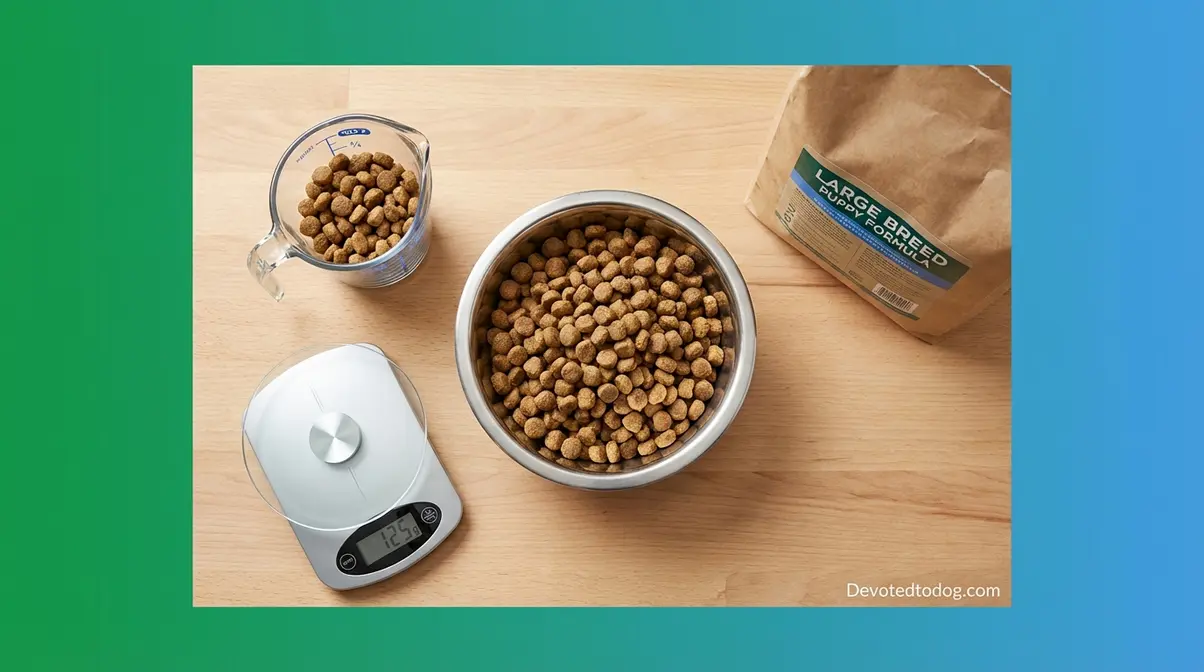
A 4-month-old Golden Retriever should eat 2-3 cups of large-breed puppy food daily, split into 3 meals to support stable energy levels and healthy digestion (AKC Puppy Feeding Fundamentals). This translates to roughly ⅔-1 cup per meal, depending on your puppy’s current weight and the caloric density of your chosen food. As with weight, the exact amount varies. Always monitor body condition alongside the cup measurement, and consult your vet if you’re unsure about adjustments.
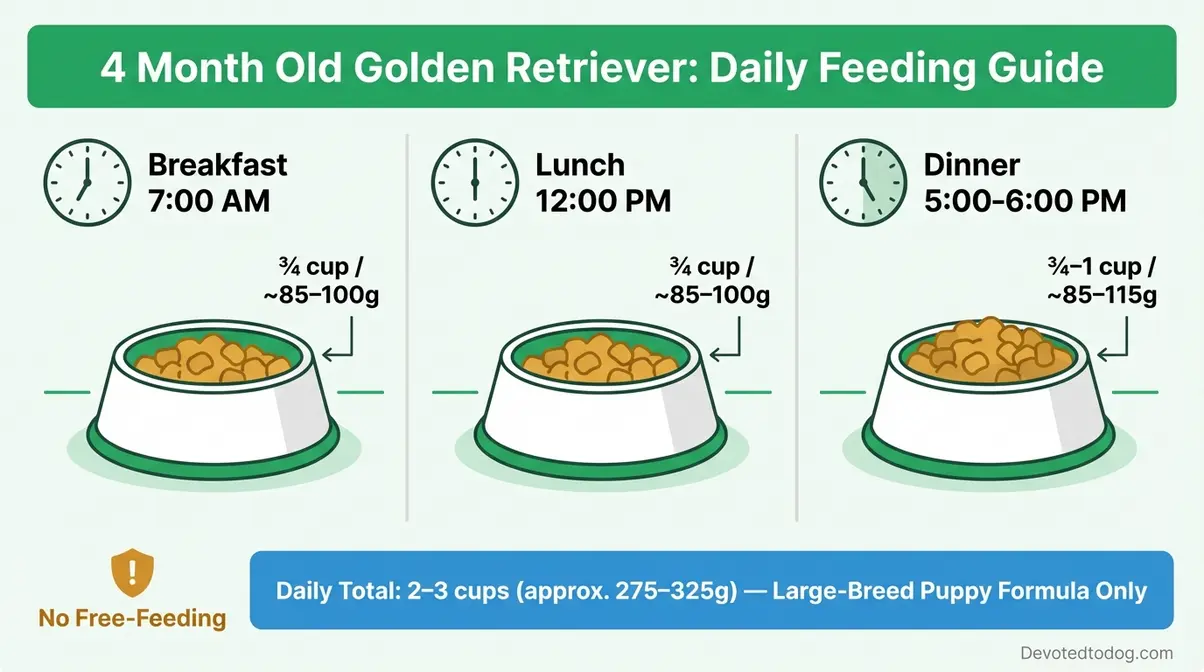
Caption: Splitting daily food into three structured meals (not free-feeding) supports blood sugar stability and makes portion monitoring far easier.
Daily Feeding Amount: Cups and Grams Explained
The cup measurement is the most common, but owners using a kitchen scale get significantly more consistency. Large-breed dry kibble averages 110-130 grams per cup, depending on kibble size and brand density (Houndsy), so a 2.5 cup daily allowance equals approximately 275-325 grams. Weigh your specific food for at least the first week to calibrate, because brand variation is meaningful.
| Meal | Time | Amount (cups) | Approx. Grams |
|---|---|---|---|
| Breakfast | 7:00 am | ¾ cup | ~85-100g |
| Lunch | 12:00 pm | ¾ cup | ~85-100g |
| Dinner | 5:00-6:00 pm | ¾-1 cup | ~85-115g |
According to AKC puppy feeding fundamentals, dividing daily food into multiple structured feedings encourages steady energy and discourages picky eating (AKC). Avoid free-feeding. Leaving food out all day makes portion control impossible and disrupts digestion. You can consult a comprehensive puppy feeding chart for weight-specific adjustments as your puppy grows through the coming months.
Choosing the Right Food: Large-Breed Puppy Formula
Large-breed puppy formulas are not a marketing category. They have a genuinely different nutritional profile. The calcium-to-phosphorus ratio is specifically calibrated to support slower, more controlled bone growth. Standard puppy food or adult food can accelerate bone development in large breeds, increasing the long-term risk of hip dysplasia and elbow dysplasia. For a breed already genetically predisposed to both conditions, this choice matters.
Look for a named meat protein, chicken, lamb, or turkey, as the first ingredient. Target 22-24% protein content for this age group. Avoid adding calcium supplements on top of the formula. The formula already accounts for the appropriate ratio, and excess calcium actively disrupts bone development. The AKC’s feeding fundamentals guidance recommends breed-appropriate puppy food as the foundation of large-breed nutrition (AKC).
Grain-free diets are worth a conversation with your vet before committing. The FDA flagged potential links between grain-free formulas and dilated cardiomyopathy in certain breeds, and Golden Retrievers are among those being studied.
What Is the Best Meat for Golden Retrievers?
The best meat sources for a 4-month-old Golden Retriever are chicken, lamb, or turkey, specifically listed as the first ingredient in a large-breed puppy formula. Look for 22-24% protein content to support healthy muscle growth without accelerating bone development too quickly. Avoid grain-free diets as a default; the FDA has flagged potential links to dilated cardiomyopathy in certain breeds, and Golden Retrievers are among those studied. Always consult your vet for breed-specific dietary guidance before making formula changes.
Appetite Loss During Teething: What’s Normal?
During peak teething weeks (14-18 weeks), many puppies eat noticeably less. Sore, inflamed gums make the pressure of chewing dry kibble genuinely uncomfortable, so your enthusiastic eater may suddenly seem picky or disinterested. This is temporary, not a health emergency.
The most practical fix: briefly soak kibble in warm water for 5 minutes before serving. The softened texture reduces chewing pressure significantly while keeping the nutritional profile intact. Return to dry kibble once adult teeth have fully settled at around 6 months.
According to VCA Hospitals warnings on canine diarrhea, even appetite changes caused by mild stress or discomfort require close monitoring, as persistent changes can indicate underlying GI issues (VCA Animal Hospitals). “A puppy that eats Monday enthusiastically, picks at food Tuesday, and refuses kibble Wednesday is almost certainly in a teething flare, not sick.” But if appetite loss persists beyond 48 hours, your puppy loses more than 10% of body weight, or lethargy accompanies the reduced appetite, call your vet. Those signals move beyond teething.
What Is the Daily Routine Blueprint for Exercise, Play, Sleep?
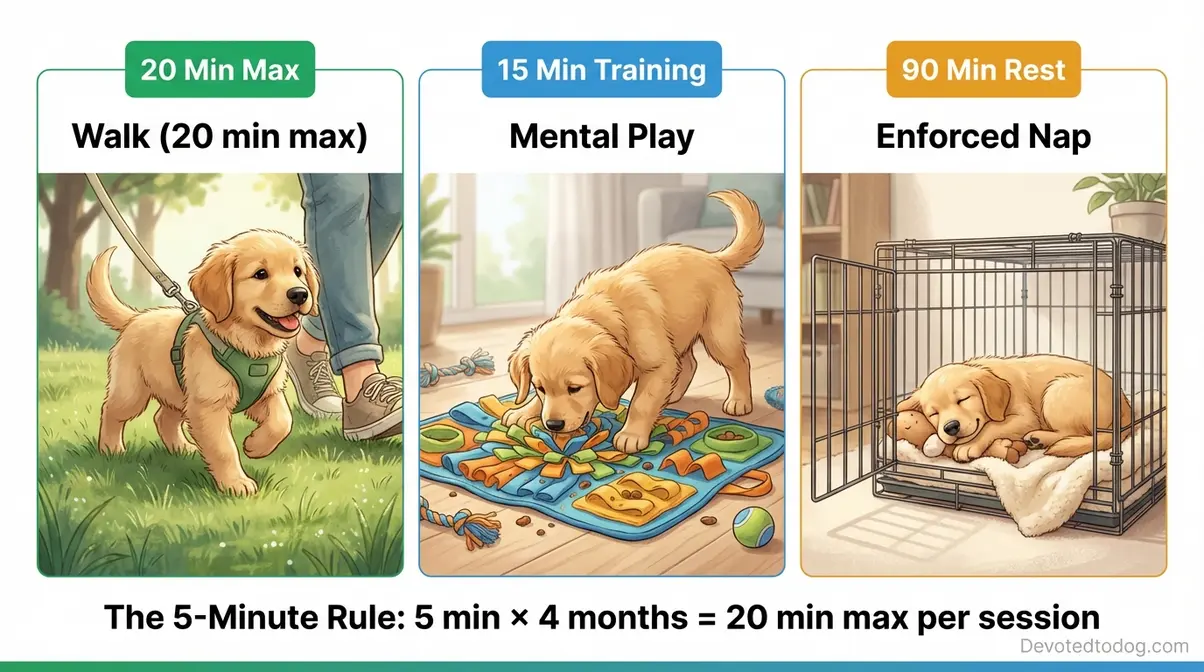
A 4-month-old Golden Retriever should be limited to approximately 20 minutes of formal leash walking per session, following the veterinary “5-minute rule” multiplied by age in months (AKC). This isn’t overly cautious advice; it’s joint protection. At this age, growth plates, the soft cartilage zones at the ends of developing bones, are still open, and repetitive impact on hard surfaces before closure carries real long-term consequences. Most owners dramatically underestimate how much rest their puppy also needs to stay regulated.
How Long to Walk a 4-Month-Old Golden Retriever
The 5-minute rule is straightforward: 5 minutes of formal leash exercise per month of age, once or twice daily. At 4 months, that’s a maximum of 20 minutes per session. According to veterinary researchers’ 5-minute rule for exercise, a 4-month-old Golden Retriever should be limited to approximately 20 minutes of formal walking once or twice per day (AKC). You can learn how much exercise is safe for your puppy as they move through each growth stage.
Growth plates in Golden Retrievers close around 12-18 months, according to veterinary orthopedic research published by the American College of Veterinary Surgeons (ACVS). Until then, formal exercise should be soft-surface, short-duration, and low-impact. The practical rule: two 20-minute off-leash yard sessions on grass are appropriate. One 45-minute pavement walk is a joint strain risk.
Always consult your veterinarian if you’re unsure about your individual puppy’s exercise tolerance, particularly if they show any signs of limping or reluctance to walk.
Mental Stimulation: Tiring Out a Puppy Without Damaging Joints
A 15-minute training session is neurologically as exhausting as a 45-minute walk, without any of the joint risk. This is the use point most owners miss entirely during the velociraptor phase.
- Best mental stimulation options at 4 months:
- Snuffle mats, nose work engages the brain intensely and is inherently tiring
- Frozen Kongs, combines focus, sustained effort, and teething relief simultaneously
- Short training bursts, sit, name recall, “leave it,” 5 minutes across 3 daily sessions
- Structured playtime sequence, 15 minutes snuffle mat → 10 minutes training → enforced nap
Avoid dog parks at this age. Overwhelming environments overstimulate, amplify the biting reflex, and expose a puppy still finishing their vaccine series to disease risk. Controlled, calm exposure is the goal, not maximum socialization intensity.
Enforced Naps: The Secret Weapon Most Owners Ignore
Four-month-old Golden Retrievers need 16-18 hours of sleep per day, a number most owners dramatically underestimate. According to veterinary guidelines on raising puppies, puppies require long stretches of rest to support rapid physiological development, with sleep needs remaining high at 4 months (VCA Animal Hospitals).
“Enforced nap” means crating your puppy for 1.5-2 hours mid-morning and again mid-afternoon, regardless of whether they seem tired. Puppies don’t self-regulate sleep well. Overtiredness creates frenetic, escalating biting, and the nap stops that cycle faster than any redirection strategy.
The direct connection is worth understanding clearly: biting escalates → puppy is actually overtired → crating them for 90 minutes stops the biting. “If your puppy has been awake for more than 90 minutes and biting is escalating, skip the toy redirect. Put them in the crate.”
What Are the Training Priorities at 4 Months?
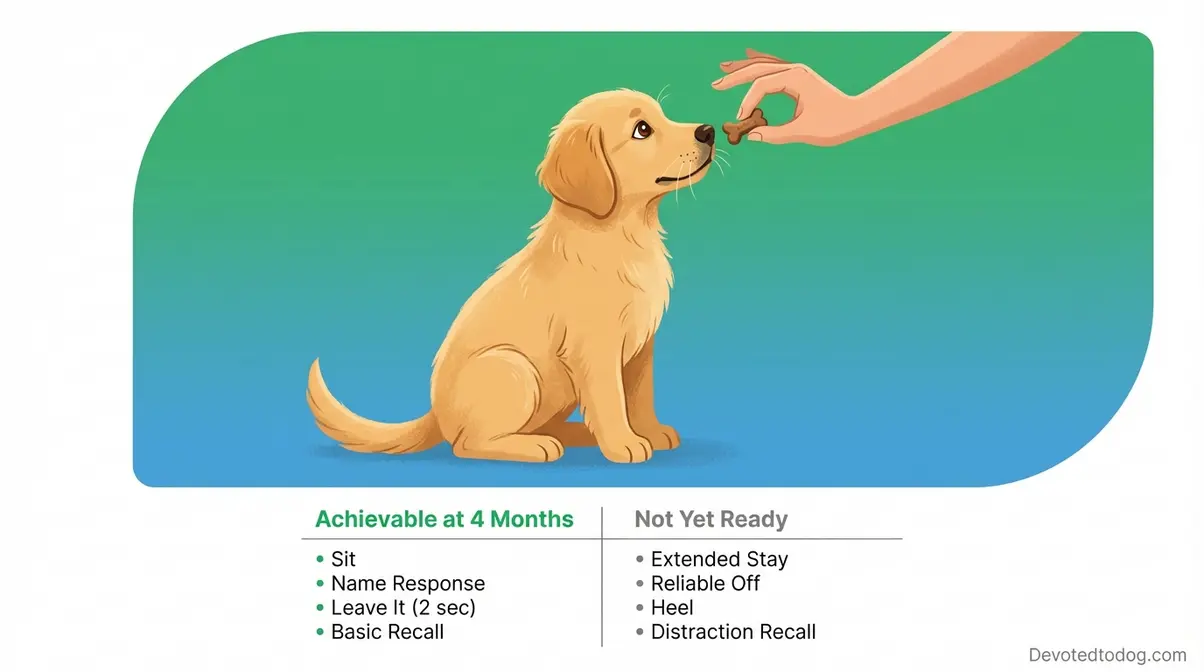
Training at 4 months is not about performance commands. It’s about socialization breadth and impulse control foundations. The 16-Week Threshold creates a narrow window where your puppy’s brain is simultaneously most plastic and most overwhelmed; meeting them at their actual developmental stage produces far better outcomes than ambitious training plans that exceed their capacity. Setting realistic expectations here prevents owner frustration and puppy confusion in equal measure.
Realistic Commands at 16 Weeks
At 4 months, Golden Retriever puppies are developmentally ready to learn sit, name recognition, basic recall, and “leave it” with consistent positive reinforcement, more complex commands require more developed impulse control (Academy for Dog Trainers consensus).
- Achievable now with consistent practice:
- Sit (high success rate, natural position, easily lured)
- Name response (high success, single-word, immediate reward)
- “Leave it” for 2 seconds
- Basic recall in low-distraction environments
- Willingness to enter and stay in crate
- Too advanced for right now:
- Extended “stay” beyond 5 seconds
- Reliable “off” command
- Consistent heel on leash
- Recall around distractions (other dogs, moving objects)
Training sessions should stay at 3-5 minutes maximum, three times daily. Short, high-reward sessions build focus far more effectively than long sessions that exhaust a puppy’s attention span. Explore our complete beginner’s guide to puppy training for session-by-session progression.
The Critical Socialization Window
The primary socialization window closes around 12-14 weeks. At 4 months, you’re in the secondary window, still highly influential, but the opportunity diminishes week by week. User consensus across Golden Retriever owner and professional trainer communities consistently emphasizes this: every new positive experience your puppy has right now shapes adult temperament in meaningful, lasting ways.
Practical socialization at 4 months focuses on calm, varied exposure: car rides, different floor surfaces (hardwood, gravel, grass), gentle interactions with strangers, supervised contact with vaccinated dogs, and age-appropriate exposure to children. The goal is positive associations, not overwhelming novelty. You can find tips for successful potty training alongside socialization guidance, since both benefit from the same consistent scheduling approach.
Force-free puppy classes are the most efficient socialization tool available at this age. They are structured, controlled, and supervised by a professional who can redirect problems before they become habits.
Potty Training Expectations
A 4-month-old can hold their bladder for approximately 4 hours maximum; a useful rule of thumb is one hour per month of age, plus one (VCA Animal Hospitals). According to VCA Animal Hospitals crate training recommendations, a puppy’s bladder control roughly correlates to their age in months, meaning a 4-month-old can generally be left for a maximum of 4 hours (VCA).
Accidents are still normal. If your puppy is going indoors more than once per hour, that warrants a vet check. Frequent urination in puppies can indicate a UTI or parasites. Otherwise, the formula is simple: consistency plus confinement plus immediate rewards for outdoor elimination.
How Do Breed Variations and Gender Differences Show at 4 Months?
Coat color does not affect development. Whether you have an English Cream, a red field-line Golden, or a standard golden-coated dog, the teething timeline, growth curve, and training readiness are identical. The confusion is understandable. Breed descriptions often blur appearance differences with behavioral differences, but at 4 months, the care advice in this guide applies universally across all Golden Retriever color variants.
English Cream, Red & Standard: Does Color Affect Development?
English Cream Goldens often appear stockier at 4 months, not because of their coat color, but because English Cream dogs more frequently come from show-line breeding, which selects for a heavier build. Red Goldens, by contrast, typically look leaner and more athletic because field-line breeding prioritizes agility and endurance over conformation. You can discover the unique traits of English Cream Golden Retrievers to understand these lineage-specific characteristics in more depth.
Developmentally, it’s the same puppy. Teething at the same weeks, gangly stage at the same age, velociraptor phase with equal intensity. The coat color itself is cosmetic, as confirmed by the Golden Retriever Club of America (GRCA) breed standard, it carries no relationship to temperament, growth rate, or health predispositions at this age.
Male vs. Female Golden Retriever at 4 Months
Males run 3-7 lbs heavier at 4 months, and both sexes hit the velociraptor phase with comparable intensity. The idea that one sex is meaningfully calmer at this age doesn’t hold up in practice. Individual temperament variation within a sex is far greater than the average difference between sexes. Don’t make care decisions based on gender alone.
If your female is smaller than an online photo of a male, she’s not malnourished. She’s a smaller sex within a breed that has a wide normal range. Body condition (can you feel ribs without pressing hard? Is there a visible waist?) matters more than the number on the scale or a comparison to someone else’s dog.
What Warning Signs Mean Your 4-Month-Old Needs a Vet?
The velociraptor phase is normal. The gangly stage is normal. The scant coat is normal. What isn’t normal is a specific cluster of signs that move beyond typical 4-month development, and knowing the difference keeps you from either panicking unnecessarily or missing something that genuinely warrants attention.
Red Flags in Growth and Weight
Most weight variation at this age is bloodline-driven, not pathological. But three specific presentations warrant a vet check rather than watchful waiting:
- Puppy consistently below 18 lbs at 4 months, with a dull or thinning coat and low energy. This combination suggests possible parasites or nutritional deficiency, not just a small-lineage dog.
- Puppy above 35 lbs with rapid, visible weight gain. This is worth a vet conversation about portion sizes and thyroid function; Golden Retrievers are prone to hypothyroidism, which can manifest early.
- Visible growth asymmetry, such as one leg noticeably longer or a limb growing at a different rate. This warrants an orthopedic evaluation, not monitoring at home.
Frame this as “when to act,” not “when to panic.” The vast majority of 4-month-old Golden Retrievers are fine. These are the exceptions.
Digestive Issues: Diarrhea, Vomiting & the Skinny Puppy
Occasional loose stool after a diet change or stressful event is normal. Monitor for 24-48 hours, ensure hydration, and return to regular feeding. Three scenarios require faster action:
- Bloody diarrhea, vomiting combined with lethargy, or dehydration signs (dry gums, skin that stays “tented” when pinched) → vet immediately, same day.
- Frequent vomiting alongside refusal to eat for more than 24 hours → vet check, not watchful waiting at this age.
- Puppy eating normally but losing weight or failing to gain → intestinal parasites, which are extremely common at 4 months. A fecal test at your vet costs very little and rules this out quickly.
“Consult your veterinarian if digestive symptoms persist beyond 24 hours in a 4-month-old puppy.” That’s the practical threshold (VCA Animal Hospitals).
When Biting Becomes Aggression
Biting during the velociraptor phase has a specific signature: loose body, wiggly tail, easily redirected, calms after a nap. Aggression looks different: stiff body, pinned ears, whale eye (whites of the eye visible), and biting that occurs without a play trigger.
Resource guarding at 4 months, including growling or snapping when you approach food, water, or toys, requires a veterinary behaviorist or certified professional trainer (CPDT-KA), not standard teething redirection. This behavior does not resolve with patience alone, and early intervention produces dramatically better outcomes than waiting.
If you’re seeing these signs, call your vet. Don’t wait for your puppy to “grow out of it.”
Frequently Asked Questions
What to Expect from a 4 Month Old Golden Retriever?
At 4 months, a Golden Retriever puppy enters the 16-Week Threshold, a convergence of rapid growth, teething, and emerging independence. Expect high energy and intense mouthing during the “velociraptor stage.” Most puppies weigh 20-30 lbs at this age. Consistent routines and enforced naps are your most effective tools.
How Big Is a 4 Month Old Golden Retriever?
A 4-month-old Golden Retriever typically weighs 20-30 pounds (9-14 kilograms), with males averaging slightly heavier than females. Puppies are deep in the “gangly stage” as bone growth outpaces muscle development.
How Much Should a 4 Month Old Golden Retriever Eat?
A 4-month-old Golden Retriever should eat 2-3 cups of large-breed puppy food per day, divided into three meals. Always choose a large-breed formula to protect developing joints. You should be able to feel ribs without pressing hard. Adjust portions by ¼ cup based on your vet’s guidance, and weigh kibble for consistency.
How Do You Build the 16-Week Survival Kit?
For owners navigating a 4 month old golden retriever, the most important mindset shift is this: the chaos is biological, not behavioral. At The 16-Week Threshold, growth, teething, and independence arrive together, making this feel like the hardest stage, even when your puppy is developing perfectly. Keep daily weight around 20-30 lbs (9-14 kg), feed 2-3 cups of large-breed formula across 3 meals, cap walks at 20 minutes per session, and enforce naps at 90-minute awake intervals. Those four levers handle the majority of what feels “out of control” right now.
The 16-Week Threshold doesn’t last forever. Most owners find the velociraptor biting drops noticeably by 5-6 months as adult teeth settle and daily routines become embedded habits. The foundation you’re building right now, redirection over punishment, structured rest, consistent feeding, is what shapes the calm, confident adult dog a Golden Retriever is capable of becoming.
Start with the enforced nap strategy today. It requires nothing except a crate and the willingness to be consistent. When you’re ready for the next stage, explore our complete puppy training guide or jump directly to guidance on choosing the right Golden Retriever puppy if you’re still in the research phase. Either way, you’re already asking the right questions.
Brianna York is a former veterinary technician with hands-on clinical experience in canine health. She contributes medical accuracy review to DevotedToDog health articles and validates clinical claims against current AVMA, AAHA, and OFA standards.