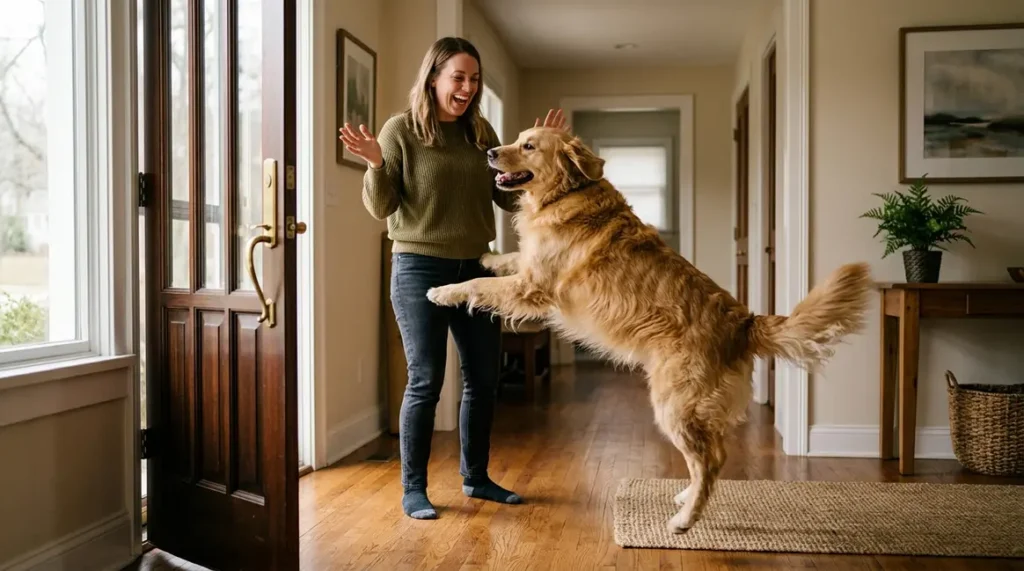
Your dog isn’t trying to hurt anyone. They’re just so excited they can’t contain it. And somehow, that excitement keeps leaving scratches on your arms, your guests’ clothes, and your patience. Here’s the part that surprises most owners: the way you’ve been reacting to the jumping is probably the very thing teaching your dog to do it more.
You’ve tried saying “no.” You’ve tried pushing them down. You may have even tried ignoring it. And then watched helplessly as a visitor immediately undid your progress by scratching your dog’s ears while they were mid-jump. The frustration is real, and it makes sense. Most advice misses the actual mechanism.
By the end of this guide, you’ll understand exactly why your dog jumps on people, including why they target guests more than you. And you’ll have a three-step training plan you can start today. We’ll cover the root cause, the specific scenarios that confuse owners most, and the one rule that makes everything else work.
Dogs jump on people because it works. Any reaction, even pushing them away, teaches them that jumping gets attention.
- Root cause: Jumping is a natural greeting behavior that becomes a habit when humans accidentally reward it.
- The Attention Reward Loop: Any reaction, positive or negative, reinforces jumping. Consistent non-reaction from everyone is the fix.
- Guests get jumped on more because they’re exciting and more likely to accidentally reward the behavior.
- The three-step fix: Withdraw attention → teach an alternative behavior (like “sit”) → enlist every person your dog meets.
- Sudden jumping often signals a routine change, excess energy, or inadvertent retraining by a new person in the dog’s life.
Written by Coral Drake · Reviewed by Brianna York, Former Veterinary Technician · Last updated July 29, 2026 · Sources accessed July 2026
Why Do Dogs Jump on People?
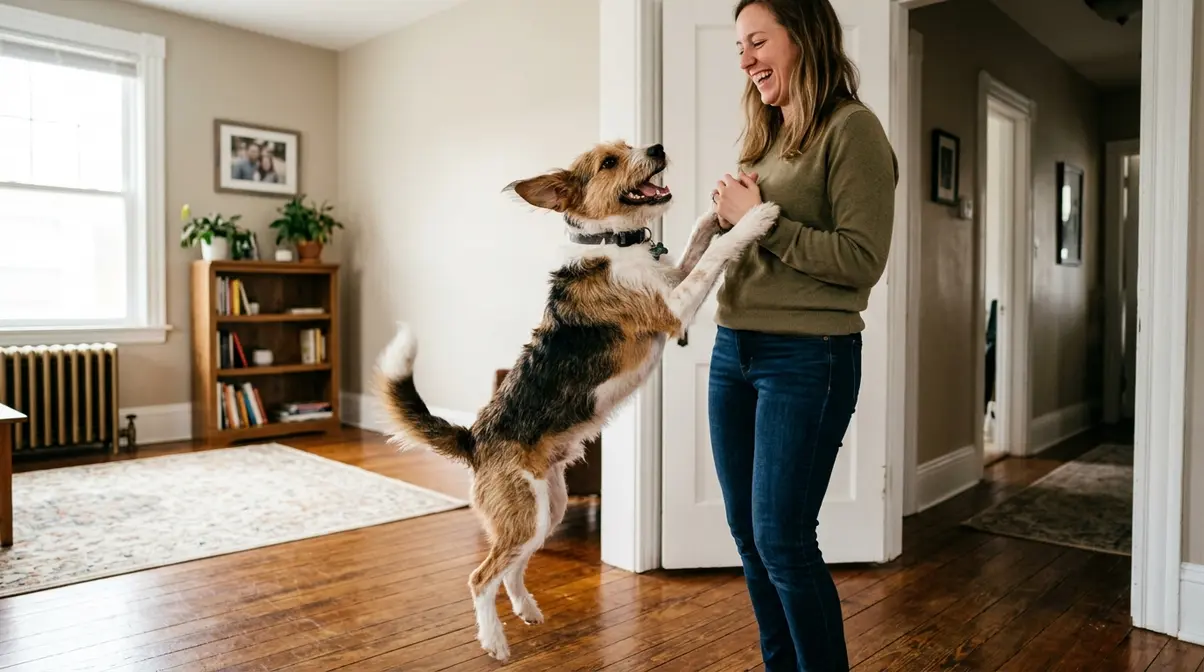
Dogs jump on people to greet them face-to-face, seek attention, or express excitement. And any human reaction, even a correction, teaches them the behavior works. According to the natural form of play for dogs described by the Collaborative for Shelter Dogs at Tufts University, dogs play with each other by jumping and mouthing, so it’s natural for them to try the same thing with people. This is where The Attention Reward Loop begins: every time a human reacts to jumping, whether with a pet, a push, or a sharp “no”, the dog receives attention, and the jump gets reinforced.
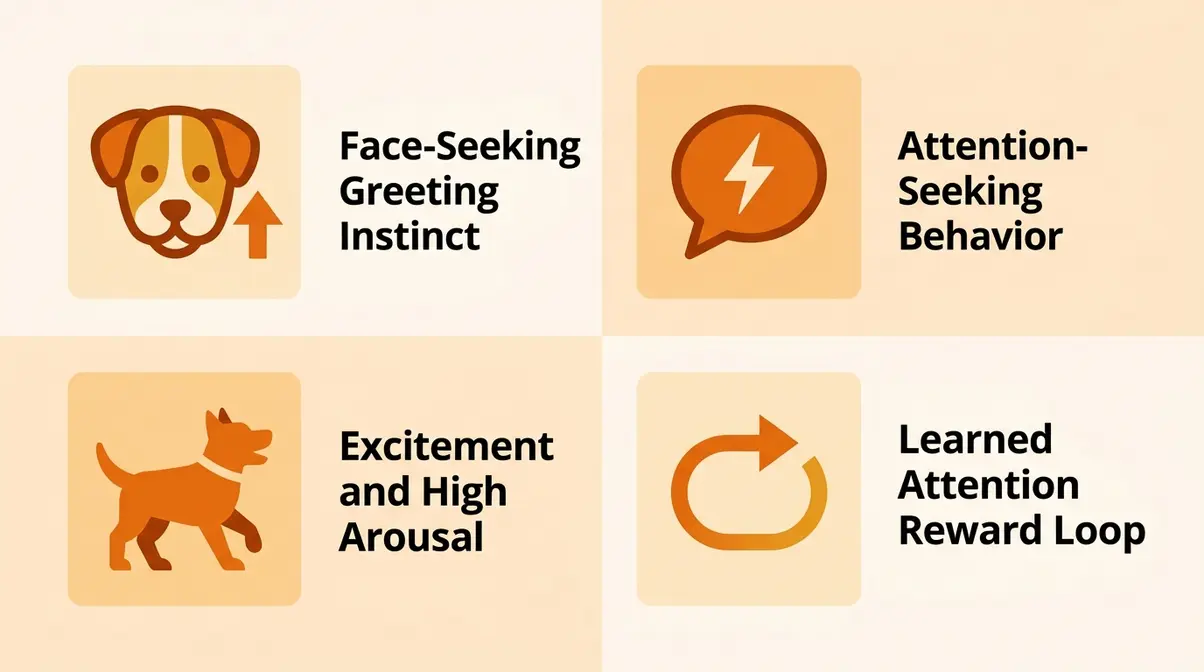
For dog owners understanding the science behind their affectionate personality, this instinct makes complete sense: dogs are social animals wired to seek closeness, and jumping is their version of a handshake.
Jumping as a Greeting Ritual
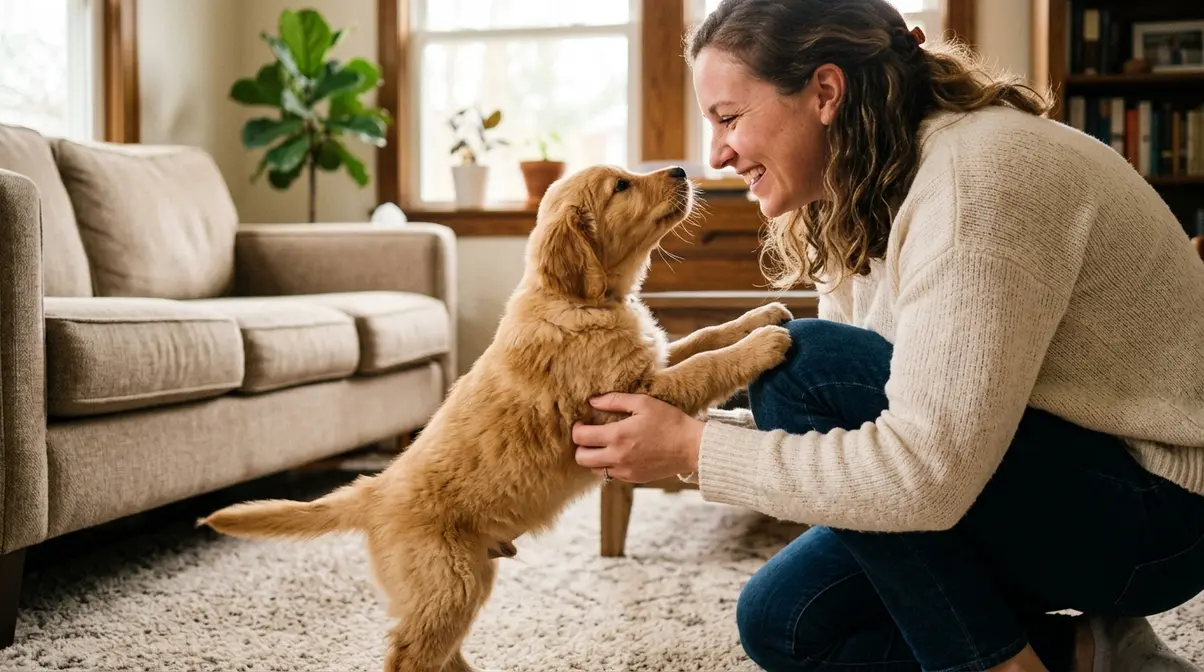
When you understand why dogs jump on people in the first place, the behavior stops feeling random. In the wild, puppies lick the mouths of returning adult dogs as a greeting. It’s a face-seeking ritual that signals friendliness and submission. Domestic dogs carry this same instinct, and since human faces are several feet above the floor, jumping up is simply their attempt to reach yours.
A 2018 study from Duke University found that dogs engage in affiliative behaviors, actions that promote social bonding, when interacting with people, particularly strangers (Tan et al., Learning & Behavior, 2018). Jumping is one of these bonding attempts. It’s social, not a power play.
That last point matters. Many beginners are told “your dog is trying to dominate you” when they jump, but current behavioral science doesn’t support this. A dog that jumps on every visitor at the door is displaying the same greeting instinct as a puppy licking an adult dog’s muzzle, just scaled up to human height. And if your dog sometimes jumps on you from behind when you turn away or bend down, that’s the same face-seeking instinct triggered by a sudden change in your position.
“But if jumping is just a friendly greeting, why does it keep happening even after you’ve told your dog ‘no’ a hundred times? That’s where the Attention Reward Loop comes in.”
When Jumping Becomes a Learned Habit
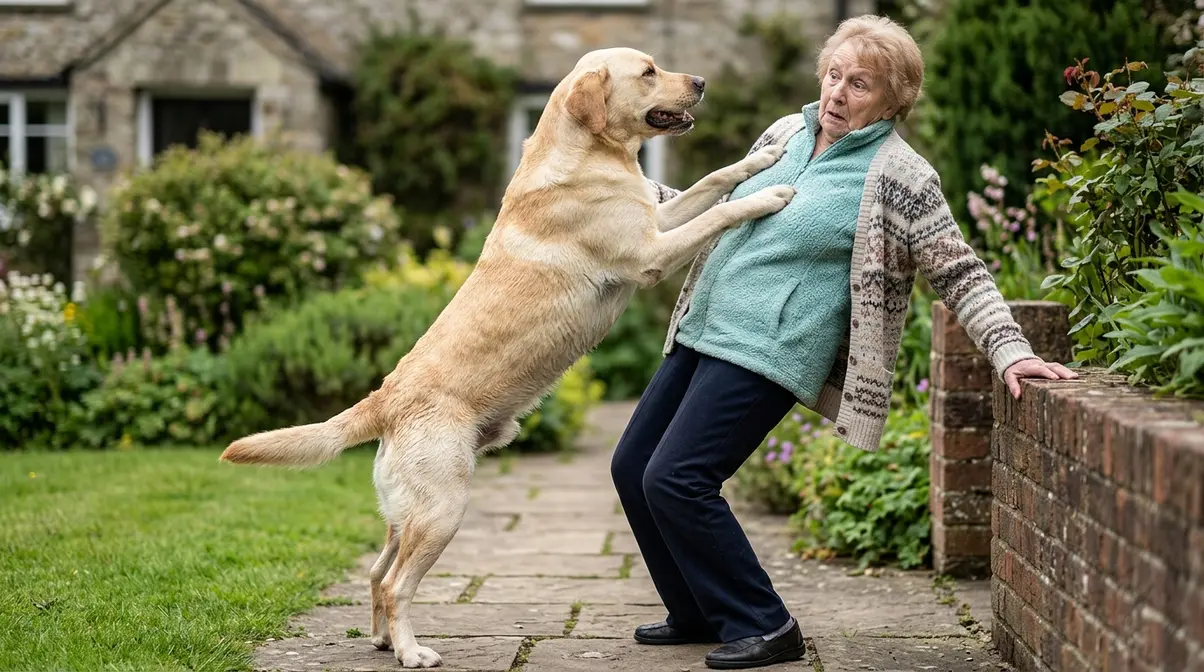
The Attention Reward Loop works like this: every time a human reacts to jumping, pushing the dog down, saying “off,” making eye contact, or even laughing, the dog receives attention. Attention is the reward. The jump worked. The loop completes, and the behavior gets stronger.
This is genuinely counterintuitive for beginners. Saying “no” feels like a correction, but to the dog, it’s engagement. Think of a child who acts out to get a parent’s attention: any reaction, even a frustrated one, is better than being ignored. Dogs operate on the same principle. The habit solidifies quickly because the reward is immediate and consistent every time a human reacts.
The same over-excitement that drives jumping can also trigger humping. Both behaviors follow the same reward loop and share the same root cause: high arousal combined with a learned history of getting a reaction.
A dog that jumps on guests specifically, more than the owner, has already learned that guests react while the owner doesn’t. The loop is selective, which is actually useful information. It means your dog is trainable.
The loop gets even more complicated when your dog jumps on guests but leaves you alone, which is exactly what the next section explains.
Why Does My Dog Jump on Guests But Not Me?
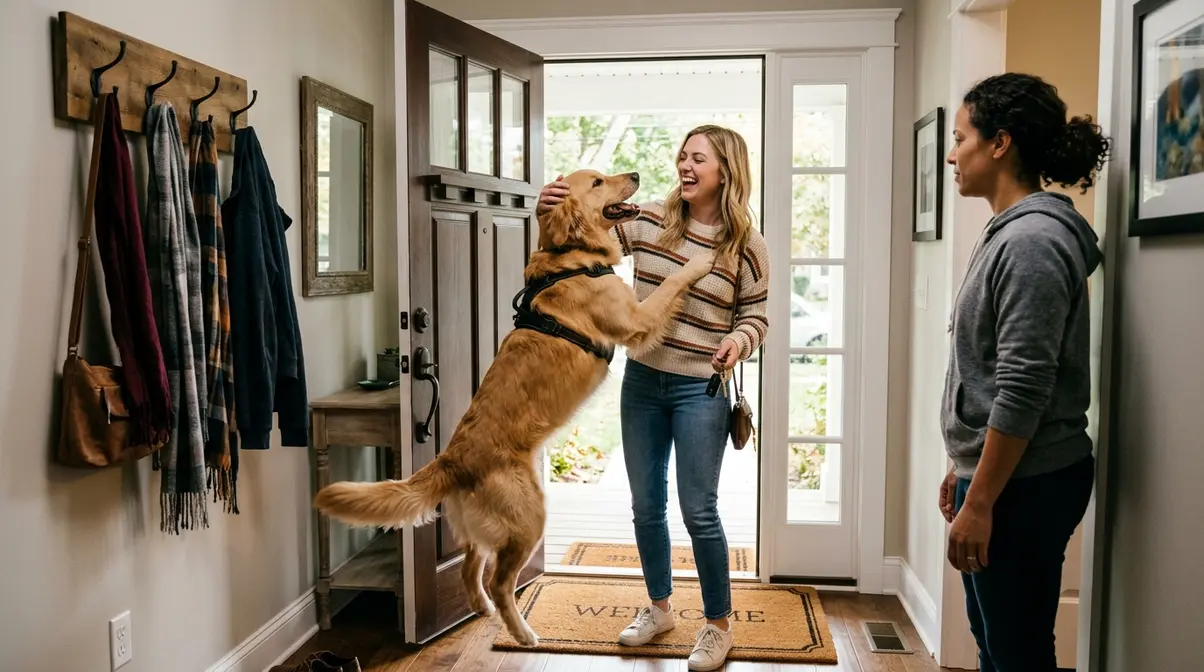
Your dog jumps on guests because they’re a new, exciting stimulus. And they’re far more likely to accidentally reward the behavior. You’ve probably learned to ignore the jumping, which taught your dog it doesn’t work on you. Guests haven’t established that rule, so the dog tries. Dogs display more intense social bonding behaviors toward strangers than familiar people, according to the 2018 Duke University study (Tan et al.), and every new visitor essentially resets the Attention Reward Loop your training has been building.
Guests Are a New and Exciting Stimulus
Strangers carry new smells, new voices, and new energy, all of which spike a dog’s arousal level. Higher arousal means more intense greeting behavior. This is why a dog that calmly greets the owner at the door can launch itself at a visitor within seconds of their arrival.
The Duke University research (Tan et al., 2018) confirms that dogs display more intense affiliative behaviors, actions meant to create a social bond, with strangers than with people they already know. A dog that greets the owner with a tail wag and a sniff may greet a visitor with full-body jumping. It’s the same instinct, just amplified because the stimulus is new.
Arousal alone doesn’t explain why the behavior keeps happening, though. Accidental rewards do.
Accidental Rewards from Visitors
Guests unknowingly reset the Attention Reward Loop in three common ways:
- Petting the dog while it’s jumping, the most direct reward: the dog jumped, got scratched behind the ears, and filed that result away.
- Talking to the dog, “down, boy!” or “oh. You’re so sweet!” is verbal attention. The dog doesn’t understand the words; it understands that jumping produced a response.
- Pushing the dog away with their hands, physical contact is still contact. The dog reads it as engagement, not rejection.
This also explains the reverse scenario: if you’ve been consistent about ignoring the jump, your dog has learned it doesn’t work on you. Guests haven’t established that rule, so the dog tries them instead. That’s also why recognizing the signs of an unhappy or anxious dog matters: sometimes what looks like excitement is actually anxiety about a new person.
A guest who says “oh. It’s okay, I love dogs!” and scratches your dog’s ears mid-jump has just sent a very clear message: jumping on guests works. Training the owner alone is never enough. Every person the dog meets needs to follow the same rule.
Your dog isn’t just learning from guests in general. They’re learning from specific people who react in specific ways.
Why Does My Dog Jump on Certain People?
Dogs jump on certain people because they’ve learned those people react. And any reaction counts as a reward. According to AKC’s guide to stopping jumping, dogs learn to jump on people who react, whether the reaction is petting, pushing, or talking. Here’s the empowering part: a dog that has already learned not to jump on one person has proven they’re capable of learning not to jump on anyone.
Your Dog Has Learned Who Rewards the Jump
Dogs observe and remember. After just a few interactions, they know: jumping on the owner produces nothing (the owner turns away); jumping on Grandma produces a hug and an “oh, you silly dog!” The dog jumps on Grandma. Your dog has essentially run the Attention Reward Loop with every person they’ve met and filed the results.
The types of people dogs commonly target follow a clear pattern:
- Excitable visitors who react with high energy, squealing, arms out, immediate eye contact
- Children who squeal and run, which the dog reads as an invitation to play
- People who push the dog away with their hands, because physical contact registers as engagement
If your dog jumps on your partner but not you, it’s not favoritism. Your partner is probably reacting in a way the dog finds rewarding, even without realizing it. The fix is the same: consistent non-reaction from everyone, not just you.
The positive reframe matters here. A dog that has learned not to jump on you has already proven the mechanism works in reverse. Make jumping unrewarding for everyone, and the behavior fades. Your dog isn’t being stubborn. They’re being logical.
But what if the jumping started suddenly, seemingly out of nowhere? That’s a different problem with a different cause.
Why Is My Dog Suddenly Jumping on People?
Sudden jumping usually means one of three things: a routine change is creating excess energy, someone new is accidentally rewarding the behavior, or, rarely, your dog is trying to communicate physical discomfort. According to Goddard Vet Group’s guidance on sudden behavior changes, a strong desire for attention or inadvertent training from a new person in the dog’s life are the most common drivers. The reassuring news: once you identify the cause, this is fixable.
Routine Changes and Excess Energy
If your dog suddenly starts jumping more, check these three things:
- Has their routine changed? Less exercise, a new work schedule, or a recent move can create pent-up energy that comes out as jumping. A dog that used to get a 45-minute walk and now gets 20 minutes has somewhere to put that energy. And jumping on people at the door is an outlet.
- Has someone new entered their life? A new roommate, a visiting relative, or a dog walker who reacts to the jumping can reset the Attention Reward Loop entirely. One consistent rewarder is enough to undo weeks of your training.
- Is your dog showing other signs of discomfort? Jumping combined with restlessness, whining, or changes in appetite can signal physical discomfort. Consult a vet if you notice these together.
Causes #1 and #2 account for the vast majority of sudden jumping cases. The third is rare but worth noting: a dog that was previously calm and is now jumping more alongside other behavioral shifts deserves a vet check before you assume it’s purely a training issue.
A dog that was perfectly calm before a new baby arrived may start jumping more. Not because of the baby, but because the owner’s attention has shifted and the dog is trying to recapture it. That’s the Attention Reward Loop responding to a changed environment, not a new problem.
Whatever the cause, the fix follows the same three steps.
How to Stop Your Dog From Jumping on People
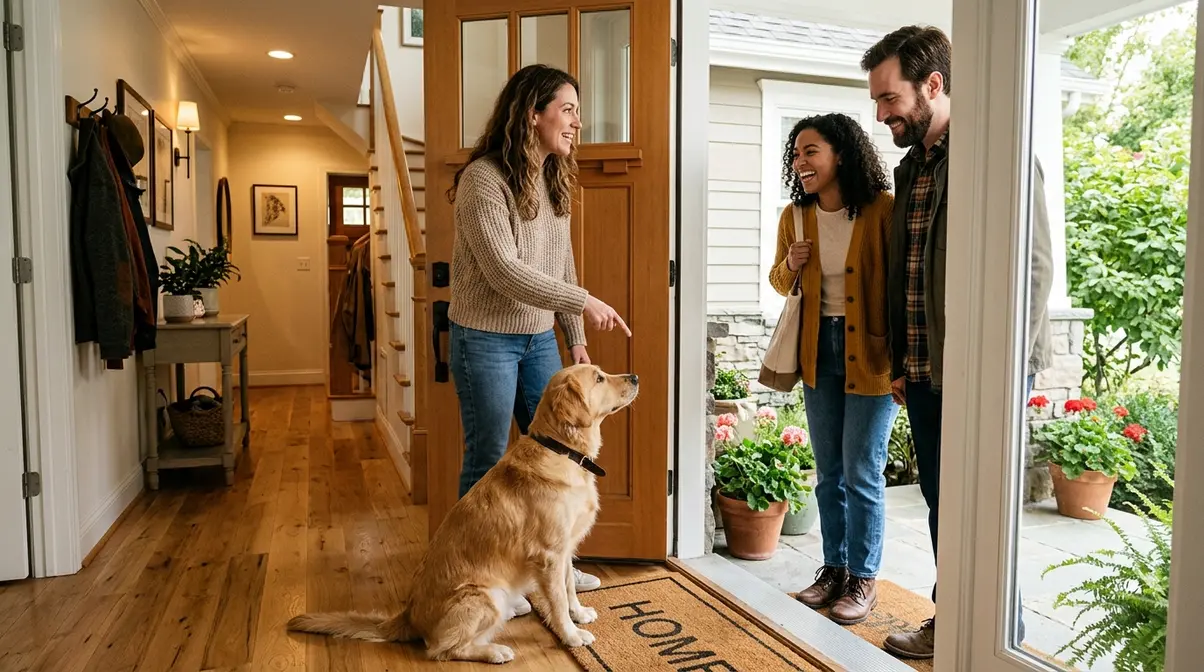
Stopping jumping requires three consistent actions: withdraw all attention the moment the jump happens, teach and reward an alternative behavior, and enlist every person your dog meets. Experts at teaching a dog good manners at Texas A&M’s School of Veterinary Medicine & Biomedical Sciences, one of the top veterinary programs in the U.S., recommend training dogs not to jump as a foundation skill for all social interactions. Step 1 breaks the Attention Reward Loop; Step 2 replaces it with something better; Step 3 makes sure no one accidentally restarts it.
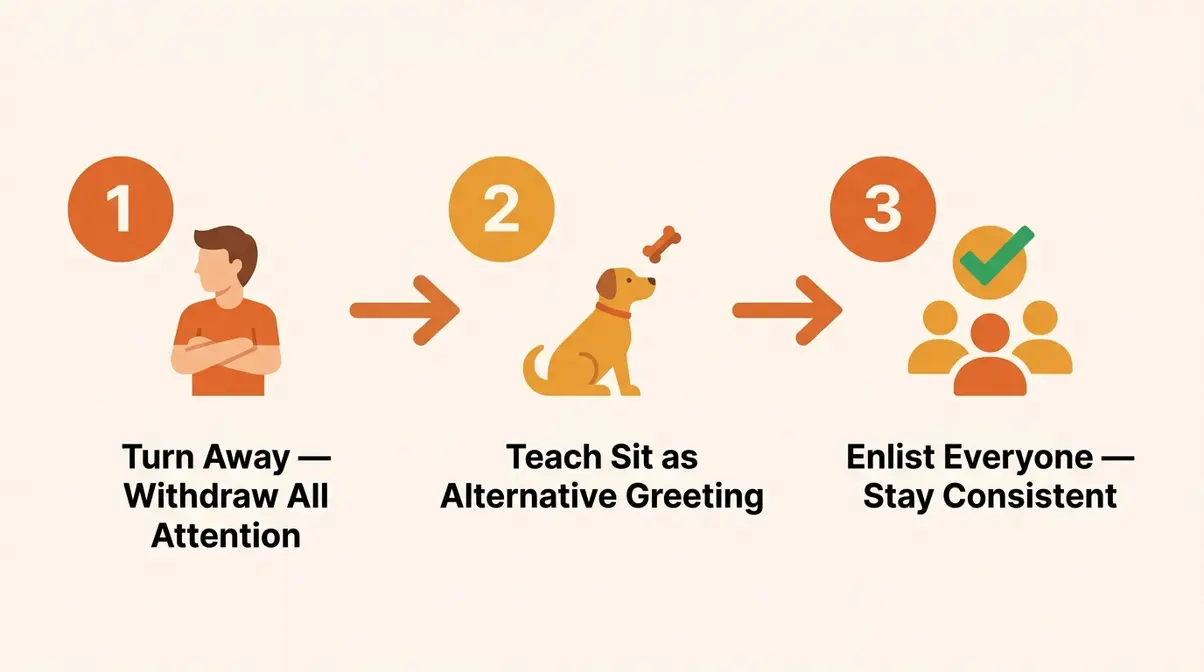
Step 1: Withdraw All Attention When Your Dog Jumps
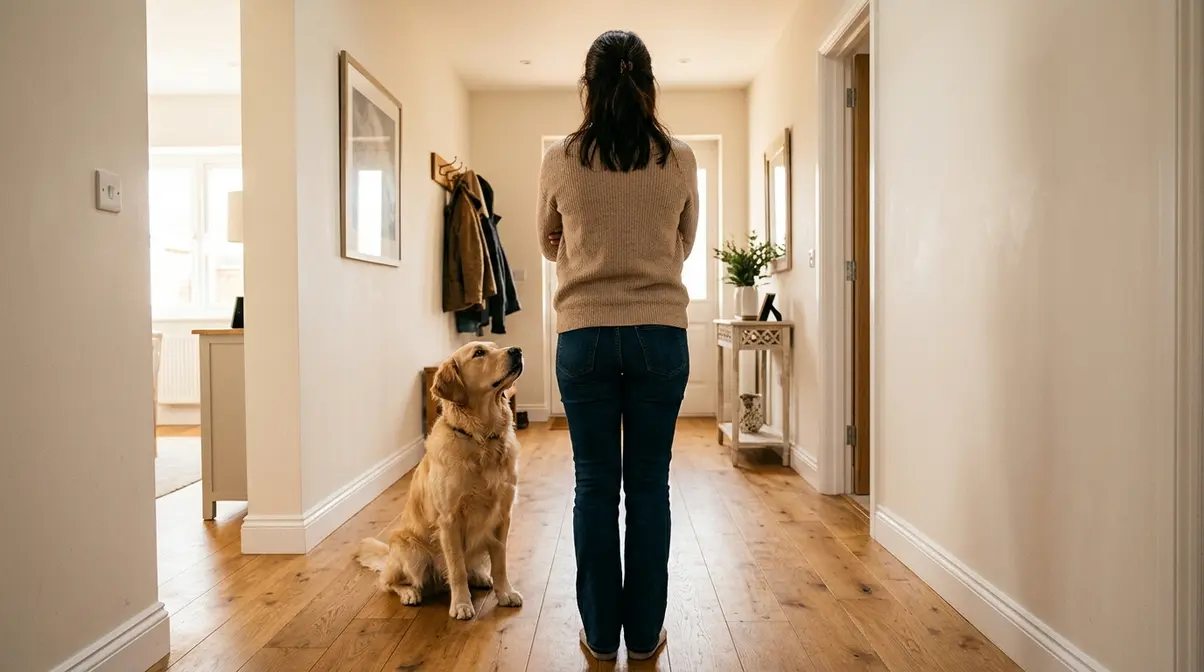
The moment your dog’s paws leave the ground, turn your back completely, cross your arms, look away, and say absolutely nothing. No “off,” no “no,” no eye contact. The specific body language matters: a full turn, arms crossed, gaze averted. Beginners often half-turn or glance back to check if the dog has stopped; that glance counts as attention.
- What NOT to do:
- Push the dog away with your hands, physical contact is still contact, and the dog reads it as engagement
- Knee the dog in the chest, this technique appears in older guides but is outdated, potentially harmful, and can create fear or aggression responses
- Say anything at all, even a sharp “no” is verbal attention and rewards the jump
Woods Humane Society recommends turn around and step away the moment a dog jumps, then immediately turning back and acknowledging the dog only when all four paws are on the floor. That last part is just as important as the turn: when the dog is calm with four paws down, you turn back and offer quiet, calm praise. The dog learns: jumping = nothing; four paws on the floor = attention.
The same technique applies if your dog jumps on you from behind. If they launch at you when you turn away, stay turned. Don’t peek. Wait for four paws on the floor, then calmly turn back. Consistency in those first few seconds is everything.
Withdrawing attention stops the reward. But it doesn’t tell your dog what to do instead. That’s Step 2.
Step 2: Teach and Reward an Alternative Behavior
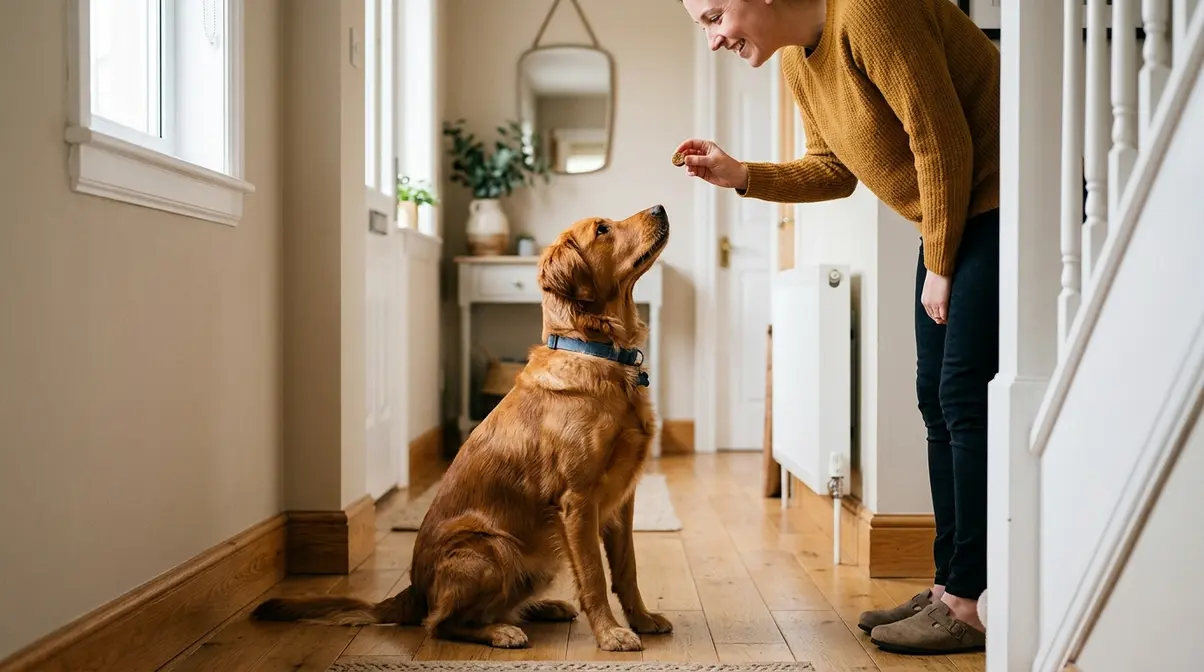
You can’t simply remove a behavior without replacing it. The goal of Step 2 is to give your dog a different way to get the attention they were seeking, one that works for both of you. “Sit” is the most effective alternative greeting behavior because it’s physically incompatible with jumping: a sitting dog cannot simultaneously jump.
The training sequence:
- Ask for “sit” before the dog has a chance to jump, at the door, before a visitor enters, before any high-excitement moment. You’re getting ahead of the arousal spike rather than reacting to it.
- Reward the sit immediately with a treat or calm verbal praise the instant all four paws are on the floor and the dog is seated. Timing matters. The reward needs to land within two seconds of the behavior.
- Practice in low-distraction environments first, then gradually increase difficulty: practice with a calm family member, then a mildly exciting visitor, then the most exciting person in your dog’s life.
Humane Society International recommends rewarding the good behavior immediately when a dog sits as a guest enters. The sit replaces the jumping habit rather than simply suppressing it. This is positive reinforcement (rewarding the behavior you want to see more of) in its most practical form, and it’s more durable than punishment-based methods because the dog is actively learning a new skill, not just learning to suppress an old one.
For owners who want additional tools to support the training process, exploring different types of training collars can help you find the right fit once the foundational steps are in place.
Steps 1 and 2 will work perfectly, as long as everyone follows them. That’s the hardest part.
Step 3: Enlist Every Person Your Dog Meets
The Attention Reward Loop resets with every person who doesn’t follow the rules. One visitor who pets the jumping dog undoes days of careful training. Consistency isn’t optional. It’s the mechanism that makes everything else work.
Briefing visitors before they enter is simpler than it sounds. A brief script works well: “When you come in, please ignore the dog completely until all four paws are on the floor. Then you can say hello.” Most people are happy to cooperate when they understand why. This isn’t rude. It’s responsible dog ownership.
For situations you can’t fully control, dog parks, walks, and strangers on the street, a leash gives you the management tool you need. A short leash and a “sit” cue before any greeting prevents the jump from happening entirely. The dog never gets the chance to practice the behavior, which means the habit gets weaker instead of stronger.
The Arizona Humane Society’s certified trainers use positive reinforcement, force-free, and science-based methods, the same approach that makes the consistency requirement in Step 3 effective. For owners who have already worked through Steps 1 and 2 consistently and are exploring additional management tools, guidance on using e-collars for training is available, though positive reinforcement should always be the first approach.
Even with the best training plan, there are situations where jumping crosses from annoying into genuinely dangerous.
When Jumping Becomes a Problem: Safety Risks and When to Get Help
Jumping is more than a nuisance. As Best Friends Animal Society explains in their Best Friends Animal Society’s guide, jumping can startle people, cause them to lose balance, or leave scratches. It’s a cute puppy habit that becomes dangerous as the dog grows. A 20-pound puppy jumping on a toddler is annoying. A 70-pound adult dog jumping on the same child is a fall risk.
Safety Risks You Shouldn’t Ignore
Is it rude to let your dog jump on people? Yes. And it goes beyond social etiquette. Jumping is a genuine safety issue that scales with the dog’s size. The three most common risks:
- Scratches from nails, even a friendly, excited jump can break skin, particularly on bare arms or legs. This is especially true for older dogs with longer, sharper nails.
- Falls, a large dog jumping on an elderly person or a young child can cause a serious fall. A 60-pound dog launching at full speed is enough to knock an adult off balance, let alone a child or an elderly visitor.
- Fear and lasting trauma, a dog that jumps on a fearful visitor can create or reinforce a lasting fear of dogs, even when no physical harm occurs. Not every guest loves dogs, and an enthusiastic greeting can feel threatening to someone who doesn’t.
The behavior that’s endearing in a small puppy becomes a liability in a large adult dog. Addressing it early protects both your guests and your dog.
When to Consult a Professional Trainer
Most jumping responds well to the three-step plan above. Seek professional help when:
- The jumping is accompanied by growling, snapping, or other signs of aggression, this is no longer a greeting behavior problem and requires a certified behaviorist, not just a trainer.
- Your dog is large enough to cause injury and hasn’t responded to four to six weeks of consistent training, at this point, a professional can assess whether there are underlying factors the at-home plan isn’t addressing.
- The jumping appears fear-based, a dog that jumps on people and then immediately retreats, or shows stress signals like yawning, lip-licking, or “whale eye” (showing the whites of their eyes), needs a different approach than excitement-based jumping.
Look for a trainer who uses force-free, positive reinforcement-based methods. The Arizona Humane Society’s approach is a good reference point for what that looks like in practice.
If the behavior changed suddenly and your dog is also showing signs like excessive licking, restlessness, or appetite changes, rule out a physical cause first. A medical reason your dog keeps licking their feet is worth investigating before assuming it’s purely behavioral. For dogs that also exhibit other high-energy or destructive behaviors, how to manage destructive digging or chewing on their bed is a related challenge many owners face alongside jumping.
Frequently Asked Questions About Dog Jumping
What does it mean if a dog tries to jump on you?
Jumping on you is almost always a greeting or attention-seeking behavior. Your dog is trying to reach your face the way dogs greet each other in the wild. It’s a natural instinct, often learned as a puppy. That becomes a habit when humans react to it. Even pushing the dog away counts as attention and reinforces the behavior. Most dogs that jump are excited and friendly, not aggressive. The behavior can be redirected with consistent training.
Why does my dog jump on guests but not me?
Your dog jumps on guests because they’re a new, exciting stimulus. And they’re more likely to accidentally reward the behavior. You’ve probably learned to ignore the jumping, which taught your dog it doesn’t work on you. Guests haven’t established that rule, so the dog tries. Even a single reaction from a visitor, petting, talking, or pushing, can reset weeks of your training. Briefing guests before they enter is a key part of the fix.
Is it rude to let your dog jump on people?
Yes, letting your dog jump on people is considered rude and can be genuinely unsafe. Jumping can startle people, cause them to lose balance, or leave scratches. What’s cute in a puppy becomes a real hazard in a large adult dog. Elderly visitors and young children are particularly vulnerable to falls caused by an enthusiastic jumping dog. Consistent training protects both your guests and your dog.
Why is my dog suddenly jumping on people?
Sudden jumping is usually caused by a routine change, a new person in your dog’s life who’s accidentally rewarding the behavior, or pent-up energy from less exercise. Dogs are quick learners. If one new person reacts to the jumping, the dog will generalize that and try it on everyone. In rare cases, sudden behavior changes can signal physical discomfort. If the jumping is accompanied by other symptoms, consult a vet.
Why do dogs only jump on certain people?
Dogs jump on certain people because they’ve learned those people react. And any reaction is a reward. Your dog has essentially run an experiment on every person they’ve met: jumping on Person A always produces a response; jumping on Person B never does. Dogs consistently target people who react with excitement, petting, or even pushing. People who turn away and offer no reaction are quickly removed from the jumping list.
Is it ever okay for a dog to jump on people?
Jumping can be acceptable only if it’s a trained behavior performed on a specific cue, not a default greeting. Some owners teach their dog to jump up on command (useful for hugging or playing) while keeping “four paws on the floor” as the default. The key is that the dog jumps only when asked, not whenever they feel excited. Without that distinction, allowing jumping creates confusion and makes training significantly harder.
Start Stopping the Jump Today
For dog owners frustrated by jumping, the root cause is almost always the same: The Attention Reward Loop. Dogs jump on people because any human reaction, even a correction, teaches them that jumping works. According to the Collaborative for Shelter Dogs at Tufts University, jumping is a natural form of play for dogs, and it becomes a persistent habit when humans accidentally reinforce it. The fix requires three consistent steps: withdraw attention, teach an alternative behavior, and enlist everyone your dog meets.
The Attention Reward Loop is the reason “just ignore it” fails. One visitor who reacts resets the loop for everyone. Understanding this mechanism is what makes the three-step plan actually stick. Your dog isn’t being stubborn; they’re being logical. Once you break the loop consistently, the jumping fades faster than most owners expect.
Start with Step 1 today. The next time your dog jumps, turn your back, cross your arms, and say nothing. Practice for one week before adding Step 2. If you’re ready to explore additional training tools to support the process, exploring different types of training collars can help you find the right fit for your dog and your training style.