

Author: Coral Drake
This article is for informational purposes only. Always consult a licensed veterinarian for advice specific to your dog’s health.
Around 60 percent of Golden Retrievers die from cancer, a rate far higher than most other breeds (Morris Animal Foundation, 2024). That statistic can stop a loving owner cold. But it is not a sentence. It is a starting point for understanding how long Golden Retrievers live and, more importantly, what you can do about it.
Most guides tell you “10 to 12 years” and leave you there. You deserve to know why that number is what it is, why it has actually been shrinking, and what genuinely moves it in a better direction.
This guide covers the average Golden Retriever lifespan, the specific health threats that shorten it, how to recognize the senior years, and the evidence-based steps you can take right now to help your dog live their best fullest lifespan.
If you are asking how long do Golden Retrievers live, the answer is typically 10 to 12 years, but genetics, diet, and early cancer detection can directly influence that range, closing what we call “The Healthspan Gap.”
- Average lifespan: 10 to 12 years; well-cared-for dogs sometimes reach 14 to 15
- Biggest threat: Cancer accounts for approximately 60% of Golden Retriever deaths (Morris Animal Foundation, 2024)
- Top actions: Maintain a healthy weight, schedule annual vet screenings, and know the early warning signs
- Senior status: Goldens are generally considered senior around age 8
How Long Do Golden Retrievers Live?

Golden Retrievers typically live 10 to 12 years, according to American Kennel Club breed information. That means if you bring home a Golden puppy today, you can realistically plan for about a decade of companionship. Some well-cared-for dogs reach 14 to 15 years, though that requires attentive health management throughout their lives.
The Golden Retriever is a large sporting breed beloved for its loyal, gentle nature. The American Kennel Club, the leading U.S. breed registry, places the breed’s life expectancy firmly at 10 to 12 years. At age 10, a healthy Golden can still be playful and engaged, but their body is working harder to stay that way. Understanding that is the first step toward giving them more good years.
What surprises many owners is that this number has not always been so modest. DeepScan DX analysis of historical breed data documents that Golden Retrievers reportedly lived 16 to 17 years in the 1970s. Today’s average is roughly 40 percent shorter. The reasons are complex and still being studied, but they include changes in breeding practices, increased cancer rates, and diet-related factors.
That historical shift points to something important: golden retriever lifespan is not fixed. It responds to the world these dogs live in, and to the choices their owners make.
The timeline below shows how a Golden’s health needs shift at each life stage.
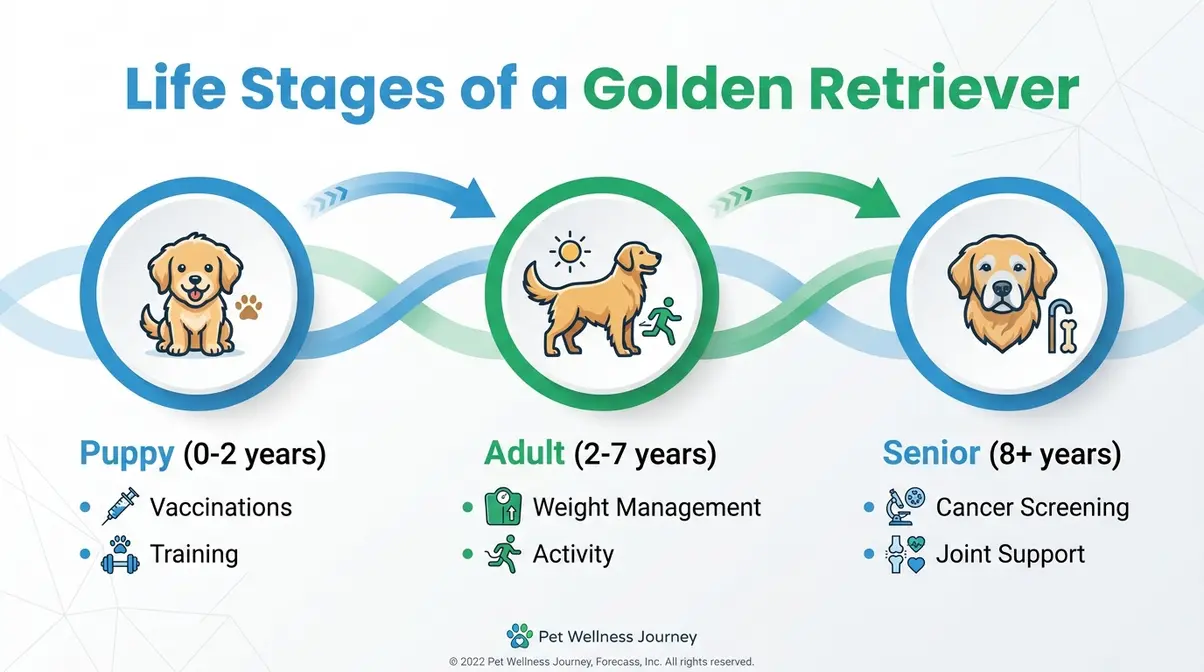
This is where “The Healthspan Gap” comes in. A 12-year life filled with pain, obesity, and undetected cancer is a very different experience from a 12-year life full of energy and joy. Coral Drake, writing for devotedtodog.com, defines The Healthspan Gap as the difference between how long your Golden lives and how well they live during those years. The goal of this guide is to help you close that gap.
What Factors Affect How Long a Golden Retriever Lives?

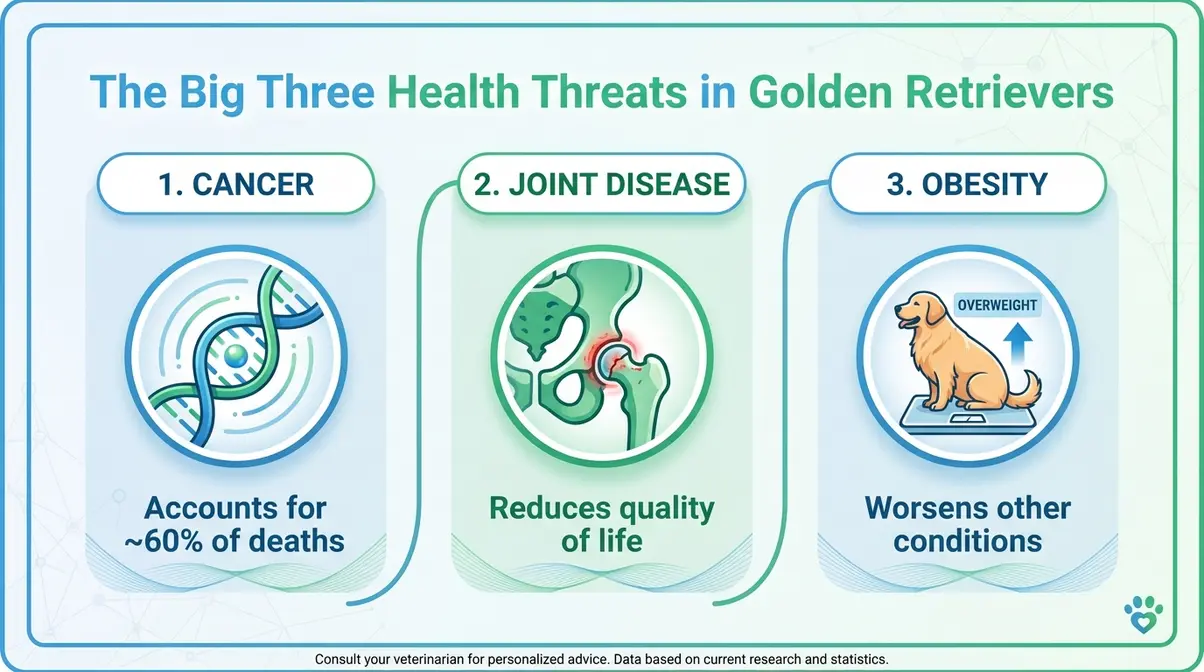
Approximately 60% of Golden Retrievers die from cancer, according to the Morris Animal Foundation’s ongoing U.S. longitudinal study (Morris Animal Foundation, 2024). That single statistic shapes almost every conversation about golden retriever life expectancy in veterinary circles. But cancer is not the only force at work, and understanding all three primary threats gives you a clearer picture of where your energy as an owner is best spent.
The Big Three Health Threats
The Golden Retriever Lifetime Study data from Morris Animal Foundation, a nonprofit that funds animal health research, is tracking more than 3,000 dogs to build the most comprehensive picture yet of what shortens and extends a Golden’s life (Morris Animal Foundation, 2024).
Cancer is the primary threat. The two most common types are hemangiosarcoma, a cancer of the blood vessel lining that often develops without visible symptoms until it is advanced, and lymphoma, a cancer of the lymphatic system. Both are aggressive. Asking how long do golden retrievers live with cancer depends heavily on the type and stage at diagnosis, which is exactly why early detection matters so much.
Joint disease is the second major factor. Hip and elbow dysplasia, meaning abnormal joint development, are common in the breed and reduce quality of life significantly in the senior years. Maintaining a healthy weight is the single most controllable prevention factor available to you.
Obesity compounds both of the threats above. Overweight Goldens carry extra stress on already vulnerable joints, and emerging research suggests excess body fat may also influence cancer risk. A lean body condition is one of the most evidence-backed longevity tools available to any owner.
The good news is that several of these risks respond directly to the choices you make every day.
How to Help Your Golden Live Longer

Closing The Healthspan Gap starts with consistent, proactive care. These six steps, reviewed by Brianna York, Vet Tech at devotedtodog.com, represent the highest-impact actions you can take:
- Keep your Golden lean. Obesity shortens life and worsens joint disease. Ask your vet about your dog’s ideal body condition score at every visit.
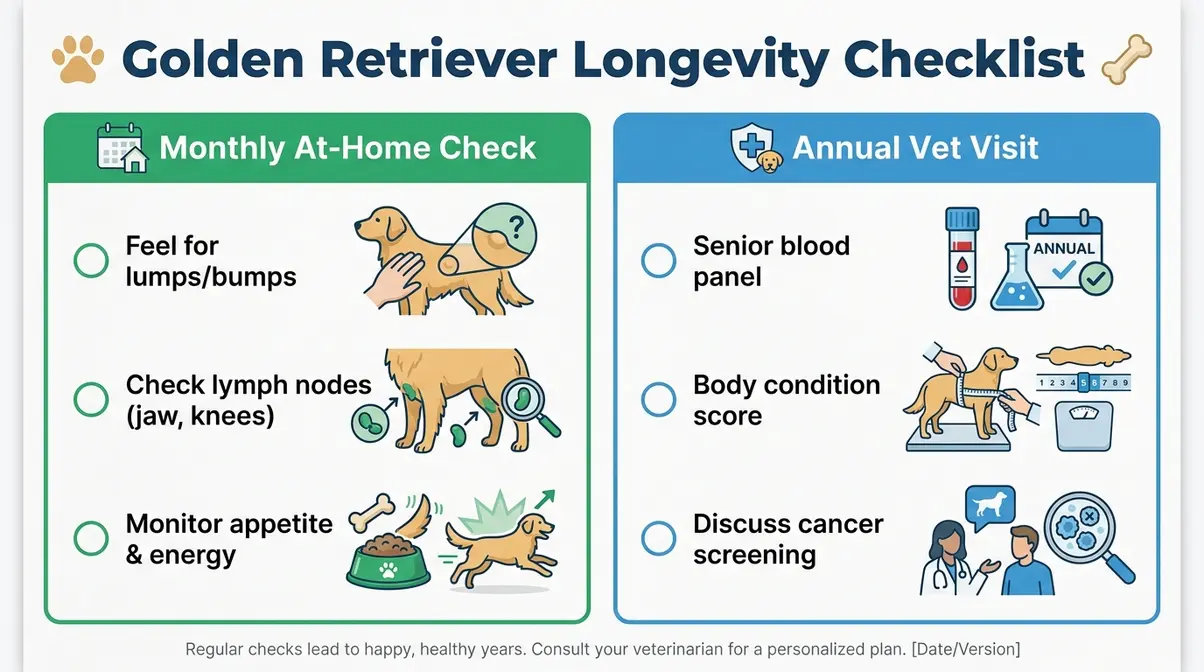
- Schedule annual vet visits, and twice yearly after age 7. Early cancer detection is the most powerful tool you have. The Merck Veterinary Manual on canine health outlines senior care protocols that support more frequent check-ups as dogs age (Merck Veterinary Manual, 2022).
- Discuss spay/neuter timing with your vet. A UC Davis study on neutering and health found that the timing of neutering is associated with increased risk of hemangiosarcoma and lymphoma in Goldens (UC Davis, 2019). There is no single right answer for every dog.
- Feed a high-quality, appropriately portioned diet. Avoid free-feeding. Work with your vet to choose a food suited to your Golden’s life stage.
- Do a monthly at-home check. Run your hands along your dog’s body to feel for lumps, bumps, or swollen lymph nodes, the small glands under the jaw, behind the knees, and in the armpits. Brianna York, Vet Tech, recommends this monthly check as the single most underused tool in owner-level cancer surveillance. Report anything unusual to your vet promptly.
- Choose a reputable breeder. Ask for health clearances for hips, elbows, eyes, and heart from both parents (OFA and CAER certifications). Genetics matter significantly to how long healthy Golden Retrievers live.
Beyond lifestyle, owners often wonder whether their Golden’s sex or specific “type” affects how long they live.
Do Male and Female Golden Retrievers Live Different Lengths?
If you have spent any time on Golden Retriever forums, you have probably seen the debate: do females live longer, are English Creams healthier, and what about Mini Goldens? The short answer is that the difference between male and female Golden Retriever lifespan is minimal and not consistently documented in research. Both fall within the 10 to 12 year average, and individual health management matters far more than sex.
Some owner communities report that females live slightly longer on average, but there is no strong veterinary consensus supporting this. What is more relevant is the UC Davis neutering research cited earlier. Spay/neuter timing may affect cancer and joint disease outcomes more meaningfully than biological sex alone, which is why discussing this with your vet early is worthwhile.
The “English Cream Golden Retriever” is a marketing term used for lighter-coated Goldens, not a separate breed. The Kennel Club, the UK’s official breed registry, recognizes one Golden Retriever standard regardless of coat color. The Kennel Club health survey found that cancer accounted for 38.8% of Golden Retriever deaths in its 2014 breed health survey of UK dogs, a figure that applies across all coat colors and regional types (The Kennel Club, 2014). This UK figure differs from the Morris Animal Foundation’s 60% figure for U.S. Goldens, reflecting different study populations and methodologies, but both confirm cancer as the leading cause of death in the breed. Claims that English Creams are inherently healthier or longer-lived are not supported by breed health data.
Mini Golden Retrievers are typically mixed breeds, often Golden crossed with Cocker Spaniel or Poodle. Lifespan varies by the specific mix. They are not a recognized breed and do not have the same health data as purebred Goldens.
Now that you know how long Goldens typically live and what affects that number, the next question most owners ask is: when does a Golden Retriever actually become a senior dog?
When Is a Golden Retriever Considered Senior?

Picture your Golden on a Sunday afternoon walk. They used to trot ahead, nose to the ground, pulling toward every smell. Lately, they hang back a little. They tire sooner. Their muzzle has gone gray around the edges. This is not a problem. It is a season, and knowing it is coming helps you meet it well.
Golden Retrievers are generally considered senior dogs around age 7 to 8, when more frequent veterinary check-ups and adjusted nutrition become important for their quality of life (Merck Veterinary Manual, 2022). For context, a Golden at age 8 is somewhere around 55 to 60 in rough human-year equivalents. The old “multiply by 7” rule is an oversimplification; large breeds age faster in their early years than the formula suggests.
Signs of the Senior Years
The Merck Veterinary Manual on canine health outlines senior care protocols that apply directly to how long Golden Retrievers live in dog years and how comfortably they do so (Merck Veterinary Manual, 2022). Recognizing the transition early lets you adjust care before small problems become larger ones.
Observable signs that your Golden is entering their senior years include:
- Slowing down on walks or tiring more quickly than before
- Gray fur around the muzzle and eyes
- Stiffness after resting, particularly in the mornings
- Sleeping more than usual
- Subtle changes in appetite
These changes are normal. Noticing them is not cause for alarm; it is cause for action. This is also when twice-yearly vet visits become especially important.
Caring for a senior Golden is deeply rewarding. But many owners also carry a quiet fear about the harder end of that journey.
End-of-Life Signs to Watch For
The Golden Retriever owner community captures this feeling well:
That question comes from love. And part of loving your dog deeply is knowing what to watch for when things are nearing the end. Recognizing signs that your Golden is nearing the end of life is not something to dread; it is one of the most caring things you can do for them.
Specific, observable signs include:
- Significant, sustained loss of interest in food and water
- Extreme fatigue, not just slowing down but a disengagement from surroundings and people they love
- Difficulty breathing or chronic, unmanaged pain
- Loss of mobility, such as an inability to stand or frequent falls
- Incontinence combined with confusion or social withdrawal
Dogs instinctively mask pain, so these signs may be subtle at first. If something feels “off” about your dog’s behavior, trust that instinct and call your vet. A veterinary quality-of-life assessment can help you understand your dog’s comfort level and guide compassionate decisions together. Never rely on a symptom list alone when your dog’s wellbeing is at stake.
How Does the Golden Retriever Lifespan Compare to Other Breeds?
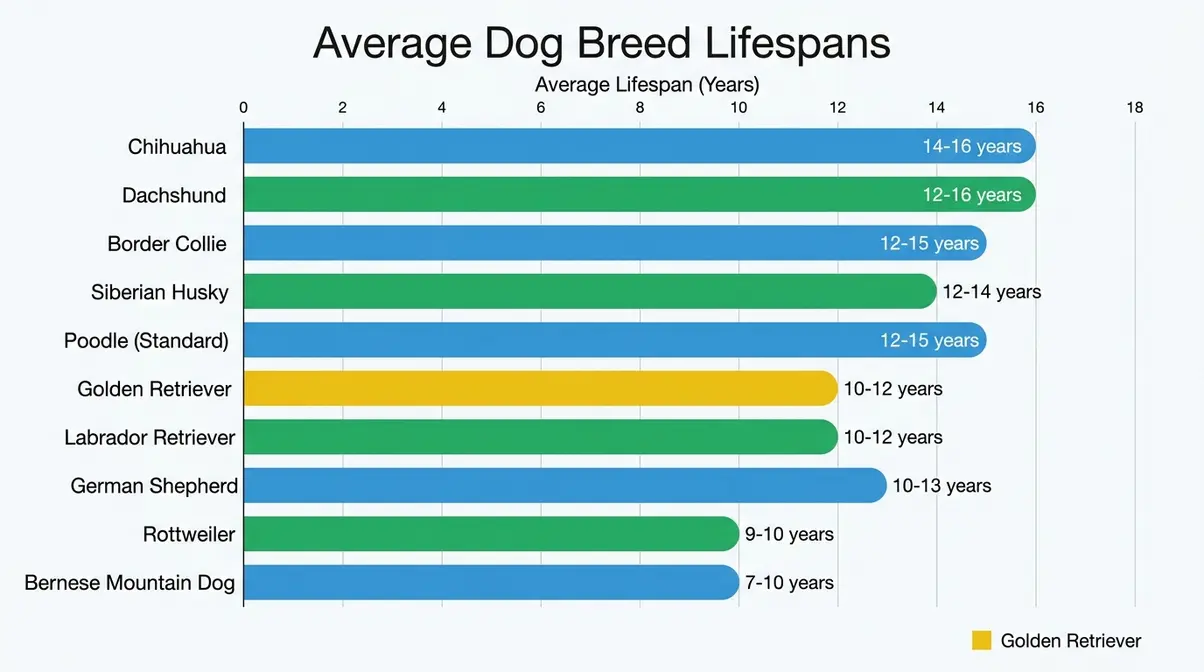
As a large breed, the Golden Retriever falls in the middle of the lifespan range for popular dogs. Smaller breeds often live 15 or more years, while very large breeds may average only 8 to 10. Here is how Goldens compare:
| Breed | Average Lifespan |
|---|---|
| Golden Retriever | 10–12 years |
| Labrador Retriever | 10–12 years |
| Border Collie | 12–15 years |
| Siberian Husky | 12–14 years |
| Rottweiler | 9–10 years |
| Bernese Mountain Dog | 7–10 years |
| Cocker Spaniel | 12–14 years |
| Doberman Pinscher | 10–12 years |
| Dachshund | 12–16 years |
| Chihuahua | 14–16 years |
Note: Lifespans are averages. Individual dogs vary based on genetics, care, and health management.
The pattern is consistent across veterinary science: smaller bodies tend to age more slowly. Goldens sit at a natural disadvantage compared to smaller breeds, which makes proactive health management even more valuable for this breed specifically.
Honest Limitations of This Guide
This guide gives you a strong foundation, but it has limits worth naming.
Common pitfalls to avoid:
- Relying on averages alone. The 10 to 12 year figure is a range, not a prediction. Your specific dog’s genetics, breeder practices, and lifetime health history all shape the actual outcome.
- Treating online symptom lists as a diagnosis. The end-of-life signs listed above are a guide, not a clinical assessment. Always consult your veterinarian for any specific concern.
- Ignoring breeder health testing. Buying from a breeder who skips OFA and CAER certifications significantly increases your dog’s lifetime cancer and joint disease risk.
- When to consult your vet rather than this guide:
- Any new lump, bump, or swelling
- Sudden behavioral changes in a dog over age 7
- Questions about spay/neuter timing specific to your dog
- Any concern about quality of life in a senior dog
Frequently Asked Questions
What is the main cause of death in Golden Retrievers?
Cancer is the primary cause of death in Golden Retrievers. The Morris Animal Foundation’s U.S. longitudinal study found cancer accounts for approximately 60% of deaths in the breed (Morris Animal Foundation, 2024), while the Kennel Club health survey of UK dogs found a figure of 38.8% (The Kennel Club, 2014). Both studies, despite their different populations and methodologies, confirm cancer as the leading cause. The most common types are hemangiosarcoma, a cancer of the blood vessel lining that often develops silently, and lymphoma, a cancer of the lymphatic system. Regular veterinary check-ups and monthly at-home checks can help catch warning signs earlier.
Can Golden Retrievers live for 20 years?
Reaching 20 years is extremely rare for a Golden Retriever and should not be considered a realistic expectation. The typical lifespan is 10 to 12 years, with exceptionally well-cared-for dogs occasionally reaching 14 to 15 years. Reports of 20-year-old Goldens are anecdotal and not supported by breed health data.
Is 12 old for a Golden Retriever?
Yes, 12 years is considered a senior age for a Golden Retriever, placing the dog at or beyond the upper end of the typical lifespan range. A 12-year-old Golden is in their golden years in the truest sense, often requiring adjusted nutrition, joint support, and more frequent veterinary visits. Reaching this age is genuinely something to celebrate. At this stage, dogs benefit most from twice-yearly vet check-ups to catch age-related changes early. Quality of life, not just age, is the most important measure at this point.
What are signs my golden is nearing the end of life?
Signs that a Golden Retriever may be nearing the end of life include significant loss of interest in food and water, extreme fatigue, and loss of mobility. Difficulty breathing, chronic unmanaged pain, incontinence, and social withdrawal are also common indicators. Dogs often mask discomfort, so behavioral changes can be subtle before they become obvious. If you notice several of these signs together, a veterinary quality-of-life assessment can help you understand your dog’s comfort level. Consulting your vet early gives you more time to make compassionate decisions together.
Make Every Year Count for Your Golden
For Golden Retriever owners wondering how long do golden retrievers live, the 10 to 12 year average is a starting point, not a fixed outcome. Cancer accounts for approximately 60% of deaths in the breed (Morris Animal Foundation, 2024), but proactive owners have real tools at their disposal. The best approach combines weight management, twice-yearly vet screenings after age 7, monthly at-home checks, and thoughtful conversations with your vet about spay/neuter timing and cancer surveillance. Coral Drake, writing for devotedtodog.com, consistently finds that owners who act early give their dogs the best chance at a longer, healthier life.
The Healthspan Gap is the difference between a decade of managed decline and a decade of vitality. That gap is not determined by luck alone. Genetics matter, but so does every feeding decision, every vet visit, and every time you run your hands along your dog’s body checking for something that should not be there. Closing that gap is within your reach.
Schedule a preventative health conversation with your vet at your Golden’s next annual visit. Ask specifically about cancer screening protocols and whether their spay/neuter timing is optimal for their age and health history. Starting that conversation today is the most concrete step you can take.
➤ Your Golden can’t add years to their life on their own, but with the right care, you can help them make every one of those years count.
About the Author: Coral Drake is a staff writer at devotedtodog.com, where she covers dog health, behavior, and breed-specific care with a focus on practical, owner-friendly guidance.
Related gear: see our guide to joint supplements for aging dogs.
Protect paws year-round with winter paw care.