By Coral Drake · Reviewed by Brianna York, Former Veterinary Technician · Last updated May 2026
If your Golden Retriever is suddenly bunny-hopping up the stairs, sitting with hips off to one side, or hesitating before jumping into the car, you are likely watching the early signs of canine hip dysplasia. Hip dysplasia in dogs is one of the most common orthopedic conditions in medium and large breeds, and Golden Retrievers are commonly affected: 19.3 percent of Golden Retriever hip evaluations in the Orthopedic Foundation for Animals (OFA) database are rated dysplastic (OFA breed statistics).
The good news: hip dysplasia is rarely a sudden emergency, and most affected dogs live full active lives when the condition is caught early and managed correctly. The harder news: there is no cure, and the gap between a dog managed well and a dog managed poorly can be years of mobility and quality of life.
This guide walks you through everything a Golden Retriever owner needs to know, from the first quiet signs to the cost of every treatment option to the prevention steps that matter most in the puppy years.
- Most common early sign: bunny-hopping gait when running, especially up stairs or hills
- Diagnosis: physical exam (Ortolani sign in puppies, range-of-motion test in adults) plus hip x-rays read against OFA or PennHIP standards
- Best non-surgical management: weight kept at the lean end of normal, controlled exercise, joint supplements with glucosamine and omega-3s, and physical therapy
- Cost: varies widely by treatment and region; surgery costs far more than conservative care, so ask your vet for a quote
What is hip dysplasia in dogs?
Hip dysplasia in dogs is an inherited orthopedic condition where the ball-and-socket hip joint forms incorrectly during a puppy’s growth period. The femoral head (the ball) and the acetabulum (the socket) do not fit snugly together, which creates joint laxity. That laxity allows the joint surfaces to grind against each other instead of gliding smoothly. Over time, the abnormal motion damages cartilage, triggers inflammation, and leads to osteoarthritis.
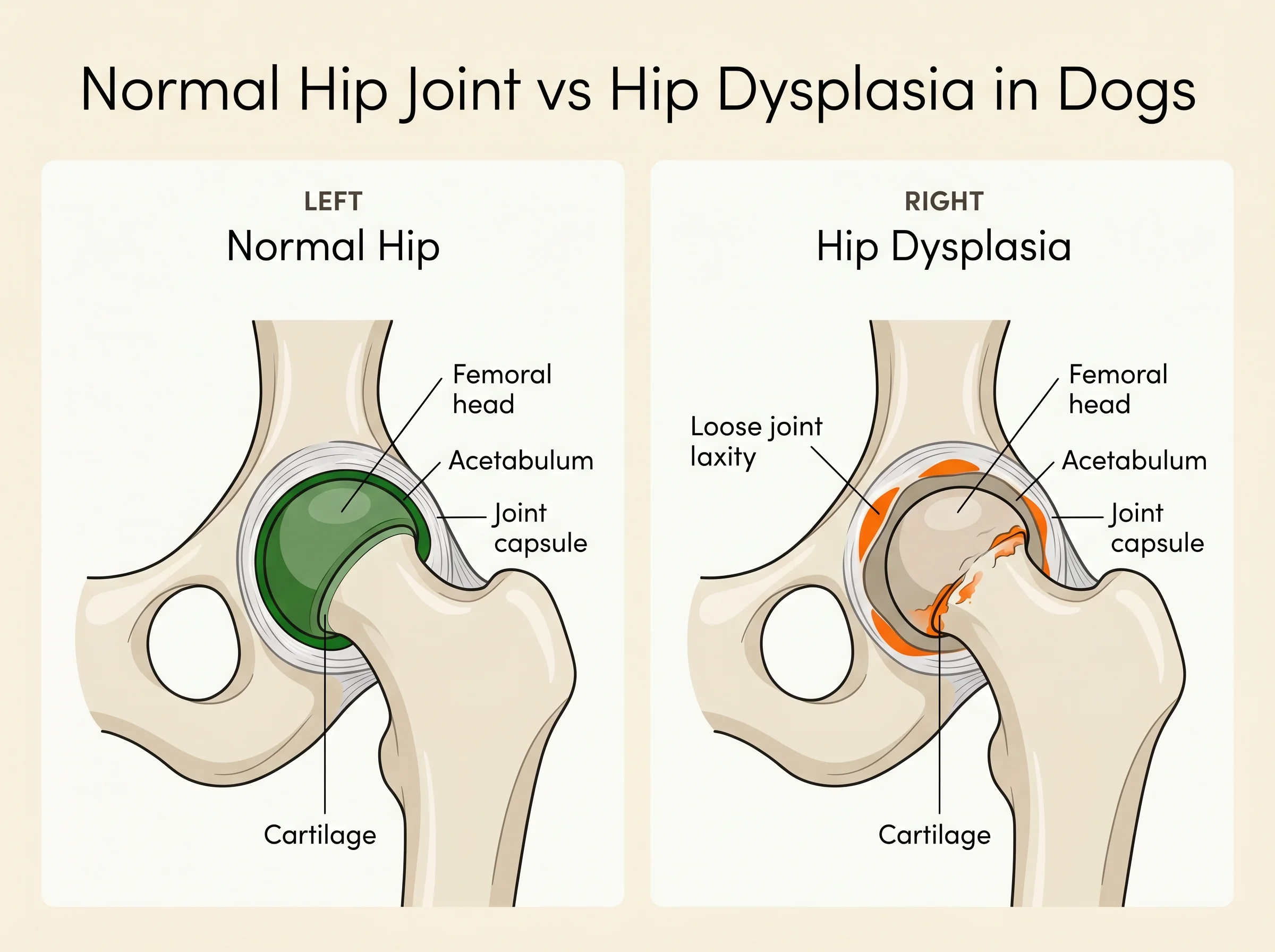
Two anatomical patterns drive hip dysplasia in dogs. In some dogs, the socket is too shallow and the ball pops partially out under load. In others, the ball is misshapen and rotates poorly inside an otherwise normal socket. Many Golden Retrievers show a combination of both. The American College of Veterinary Surgeons (ACVS) describes hip dysplasia as a developmental disorder, which means it begins in puppyhood even when symptoms only appear years later.
Hip dysplasia often affects both hips, even when only one side shows obvious symptoms. This matters because owners often assume the unaffected leg is healthy, when in reality both joints are deteriorating at slightly different speeds.
Why are Golden Retrievers so prone to hip dysplasia?
Golden Retrievers carry a substantial inherited risk because the gene pool concentrated traits that, alongside the breed’s signature build and temperament, also concentrated joint laxity. The Orthopedic Foundation for Animals tracks dysplasia rates across registered breeds, and Goldens rank 55th of more than 200 breeds. Per OFA’s hip dysplasia statistics, covering more than 190,000 Golden Retriever hip evaluations, 19.3 percent were rated dysplastic and 0.7 percent were graded severe.
Three factors stack up against the breed:
Genetic predisposition. Hip dysplasia in dogs is polygenic, meaning many genes contribute. Goldens inherit risk alleles from multiple chromosomes, and even healthy-hipped parents can produce affected puppies if the random combination of inherited genes is unlucky. The Golden Retriever Club of America (GRCA) Code of Ethics asks members to obtain a hip report from OFA or PennHIP at 24 months or older before breeding, because individual ratings cannot guarantee puppy outcomes, only shift the odds.
Rapid growth pattern. Goldens do much of their growing in the first six months and continue growing until 18 months. The faster a puppy grows, the more stress the still-forming joints absorb. Studies in the Journal of the American Veterinary Medical Association have linked free-fed puppy nutrition (constant access to food) to higher dysplasia rates compared to portion-controlled feeding.
Activity level. Goldens love to run, leap, and play hard. The same exuberance that makes them family-friendly also exposes their developing joints to repeated impact. Concrete and tile flooring during the first 12 months add measurable joint stress that softer surfaces do not.
The combination is genetic loading plus environmental amplification. Owners cannot change the genes their puppy inherits, but the environmental side of the equation is mostly within your control.
What are the first signs of hip dysplasia in dogs?
The first signs of hip dysplasia in dogs are usually subtle and easy to dismiss as fatigue or laziness. Most Golden Retriever owners do not realize they have been watching the disease progress for months until a single more obvious symptom appears. Here is what to look for at each life stage.
Signs in puppies (4 to 12 months)
Puppies with hip dysplasia rarely show pain in the way adults do, but they show abnormal movement patterns:
- Bunny-hopping when running, especially up stairs or up an incline. Both hind legs move together instead of alternating.
- Reluctance to climb stairs or jump into a vehicle, even when the puppy is otherwise energetic.
- Sitting in unusual positions, with one or both hips flopped to the side (lazy sit, sometimes called the puppy slouch).
- Audible clicking or popping at the hips during normal movement.
- Slower than littermates during play, despite no obvious illness.
If you notice these patterns, schedule a veterinary orthopedic exam. The Ortolani sign test (a physical maneuver your vet performs under sedation) can detect joint laxity in young puppies, well before x-rays show clear damage.
Signs in adult dogs (1 to 7 years)
Adult dogs with progressing hip dysplasia start showing pain-driven behavior changes:
- Stiffness after rest, especially in the morning or after a nap, that loosens up after a few minutes of walking.
- Reluctance to play for as long as before. Your Golden used to fetch for an hour and now quits after 20 minutes.
- Visible weight shift to the front legs, with hindquarters that look thinner than expected for the breed.
- Trouble rising from a down position, particularly on slippery floors.
- Decreased range of motion when you gently extend the hind legs back. Healthy hips extend smoothly; affected hips resist or click.
The American Veterinary Medical Association notes that pain in dogs is often expressed as behavioral change rather than vocalization. A Golden who used to greet you at the door but now waits on the bed is probably hurting.
Signs in senior dogs (7+ years)
By the senior years, hip dysplasia has usually advanced to secondary osteoarthritis. Signs become harder to miss:
- Limping, especially after exercise or in cold weather.
- Muscle atrophy in the hindquarters compared to the front shoulders.
- Difficulty squatting to urinate or defecate, sometimes with accidents indoors.
- Avoidance of stairs entirely.
- Mood changes, including grumpiness or withdrawal from family interaction.
If your senior Golden shows any combination of three or more of these signs, the kindest first step is a vet visit. Many seniors live well with managed hip dysplasia for years; many also suffer silently for months because owners assume the symptoms are normal aging.
What causes hip dysplasia in dogs?
Hip dysplasia is caused by a combination of genetic predisposition and environmental factors during the puppy growth period. The American College of Veterinary Surgeons calls heredity the biggest single risk factor; nutrition, exercise, and weight during the growth period also influence whether and how severely the disease develops.
Genetic factors. Many genes contribute, and the inheritance pattern is not predictable from any single test. Two parents with OFA Excellent hips can produce a dysplastic puppy. The reverse is also true, though far rarer. The best a breeder can do is OFA-screen all breeding stock and select against affected lines.
Nutrition. Free-fed puppies (food available all day) gain weight faster than portion-fed puppies. Faster growth correlates with higher dysplasia rates per multiple JAVMA studies. Goldens specifically should be portion-fed on a large-breed puppy formula that limits calcium and energy density.
Exercise. Repetitive impact on hard surfaces during the growth period (concrete, tile, hardwood) loads developing joints in ways that promote laxity. Jumping, especially from height, before 12 months is the worst single offender. Swimming and grass walks are the best alternatives.
Body weight. Extra body weight increases the forces across the hip joint, especially during running and jumping. Lean adults (visible waist, ribs palpable under a thin fat layer) have measurably less joint deterioration over time than overweight adults of the same breed.
Hormonal factors. Spaying or neutering before 12 months has been associated with higher dysplasia rates in retrievers in studies published by the University of California Davis Veterinary School (Hart et al., 2014). Discuss timing with your veterinarian, especially for working or sport-line Goldens.
How do veterinarians diagnose hip dysplasia?
Veterinarians diagnose hip dysplasia through a combination of physical examination and hip x-rays read against established orthopedic standards. The diagnostic process varies slightly by life stage.
Physical examination. Your vet will watch your dog walk and trot, then perform a hands-on orthopedic exam. The Ortolani sign test, performed under sedation, detects joint laxity by gently pushing the femoral head against the acetabulum. A positive Ortolani sign is the classic puppy diagnostic. In adults, range-of-motion testing replaces the Ortolani because mature joints have lost the laxity that the test detects.
Hip x-rays. X-rays remain the diagnostic gold standard. Two readings systems dominate:
- OFA (Orthopedic Foundation for Animals): evaluates a single x-ray taken at 24 months or older. Rated Excellent, Good, Fair, Borderline, Mild, Moderate, or Severe. Most Golden breeders require Good or Excellent on both parents.
- PennHIP (University of Pennsylvania Hip Improvement Program): measures joint laxity using a Distraction Index between 0.0 and 1.0. PennHIP can be performed at 16 weeks and predicts adult dysplasia risk earlier than OFA. PennHIP scores are reported on a percentile basis within breed.
For a puppy buyer, OFA is the more common standard because it is more widely used by breeders and registered with public databases. For early intervention decisions, PennHIP gives more actionable data. Many veterinary orthopedic specialists run both.
The American College of Veterinary Radiology recommends sedation for any diagnostic hip x-ray to ensure the dog’s body is positioned correctly. Awake x-rays often show false negatives because the dog tenses muscles that mask laxity.
What are the stages of hip dysplasia in dogs?
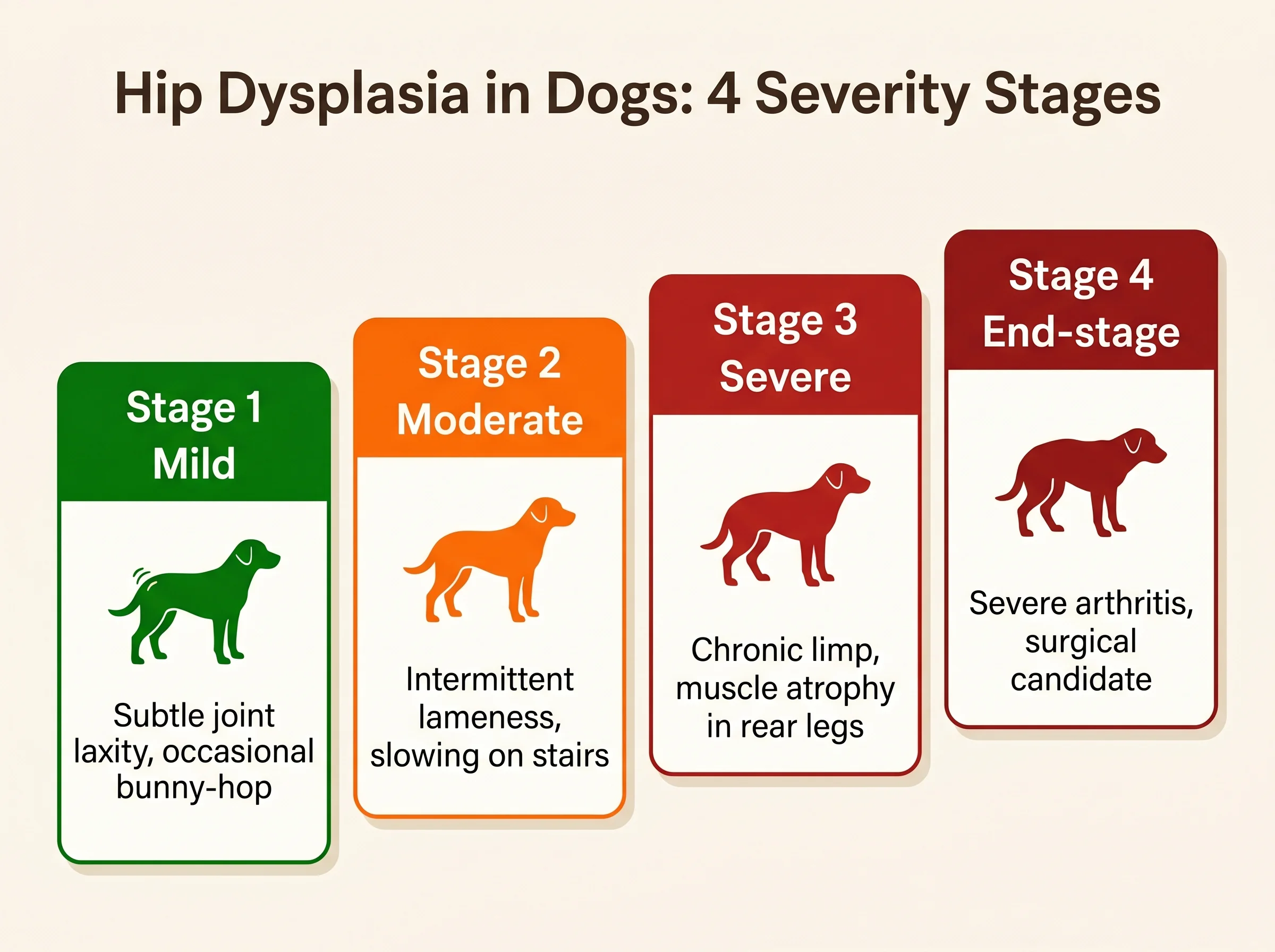
Veterinarians grade hip dysplasia in four stages based on x-ray findings and clinical symptoms:
| Stage | X-ray findings | Typical symptoms | Treatment focus |
|---|---|---|---|
| Mild | Minor joint laxity, minimal arthritis | Occasional bunny-hopping, mild stiffness after exercise | Weight management, joint supplements, exercise modification |
| Moderate | Visible subluxation, early arthritis, bone remodeling | Persistent stiffness, reduced exercise tolerance, occasional limping | Add NSAIDs as needed, physical therapy, hydrotherapy |
| Severe | Significant subluxation, advanced osteoarthritis, bone deformation | Persistent limping, muscle atrophy, reluctance to move | Surgical evaluation (FHO or THR), ongoing pain management |
| End-stage | Joint architecture severely altered, bone-on-bone contact | Constant pain, inability to rise without help, complete exercise refusal | Surgery if dog is a candidate, otherwise palliative care + quality-of-life evaluation |
Progression speed varies. A young Golden with mild dysplasia and excellent management may stay at the mild stage for life. The same dog with poor weight management and concrete flooring may reach the severe stage much sooner.
How is hip dysplasia in dogs treated?
Hip dysplasia in dogs follows a stepped-care treatment approach. Most dogs respond well to conservative (non-surgical) management, and surgery is reserved for cases that do not respond or that present with severe pain. The American College of Veterinary Surgeons publishes the standard treatment hierarchy:
Step 1: Weight management. Every pound off a Golden Retriever’s frame reduces the load on the hip joints, especially during running. The single most impactful intervention you can make is keeping your Golden at the lean end of breed-standard weight (55 to 65 pounds for females, 65 to 75 pounds for males).
Step 2: Exercise modification. Replace high-impact activity (concrete walks, fetch on hard ground, jumping) with controlled low-impact exercise (swimming, grass walks, leash walks on dirt trails). Ask your vet or a veterinary rehabilitation therapist how much daily low-impact activity suits your dog; steady daily activity is gentler on the joints than weekend-warrior sessions.
Step 3: Joint supplements. The American College of Veterinary Surgeons lists fish-oil omega-3 fatty acids as an anti-inflammatory option, but notes there is no evidence in peer-reviewed literature that cartilage-protective supplements help repair or protect cartilage. Ask your vet whether a supplement is worth trying for your dog and what dose to use.
Step 4: Non-steroidal anti-inflammatory drugs (NSAIDs). When dogs show breakthrough pain, your vet may prescribe carprofen, meloxicam, or similar canine-specific NSAIDs. Long-term NSAID use requires periodic blood work to monitor liver and kidney function.
Step 5: Physical therapy and hydrotherapy. Underwater treadmill sessions, in particular, build hindquarter muscle without joint impact. Ask your vet whether a rehabilitation program with hydrotherapy suits your dog.
Step 6: Surgical options. When conservative management is no longer enough, three surgeries are common:
- Femoral Head Ostectomy (FHO): removes the femoral head entirely. The body forms scar tissue that acts as a false joint. Best for smaller dogs (under 50 lb) or as a last-resort procedure. Recovery: 8 to 12 weeks.
- Total Hip Replacement (THR): replaces the joint with implants. Considered the gold-standard for large breeds with severe dysplasia. Long recovery (12 to 16 weeks) but excellent long-term outcomes.
- Juvenile Pubic Symphysiodesis (JPS): preventive surgery performed at 16 to 20 weeks of age in puppies identified at risk via PennHIP. Closes the pubic growth plate so the pelvis develops a deeper socket. Most cost-effective when applied before symptoms appear.
Many dogs with hip dysplasia are managed without surgery; the American College of Veterinary Surgeons lists keeping the dog slim, limited exercise, NSAIDs, omega-3 fatty acids, and physical therapy as medical management. Surgery becomes the right answer when pain control fails or when severe structural damage limits mobility.
How much does hip dysplasia treatment cost?
Hip dysplasia can be one of the more expensive conditions a Golden Retriever owner faces over a dog’s lifetime. Costs vary widely by treatment, clinic and region, so ask your vet for a written estimate before you commit. What to budget for:
| Treatment | Recurring? |
|---|---|
| Joint supplements (annual) | Annual |
| Veterinary visits + x-rays (annual) | Annual |
| NSAIDs (annual) | Annual |
| Physical therapy (6-week course) | One-time per flare |
| Hydrotherapy (per session) | Often weekly |
| FHO surgery | One-time |
| Total Hip Replacement (per hip) | One-time |
| Bilateral THR | One-time |
Ongoing conservative care adds up year after year, and surgery, especially total hip replacement on both hips, is the largest single cost. Ask for a quote for your dog.
Pet insurance covers hip dysplasia in many cases, but only when enrolled before symptoms appear. Read your policy’s pre-existing condition language carefully. Some policies also have specific waiting periods or rules for hip conditions, so check before you enroll.
How can you prevent hip dysplasia in puppies?
Hip dysplasia cannot be prevented entirely because the genetic component is significant. But the environmental side is mostly within your control, and the puppy years are when those choices matter most.
Choose a breeder who screens for hip dysplasia in dogs. Both parents should have OFA Good or Excellent hip ratings (or a PennHIP evaluation; ask how the parents’ scores compare with the breed). Ask to see certificates, not verbal claims. The GRCA is a breed club, not a registry; its Code of Ethics asks members to get an OFA or PennHIP hip report before breeding. (See our guide on how to find reputable Golden Retriever breeders.)
Use a large-breed puppy food until 18 months. Standard puppy formulas are too calorie-dense for slow-growing large breeds. Brands certified by AAFCO (Association of American Feed Control Officials) for large-breed growth meet the calcium and energy targets that promote even joint development.
Feed measured portions, not free-fed. Free-fed puppies grow faster, gain more weight, and show measurably higher rates of hip dysplasia in dogs per JAVMA studies. Twice-daily measured meals are the standard.
Limit jumping and stair climbing in the first 12 months. Carry small puppies up stairs. Use a ramp for car entry. Avoid fetch on concrete or pavement.
Avoid free play with adult dogs that body-slam puppies. Rough play with adult dogs adds impact stress to developing joints.
Ask your vet about spay/neuter timing. In UC Davis research, 10 percent of male Golden Retrievers neutered before 12 months were diagnosed with hip dysplasia, double the rate in intact males (Torres de la Riva et al., PLoS ONE, 2013); in a follow-up study, the increase in early-spayed females did not reach statistical significance (Hart et al., PLoS ONE, 2014). Discuss timing with your veterinarian based on your dog’s lifestyle.
Stay lean. Most overweight adult Goldens started getting overweight as puppies. Body condition score is the single best longitudinal indicator your vet will track.
If your puppy is identified as at-risk via PennHIP at 16 weeks, talk to a veterinary orthopedic surgeon about Juvenile Pubic Symphysiodesis (JPS). Performed before 20 weeks of age, JPS can guide pelvic development to reduce adult dysplasia severity.
How long can a dog live with hip dysplasia?
Most dogs with managed hip dysplasia live full lifespans, with quality of life depending heavily on weight management and pain control. A Golden Retriever’s life expectancy is 10 to 12 years per the AKC breed profile. Goldens with hip dysplasia who receive conservative management at appropriate stages live within that range. Goldens with poorly managed hip dysplasia may have their working lifespan cut short by years, even if their total lifespan is similar.
The deciding factor is not the diagnosis but the management quality. Two Goldens diagnosed at age 4 with the same x-ray findings can have very different stories at age 10:
- Well-managed: lean weight, daily controlled exercise, joint supplements, twice-yearly vet exams, NSAIDs as needed during flares. The dog is comfortable, active, and present in family life until late seniorhood.
- Poorly managed: overweight, free-access to food, occasional weekend walks, no supplements, only sees vet for annual shots. The dog stops climbing stairs at 7, stops playing fetch at 8, and visibly suffers by 9 even when not surgical.
Quality of life evaluations using the Lap of Love quality-of-life scale or the Canine Brief Pain Inventory help families recognize when conservative management is no longer enough.
Hip dysplasia rates by breed
Goldens are far from the most-affected breed. The OFA breed registry shows where Goldens sit relative to other popular dogs:
| Breed | OFA hip evaluations rated dysplastic (%) |
|---|---|
| Bulldog | 70.9% |
| Pug | 72.7% |
| French Bulldog | 33.1% |
| Saint Bernard | 49.9% |
| Golden Retriever | 19.3% |
| Labrador Retriever | 11.3% |
| German Shepherd | 20.4% |
| Border Collie | 9.9% |
| Australian Shepherd | 6.3% |
| Greyhound | 2.2% |
Source: OFA hip dysplasia statistics by breed (ofa.org, checked October 2026). Rates reflect dogs evaluated, not the breed’s true population (which may have higher rates in unscreened lines). OFA does not report Goldendoodles as a separate breed.
Frequently Asked Questions
Can hip dysplasia in dogs be cured?
No. Hip dysplasia in dogs cannot be cured. The structural malformation of the joint remains for life. However, the condition can be managed effectively in most dogs through weight control, exercise modification, joint supplements, and pain medications when needed. Many affected dogs are managed without surgery, and the American College of Veterinary Surgeons lists medical management options such as keeping the dog slim, limited exercise, and NSAIDs. For dogs that do need surgery, total hip replacement essentially eliminates the dysplastic joint and replaces it with a functional implant, which is closer to a cure than any non-surgical option.
What are the first signs of hip dysplasia in dogs?
The earliest first signs of hip dysplasia in dogs are typically a bunny-hopping gait when running uphill or up stairs, audible clicking from the hips during normal walking, sitting with one or both hips flopped to the side, and reluctance to climb stairs or jump into a car. Puppies between 4 and 12 months show these signs without obvious pain. Adults add stiffness after rest, decreased exercise tolerance, and visible muscle loss in the hindquarters. If your Golden Retriever shows any of these signs persistently for more than a week or two, schedule an orthopedic exam.
How is hip dysplasia diagnosed in dogs?
Hip dysplasia in dogs is diagnosed through a combination of physical examination and hip x-rays. Veterinarians use the Ortolani sign test in puppies to detect joint laxity, and range-of-motion testing in adults. X-rays read against OFA or PennHIP standards confirm the diagnosis and grade severity. PennHIP can be done as early as 16 weeks; OFA requires the dog to be at least 24 months old. Both methods require sedation for accurate positioning. Discuss with your veterinarian which method suits your dog’s age and your goals.
How do you help a dog with hip dysplasia?
You help a dog with hip dysplasia primarily through weight management, controlled exercise, and joint-supportive nutrition. Keep your Golden at the lean end of breed-standard weight. Replace concrete walks with grass or dirt trails. Add an orthopedic dog bed to reduce joint stiffness during rest. Ask your veterinarian whether a supplement is worth trying: the American College of Veterinary Surgeons lists fish-oil omega-3 fatty acids as an anti-inflammatory option but notes there is no peer-reviewed evidence that cartilage-protective supplements repair or protect cartilage. Talk to your veterinarian about whether a short course of physical therapy or hydrotherapy would help build hindquarter muscle. For pain flares, your vet may prescribe NSAIDs.
What is the 2:1 crate rule for dogs with hip dysplasia?
The 2:1 crate rule is an informal rule of thumb, not a published veterinary guideline: for every 2 hours your dog spends inside a crate, they should spend 1 hour out. The rule applies to all dogs but matters more for patients with hip dysplasia in dogs because prolonged confinement on hard surfaces accelerates joint stiffness. If your Golden uses a crate, ensure the inside has an orthopedic pad rather than wire bars or thin matting. Ask your vet how long your dog can comfortably stay crated, especially after a hip dysplasia diagnosis.
When should I consider euthanasia for a dog with severe hip dysplasia?
Euthanasia is a deeply personal decision and almost never the right answer until pain can no longer be controlled. Most dogs with end-stage hip dysplasia can be made comfortable with multimodal pain management (combinations of NSAIDs, gabapentin, amantadine, and rehabilitation). Surgery, even at advanced age, can return mobility for many years. The HHHHHMM quality-of-life scale, developed by veterinary oncologist Dr. Alice Villalobos, scores 7 areas (hurt, hunger, hydration, hygiene, happiness, mobility, more good days than bad) from 0 to 10 each; on that scale, a total over 35 represents acceptable quality of life. Your veterinarian can help you score it and talk through what the result means. Until then, focus on management and remember that bad weeks do not mean the end.
What dog breeds are most prone to hip dysplasia?
Pugs (72.7% of OFA hip evaluations rated dysplastic), Bulldogs (70.9%), and Saint Bernards (49.9%) rank near the top of the OFA hip dysplasia ranking, and French Bulldogs (33.1%) and Newfoundlands (25.8%) are also above Golden Retrievers (19.3%). Golden Retrievers and German Shepherd Dogs (20.4%) are commonly cited as high-risk because of their popularity, even though many breeds have higher rates. Herding breeds such as Border Collies (9.9%) and Australian Shepherds (6.3%) show lower rates, and Greyhounds (2.2%) have one of the lowest rates in the OFA ranking.
The bottom line
Hip dysplasia in dogs is common, manageable, and not a death sentence. Golden Retriever owners specifically should know two things: the breed’s genetic risk is real and environmental management matters too, and the gap between a well-managed Golden and a poorly-managed one can be years of good life.
If your puppy is still young, focus on weight management, large-breed nutrition, and joint-friendly exercise. If your adult is showing first signs, get an orthopedic exam this month rather than waiting. If your senior is already symptomatic, talk to your veterinarian about a stepped pain-management plan that prioritizes quality of life over single-modality solutions.
For a deeper look at how hip dysplasia in dogs interacts with the other common Golden Retriever health issues, our companion guide walks through the full breed health profile. If you are evaluating breeders and want to know exactly what hip-screening certificates to ask for, see our guide to finding reputable Golden Retriever breeders. And if hip dysplasia is part of why you are considering a senior rescue rather than a puppy, our Golden Retriever rescue guidance is a sensible starting place. For households with a senior Golden whose hips are already symptomatic, an escape-proof or heavy-duty dog crate with low entry height and an orthopedic floor pad can reduce mobility stress during alone-time.
Brianna York is a former veterinary technician with hands-on experience in canine orthopedic cases. She contributes medical accuracy review to DevotedToDog health articles and validates clinical claims against current AVMA, AAHA, and OFA standards.
For related background, see our guide on Dogs Similar to Golden Retrievers: 2026 Top 10 Guide.
For related background, see our guide on Golden Retriever Sleeping: Habits, Positions Health Signs.