

If you’ve ever watched your Goldendoodle shred a throw pillow while making direct eye contact, you already know the feeling. One moment they’re the sweetest dog you’ve ever met. The next, they’ve eaten your favorite shoe, launched themselves at your dinner guest, and started barking the second you touched the door handle. You love this dog completely, and you’re completely exhausted.
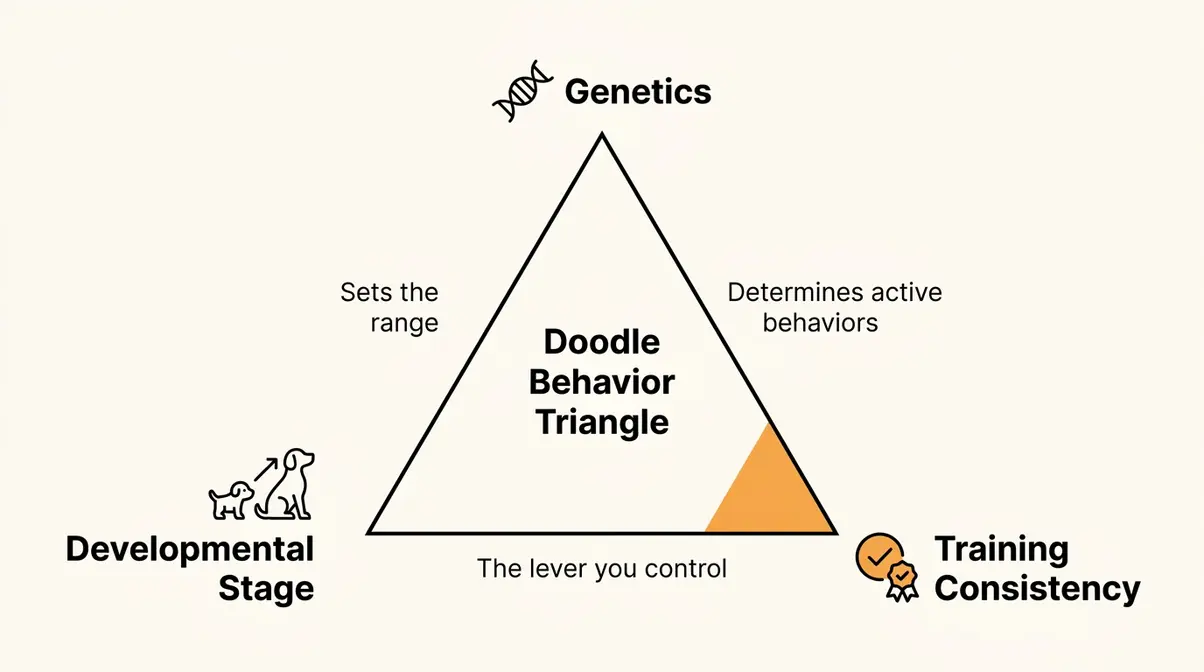
Goldendoodle behavior problems like hyperactivity, destructive chewing, separation anxiety, and jumping are among the most common frustrations owners bring to forums, trainers, and late-night internet searches. The good news: these behaviors are predictable, explainable, and fixable. But fixing them requires understanding three things working together: genetics, developmental stage, and training consistency. Coral Drake covers the behavioral patterns that frustrate Goldendoodle owners most, and this guide walks through each one using that three-factor framework, which we call the Doodle Behavior Triangle.
By the end, you’ll know exactly why your Goldendoodle behaves this way, and you’ll have a step-by-step plan to address it.
Goldendoodle behavior problems (hyperactivity, destructive chewing, separation anxiety, and jumping) are common and fixable, but they share three root causes: genetics, developmental stage, and training consistency.
- Most common problems: hyperactivity, destructive chewing, jumping, nipping, and separation anxiety
- When they calm down: most Goldendoodles settle between 18 and 24 months with consistent training
- The Doodle Behavior Triangle: genetics + developmental stage + training consistency. Address all three for the most lasting results
- Mini vs. standard: size affects energy intensity and exercise volume, not the type of problems
- Training approach: positive reinforcement only. The AVMA and ASPCA both oppose aversive methods
Written by Coral Drake · Reviewed by Brianna York, Former Veterinary Technician · Last updated July 29, 2026 · Sources accessed July 2026
What Are the Most Common Goldendoodle Behavior Problems?

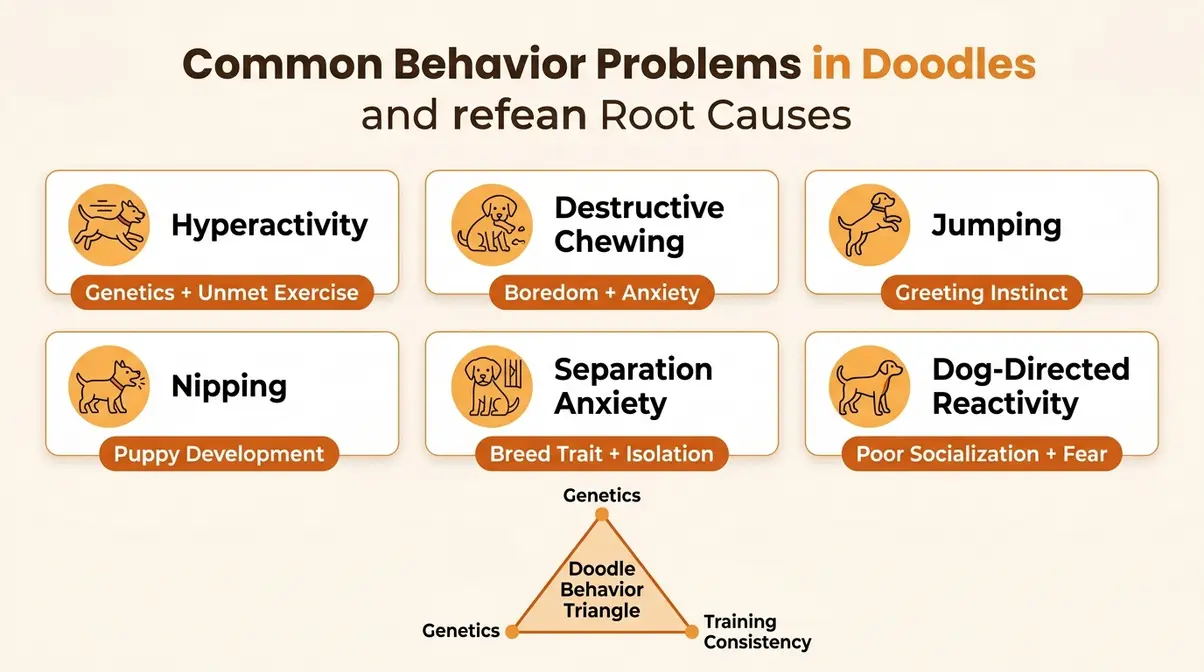
The most common goldendoodle behavior problems are hyperactivity, destructive chewing, jumping on people, nipping and mouthing, separation anxiety, and dog-directed reactivity. Most stem from three root causes: genetics, developmental stage, and training consistency, which together form what we call the Doodle Behavior Triangle. Understanding which of these three factors is driving your dog’s behavior is the fastest path to a real fix.
Across Goldendoodle owner communities, the most frequently reported frustration is a dog that seems to operate at one speed: full throttle. The mischievous streak, the zoomies that strike at 10 p.m., the way they steal and destroy anything left at nose height. These are not signs of a broken dog. They are the predictable output of a high-energy, high-intelligence hybrid that was bred for human interaction, not independence. Knowing that changes everything about how you respond.
Goldendoodles may show more dog-directed reactivity and fear than Poodles, according to some owner-reported surveys. That finding surprises most owners. But it makes sense once you understand the genetics involved. Behavior varies with the dog even within a single litter, with some puppies inheriting a Poodle-like attitude and others leaning more Golden Retriever, according to the Golden Retriever Club of America. For a broader look at understanding the root of common behaviors in retriever-type dogs, the patterns described here apply across the family.
Hyperactivity and the Zoomies
Hyperactivity is the single most-reported complaint in Goldendoodle owner communities, and it’s the behavior that most commonly sends owners searching “is my doodle broken?” at midnight. Those explosive bursts of sprinting, spinning, and general chaos have a name: Frenetic Random Activity Periods, or FRAPs. More commonly, owners just call them zoomies. They are a completely normal energy-release mechanism, not a sign of aggression or disobedience.
The doodle-specific reason is straightforward: both Golden Retrievers and Poodles are working and sporting breeds with high exercise requirements. The hybrid inherits those demands from both parent lines. As a general rule, a Goldendoodle that gets less than about an hour of combined physical and mental activity a day is far more likely to show indoor zoomies and other hyperactive behaviors. That’s not a character flaw. It’s an unmet need.
Hyperactivity often shows up alongside another frustrating habit: destructive chewing. Both share the same root cause, boredom.
Destructive Chewing and Digging
If your Goldendoodle steals and destroys anything left at nose height, you’re dealing with one of the most common goldendoodle puppy behavior problems, and one that persists into adulthood when the underlying cause isn’t addressed. Chewing is normal canine behavior, but it’s amplified in high-intelligence breeds when they’re understimulated. Poodles in particular are problem-solvers that need mental outlets; when those outlets aren’t provided, furniture and shoes become the puzzle.
Digging often serves a different function. It can be self-soothing behavior, an attempt to create a cool resting spot, or displacement behavior when a dog is anxious. The key distinction to make is between puppy chewing and adult destructive chewing. Puppy chewing (roughly 3–6 months) is primarily teething, a physiological process that calls for appropriate chew toys and redirection, not correction. Adult destructive chewing is driven by boredom or anxiety and requires addressing the root cause. A Goldendoodle left alone for four or more hours without a Kong or puzzle feeder is a predictable chewing risk, a point we’ll return to in the separation anxiety section.
Chewing is usually a solo activity. Jumping, on the other hand, is your Goldendoodle’s most enthusiastic attempt at connection, which makes it harder to correct without the right approach.
Jumping on People
Jumping is a greeting behavior, not a dominance display. Goldendoodles are bred for human affection, and jumping accomplishes exactly what they’re after: immediate physical and eye contact from the person they love most. The problem is that even negative reactions, pushing the dog down, saying “no” while making eye contact, still count as attention. Negative attention is still attention, and attention is the reward the dog was seeking.
The common mistake is believing that physical correction teaches the dog to stop. It doesn’t. It teaches the dog that jumping triggers engagement. The correct protocol, turn away, wait for four paws on the floor, then reward, removes the reward entirely until the dog offers the behavior you actually want. The full step-by-step protocol is in the training section; this H3 is about understanding why the usual approach fails. Jumping on guests is the most common complaint in multi-person households, and the most important variable is consistency: if one family member rewards the jumping while another corrects it, the dog learns that jumping works sometimes, which is actually harder to extinguish than if it worked all the time.
Jumping is exuberant. Nipping is something else, and it’s the behavior that most surprises new Goldendoodle owners who expected a gentle, soft-mouthed dog.
Nipping and Mouthing
Nipping is normal puppy behavior through roughly 8 weeks to 5 months of age. During this window, puppies learn bite inhibition, how much pressure is too much, primarily through play with littermates. Golden Retrievers are traditionally soft-mouthed, but Poodle influence in Goldendoodles can increase play-biting intensity, which surprises owners who expected a gentler experience.
The distinction that matters most is between play-mouthing and hard nipping. Play-mouthing is soft, involves little to no pressure, and happens during active play. Hard nipping, with real pressure, often during resource guarding or overstimulation, is a different behavior that warrants professional assessment. The “yelp and redirect” method (a sharp yelp to signal the bite was too hard, followed immediately by offering a toy) is the standard starting point; the full protocol is in the training section. Goldendoodle puppy behavior problems like nipping that continue past 6 months without improvement are a signal to consult a certified trainer rather than continuing to manage alone.
Nipping is usually a puppy phase. Separation anxiety, by contrast, can develop at any age, and it’s the behavior problem most likely to get worse without targeted intervention.
Separation Anxiety and Excessive Barking

Goldendoodles are bred for human companionship. Both parent breeds, Golden Retrievers and Poodles, are social, people-oriented dogs for whom independence is genuinely unnatural. When that companionship is removed, even temporarily, many Goldendoodles experience real distress.
The signs of separation anxiety go beyond barking. They include destructive behavior specifically when alone (not when the owner is home), house-training regression, pacing or scratching at exits, and in severe cases, self-injury. Anxious and territorial behaviors in dogs are significantly influenced by environmental management, according to Cornell University College of Veterinary Medicine research on how to help dogs cope with unsettling situations.
The critical distinction is between mild distress and clinical separation anxiety. Mild distress typically settles within 20–30 minutes as the dog realizes the owner will return. Clinical separation anxiety escalates. The dog doesn’t settle, and distress may intensify over the entire absence. The former responds well to the management protocol in the training section; the latter requires professional or veterinary support. For more on tackling separation anxiety and related anxiety behaviors, the same principles that apply to travel anxiety translate directly to home-alone situations.
Most of the behaviors above stem from anxiety or excess energy. Dog-directed aggression is different. It’s also the finding that surprised researchers most.
Dog-Directed Aggression and Fear
This is the most counterintuitive goldendoodle temperament problem in the research literature. Goldendoodles may show more dog-directed reactivity and fear than Poodles, according to some owner-reported surveys. For a breed with a reputation as universally friendly and social, this finding catches most owners off guard.
The key word is “dog-directed.” This is not aggression toward people. It’s reactivity toward other dogs, and it’s typically fear-based rather than predatory. A Goldendoodle that lunges at other dogs on leash is almost always expressing a learned fear response, not a dominance drive. The distinction matters enormously for training: dominance-based corrections will worsen a fear response, while structured desensitization and positive counter-conditioning address the actual cause. Common triggers include poor early socialization, leash frustration, and resource guarding in multi-dog households. This behavior is manageable, but it’s one of the scenarios most likely to benefit from professional support.
Understanding what your Goldendoodle is doing is the first step. Understanding why, and what you can actually change, is where the Doodle Behavior Triangle comes in.
What Drives Goldendoodle Misbehavior: Root Causes Explained

Goldendoodle behavior problems have three root causes. Only one of them is fully within your control. The Doodle Behavior Triangle frames it this way: genetics sets the range of possible behaviors; developmental stage determines which behaviors are active right now; training consistency determines which behaviors become habits. Owners who understand all three levers, and focus their energy on the one they can actually move, see the most lasting results.
The most actionable insight in this section is also the most empowering: you cannot change your dog’s genetics, and you cannot fast-forward their developmental stage. But training consistency is entirely in your hands, starting today.
Genetics, Breeding Quality, and the Doodle Behavior Triangle
Understanding goldendoodle temperament problems starts with genetics. Not because genetics determines outcomes, but because it sets the range. A Goldendoodle from a high-anxiety Poodle line will have a different behavioral baseline than one from a calm, working-line Poodle. Both may be wonderful dogs, but one will require more active anxiety management from day one.
Dog genetics suggest behavior is more than breed: a study of over 2,000 dog genomes found that physical traits are more determined by breed than behavioral traits are, with 11 genetic regions strongly associated with behavior but high individual variation throughout (Broad Institute, 2022). In practical terms, this means your Goldendoodle’s coat is more predictable than their temperament. Two puppies from the same litter can have completely different behavioral profiles depending on which parent’s genetics dominate, a reality the Golden Retriever Club of America acknowledges directly, noting that some puppies take after the Poodle parent while others lean strongly Golden Retriever.
Genomic inbreeding in Golden Retrievers averages approximately 23.5%, according to the Institute of Canine Biology, a figure with real implications for temperament predictability in hybrid lines. A puppy from a reputable breeder who health-tests and temperament-tests parent dogs is statistically more likely to have a predictable behavioral baseline than one from a breeder who doesn’t screen for these factors. This is one of the few places where genetics becomes actionable before you even bring a puppy home.
Genetics sets the range. But the single most controllable factor in your Goldendoodle’s behavior is also the most commonly underestimated: daily exercise and mental stimulation.
Unmet Exercise and Mental Stimulation Needs
Here’s why Goldendoodles misbehave more often than owners expect: physical exercise and mental stimulation are not the same thing, and most dogs need both. Running, fetch, and swimming burn physical energy. Puzzle feeders, training sessions, and scent work tire the brain. A Goldendoodle that gets a long walk but no mental engagement is the canine equivalent of a smart kid who ran laps at recess but still has nowhere to put their energy in class.
The most common owner mistake is providing physical exercise and assuming that’s sufficient. The result is a dog that’s physically tired but mentally restless, and a mentally restless Goldendoodle still chews, still barks, and still can’t settle. A focused 30-minute training session can tire a smart, high-drive dog as much as a far longer walk. The “two-tired” principle captures it simply: before leaving your dog alone, aim for a dog that’s both physically and mentally spent. Specific tools that help: a stuffed Kong, a snuffle mat, and rotating puzzle feeders. These aren’t luxury items for a Poodle-cross. They’re a basic need.
Exercise needs also vary by size, which is where mini and standard Goldendoodles start to diverge.
Mini vs. Standard Goldendoodles: Does Size Change Behavior?
Mini Goldendoodle behavior problems are the same as standard Goldendoodle behavior problems. The type of issue doesn’t change with size. What changes is intensity, anxiety tendency, and exercise volume. That’s a meaningful distinction for owners trying to understand why their 20-pound mini seems more wound-up than their neighbor’s 70-pound standard.
Mini Goldendoodles (Miniature Poodle × Golden Retriever) tend to have higher energy intensity relative to their size and can be more prone to anxiety. The Miniature Poodle parent line is generally more reactive than the Standard Poodle, and that reactivity can amplify the anxiety-driven behaviors that already show up in the breed: barking, separation distress, and leash reactivity. Standard Goldendoodles are generally calmer in temperament but have higher absolute exercise requirements due to their size. A standard that doesn’t get enough physical activity will be destructive in its own way, just for different reasons.
| Trait | Mini Goldendoodle | Standard Goldendoodle |
|---|---|---|
| Size | 15–35 lbs | 50–90 lbs |
| Energy intensity | Higher (relative to size) | Moderate–high |
| Anxiety tendency | More prone (Miniature Poodle influence) | Less prone |
| Exercise volume needed | Lower absolute, higher relative | Higher absolute |
| Core behavior problems | Same as standard | Same as mini |
| Best for | Smaller spaces, less active owners | Active families, larger spaces |
Behavior varies with the dog even within a single litter (GRCA), so a calm mini from a well-tempered line will often be easier to manage than an anxious standard from a high-strung one. Size is a factor, not a sentence.
Size is one variable. Gender is another. And it’s the question owners ask most often when choosing a puppy.
Are Boy or Girl Goldendoodles Calmer?
Neither male nor female Goldendoodles are consistently calmer. Individual temperament, training, and socialization matter far more than sex. That’s the honest answer, and any source that tells you otherwise is overstating what the evidence supports.
That said, there are general tendencies worth knowing. Intact males may show more territorial behavior, roaming instinct, and marking. Intact females may experience mood fluctuations around heat cycles. Spaying or neutering reduces these sex-hormone-driven behaviors in both, which is why the calmer-male-vs-female question becomes even less meaningful in altered dogs. The GRCA’s litter variability principle applies here directly: a calm female from an anxious line will be more anxious than a confident male from a calm one. The most reliable predictor of a calm Goldendoodle is not sex. It’s the temperament of the parent dogs and the quality of early socialization in the first 16 weeks of life.
When you’re choosing a puppy, ask the breeder for their temperament-testing results. That data will tell you far more than the puppy’s sex.
Whether you have a mini or standard, male or female, the second point of the Doodle Behavior Triangle, developmental stage, shapes behavior more than almost anything else during the first two years.
Goldendoodle Behavior Stages, From Puppy to Adult

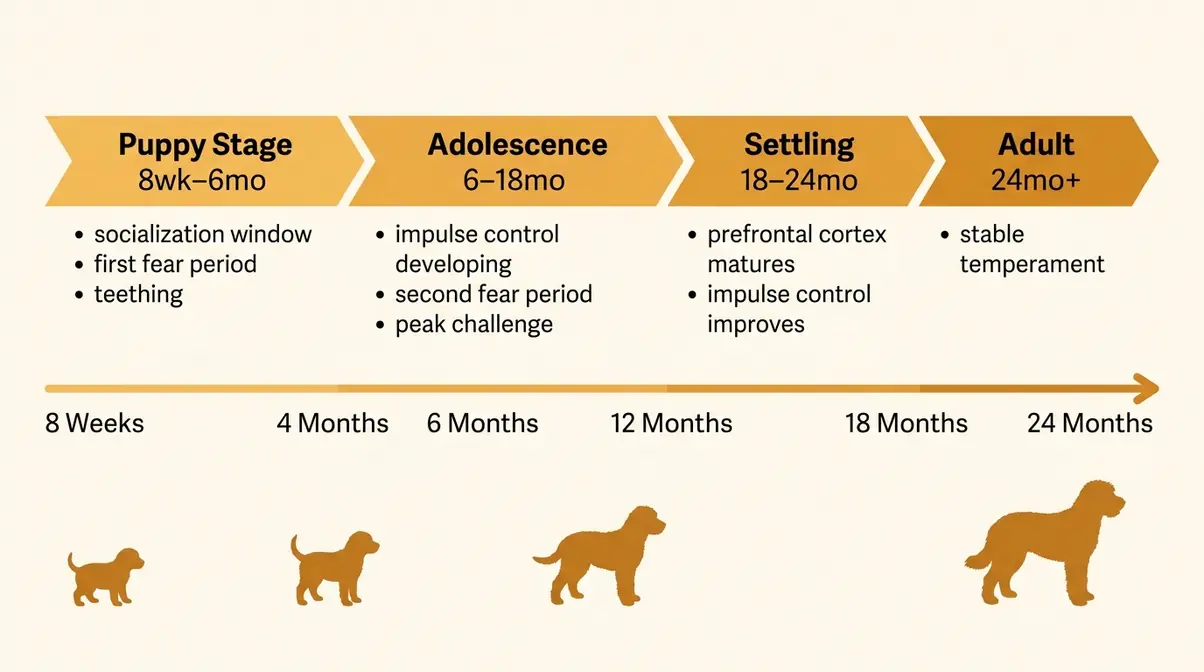
Goldendoodle behavior stages follow a predictable pattern from 8 weeks to 2 years. Understanding which stage your dog is in, and what’s developmentally normal at that stage, is the fastest way to stop fighting the behavior and start working with it. Many of the behaviors owners interpret as stubbornness or regression are actually neurologically expected at specific ages.
For a broader look at how behavior changes with age in retriever-type dogs, the developmental framework is consistent across the Golden family.
Puppy Stage (8 Weeks to 6 Months): Goldendoodle Puppy Behavior Problems
The puppy stage is one of the most important developmental windows in a dog’s entire life. And one of the most misunderstood. The socialization window runs from roughly 8 to 16 weeks. Positive, calm exposure to different people, environments, sounds, and animals during this period shapes adult behavior more powerfully than almost any other factor. A Goldendoodle puppy that misses this window, due to illness, quarantine, or an isolating early environment, is at meaningfully higher risk for anxiety and reactivity as an adult.
Layered on top of socialization is the first fear period, which typically occurs between 8 and 11 weeks. During this window, puppies may suddenly become fearful of things that didn’t bother them the week before. A puppy that happily approached strangers at 7 weeks may startle and back away at 9 weeks. This is normal and temporary. The correct response is patient, positive exposure, never forcing the puppy to confront what frightens them. Flooding a fearful puppy during a fear period can create lasting aversions.
Teething drives the chewing behavior that peaks from roughly 3 to 6 months. This is physiological, not behavioral. The puppy’s mouth genuinely hurts, and chewing provides relief. Punishing teething chewing is both ineffective and counterproductive. Redirect to appropriate chew toys, rotate them for novelty, and manage the environment by removing accessible items. Socialization classes are also worth considering during this window. They address the socialization need and begin the training foundation simultaneously. For help managing your puppy’s environment during this stage, the same puppy-proofing principles that apply to Goldens translate directly.
The puppy stage is intense but short. What comes next, the adolescent phase, is longer, harder, and the reason most owners feel like they’re starting over.
The Adolescent Phase (6 to 18 Months): The Hardest Part

Between 6 and 18 months, most Goldendoodles go through their most challenging behavioral phase. This is the window when owners most often describe their dog as “out of control,” question whether training is working, and, in the most difficult cases, begin to consider rehoming. Naming this directly matters: the adolescent phase is the primary reason Goldendoodles end up surrendered to shelters. It is also temporary.
The neurological explanation is straightforward: the prefrontal cortex, which governs impulse control, is still developing throughout adolescence. A Goldendoodle that reliably sat on command at 4 months may appear to forget the command entirely at 8 months. This is not defiance. It’s not a training failure. It’s the same reason a teenager who understood the rules at age 10 still makes impulsive decisions at 15. The brain’s regulatory systems aren’t finished yet. Knowing this makes it much easier to stay consistent rather than escalating corrections.
The second fear period compounds the challenge. Running roughly from 6 to 14 months, this window is marked by a second phase of heightened anxiety and reactivity. Dogs may suddenly become fearful of familiar people, objects, or environments they’ve encountered dozens of times. An 8-month-old Goldendoodle that starts barking at the neighbor it’s known for months isn’t being difficult. It’s likely in the second fear period. The correct response is calm, positive counter-conditioning: pair the feared stimulus with something good, at a distance where the dog remains comfortable, and let the dog set the pace.
Age-appropriate management during adolescence makes a significant difference in how smoothly the transition to adulthood goes. Increase physical exercise and mental enrichment, maintain consistent training using shorter and more frequent sessions (10–15 minutes several times a day outperforms a single 45-minute session), and avoid punishment-based corrections during fear periods. Consistency from all family members is not optional during this phase. It’s the difference between a dog that emerges from adolescence with a solid behavioral foundation and one that doesn’t.
The adolescent phase ends. Most Goldendoodles begin to settle into their adult temperament between 18 and 24 months, but calming down doesn’t happen automatically.
When Do Goldendoodles Calm Down? (18 to 24 Months)
Most Goldendoodles begin to calm down between 18 and 24 months of age. For owners asking at what age Goldendoodles start to calm down, the answer is consistent: the transition begins around 18 months and is largely complete by age 2 in dogs that received consistent training throughout adolescence. This is when the prefrontal cortex reaches functional maturity, impulse control improves noticeably, and the dog begins to generalize previously learned commands to new environments without constant reinforcement. This 18–24 month window is the calming milestone owners and trainers report most often. For owners who have been grinding through adolescence, this transition can feel almost overnight.
“Calming down” is conditional, though. Dogs that received consistent training, adequate daily exercise, and mental stimulation throughout adolescence reach this milestone more reliably than those that didn’t. A Goldendoodle that spent months 6 to 18 without a training foundation may still be working on impulse control at age 3. This isn’t a permanent state. It’s a delayed developmental outcome, and it responds to the same consistent training at any age.
It’s also worth distinguishing energy level from impulse control. High-energy individuals, particularly those with strong Poodle genetics, may remain physically energetic well past age 2. That’s normal. A 2-year-old Goldendoodle that still wants to run and play but responds reliably to commands and doesn’t destroy furniture is “calm” in the behavioral sense that matters. Energy and chaos are different things, and the goal of the Doodle Behavior Triangle’s training consistency point is the latter, not the former.
Understanding the stages is essential. But knowing what to do in each stage is what actually changes behavior, and that’s what the next section covers.
How Do You Discipline a Goldendoodle? Step-by-Step Training Protocols

Disciplining a Goldendoodle means teaching it what to do, not punishing it for what it did wrong. Both the AVMA and ASPCA recommend reward-based training as the most effective and humane approach. According to their position on aversive dog training, veterinary behaviorists find no role for aversive practices, reward-based methods are the recommended approach (AVMA, 2021). Humane training methods, per the ASPCA’s official position, should primarily use lures and rewards such as food, praise, petting, and play. Here are step-by-step protocols for the four most common problems.
Training consistency is the third point of the Doodle Behavior Triangle. It’s also the only point you fully control. For a deeper look at disciplining your dog effectively using these same principles, the Golden Retriever training framework translates directly.
- What You’ll Need:
- High-value treats (small, soft, chicken, cheese, or commercial training treats)
- A consistent verbal cue for each target behavior
- All family members using the same cues and responses, every time
The Positive Reinforcement Foundation
Positive reinforcement means rewarding the behavior you want within two seconds of it happening, so the dog clearly associates the action with the reward. It’s not bribery. It’s communication in the only language that reliably crosses the species barrier. The timing matters: a reward delivered five seconds after the behavior teaches the dog almost nothing about what earned it.
Goldendoodles are particularly sensitive to owner disapproval. Punishment, even mild corrections like a sharp “no” or a push, increases anxiety in this breed, and elevated anxiety worsens the exact behaviors punishment is meant to correct. You end up in a loop: punishment creates anxiety, anxiety creates problem behavior, problem behavior triggers more punishment. The exit from that loop is removing punishment and replacing it with clear, rewarded guidance. The consistency rule is equally important: all family members must use the same verbal cues and responses. One person rewarding a behavior while another corrects it is the single most common reason Goldendoodle training stalls.
With the foundation in place, here’s how to apply it to the three most common Goldendoodle behavior problems.
Step-by-Step: Stopping Jumping on Guests
- When your Goldendoodle jumps, immediately turn your back and cross your arms, remove all eye contact and physical contact.
- Wait for four paws on the floor, even briefly. Do not speak or look at the dog until all four paws are down.
- The moment all four paws touch the floor, turn back and reward with a treat and calm, quiet praise.
- Ask for a “sit”, reward the sit with a higher-value treat than the four-paws reward.
- Repeat this with every person who enters the home. Brief guests on the protocol before they arrive. One person who bends down to greet the jumping dog will reset weeks of progress.
- Practice the arrival scenario daily with a family member until the sit-on-greeting becomes the dog’s automatic response.
Common Mistake: Pushing the dog down or saying “off” while making eye contact. This is still attention, and attention is the reward the dog was seeking. Even negative engagement reinforces jumping.
Jumping is a greeting problem. Destructive chewing is a boredom problem, and the fix is different.
Step-by-Step: Redirecting Destructive Chewing
When your Goldendoodle steals and destroys household items, the issue is almost always misdirected chewing energy, not defiance. Here’s how to redirect it:
- Identify your Goldendoodle’s preferred chew texture (soft rubber, hard nylon, rope) and provide three to four appropriate options that match it.
- When you catch your dog chewing something inappropriate, say “leave it” in a calm, neutral tone, not angry, not urgent.
- Immediately offer an appropriate chew toy. The moment the dog takes it, reward with praise and a treat.
- Rotate chew toys weekly to maintain novelty. A dog that’s had the same toy for two weeks will ignore it; novelty is what makes the appropriate option more interesting than the furniture.
- Before leaving the house, provide a stuffed Kong or puzzle feeder. This occupies the dog during the highest-risk period, the first 30–60 minutes after departure.
- Dog-proof the environment during the training period. Remove accessible items from reach; management and training work together, not as substitutes for each other.
Common Mistake: Chasing the dog to retrieve the stolen item. This becomes a game. One your Goldendoodle will happily play every day. Instead, offer a trade: approach calmly, offer a high-value treat, and swap when the dog drops the item.
Note: chewing driven by separation anxiety requires the anxiety protocol below, not just redirection. If your dog only destroys things when alone, start there.
Chewing and jumping are manageable with consistent redirection. Separation anxiety requires a different approach. One that works with your dog’s emotional state, not against it.
Managing Separation Anxiety at Home
This protocol addresses mild-to-moderate separation anxiety. Clinical separation anxiety, where distress escalates rather than settling, involves self-injury, or includes house-training regression, requires professional or veterinary support beyond this guide.
- Practice “departure desensitization”: pick up your keys, put on your coat, then sit back down without leaving. Repeat until the dog stops reacting to departure cues. The goal is to uncouple those cues from the actual departure.
- Start with very short absences of 2 to 5 minutes, then gradually increase the duration over two to three weeks. Progress at the dog’s pace, not yours.
- Provide a high-value Kong or puzzle feeder only during departures. This creates a positive association with alone time; the Kong becomes a signal that something good is about to happen, not something bad.
- Keep departures and arrivals calm and matter-of-fact. Long, emotional goodbyes and excited homecomings amplify the emotional intensity of transitions. A brief, quiet exit and a calm greeting on return reduce the contrast between “you’re here” and “you’re gone.”
- Create a safe space, such as a crate or a designated room, that the dog associates with rest and comfort, not punishment or confinement. Build this association gradually before using it for absences.
Common Mistake: Returning home when the dog is barking or whining. This teaches the dog that vocalizing brings you back, which is a powerful reinforcement that will make separation anxiety worse over time.
These protocols address the most common behavior problems. But sometimes a Goldendoodle’s behavior signals something that training alone can’t fix.
When Do Goldendoodle Behavior Problems Signal Something More?
Behavior problems don’t always start with training gaps. Before beginning a new training protocol for a sudden change in behavior, it’s worth ruling out the most common alternative explanation: a medical one. A 2023 Frontiers in Veterinary Science study found that common medical conditions in mixed-breed dogs, including ear infections, dental calculus, and osteoarthritis, can all influence behavior, according to owner-reported medical conditions data (Frontiers in Veterinary Science, 2023). Pain changes behavior in dogs just as it does in people.
Medical Causes of Sudden Behavior Changes
Sudden behavior changes in a previously well-behaved dog are a veterinary concern first, a training concern second. The distinction matters because applying a training protocol to a pain-driven behavior won’t fix the behavior, and may make it worse by adding stress to an already uncomfortable dog.
Specific medical conditions that can drive behavior changes include ear infections (pain-driven irritability and head-shyness), dental disease (pain-driven aggression when the mouth or face is touched), osteoarthritis (reduced tolerance for handling and decreased activity), thyroid dysfunction (anxiety, hyperactivity, or sudden lethargy), and seasonal allergies (chronic discomfort that lowers the dog’s overall tolerance threshold). The 2023 Frontiers in Veterinary Science study on mixed-breed dogs identified these as the most commonly reported owner-observed conditions with behavioral components.
The “rule out medical first” principle is simple: if your Goldendoodle’s behavior changed suddenly, particularly if the change involves increased irritability, new aggression, or a dog that was previously reliable becoming unpredictable, schedule a veterinary check-up before starting any new training protocol. This is not a generic disclaimer. It’s a specific, actionable first step.
If medical causes are ruled out and the behavior continues, a professional trainer or veterinary behaviorist can provide assessment and a tailored protocol.
When to Call a Professional Trainer or Behaviorist

Three specific scenarios warrant professional assessment rather than continued DIY training:
- Aggression toward people. Growling, snapping, or biting directed at humans, including children, is not a training protocol situation. It’s a safety situation that requires a professional assessment before any intervention begins. Do not attempt to correct this behavior with DIY methods; contact a CPDT-KA certified trainer immediately.
- Clinical separation anxiety. If your Goldendoodle shows escalating distress despite consistent application of the departure desensitization protocol, including self-injury, prolonged vocalizing, or destruction that doesn’t diminish over two to three weeks. A veterinary behaviorist can assess whether pharmacological support is appropriate alongside behavior modification.
- Fear-based reactivity that’s worsening. If leash reactivity or dog-directed fear is intensifying despite positive counter-conditioning, a professional can assess whether the threshold work is calibrated correctly and adjust the protocol. Worsening reactivity is a signal that the current approach needs expert recalibration, not just more repetition.
Who to contact: a CPDT-KA (Certified Professional Dog Trainer – Knowledge Assessed) for behavior modification and training protocols; a Diplomate ACVB (American College of Veterinary Behaviorists) for severe anxiety or aggression that may have a pharmacological component. Results vary by individual dog and owner consistency. The protocols in this guide are evidence-based starting points, not guarantees. Professional assessment is warranted when those starting points aren’t producing improvement.
Frequently Asked Questions About Goldendoodle Behavior
What behavioral issues do Goldendoodles have?
Goldendoodle behavior problems most commonly include hyperactivity, destructive chewing, jumping on people, nipping, separation anxiety, and dog-directed reactivity. These behaviors stem from the breed’s high intelligence and energy. Both Golden Retrievers and Poodles are working breeds that need significant daily exercise and mental stimulation to stay settled. Research shows Goldendoodles exhibit more dog-directed aggression and fear than Poodles, likely due to hybrid genetics. Most issues respond well to consistent positive reinforcement training paired with adequate daily enrichment.
At what age does a Goldendoodle calm down?
Most Goldendoodles begin to calm down between 18 and 24 months of age. This transition coincides with neurological maturity. The prefrontal cortex, which governs impulse control, finishes developing in the second year of life. Calming down is conditional, though: dogs that receive consistent training and adequate daily exercise throughout adolescence settle faster than those that don’t. High-energy individuals may remain active past age 2 while still showing meaningfully improved impulse control and responsiveness to commands.
How to discipline a Goldendoodle?
Disciplining a Goldendoodle means rewarding the behavior you want, not punishing the behavior you don’t. Positive reinforcement means immediately rewarding desired behaviors with treats, praise, or play within two seconds. It’s the most effective approach for this sensitive, people-oriented breed. Consistent commands, clear boundaries, and redirecting unwanted behaviors to appropriate alternatives all support this method. Punishment-based corrections increase anxiety in Goldendoodles and typically worsen the behaviors they’re meant to correct, according to both the AVMA and ASPCA.
What are the negatives of a Goldendoodle?
The main downsides of a Goldendoodle are high exercise requirements, significant grooming needs, and a strong tendency toward separation anxiety. As a hybrid breed, behavior is less predictable than in purebreds: two puppies from the same litter can have very different temperaments depending on which parent’s genetics dominate. Some owner surveys suggest Goldendoodles can show higher rates of dog-directed reactivity than certain other popular breeds. For owners who meet their exercise and training needs, these challenges are manageable.
Why are Goldendoodles so misbehaved?
Goldendoodles misbehave primarily because their exercise and mental stimulation needs aren’t being fully met. Not because they’re inherently difficult dogs. As a high-intelligence, high-energy hybrid, they become destructive, hyperactive, or anxious when understimulated; boredom is the most common root cause of problem behaviors in this breed. Inconsistent training across family members is the second most common factor. Addressing both, daily enrichment and consistent positive reinforcement, resolves most Goldendoodle behavior problems without aversive correction.
At what age do Goldendoodles start to calm down?
Goldendoodles start to calm down around 18 months, with most reaching a noticeably more settled temperament by age 2. The adolescent phase (6–18 months) is typically the most challenging period, marked by high energy, selective hearing, and occasional regression in previously learned commands. Owners who maintain consistent training through adolescence generally see the fastest improvement at the 18-month mark. Some individuals, particularly those with strong Poodle genetics, may remain energetic past age 2 while still showing better impulse control.
Are girl or boy Goldendoodles calmer?
Neither male nor female Goldendoodles are consistently calmer. Individual temperament, training, and socialization matter far more than sex. Intact males may show more territorial behavior and roaming instinct; intact females may experience mood changes around heat cycles. Spaying or neutering reduces these sex-hormone-driven behaviors in both. The most reliable predictor of a calm Goldendoodle is the temperament of the parent dogs, not the puppy’s sex. Choose based on temperament-testing results from the breeder rather than gender assumptions.
What is the downside to a Goldendoodle?
The biggest downside to a Goldendoodle is behavioral unpredictability. As a hybrid, they don’t breed true, which means behavior varies significantly even within a single litter. They also require substantial daily exercise, regular professional grooming, and consistent training from an early age; owners who underestimate these needs often find the experience overwhelming. Separation anxiety is more common in this breed than in many others, and dog-directed reactivity can catch social owners off guard. For committed owners, these challenges are outweighed by the breed’s affectionate, adaptable temperament.
Understanding and Fixing Goldendoodle Behavior Problems
Goldendoodle behavior problems, from hyperactivity and destructive chewing to separation anxiety and dog-directed reactivity, are common, predictable, and fixable. Behavior research consistently shows doodle behavior is shaped by genetics, developmental stage, and training consistency: the three points of the Doodle Behavior Triangle. The approach to these patterns is consistent: owners who address all three factors, rather than just correcting individual behaviors, see the most lasting results.
If your Goldendoodle feels like a devil in disguise right now, the most likely explanation is that one or two points of the Triangle are out of balance. The fix is rarely dramatic. It’s usually more exercise, more consistency, or more patience with the developmental stage your dog is actually in. Not a personality overhaul and not a reason to give up.
Start with the protocol for your dog’s most disruptive behavior: jumping, chewing, or separation anxiety. Practice it consistently for three weeks before evaluating results. If behavior doesn’t improve after three weeks of consistent application, or if you’re seeing aggression toward people, consult a CPDT-KA certified trainer for a personalized assessment. One targeted session with a professional can move things faster than months of guessing alone.
➤ Goldendoodle behavior problems are not a character flaw. They are a signal that the Doodle Behavior Triangle needs rebalancing, and consistent training is the one lever every owner controls.