

Written by: Coral Drake
A Golden Retriever can hold a raw egg in its mouth without cracking the shell. That one sentence explains almost everything you need to know about why this breed is unlike any other.
Most articles about golden retriever fun facts recycle the same 10 trivia points. You’ve probably read them all — and forgotten them just as fast. This guide is different. Here, you’ll discover 25+ golden retriever fun facts backed by science, verified Guinness World Records, and breed history straight from Scottish archives. We’ve organized everything into five themes — history, physical traits, personality, world records, and puppy facts — so you can jump straight to whatever delights you most.
Golden retrievers are one of the world’s most beloved breeds for a reason — they combine remarkable gentleness with surprising physical feats. Here’s what makes them extraordinary:
- The Golden Paradox: Gentle enough to carry a raw egg unbroken, yet one Golden holds the world record for the loudest bark at 113.1 decibels (Guinness World Records)
- Born in Scotland: Lord Tweedmouth bred the first Goldens in the 1840s–1890s in the Scottish Highlands specifically for rainy-weather retrieving
- 4th smartest breed: Canine psychologist Stanley Coren ranks them #4 in working intelligence — they learn commands in under 5 repetitions
- Three distinct types: American, Canadian, and English Golden Retrievers each have different coat colors, builds, and head shapes
- National Golden Retriever Day is celebrated every year on February 3
Contents
- Fact #1–5: Where Did Golden Retrievers Come From?
- Fact #6–11: What Makes a Golden’s Body So Special?
- Fact #12–17: How Smart and Loving Are Golden Retrievers?
- Fact #12: They’re the 4th Smartest Dog Breed
- Fact #13: Their Emotional Intelligence Is Written in Their DNA
- Fact #14: They Don’t Get “Depressed” — They Self-Soothe
- Fact #15: Dogs Understand Humans Like 2-Year-Old Children Do
- Fact #16: Golden Retrievers Make Terrible Guard Dogs (On Purpose)
- Fact #17: They Keep Their Puppy Energy for Life
- Fact #18–22: Record-Breakers and Famous Golden Retrievers
- Fact #23–26: Golden Retriever Puppy Facts and Fun for Kids
- What to Know Before Getting a Golden Retriever
- Frequently Asked Questions About Golden Retrievers
Fact #1–5: Where Did Golden Retrievers Come From?
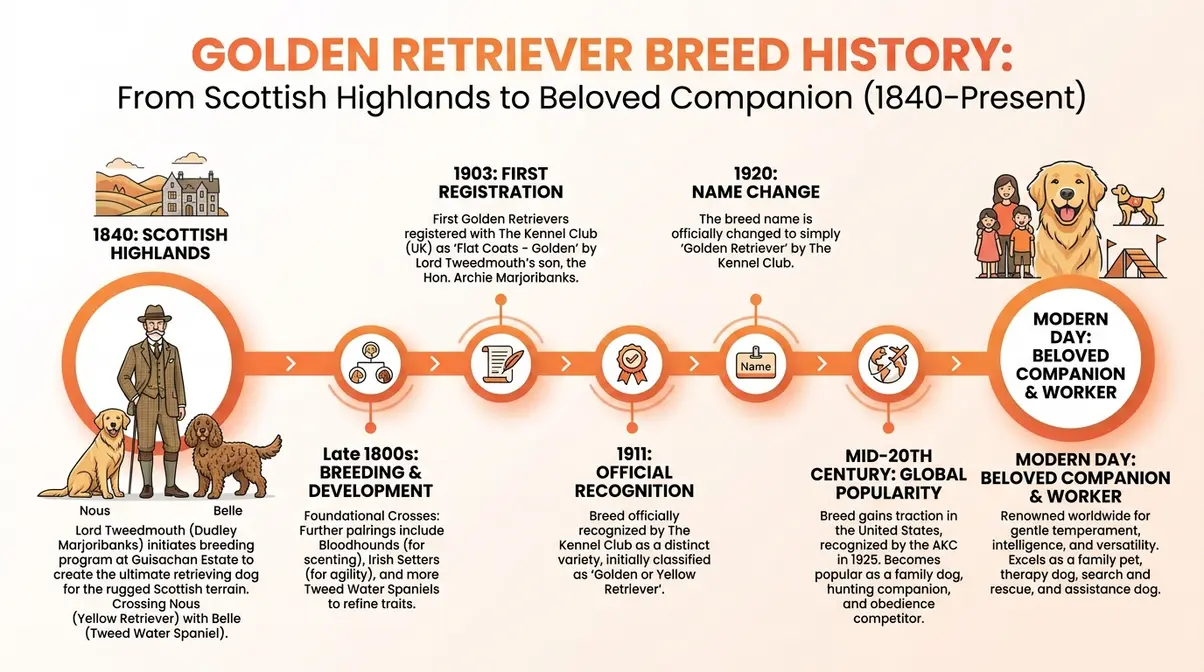
Golden Retrievers were developed in Scotland between the 1840s and 1890s by Lord Tweedmouth, a Scottish nobleman who needed a dog capable of retrieving waterfowl in cold, wet Highland conditions. According to a UMass Amherst study guide, Lord Tweedmouth developed the Golden Retriever in the Scottish Highlands between 1840 and 1890 by crossing a Yellow Retriever with the now-extinct Tweed Water Spaniel to create a gundog suited for rainy climates.
“Lord Tweedmouth developed the Golden Retriever in the Scottish Highlands between 1840 and 1890 by crossing a Yellow Retriever with the now-extinct Tweed Water Spaniel” (UMass Amherst).
Even the breed’s origin reflects what we call “The Golden Paradox” — a dog bred for rugged outdoor work in freezing Scottish rivers, yet gentle enough to carry a delicate game bird back to its owner completely undamaged.
Fact #1: They Were Born on a Scottish Estate
Golden retriever history begins on a single estate in the Scottish Highlands. Lord Tweedmouth, a Scottish nobleman and avid hunter, developed the breed at the Guisachan Estate (pronounced “GWEE-sa-han”) in Inverness-shire, Scotland, from the 1840s through the 1890s. His goal was specific: a dog that could handle cold, wet Scottish weather while retrieving waterfowl (birds hunted near lakes and rivers) for hunters. The rainy Highland terrain demanded a dog with a water-resistant coat, powerful swimming ability, and the gentleness to bring birds back undamaged. Read more about the true Scottish origins of the Golden Retriever to explore how that environment shaped every trait you see today.
Fact #2: The First Puppies Had Flower Names
Lord Tweedmouth kept meticulous breeding records — which is why we know exactly what the first Golden Retrievers were called. The founding father was “Nous” (pronounced “noose”), a wavy-coated yellow retriever. The mother was “Belle,” a Tweed Water Spaniel — a breed that no longer exists today, having been bred out of existence by the early 20th century. Their first litter produced three puppies: Primrose, Crocus, and Cowslip — all named after Scottish wildflowers. According to King’s College London historical records, these records survived because Tweedmouth documented his breeding program in personal game books that were later donated to historical archives.
This careful record-keeping had a specific purpose — Tweedmouth was engineering a dog with a very particular physical gift.
Fact #3: They Were Bred to Be Gentle by Design
The soft mouth (the ability to hold game birds or objects in the mouth without biting down or damaging them) was not a happy accident. It was the central goal of Tweedmouth’s entire breeding program. Hunters needed a dog that could retrieve a shot bird from a lake or marsh and carry it back with the feathers intact and the meat undamaged — ready for the table. The AKC breed standard still lists soft mouth as a defining characteristic of the Golden Retriever today.
The raw egg demonstration you may have seen online — a Golden holding an uncracked egg in its mouth — is modern proof that the trait survived 150 years of breeding. This is The Golden Paradox in its purest form: gentleness that was engineered, not accidental.

Fact #4: Three U.S. Presidents Owned Golden Retrievers
Golden retriever facts don’t get more distinguished than this. President Gerald Ford kept a Golden named Liberty in the White House — and Liberty gave birth to a litter of puppies there, making her one of the most famous dogs in American political history. President Ronald Reagan also owned a Golden named Victory. The breed’s presence in the White House isn’t coincidental. A dog trusted in one of the most scrutinized households on earth sends a clear message about temperament. Learn more about the Golden Retriever breed and why their people-first personality has made them a fixture in family homes worldwide.
Fact #5: February 3 Is National Golden Retriever Day
National Golden Retriever Day falls on February 3 every year — a community-driven celebration of the breed that has grown into a genuine cultural moment. Owners typically mark the day with extra-long walks, special treats, social media photo posts, and donations to Golden Retriever rescue organizations across the country. The golden retriever fun facts community has embraced the day enthusiastically: search interest in Golden Retriever content has grown +182% year-over-year, based on search trend analysis, reflecting just how deeply this breed has embedded itself in popular culture.
Now that you know where Goldens came from, it’s time to look at what makes their bodies so remarkable.
Fact #6–11: What Makes a Golden’s Body So Special?
Fun facts about golden retrievers get even more interesting once you understand the physical engineering behind the breed. Golden Retrievers were built for wet, cold environments — their webbed toes, double coat, and soft mouth are all deliberate breeding outcomes, not coincidences. Each trait solves a specific problem that Scottish Highland hunting conditions created.
Fact #6: Their Toes Are Webbed Like a Duck’s
Look closely at a Golden’s paws and you’ll find webbing between the toes — a natural paddle that works like built-in swim fins. Combined with their powerful hindquarters, this webbing makes them exceptional swimmers. Most Goldens instinctively love to swim from their very first encounter with water — you rarely need to coax one into a lake. According to FitBark’s Golden Retriever guide, Golden Retrievers possess webbed paws and a water-repellent double coat that make them natural swimmers. For owners, this means pools, lakes, and even rain puddles are irresistible. Budget for towel duty.

Fact #7: Their Coat Is Naturally Waterproof
The Golden’s double coat (two distinct layers of fur: outer guard hairs that repel water, and a soft, insulating undercoat for warmth) is a masterpiece of natural engineering. The outer layer is dense and water-resistant — a Golden can swim in cold water without getting soaked to the skin the way a single-coated dog would. The inner layer traps warm air close to the body. This is also why Goldens shed heavily twice a year in a process called “coat blowing,” when the undercoat releases in large amounts. Daily brushing during shedding season is non-negotiable. Explore the unique physical traits of different Golden Retriever types to understand how coat texture varies across American, Canadian, and English varieties.
Fact #8: Goldens Come in Three Official Colors
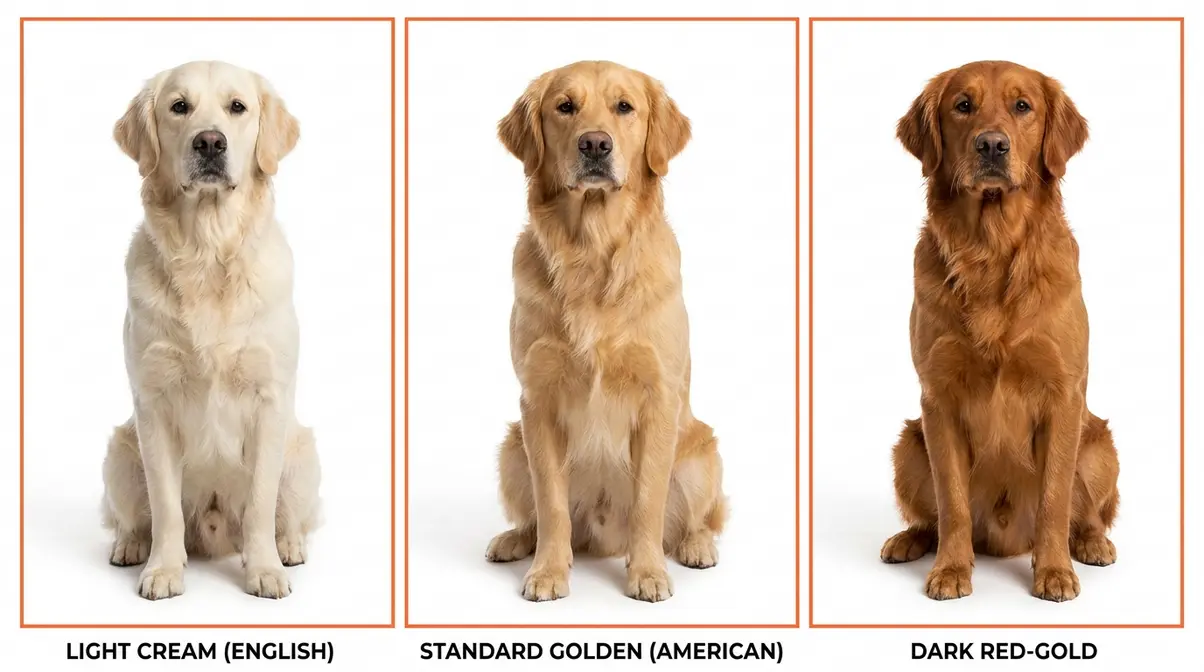
The American Kennel Club (AKC, the United States’ primary dog breed registry) recognizes three official coat shades: light golden (cream), golden, and dark golden (red-gold). Pure white and pure red are not separate breeds — they are color variants within the same breed standard. English Cream Goldens tend toward lighter, almost ivory shades. American Goldens typically carry a richer, deeper gold. One charming detail: a puppy’s color can lighten or darken slightly as it matures, so the puppy you bring home may look a little different at age two. Compare English and American Golden Retriever physical characteristics for a full side-by-side breakdown.
Fact #9: There Are Three Types of Golden Retrievers
Beyond color, there are three physically distinct types of Golden Retrievers — and they differ more than most people expect.
- American Golden: Leaner build, richer golden coat, most common in the United States
- Canadian Golden: Taller and leaner than the American type; thinner, less feathered coat
- English (British) Golden: Stockier build, broader head, lighter cream coat — popular in Europe and Australia
All three share the same even-tempered, adoring-of-human-company personality. The differences are physical only — temperament is consistent across all three types.
Fact #10: How Big Do Golden Retrievers Get?
Golden Retrievers are a medium-to-large breed, and their size is consistent enough that you can plan for it before bringing one home.
| Male | Female | |
|---|---|---|
| Weight | 65–75 lbs | 55–65 lbs |
| Height (shoulder) | 23–24 inches | 21.5–22.5 inches |
| Average Lifespan | 10–12 years | 10–12 years |
Health, diet, and genetics all influence lifespan. For a deeper look at what affects longevity, explore interesting facts about their lifespan — including what owners can do to add healthy years.
Fact #11: They Can Smell Up to 100,000 Times Better Than Humans
Golden Retrievers have approximately 300 million olfactory receptors in their nose — compared to roughly 6 million in humans. That keen sense of smell is why Goldens excel as search-and-rescue dogs, detection dogs, and medical alert animals. Their soft mouth combined with their extraordinary nose makes them the ideal retriever: they can locate a downed bird by scent alone, then carry it back without a single tooth mark. Practically speaking, your Golden knows you’re home before your car turns onto the street.
With their physical traits covered, it’s time to explore what’s happening inside that golden head.
Fact #12–17: How Smart and Loving Are Golden Retrievers?
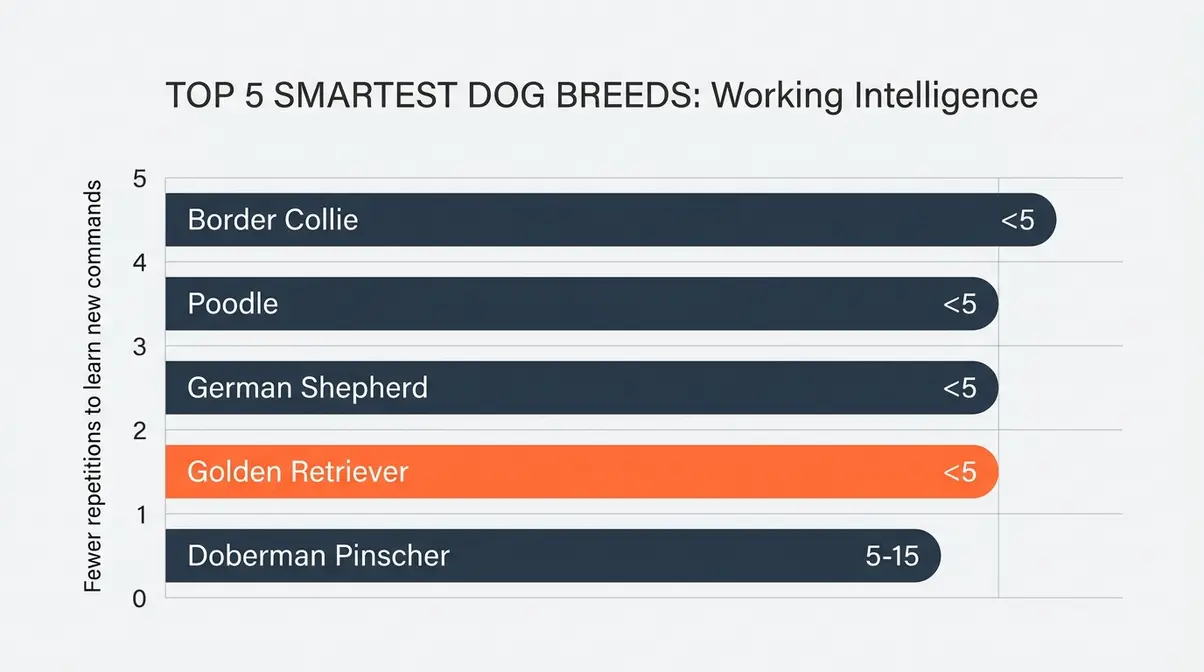
Golden Retrievers rank 4th among all dog breeds in working intelligence, according to canine psychologist Stanley Coren. They learn new commands in under 5 repetitions and obey them 95% of the time — which is why they dominate service dog, therapy dog, and search-and-rescue roles worldwide. But raw intelligence only tells part of the story. Their emotional awareness is what truly separates them from every other smart breed.
Fact #12: They’re the 4th Smartest Dog Breed
Golden retriever intelligence is well-documented. Stanley Coren, a canine psychologist and author of The Intelligence of Dogs, developed a ranking system based on working intelligence (the ability to learn commands quickly and obey them consistently). Golden Retrievers rank #4 overall, behind only the Border Collie, Poodle, and German Shepherd. The numbers are striking: the average dog needs 25–40 repetitions to learn a new command. A Golden needs fewer than 5. According to APA data on dog breed intelligence rankings, Golden Retrievers rank as the fourth smartest dog breed in working and obedience intelligence. Understand the intelligence and temperament of Golden Retrievers for a full breakdown of what this means in daily life.
But raw intelligence is only part of the story — Goldens have a kind of emotional awareness that science is only beginning to explain.
Fact #13: Their Emotional Intelligence Is Written in Their DNA
A 2026 study highlighted by ScienceDaily on Golden Retriever genetics found a genetic connection between trainability in Golden Retrievers and the ROMO1 gene — a genetic marker linked to emotional sensitivity and trainability. The ROMO1 gene has previously been associated with intelligence and emotional responsiveness in humans. In plain terms: a Golden’s instinct to connect with humans and read emotional cues may be partly built into their genes, not just a product of training. This is emerging science, and researchers are careful to note it represents a correlation, not a complete explanation. Still, it offers a fascinating glimpse into why Goldens make such exceptional therapy dogs — it isn’t just what they learn, it’s partly what they’re born with (ScienceDaily, 2026).
This emotional connection also explains one of the most misunderstood Golden Retriever behaviors — their tendency to look sad when you leave.
Fact #14: They Don’t Get “Depressed” — They Self-Soothe
You’ve probably seen the videos: a Golden greeting its owner at the door with a shoe or stuffed animal in its mouth, tail wagging furiously. This is displacement behavior (a self-soothing mechanism in which a dog redirects anxious or excited energy into a familiar, comforting action — in this case, carrying something). It is not clinical depression. The distinction matters. True separation anxiety looks different: destructive chewing, inability to settle, excessive vocalization, and physical symptoms like panting or drooling when left alone. Displacement behavior is normal and healthy. A practical tip for owners: place a designated “carrying toy” near the front door so your Golden always has something to grab when you arrive home.
Fact #15: Dogs Understand Humans Like 2-Year-Old Children Do
Research from the Arizona Canine Cognition Center reveals that dogs possess social intelligence comparable to a 2-year-old human child, according to University of Arizona research on canine social intelligence. They understand pointing, follow human gaze, and cooperate with people in ways that other animals — including chimpanzees in controlled tests — cannot reliably replicate. Golden Retrievers are particularly noted for this cooperative communication. What this means for owners: your Golden isn’t just following commands. They are actively reading your body language, tone of voice, and eye direction. Learn about their social nature and suitability with children for practical guidance on raising a Golden in a family environment.
All of this intelligence and gentleness makes them exceptional with children — but it also means they are spectacularly bad guard dogs.
Fact #16: Golden Retrievers Make Terrible Guard Dogs (On Purpose)
Goldens were bred to be friendly with humans — all humans, including strangers who walk through your front door uninvited. They are not territorial, rarely bark aggressively, and will almost certainly greet an intruder with enthusiasm rather than alarm. This is not a flaw. It is the breed working exactly as designed. Tweedmouth needed a dog that would cooperate with hunters, gamekeepers, and beaters — not one that would challenge every unfamiliar face. For families who want a deterrent, the good news is that a Golden’s bark can be surprisingly loud. How loud? Loud enough to set a world record.
Fact #17: They Keep Their Puppy Energy for Life
Goldens mature more slowly than most breeds — many act like puppies until age 3 or even 4. This is related to selective breeding for playfulness, cooperation, and a willingness to engage with humans. One Golden Retriever owner put it perfectly:
For a visual walkthrough of these personality traits, watch our video guide above. The practical implication for owners: consistent training and mental stimulation are important well into adulthood — a three-year-old Golden is physically full-grown but emotionally still very much a puppy.
Now for the section that surprises everyone — the world records and famous Goldens that prove this breed is extraordinary in every dimension.
Fact #18–22: Record-Breakers and Famous Golden Retrievers
Fun facts about golden retrievers reach their most entertaining peak in this section. Golden Retrievers don’t just make wonderful pets — they hold verified Guinness World Records, have gathered by the thousands in public parks, and have lived in the White House. These are the most shareable facts in the article.
“A Golden Retriever named Charlie holds the Guinness World Record for the loudest bark by a dog at 113.1 decibels — louder than a chainsaw” (Guinness World Records).
Fact #18: One Golden Holds the World Record for Tennis Balls
Finley, a Golden Retriever from New York, holds the Guinness World Record for the most tennis balls held in the mouth by a dog — successfully fitting six tennis balls in his mouth simultaneously (Guinness World Records, 2020). This is The Golden Paradox in its most playful form: the same soft mouth that can carry a raw egg without cracking the shell is also capable of juggling six tennis balls without dropping a single one. The two facts seem contradictory. They are actually the same trait, expressed at different scales.

The tennis ball record shows their gentleness. The next record shows the other side of the Golden Paradox entirely.
Fact #19: One Golden’s Bark Was Louder Than a Chainsaw
Charlie, a Golden Retriever from Australia, holds the Guinness World Record for the loudest bark by a dog at an astonishing 113.1 decibels (Guinness World Records). For context: a chainsaw runs at approximately 110 decibels, and a rock concert sits around 115. Charlie’s single bark fell directly between them. The contrast with the breed’s reputation as gentle, non-aggressive dogs is striking — Goldens can produce extraordinary volume. They simply choose not to use it as a weapon.
Records aren’t just set by individual Goldens — the breed once gathered in record-breaking numbers.
Fact #20: Over 2,000 Goldens Once Gathered in One Park
In Buenos Aires, Argentina, 2,397 Golden Retrievers gathered in a single park in an event organized by local Golden Retriever owners — surpassing the previous record of 1,685. According to an AP News report on the largest gathering of Golden Retrievers, the event was unofficial but independently verified (AP News). That it happened at all — that thousands of Golden Retriever owners organized a mass gathering purely to celebrate their breed — says something profound about the community these dogs create around themselves.
Fact #21: A Golden Lived in the White House
Liberty, President Gerald Ford’s Golden Retriever, didn’t just visit the White House — she lived there and gave birth to a litter of puppies within its walls. President Ronald Reagan also owned a Golden named Victory. The breed’s presence at 1600 Pennsylvania Avenue is a quiet testament to their temperament. These are dogs trusted in one of the most scrutinized, security-conscious environments on earth.
Fact #22: Search Interest in Golden Retrievers Has Grown 182% in One Year
Based on search trend analysis, interest in “golden retriever fun facts” has grown +182% year-over-year, and AI search queries about Golden Retrievers have increased by approximately 40% in the same period. People are asking AI assistants about Goldens more than ever — and it’s easy to understand why. The breed’s combination of verifiable records, scientific depth, and genuine charm makes them one of the most endlessly fascinating topics in the dog world.
Fact #23–26: Golden Retriever Puppy Facts and Fun for Kids
Golden Retriever puppies arrive in the world with a specific developmental timeline that explains a lot about adult Golden behavior. These facts are especially fun for children — and surprisingly informative for new owners who want to know what to expect.
Fact #23: Golden Retriever Puppies Are Born Blind and Deaf
Every Golden Retriever puppy enters the world with its eyes and ears completely closed. Eyes begin to open around 10–14 days after birth; hearing develops around the same time. For those first two weeks, puppies navigate their world entirely through smell and warmth — pressing close to their mother and littermates. A fun comparison: their eyes open right around the time human newborns begin to smile. Once those senses come online, their personalities start to emerge fast. Discover facts about Golden Retriever puppy teeth growth to understand what happens next in their development.
Fact #24: Puppies Get Two Sets of Teeth
Golden Retriever puppies are born toothless, but that changes quickly. Baby teeth (28 teeth) appear around 3–4 weeks old. By 4–6 months, adult teeth (42 teeth) push through, replacing the baby set entirely. This is why puppies chew everything in sight — teething is genuinely uncomfortable. Here’s something many new owners don’t realize: the soft mouth trait isn’t purely instinctive in puppies. It requires active training during the teething phase. Providing appropriate chew toys and consistently redirecting biting behavior during this window builds the gentle mouth that adult Goldens are famous for.
Fact #25: They Don’t Fully Grow Up Until Age 3 or 4
Golden Retrievers reach their full physical size by 12–18 months — but emotional maturity takes considerably longer. Most Goldens remain “puppy-brained” until age 3 or 4, which is exactly what the user voice quote captures so well: they keep their puppy-like natures even as they get older. This extended juvenile phase is a feature, not a bug — it’s why Goldens are such joyful, playful companions well into adulthood. Explore the Golden Retriever puppy growth chart for a month-by-month breakdown of what to expect.

Fact #26: Golden Retriever Day Is February 3 — Celebrate Your Dog!
National Golden Retriever Day falls on February 3 every year, and it’s one of the most enthusiastically observed dog holidays on the calendar. Owners celebrate with extra-long walks, special homemade treats, donation drives for Golden Retriever rescue organizations, and a flood of social media photos. For kids with a Golden at home, February 3 is the perfect day to draw a picture, write a story, or plan a special outing for their dog. It’s a small, joyful reminder of how much these dogs mean to the people who love them.
As delightful as Golden Retrievers are, there are a few things every owner should know before bringing one home.
What to Know Before Getting a Golden Retriever
They Shed — A Lot
The double coat that makes Goldens such remarkable swimmers is also the source of their most notorious trait: shedding. Twice a year — typically in spring and fall — Goldens “blow” their undercoat, releasing hair in impressive quantities. Year-round shedding is also moderate. Daily brushing during shedding season is non-negotiable if you want to keep your furniture manageable. This is the single biggest surprise for new Golden owners — not the energy level, not the training demands, but the sheer volume of golden hair on every surface.
When a Golden Isn’t the Right Fit
Goldens thrive in active households with outdoor access and consistent companionship. They are not well-suited to small apartments with no yard, owners who travel frequently without solid pet care arrangements, or households where someone has severe dog allergies (the double coat produces more dander than single-coated breeds). For allergy-prone households, Labradoodles or Poodles — both low-shedding breeds — are worth considering as alternatives. Learn more about the Golden Retriever breed to make a fully informed decision before adopting.
Frequently Asked Questions About Golden Retrievers
Why Are Golden Retrievers So Special?
Golden Retrievers are special because they combine exceptional intelligence, a gentle temperament, and a history as skilled working dogs in a single breed. Their famous soft mouth allows them to carry delicate objects without damaging them, and their high emotional intelligence makes them exceptional therapy and service animals. They rank as the 4th most intelligent dog breed, learning new commands in under 5 repetitions. Their unique combination of trainability and affection — backed now by genetic research on the ROMO1 gene — makes them one of the most versatile and beloved breeds in the world.
Do Golden Retrievers Have a High IQ?
Yes — Golden Retrievers have a very high working intelligence, ranking 4th among all dog breeds according to canine psychologist Stanley Coren. They learn new commands in fewer than 5 repetitions and obey them 95% of the time, placing them in the top tier of trainable breeds. This is why they dominate service dog, therapy dog, and search-and-rescue roles worldwide. Recent genetic research also suggests their trainability may be partly linked to the ROMO1 gene, associated with emotional sensitivity (ScienceDaily, 2026).
What Is the #1 Nicest Dog Breed?
While “nicest” is subjective, Golden Retrievers are consistently ranked among the friendliest, most patient, and most gentle dog breeds in the world. Their eagerness to please, low aggression, and affectionate nature with children, strangers, and other animals make them a strong contender. They were bred specifically for cooperative work with humans, which means friendliness is built into their genetics — not just trained in. For families with young children, they are widely regarded as one of the safest and most reliable breed choices available.
Which Is the Safest Dog Breed?
Golden Retrievers are widely regarded as one of the safest dog breeds for families, particularly those with young children. Their predictable temperament, high trainability, and low aggression make them reliable companions in almost any household setting. Their gentle nature is not just training — it is a core characteristic of the breed standard that breeders have maintained for over 150 years. As with any dog, proper socialization and consistent training remain important, but Goldens’ inherent temperament makes them an excellent starting point for first-time dog owners.
What Are 20 Fun Facts About Dogs?
Dogs can learn hundreds of words, smell up to 100,000 times better than humans, and have social intelligence comparable to a 2-year-old child. Golden Retrievers specifically demonstrate many of the most remarkable dog facts — from a Guinness World Record bark at 113.1 decibels to the ability to hold six tennis balls in their mouth simultaneously. Across all breeds, dogs understand human pointing, follow human gaze, and cooperate with people in ways no other animal can consistently replicate. For Golden Retriever-specific facts, this article covers 26 verified, sourced examples.
What Is “I Love You” in Dog Language?
Dogs express affection through sustained eye contact, leaning against you, bringing you objects, and a relaxed, wiggly greeting when you return home. In Golden Retrievers specifically, the act of carrying a toy or shoe to greet you is a well-documented affection signal — they want to share something with you, which is a deeply social gesture. Slow blinking, a relaxed body posture, and choosing to rest near you when they could rest elsewhere are all strong “I love you” signals in dog body language. Gentle tail wagging at mid-height, combined with soft eyes, is one of the clearest happiness signals a Golden can show.
How Do Dogs Say “I’m Sorry”?
Dogs show appeasement behavior — their version of “I’m sorry” — through lowered body posture, a tucked tail, avoiding eye contact, and licking your hand or face. In Golden Retrievers, this often looks like flattened ears, a low slow tail wag, and approaching you with a slightly crouched body after a scolding. These are called “appeasement signals” in canine behavior science — the dog is communicating that it poses no threat and wants to restore the social bond. Responding calmly and positively to these signals, rather than continuing to scold, helps reinforce trust between you and your Golden.
What Dog Costs $1,000,000?
No standard dog breed costs $1,000,000 — but Tibetan Mastiffs have sold for record prices exceeding $1.5 million USD at Chinese luxury auctions, making them the world’s most expensive dog breed by sale price. Golden Retrievers, by contrast, typically cost $1,000–$3,500 from a reputable breeder, or significantly less through rescue organizations. The value of a Golden Retriever is measured not in sale price but in their proven roles as service animals, therapy dogs, and family companions. For families seeking extraordinary value, Goldens consistently rank among the best return-on-investment in the dog world.
Facts verified as of July 2026.
Golden retrievers are one of the most extraordinary dog breeds on the planet — backed by science, history, and a Guinness World Record bark of 113.1 decibels (Guinness World Records). Whether you came here for 10 or 100 golden retriever fun facts, the evidence is clear: this breed’s gentleness, intelligence, and emotional depth are not accidental. They are the result of 150+ years of deliberate, loving breeding that began on a single Scottish estate in the 1840s.
The Golden Paradox runs through every fact in this article. A Golden can carry a raw egg without cracking the shell — and a Golden holds the world record for the loudest bark. A Golden is gentle enough to work in a children’s hospital as a therapy dog — and physically capable enough to retrieve waterfowl from a freezing Scottish river. Both facts are true. That paradox is what makes them the world’s most beloved family dog, therapy animal, and working companion all at once.
Ready to learn everything about the breed? Start with our complete Golden Retriever breed guide, or explore interesting facts about their lifespan and what you can do to maximize their healthy years together.
➤ Golden Retrievers aren’t just pets — they are living proof that gentleness and strength can coexist in the same golden coat.