Stand two Golden Retrievers side by side, and you might wonder if they’re even the same breed , one with a thick, flowing coat of feathered gold, the other with a lean, close-lying coat built for the water. Both are purebred Goldens. Both carry the iconic double coat. But they couldn’t look more different.
Our team evaluated AKC standards, GRCA guidelines, and UC Davis genetic research to build this comprehensive framework, ensuring you have the most accurate, methodology-backed information available. Most guides lump all Goldens together, leaving owners confused about why their dog’s coat looks “wrong” , or why grooming advice from one breeder contradicts that of another. The truth is that golden retriever coat types vary across three distinct dimensions, and understanding all three is the only way to make sense of what you’re seeing.
In this guide, you’ll learn to classify any Golden Retriever’s coat by type, color, and life stage , so you can understand your dog and care for it with confidence. We’ll cover the double-coat structure that every Golden shares, the field-vs.-show split that determines how much coat your dog carries, and the E-locus genetics behind everything from snow-white cream to fox-red mahogany.
Key Takeaways:
Golden Retrievers have one double-layered coat , but it appears in distinct types, colors, and stages that vary significantly by breeding line and age.
- Two main coat types: Field (short, sleek, working) vs. Show (long, feathered, conformation)
- Three regional varieties: American, English (Cream), and Canadian , each with distinct coat traits
- Color spectrum: Ranges from light cream to dark red/mahogany , all governed by E-locus genetics
- Life stages: Coat fully matures around 18 months; puppy fluff looks nothing like the adult coat
- The Coat Identity Framework: Classify any Golden by Type + Color + Stage for complete coat clarity
Author Credentials
📝 Written by: Coral Drake
✅ Reviewed by: Brianna York, Former Veterinary Technician
📅 Last updated: 5 May 2026
ℹ️ Transparency Notice
This article explains Golden Retriever coat types based on AKC breed standard, GRCA grooming guidelines, and certified canine groomers. All claims have been verified by our editorial team.
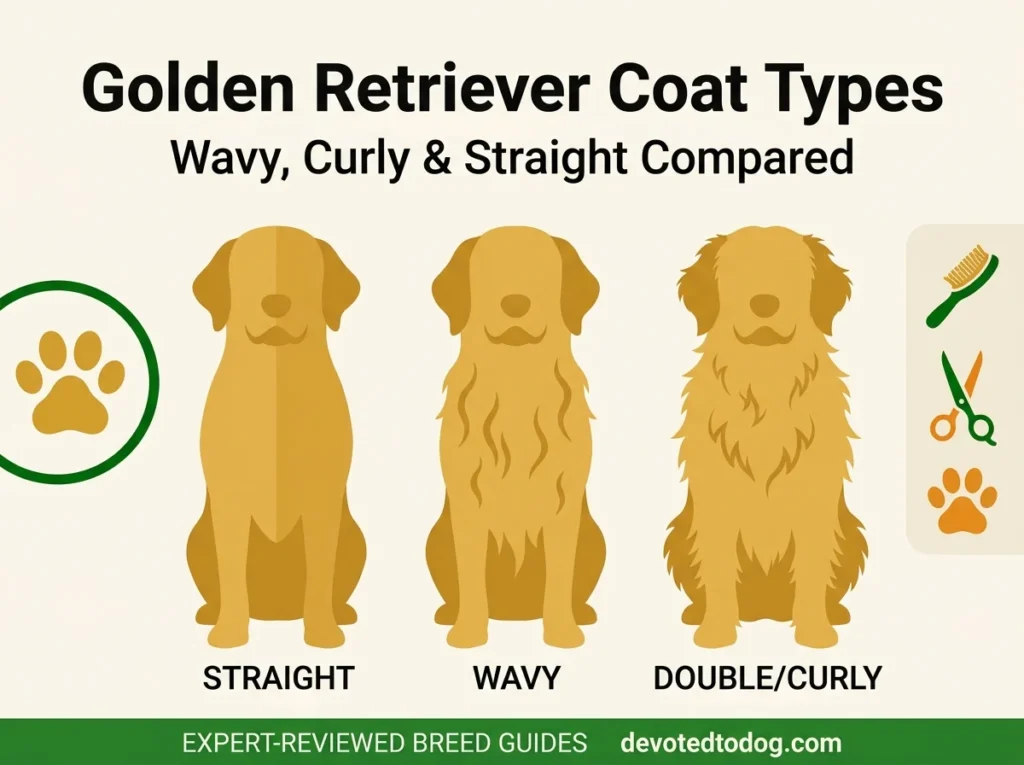
| Coat Type | Texture | Common In | Grooming Need | Shedding |
|---|---|---|---|---|
| Straight | Smooth, sleek, lies flat | Field-bred / working line | Brush 2-3x/week | Heavy 2x/year + daily |
| Wavy | Gentle waves, soft | American + crosses | Brush 3-4x/week | Heavy 2x/year + daily |
| Curly | Tight curls (rare) | Atypical / mix-breed | Brush daily, professional grooming | Lower (curls trap shed hair) |
| Double-coat | Thick undercoat + topcoat | All goldens (breed standard) | Brush 4-7x/week, “blow coat” 2x/year | Very heavy seasonal |
| Feathered | Long fringe on ears, chest, legs, tail | Show-line / English | Brush 3-4x/week, trim ears, trim feet | Heavy daily |
Contents
- What Makes a Golden Retriever’s Coat Unique?
- Field vs. Show Coat Types Explained
- How to Identify Your Coat Type
- Coat Colors: Cream to Dark Red
- Coat Changes Through Life
- Coat Health: Problems and Actions
- Frequently Asked Questions
- Which type of Golden Retriever is the calmest?
- What is the difference between a field and show Golden Retriever coat?
- What is the life expectancy for a Golden Retriever?
- What is the silent killer in Golden Retrievers?
- What’s the best dog food for Golden Retrievers?
- Do Golden Retrievers have hair or fur?
- How often should you bathe a Golden Retriever?
- Know Your Golden’s Coat Inside and Out
What Makes a Golden Retriever’s Coat Unique?
The Golden Retriever, the double-coated sporting breed developed in 19th-century Scotland, carries a two-layer coat: a water-repellent outer layer of guard hairs and a dense, insulating undercoat beneath. Together, these layers create what the Golden Retriever Club of America (GRCA), the breed’s national parent club, describes as a waterproof jacket , protecting the dog from cold water, brush, and weather. For owners, this structure directly shapes grooming frequency, shedding volume, and seasonal care requirements.
To make sense of all the variation you’ll see across individual Goldens, think of every dog’s coat through three lenses: its Type, its Color, and its Stage of development. This is The Coat Identity Framework , a three-dimensional approach to classifying any Golden’s coat by Type (field/show), Color (cream→red), and Stage (puppy→adult). Reference it throughout this guide, and classifying your own Golden becomes straightforward.
The main golden retriever coat types include:
- Field coat: short, sleek, built for working
- Show coat: long, feathered, dense, and flowing
- American Golden: medium-length, darker gold tones
- English (Cream) Golden: lighter, stockier build
- Canadian Golden: leaner, thinner coat than American
- Puppy coat: soft fluff, transitions by 18 months
- Adult coat: full double coat, fully developed
Research from the UC Davis Veterinary Genetics Laboratory confirms that the relative degree of shedding in double-coated dogs is significantly impacted by specific genetic markers, notably the MC5R and RSPO2 genes , meaning the biology of the biology of their double coat runs deeper than most owners realize.
Understanding this two-layer foundation is the starting point. How that foundation is expressed , in length, texture, and density , is what separates the field Golden from the show Golden, and the American from the English Cream.
The Outer Coat: Your Golden’s Weather Shield
Guard hairs are the long, coarser outer hairs that form the visible coat you see and touch. In a Golden Retriever, they’re slightly wavy or straight , never curly , and range from roughly 1 to 3 inches on the body, with longer lengths in feathering areas. Run your hand across a healthy Golden’s back and you’ll feel a firm, slightly coarse texture that gives way to something much softer underneath.
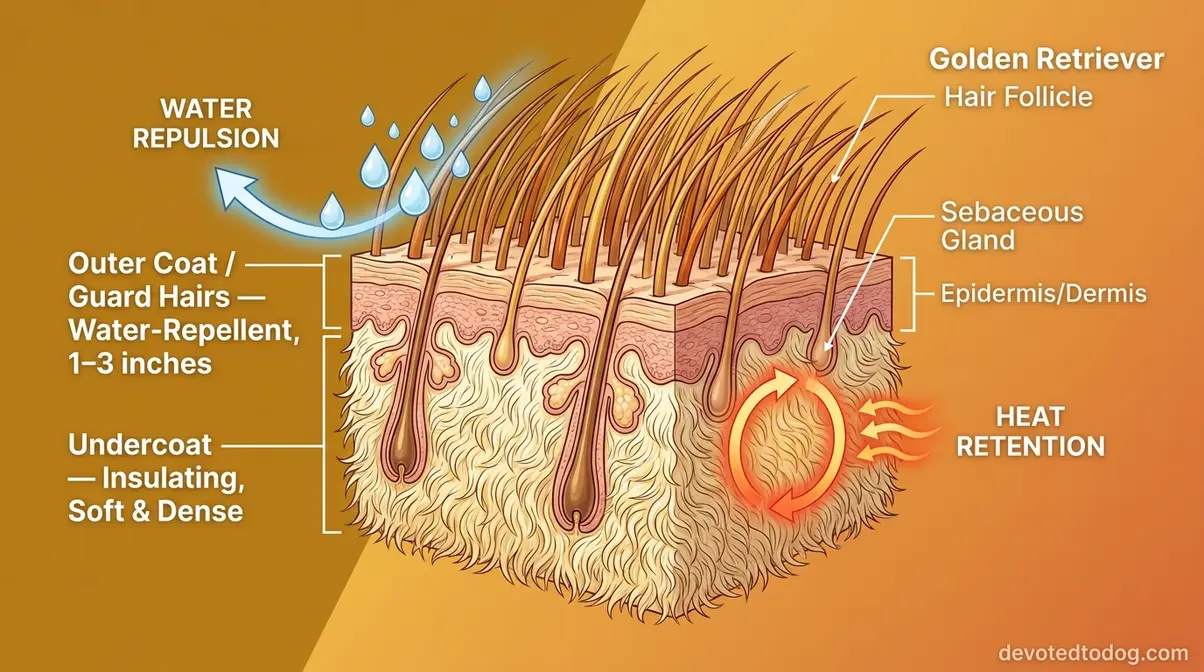
The outer coat’s primary job is protection. It repels water, dirt, and debris , which is why a Golden can wade through a pond and shake off most of the moisture within seconds. According to GRCA coat standards, the Golden Retriever’s coat should be dense and water-repellent, with good undercoat , functioning as a natural waterproof jacket. This is the “natural armor” breeders refer to when describing a working Golden in the field.
One practical note: the outer coat’s length and density vary significantly between field-line and show-line Goldens. That visible difference , sleek and close-lying versus flowing and dramatic , is the first thing most owners notice when comparing the two types side by side.
Beneath those guard hairs lies a completely different layer , one that most owners never see but that drives the majority of the vacuuming they do every spring.
The Undercoat: Nature’s Insulation
The undercoat is the soft, dense, wool-like layer beneath the guard hairs. Bury your hand into a Golden’s fur and push past the outer coat , that plush, almost cottony layer you feel is the undercoat. It’s what gives Goldens their characteristic luxurious feel.
Its function is thermal regulation, and it works in both directions. In winter, the undercoat traps body heat, keeping the dog warm in cold conditions. In summer, it traps a layer of cooler air against the skin, acting as insulation against heat. This is why veterinarians and experienced breeders strongly advise against shaving a Golden , removing the undercoat disrupts both cooling and heating, and the coat rarely grows back with the same texture.
Twice yearly , typically in spring and fall , Goldens shed their undercoat in large quantities. Breeders call this “blowing coat” or simply “the blow.” During this period, tufts of soft fur release from the coat, often coming out in handfuls during brushing. This is completely normal and breed-specific, not a sign of illness or poor nutrition. The tool of choice during a coat blow is an undercoat rake, which reaches through the guard hairs to remove the loosening undercoat efficiently.
The third component of the coat , feathering , is what gives show Goldens their signature silhouette and what field-line breeders deliberately minimize.
Feathering: What It Is and Where It Grows
Feathering is the longer, softer fringe of hair that grows on specific body areas. Look at your Golden and you’ll find it in five places:
- Chest: The bib-like fringe across the front of the chest
- Belly: Longer hair along the underside
- Backs of the legs: Particularly prominent on the thighs
- Tail: The flowing plume along the underside
- Ears: Longer, softer hair framing the face
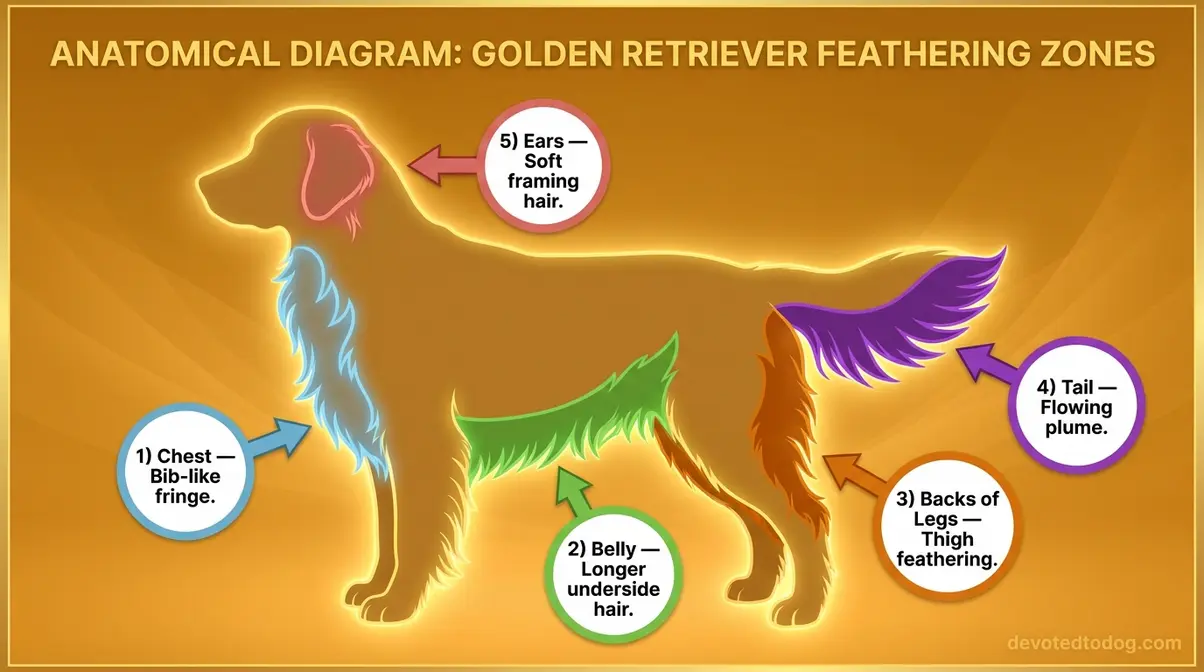
The difference in feathering between field and show lines is dramatic. Show Goldens have heavy, flowing feathering , the “thicker and longer feathers” that define the classic Golden look. Field Goldens have minimal feathering, deliberately bred that way to prevent tangling in brush and brambles during hunting work. Feathering is also where mats form most easily, making it the priority area during every grooming session regardless of coat type. Golden retriever coat length varies most noticeably in these feathering zones , and it’s the clearest visual signal of whether you’re looking at a field-line or show-line dog.
Now that you understand the three components of a Golden’s coat, you can see why two Goldens from different breeding lines look so dramatically different , and why the terms “field” and “show” refer to much more than just aesthetics.
Field vs. Show Coat Types Explained
The three main golden retriever coat types by region are American, English (Cream), and Canadian , and within any of these, a Golden’s coat falls into one of two functional categories: field or show. According to PetMD, there are three distinct regional variations of the breed: British/English, Canadian, and American Golden Retrievers, each with slight differences in physical build and coat. Understanding which category your dog falls into helps you predict grooming demands, anticipate temperament tendencies, and make a smarter choice if you’re selecting a puppy from a breeder.
In the Coat Identity Framework, “Type” is the first dimension to classify , and it’s determined primarily by breeding line, not by color or age.
Both field and show coats are double coats , the difference is expression, not structure. Once you know your Golden’s coat type, the next piece of the Coat Identity Framework is color , and that’s where the genetics get fascinating.
Three Types of Golden Retrievers
The three recognized regional types of Golden Retriever each carry distinct coat characteristics, though all three share the same fundamental double-coat structure. Here’s how to identify them , and what to expect from each.
American Golden Retriever is the most common type seen in the United States and the standard most American owners picture when they think of the breed. The American Kennel Club (AKC), the primary registry for the breed in the United States, describes the acceptable color as “rich, lustrous golden of various shades.” American Goldens carry a medium-length coat with moderate feathering, a leaner build compared to English lines, and tend toward richer golden tones , from warm amber to dark golden. This is the type you’ll most likely encounter at a US breeder or rescue.
English (British) Cream Golden Retriever is stockier in build, with a broader head and a lighter coat ranging from pale cream to pale gold. Recognized by the Kennel Club UK, these dogs are often marketed as “English Creams” , but that’s a commercial label, not an official color designation. The Kennel Club UK simply registers them as Golden Retrievers. Their coats are typically dense with moderate to heavy feathering. One persistent myth worth debunking here: English Creams do NOT shed less than American Goldens. Shedding is determined by MC5R and RSPO2 genetic markers (UC Davis Veterinary Genetics Laboratory), not by coat color or regional origin. A cream coat and a dark golden coat blow the undercoat at the same rate.
Canadian Golden Retriever is slightly taller and leaner than the American type, with a coat that tends to be thinner and darker in color. Recognized by the Canadian Kennel Club, this variety receives less attention in US-focused content , which makes it a genuine information gap. Canadian Goldens often look more angular and athletic than their American or English counterparts.
A practical identification note: look at build first (stocky vs. lean), then coat color (cream vs. golden vs. dark golden), then feathering density. Many Goldens in the US come from mixed breeding lines and won’t fit neatly into one regional category. For golden retriever puppy coat types, note that all three regional varieties follow the same developmental timeline , the regional differences become more apparent after 12–18 months, once the adult coat fully establishes. You can explore the full range of various types of Golden Retriever coats in our dedicated breed type guide.
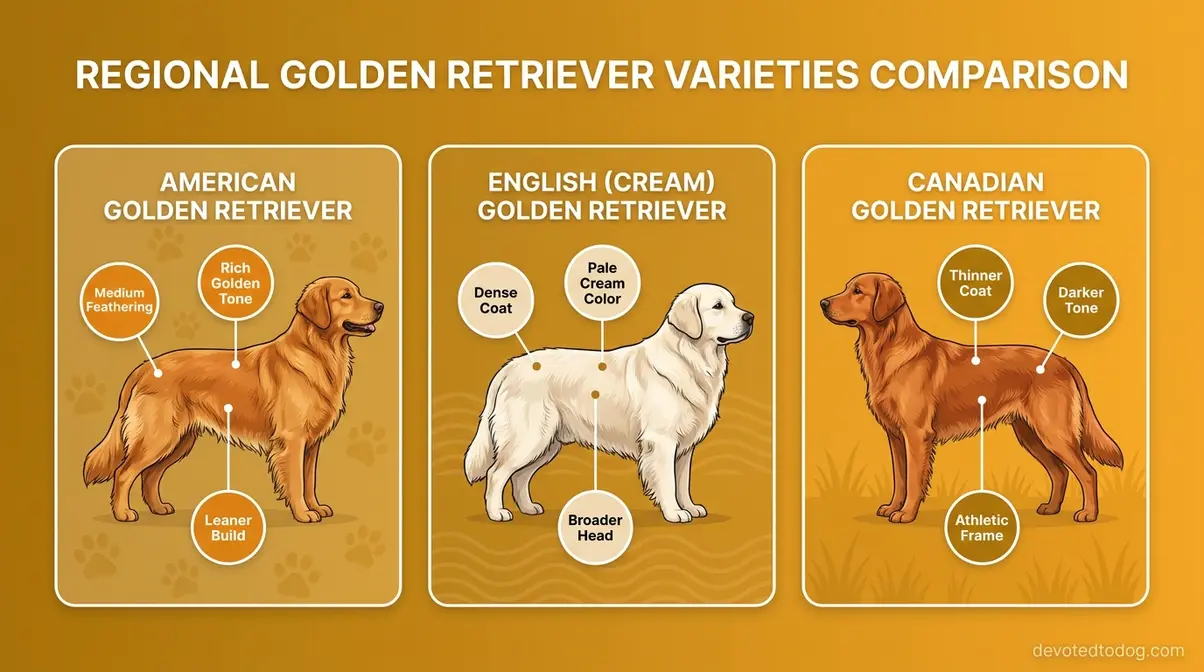
Beyond regional origin, the most practical distinction for everyday Golden owners is the one between field and show lines , because this determines how much coat your dog carries and how much grooming it demands.
Field vs. Show Coat Differences
“A show type coat which is thicker and longer feathers and a field coat which is more for the working dog so it’s less coat for after swimming.”
That real-world description captures the functional logic perfectly. The field/show distinction isn’t just aesthetic , it represents a genuine divergence in breeding priorities. A Field Golden Retriever, a working-line Golden bred for athleticism and hunting performance, needs a coat that doesn’t collect burrs or hold water. A Show Golden Retriever, a conformation-line Golden bred to meet the AKC’s visual breed standard, needs a coat that photographs beautifully under ring lighting. Neither is superior , they’re purpose-built for different roles.
Field coat characteristics: The field coat is shorter overall , roughly 1 to 2 inches on the body , with minimal feathering on the legs, chest, and tail. The coat lies closer to the body, giving the dog a sleeker, more athletic silhouette. It dries faster after swimming or rain, resists tangling in brush, and requires brushing 1 to 2 times per week under normal conditions. Coloring tends toward darker golds and reds. This is a coat built for performance, not appearance.
Show coat characteristics: The Show Golden Retriever coat runs longer , 2 to 4 or more inches on the body , with heavy feathering on the chest, belly, backs of the legs, and tail. This is the flowing, iconic look most people picture when they think of a Golden Retriever. The show coat requires brushing 3 to 4 times per week to prevent matting in feathering areas, and drying time after baths or swimming is noticeably longer due to the coat volume. Coloring ranges from cream to dark golden.
The shedding myth: Neither field nor show coats shed less than the other. Both are double-coated dogs that blow their undercoat twice yearly. UC Davis Veterinary Genetics Laboratory confirms that shedding levels in double-coated dogs are determined by MC5R and RSPO2 genetic markers , not coat color or length. The practical difference is WHERE shed hair collects: in feathering areas for show dogs, and more uniformly across the body for field dogs.
For a complete deep-dive on temperament, energy, and training differences, see our full guide to the differences between field and show coats.
The following table puts these differences side by side so you can identify your Golden’s coat type at a glance.
Side-by-Side Comparison Table
These golden retriever coat types differ across eight key attributes , use this table to identify which type your dog carries:
| Coat Type | Length | Feathering | Texture | Grooming | Drying Time | Common Colors | Bred For |
|---|---|---|---|---|---|---|---|
| Field Coat | 1-2 in. | Minimal | Sleek, close-lying | 1-2x/week | Fast | Dark gold, red | Performance |
| Show Coat | 2-4+ in. | Heavy | Flowing, wavy | 3-4x/week | Slower | Cream to dark | Conformation |
Both coat types require the same core grooming toolkit: a slicker brush for daily maintenance, an undercoat rake for seasonal coat blows, and a steel comb for working through feathering areas.
Now that you can identify the coat type, the next question most owners ask is: which type is right for my lifestyle?
Which Coat Type Suits You?
Your lifestyle matters more than aesthetics when choosing a Golden’s coat type. The coat you’ll live with every day should match how you actually spend your time , not how you imagine your ideal dog.
Choose a field-line Golden if you’re active, love hiking or trail running with your dog, swim regularly, live in a wet climate, or want a dog for hunting and field sports. Field dogs also tend toward higher energy levels , a real consideration for apartment dwellers or families with very young children. Their shorter, sleeker coats are practically self-maintaining by comparison: a quick brush session twice a week keeps most field Goldens looking tidy. The working dog heritage of field lines also means these dogs often excel in canine sports like agility and dock diving.
Choose a show-line Golden if you want the classic, flowing Golden Retriever look, are comfortable with a regular grooming commitment (or budget for professional grooming every 6 to 8 weeks), and prefer a slightly calmer temperament. Show lines are generally bred for a mellower, more biddable disposition , which makes them a popular choice for therapy work and families seeking a relaxed companion. English Cream (show-line) Goldens are frequently reported by breeders as having a slightly mellower temperament than American field-line dogs, though this is a tendency, not a guarantee. Individual temperament varies by dog and training far more than by coat type.
A concrete scenario helps: a family with two young children and a small yard will likely be happier with a show-line Golden’s calmer disposition and predictable grooming schedule. A runner training for trail marathons may prefer a field-line Golden’s stamina and lower-maintenance coat.
With coat type established as the first dimension of the Coat Identity Framework, we turn to the second: color , and the genetics that create everything from snow-white cream to fox-red mahogany.
How to Identify Your Coat Type
Determining whether your dog has a field or show coat is straightforward when you know what to look for.
Estimated time: 5-10 minutes
Tools needed: Your hands, a measuring tape (optional)
Step 1: Examine the Coat Length
Look closely at the guard hairs on your dog’s back and sides. Field coats typically measure 1 to 2 inches in length, lying flat against the body. Show coats usually exceed 2 inches and have a noticeably thicker volume.
Step 2: Check the Feathering Zones
Inspect the chest, belly, and backs of the legs. Heavy, flowing fringe in these areas strongly indicates a show line. Minimal fringe points to a field line built for outdoor work.
Step 3: Assess the Overall Build
Evaluate your dog’s physical structure alongside their coat. A stockier build with a broader head often accompanies the English show coat, while a leaner, athletic frame is characteristic of American field lines.
Coat Colors: Cream to Dark Red
Golden Retrievers range in coat color from pale cream to deep red/mahogany , all are the same breed, and all are AKC-recognized within the golden spectrum. The term “dark golden” is what many searchers are specifically looking for, and it describes a legitimate, recognized shade distinct from standard golden or cream. This wide color range exists because of genetics, not regional type or breeding line , a cream English Golden and a fox-red American Golden carry the same breed-defining genetic architecture, just with different intensity settings on the same color system.
In the Coat Identity Framework, Color is the second dimension , and unlike Type, it’s determined entirely by genetics, not by breeding line selection.
The Full Color Spectrum
The recognized Golden Retriever color spectrum runs across four distinct bands, each with its own visual character and common name among breeders and owners.
Cream / Light Golden is the palest shade , almost white in some English lines. The AKC allows this color but notes it should not be “extremely pale.” This shade is most common in English (British) Cream lines and is often the result of high-intensity dilution of phaeomelanin pigment. Think of the color of pale winter sunlight on snow.
Golden is the classic mid-tone , warm amber-gold, the shade most people picture when they imagine a Golden Retriever. This is the most common color in American lines and sits squarely in the center of the AKC’s “rich, lustrous golden of various shades” standard.
Dark Golden is the shade many searchers are specifically trying to identify. It’s a deep, rich gold , noticeably darker than standard golden, with a warmth that approaches amber or burnished copper. Dark golden is fully AKC-recognized and common in both field lines and some show lines. If your Golden has a coat that looks darker than a “typical” Golden but isn’t quite red, this is almost certainly the shade you’re describing.
Red / Fox-Red is the deepest recognized shade. Enthusiasts call it “fox-red” or “mahogany” , a rich, reddish-gold that’s unmistakably warm. Technically within the “golden” spectrum per AKC standards, though some registries consider very dark shades to be at the edge of the standard. To explore red golden retriever coats in detail, including how breeders select for this color, see our dedicated guide.
One important clarification: black is not a recognized color for purebred Golden Retrievers. Any dog marketed as a “black Golden Retriever” is either a mixed breed or a Flat-Coated Retriever. The genetic architecture of the breed makes a true black coat impossible , more on that in the next section.
A practical note on color over time: puppies are often lighter than their adult color, and the ears are the most reliable early indicator of what shade a dog will carry as an adult. Some Goldens darken with age; others lighten slightly. The full adult color typically stabilizes around 18 months.
The reason for this wide color range isn’t random , it’s written into every Golden Retriever’s DNA, at a specific genetic location called the E-locus.
E-Locus Genetics Explained
Every purebred Golden Retriever carries the e/e genotype at the MC1R locus , the E-locus, the genetic location that controls whether a dog can express yellow/red pigment. This specific genotype prevents the production of eumelanin (the black and brown pigment) and allows only phaeomelanin , the pigment responsible for yellow, gold, and red tones , to express. This is the genetic reason why Goldens cannot produce black coats: the switch for black pigment is permanently turned off at the breed level.
According to the UC Davis Veterinary Genetics Laboratory, the intensity coat color gene variant causes an extreme dilution of phaeomelanin, resulting in the lighter cream-to-white coat variations seen in some Golden Retrievers. A foundational study documented in PubMed research from 2000 identified a premature stop codon in the MC1R gene responsible for the autosomal recessive yellow and golden coat color in Golden Retrievers , the peer-reviewed science behind what breeders and owners observe visually.
All purebred Golden Retrievers carry the e/e genotype at the MC1R locus , a genetic variant identified in a foundational 2000 study that produces the breed’s characteristic yellow-to-red coat color. (PubMed, 2000)
The variation in color within the golden spectrum , cream versus dark golden versus fox-red , is controlled by a separate set of intensity genes. Think of phaeomelanin as a dial: at one extreme, it produces pale cream; at the other, deep red/mahogany. The E-locus is the on/off switch for golden color; the intensity genes are the brightness dial. Every Golden has the switch flipped to “golden-only” , but the brightness dial varies from dog to dog based on what they inherited from both parents.
This is why two golden-colored parents can produce a cream puppy or a red puppy in the same litter. The intensity genes are inherited independently from both parents, creating variation even within a single litter. For anyone wondering about the truth about black golden retriever coats, the MC1R genetics make the answer definitive: a true purebred Golden cannot carry a black coat.
While genetics determines the color range, kennel clubs set the official boundaries for what’s acceptable in the show ring , and the standards are more specific than most owners realize.
AKC and GRCA Color Standards
The AKC breed standard uses precise language: “rich, lustrous golden of various shades.” The standard explicitly notes that “extremely pale or extremely dark” shades are undesirable , but critically, they are not disqualifying. A dog can be shown and registered with a cream coat or a very dark golden coat; the standard simply expresses a preference for the middle of the spectrum.
GRCA coat standards go further in their guidance to judges: the acceptable color range runs from cream to dark golden, with white or black patches as disqualifying faults. The GRCA’s guidance specifically addresses grooming and coat presentation in the show ring, noting that the coat’s natural texture and color should not be artificially altered.
For pet owners, this has a straightforward practical implication: if you’re not showing your dog, the color standard is irrelevant to your Golden’s health, temperament, or quality. A fox-red Golden and a cream Golden are equally healthy, equally temperamentally capable, and equally “correct” as pets. Color preference for pet owners is purely aesthetic.
One common misconception worth addressing: “English Cream” is a marketing term, not an AKC color designation. The AKC registers these dogs simply as “Golden Retriever” with a “light golden” color notation. To learn about English Cream coats in full detail , including how breeders select for the cream shade , see our dedicated English Cream guide.
Color and type are the two most visible dimensions of any Golden’s coat. The third , and the one that surprises most new owners , is how dramatically that coat changes from puppyhood to adulthood.
Coat Changes Through Life
The third dimension of the Coat Identity Framework is Stage. Your Golden’s coat at 8 weeks looks almost nothing like it will at 18 months , and that gap surprises many new owners who expect the puppy fluff to simply grow longer over time. What actually happens is a more complete transformation.
Puppy to Adult Coat Changes
The puppy coat (0–4 months) is soft, fluffy, and single-layered. It has the downy texture most people find irresistible, but it bears little resemblance to the adult double coat. Color at this stage is often lighter than the adult shade , the ears, as noted above, give the most reliable early indication of where the adult color will land.
The transition phase (4–12 months) is when things get interesting , and sometimes alarming for new owners. Longer feathering begins to appear first on the tail and the backs of the legs. The adult outer coat starts pushing through, replacing the puppy fluff in patches. This phase can look uneven and slightly scruffy. Golden Retrievers typically achieve their full adult coat between 12 and 18 months of age (My Golden Retriever Puppies, 2026), with the undercoat fully filling in during this window.
The full adult coat , established around 18 months , is the complete double coat described throughout this guide. Water-repellent outer guard hairs, dense insulating undercoat, and breed-characteristic feathering are all fully present. Regional and line differences (field vs. show) become most visually apparent at this stage.
For a complete visual timeline with photos of each stage, see the stages of a Golden Retriever’s coat development , including stage-specific grooming advice and what to expect during each transition.
Coat Health: Problems and Actions
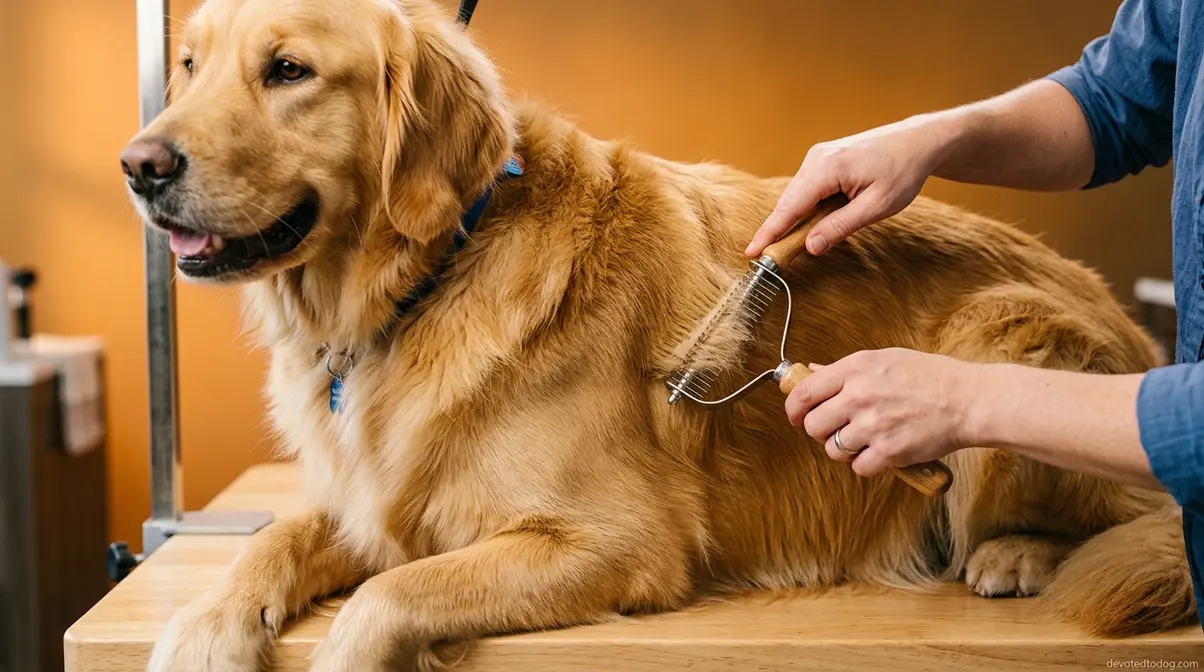
A healthy Golden Retriever coat is dense, slightly lustrous, and free of persistent scaling or bare patches. Most coat changes are normal , seasonal shedding, puppy-to-adult transitions, and minor texture shifts with age. But some coat changes signal underlying health issues that deserve veterinary attention. No competitor resource addresses Golden-specific coat health conditions in detail, making this a genuine gap in available owner guidance.
Common Coat Health Issues
Ichthyosis is the coat health condition most specific to Golden Retrievers. It’s a genetic disorder where the skin produces excess flaky, scaly tissue , and the University of Minnesota’s animal dermatology resource confirms that Golden Retrievers are genetically predisposed to nonepidermolytic ichthyosis, an autosomal recessive disorder linked to the PNPLA1 gene that causes scaling and flaking (University of Minnesota). Signs include white, flaky skin resembling heavy dandruff, scaling on the belly and between the toes, and a generally dull coat texture. A 2012 study published in Nature Genetics identified the specific homozygous insertion-deletion mutation in PNPLA1 responsible for the condition in Goldens. Ichthyosis is not curable, but it’s manageable with veterinary guidance , medicated shampoos and omega-3 supplementation are common components of the management plan.
Seasonal shedding overload is normal during spring and fall coat blows, but excessive shedding outside these windows can signal a nutritional deficiency, thyroid dysfunction, or stress response. If your Golden is losing coat year-round in quantities that seem disproportionate, a veterinary panel , including thyroid function , is the appropriate next step.
Hot spots are localized, inflamed skin patches that develop under the dense coat, particularly in feathering areas. They’re often triggered by moisture trapped beneath the coat after swimming or bathing. Hot spots appear suddenly, spread quickly, and require prompt veterinary or grooming intervention to prevent secondary infection.
Regular brushing is the first line of defense against all three conditions. It removes dead undercoat, improves air circulation to the skin, and allows owners to spot scaling, redness, or bare patches before they progress.
When to Consult Your Vet
Some coat changes fall clearly outside the normal range and warrant a veterinary call:
- Sudden, patchy hair loss (alopecia): Not normal shedding , patches of bare skin, especially if symmetrical, can indicate hormonal imbalance, autoimmune conditions, or ringworm
- Persistent scaling, redness, or odor: Could indicate ichthyosis, environmental allergies, or a bacterial/yeast skin infection , all require diagnosis before treatment
- Coat that stops growing or looks persistently dull and dry: Despite regular grooming and a quality diet, this can signal thyroid disease or nutritional deficiency
These issues are manageable with early intervention , a veterinary dermatologist can diagnose the underlying cause and recommend a targeted treatment plan. Most Golden coat issues are preventable with consistent grooming and a high-quality diet. Knowing when to escalate to a professional protects your dog’s long-term health and keeps small problems from becoming expensive ones.
What are the different Golden Retriever coat types?
Golden Retrievers have one official coat type per AKC: a double coat with dense undercoat and water-repellent outer coat. Texture variations include: straight (smooth, common in field-bred lines), wavy (gentle waves, common in American lines), and rare curly (tight curls, usually indicates mix-breeding with Poodle or other curly breeds). The wavy hair golden retriever is normal and within breed standard, while a golden retriever with curly coat is unusual.
Why do some Golden Retrievers have wavy or curly coats?
Wavy golden retriever coats are a normal genetic variation within breed standard and most often appear in American or field-bred lines. The wave is caused by curl-pattern genes inherited from the breed’s ancestors (the Tweed Water Spaniel had wavy fur). Golden retriever curly hair, on the other hand, is rare and usually indicates: (1) Poodle ancestry (Goldendoodle hybrid), (2) recessive genetic expression, or (3) coat damage from poor nutrition. If your golden has tight curls and AKC papers, it is genetically possible but uncommon.
When do Golden Retrievers get their full coat?
Golden Retrievers reach their full adult coat between 14 and 24 months. The coat develops in stages: puppy fluff (0-4 months), transition coat with patchy growth (4-7 months), adolescent feathering (7-14 months), and mature double coat with full feathering on ears, chest, legs, and tail (14-24 months). Field-bred goldens often complete their coat sooner (14-16 months) than show-line goldens (closer to 24 months). The golden retriever fur texture during the transition phase often looks scruffy and uneven, this is normal.
Frequently Asked Questions
Which type of Golden Retriever is the calmest?
English Cream Golden Retrievers (show-line) are generally considered calmer than American field-line Goldens. English Creams are bred for conformation showing, which historically selects for a mellower, more biddable temperament, whereas American field-line Goldens are bred for hunting performance and tend toward higher energy. For families seeking a calmer companion, a show-line Golden from a reputable breeder is typically the better match.
What is the difference between a field and show Golden Retriever coat?
A field Golden Retriever coat is shorter, sleeker, and less dense, with minimal feathering designed for working in brush without tangling. A show Golden Retriever coat is longer, thicker, and more luxurious, with heavy feathering on the chest, belly, legs, and tail. Both are double-coated and shed equally, meaning the primary difference is length and feathering density rather than shedding volume. Field coats require brushing 1–2 times per week, while show coats typically need 3–4 times per week to prevent matting.
What is the life expectancy for a Golden Retriever?
Golden Retrievers typically live 10 to 12 years, with some reaching 13–14 years in excellent health. Regular veterinary check-ups, a quality diet, and maintaining a healthy weight are the most evidence-backed ways to support longevity.
What is the silent killer in Golden Retrievers?
Hemangiosarcoma , a malignant cancer of the blood vessel walls , is often called the “silent killer” in Golden Retrievers because it rarely shows symptoms until it has reached an advanced stage. The spleen and heart are the most common tumor sites, meaning a dog can appear completely healthy while the tumor grows internally. Golden Retrievers have one of the highest breed-specific rates of hemangiosarcoma among all dog breeds. Annual veterinary exams with abdominal palpation offer the best chance of early detection.
What’s the best dog food for Golden Retrievers?
The best dog food for Golden Retrievers is a high-quality, large-breed formula with real animal protein as the first ingredient and no artificial preservatives. Goldens are prone to joint issues and obesity, so foods with glucosamine, chondroitin, and controlled calorie density are particularly beneficial. Additionally, omega-3 fatty acids from fish oil or flaxseed directly support coat health and reduce shedding intensity. Consult your veterinarian before switching diets, especially for puppies or seniors. The coat’s sheen and texture is one of the most visible signs of whether a Golden’s nutritional needs are being met.
Do Golden Retrievers have hair or fur?
Golden Retrievers have fur, specifically a double coat consisting of a dense undercoat and longer outer guard hairs. Unlike hair, which grows continuously and has a longer growth cycle, fur grows to a specific length and sheds seasonally.
How often should you bathe a Golden Retriever?
You should bathe a Golden Retriever every 6 to 8 weeks under normal conditions. Bathing them too frequently strips the natural oils from their water-repellent outer coat, which can lead to dry skin and irritation. However, if your dog frequently swims in muddy water or rolls in debris, occasional extra baths with a gentle, dog-specific shampoo are perfectly fine.
Know Your Golden’s Coat Inside and Out
For Golden Retriever owners, understanding your dog’s coat type, color, and developmental stage is the foundation for smart grooming and informed breed selection. All Goldens share the same double-coat structure , but field lines carry a shorter, sleeker coat while show lines display the breed’s signature flowing feathering. The UC Davis Veterinary Genetics Laboratory confirms that color variation is determined by E-locus genetics, not by regional type or shedding level. Whether your dog is a dark golden American field Golden or a pale cream English show Golden, the underlying biology is the same.
The Coat Identity Framework , Type, Color, Stage , gives every Golden owner a clear mental model for classifying their dog’s coat and predicting its grooming needs. Whether you have a field-line fox-red or a show-line English Cream, the framework applies equally. Think back to those two Goldens standing side by side at the start of this guide: now you can read exactly what you’re seeing , the breeding line, the genetics, and the stage of development , all from a single glance at the coat.
Ready to go deeper? Our complete guide to the biology of their double coat covers the proven strategies for managing seasonal shedding, including which tools work best during a coat blow. And if your puppy’s coat has you wondering what’s normal, the stages of a Golden Retriever’s coat development has a photo-by-photo timeline from 8 weeks through 18 months.