
Your Goldendoodle just figured out how to open the treat cabinet — then sat down and looked at you like they were waiting for applause. So are Goldendoodles smart, or is this just adorable chaos? You’ve heard breeders call them “little Einsteins.” You’ve also watched your dog zoom around the yard for no apparent reason, ignore a command they mastered last week, and steal your spot on the couch the moment you stand up.
Breeders say they’re brilliant. Your daily experience says… complicated. Both are true — and the reason why is actually fascinating science.
In this guide, you’ll discover exactly how smart Goldendoodles are — using real science, not breeder marketing — so you can train, challenge, and connect with your dog on a whole new level. We’ll cover the three dimensions of their intelligence, how they compare to other breeds, and — critically — what to do when all that brainpower turns into chaos.
If you are wondering, “are goldendoodles smart?” the answer is a resounding yes. Goldendoodles are genuinely smart dogs — they rank among the top intelligent crossbreeds, inheriting their brains from the Poodle (the #2 smartest breed) and the Golden Retriever (the #4 smartest breed) according to AKC intelligence rankings (AKC).
- Working Intelligence: Top-tier breeds like the Poodle learn new commands in as few as 5 repetitions and obey on the first command 95%+ of the time — Goldendoodles inherit this capacity directly (Coren, The Intelligence of Dogs)
- Emotional Intelligence: They read human moods and body language with remarkable accuracy — a trait owners consistently describe as “knowing and aware”
- The Goldendoodle Intelligence Matrix: Their smarts come in three forms — working, emotional, and instinctive — and understanding all three changes how you train and bond with them
- Warning: High intelligence means high boredom risk — without mental stimulation, smart dogs create their own (destructive) entertainment
Contents
Why Are Goldendoodles Considered Smart Dogs?
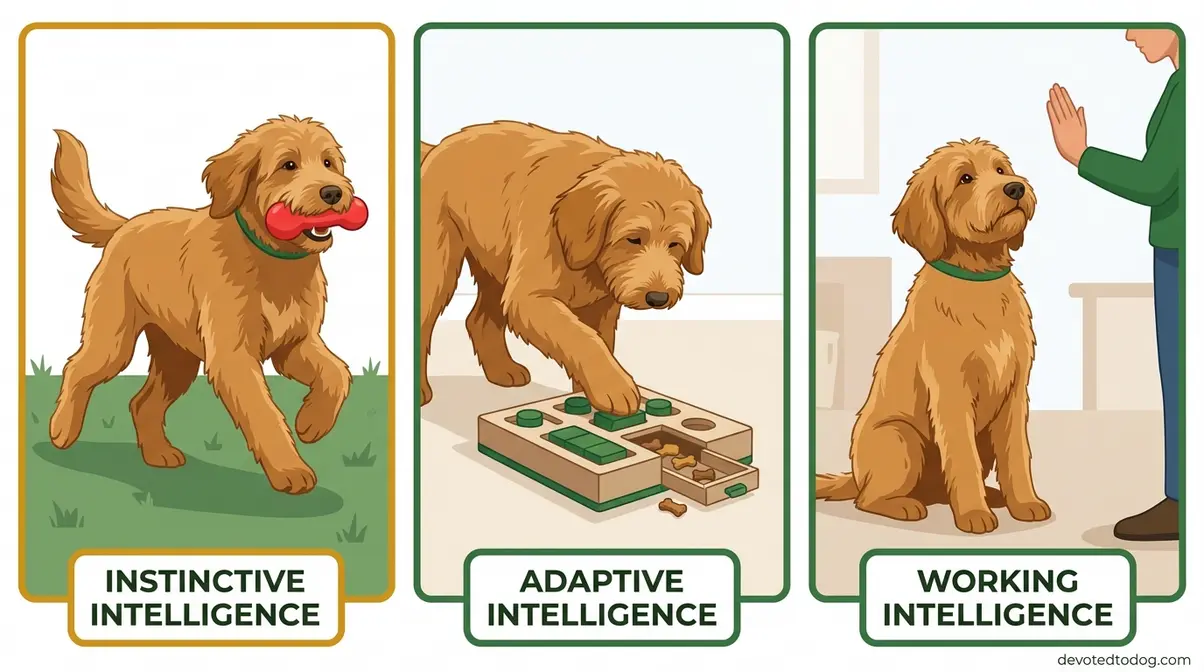
Yes, Goldendoodles are genuinely smart dogs — and there’s science behind it, not just breeder enthusiasm. Their intelligence comes in three distinct forms, inherited from two of the world’s top-ranked breeds. Understanding which type of intelligence your Goldendoodle has changes how you train, play with, and connect with them.
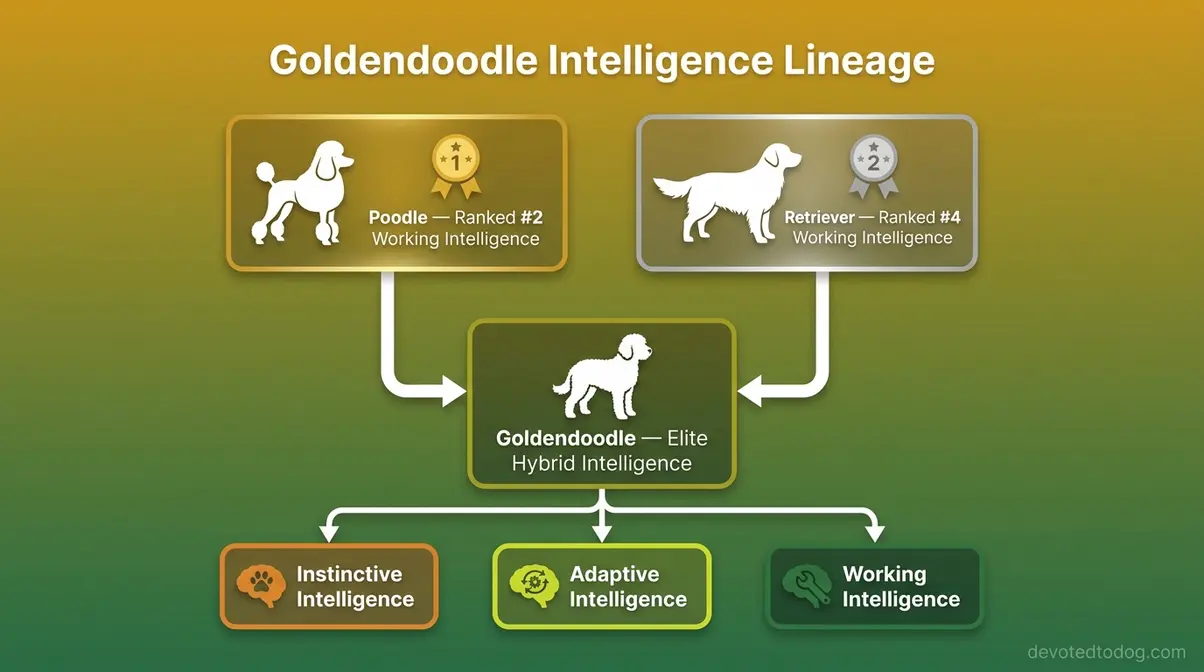
Goldendoodles inherit their intelligence from two of the world’s top-ranked breeds — the Poodle (#2) and the Golden Retriever (#4) in working intelligence (American Kennel Club). That’s not a coincidence — it’s genetics working exactly as you’d expect.
Three Types of Dog Intelligence
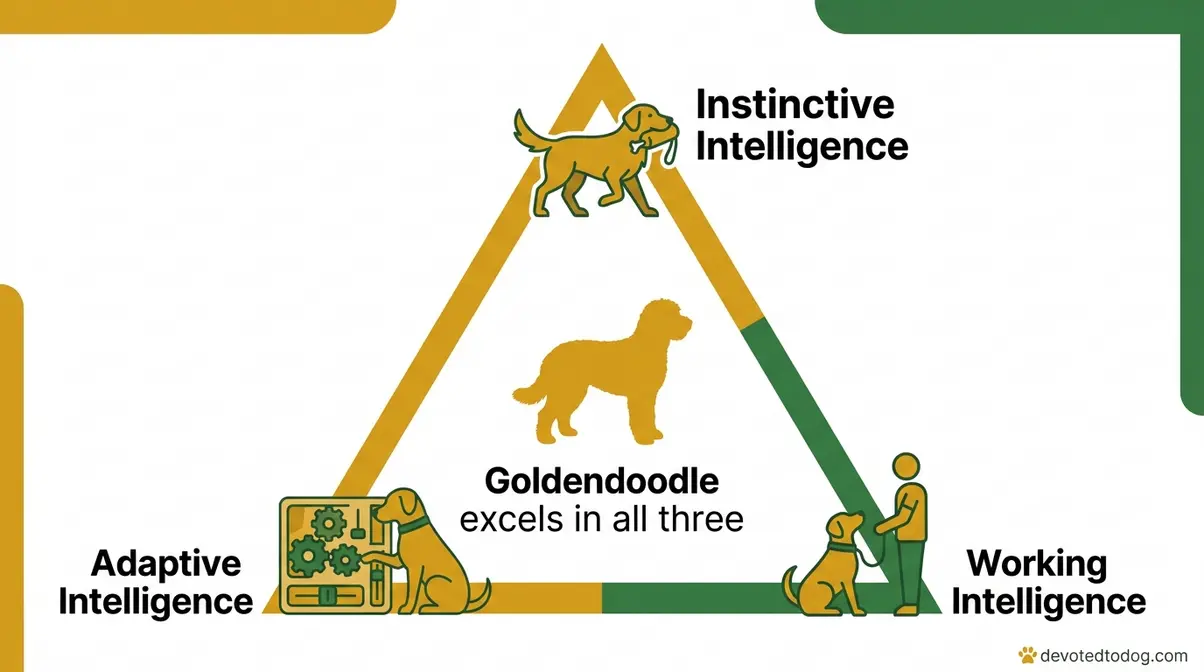
How smart are Goldendoodles? To answer that properly, you first need to know that “smart” means different things for different dogs. Dr. Stanley Coren, a neuropsychologist and author of The Intelligence of Dogs, identified three distinct types of canine intelligence — and Goldendoodles score well across all three.
Here’s what each type means and how it shows up in your dog:
- Instinctive intelligence (what a breed was purpose-bred to do): For Goldendoodles, this means retrieving instincts inherited from the Golden Retriever parent. You’ll notice it when your dog naturally brings things to you — toys, socks, the TV remote.
- Adaptive intelligence (solving new problems on their own): This is where Goldendoodles genuinely shine. Think of your dog figuring out that barking doesn’t get your attention, so they switch to pawing your leg. Or pushing a treat ball with their nose, then learning to use their paw when the nose stops working.
- Working/obedience intelligence (learning from humans): This is the ability to learn and follow commands. The Poodle — one of Goldendoodle’s parent breeds — is one of the best in the world at this.
Together, these three types form what we call The Goldendoodle Intelligence Matrix — a complete picture of how your dog thinks. Understanding it changes everything about how you approach training.
According to Dr. Stanley Coren’s breakdown of canine intelligence, Coren’s framework identifies instinctive, adaptive, and working intelligence as the three pillars of canine smarts (Psychology Today, 2009).
Now that you know the types of intelligence, here’s where it gets interesting: Goldendoodles don’t just inherit one of these — they inherit all three, from two breeds that each excel in different categories.
Inheritance from Parent Breeds
What makes Goldendoodles smart is the remarkable intelligence of both parent breeds. The Poodle, the second-smartest dog breed according to canine intelligence rankings, and the Golden Retriever, ranked fourth in working and obedience intelligence, are the genetic foundation of every Goldendoodle. According to AKC’s ranking of the smartest dog breeds, the Poodle ranks #2 and the Golden Retriever ranks #4 in working and obedience intelligence, based on Dr. Coren’s research (AKC).
What does Coren’s ranking actually mean? Breeds in the top tier learn a new command in under 5 repetitions and obey on the first command 95%+ of the time. That’s genuinely elite performance.
Each parent contributes something distinct:
- Poodle: Exceptional working and obedience intelligence, problem-solving ability, and a history of water retrieval tasks requiring independent thinking
- Golden Retriever: High emotional intelligence, an eagerness to please that makes training cooperative and enjoyable, and a naturally gentle social awareness
The Goldendoodle, a hybrid dog breed created by crossing a Golden Retriever and a Poodle, gets both. A 2019 behavioral study on Goldendoodles published in the journal Animals found that Goldendoodle trainability scores fall between those of their parent breeds — the Golden Retriever and Poodle — placing them above average across all dog breeds (2019). This is the only peer-reviewed data specifically on Goldendoodles, not just their parent breeds. It matters.
Understanding the genetics is one thing. But what does this intelligence actually look like when your dog is living in your house, eating your socks, and stealing your pillow?
5 Real-World Intelligence Examples
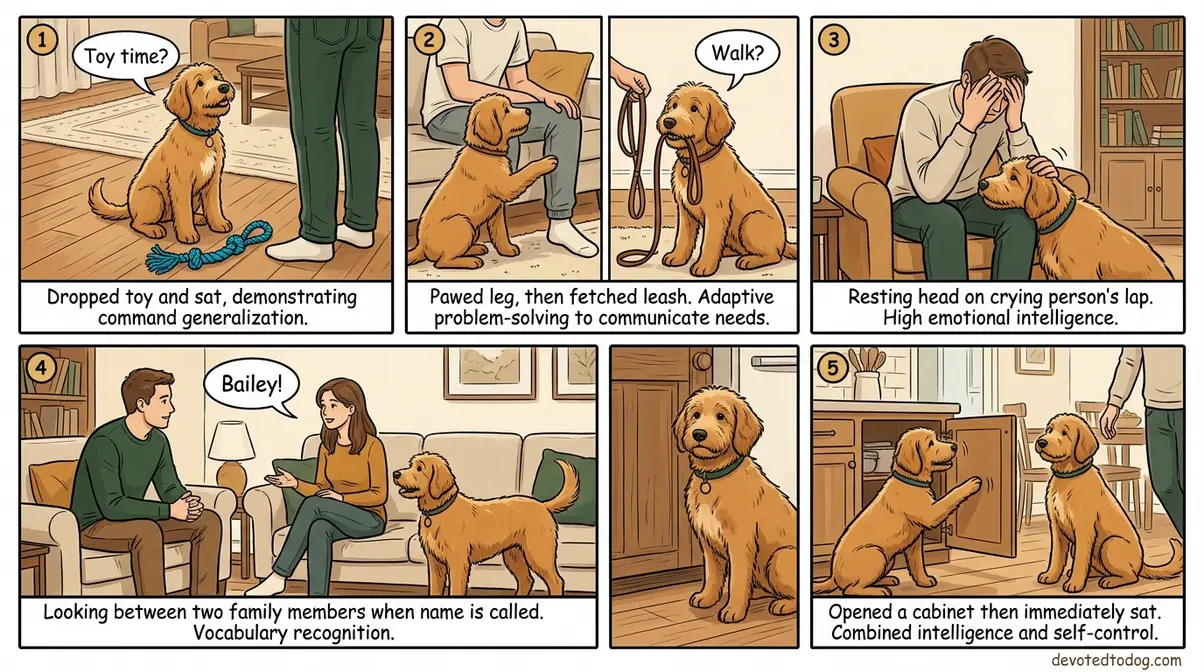
Are Goldendoodles dumb? Not even close. That goofy spin before sitting? That’s not stupidity — it’s excitement. The brain is working; the body just hasn’t caught up yet. Here are five specific, recognizable moments that demonstrate what Goldendoodle intelligence actually looks like in daily life.
- Learns “leave it” and “drop it” in the same training session, then uses “leave it” to signal YOU when another dog approaches. This is command generalization — working intelligence at its most impressive. This quick-learning ability is also why potty training your Goldendoodle is often easier than owners expect.
- Figures out that barking doesn’t get attention, so switches to pawing your leg — then escalates to bringing you their leash. This is adaptive intelligence: a problem-solving progression that shows genuine cause-and-effect reasoning.
- Notices you’re crying before you make a sound — comes to rest their head on your lap without being called. This demonstrates emotional intelligence, the ability to read subtle human cues and respond appropriately without prompting.
- Learns all 12 family members’ names and fetches specific people by name when asked. Research by Dr. Coren found the average dog understands around 165 words — this vocabulary acquisition example sits comfortably within that range (APA, 2009).
- Opens the treat cabinet (adaptive problem-solving), then immediately sits and stares at you (working obedience) — combining both types simultaneously. This is the “little Einstein” moment every Goldendoodle owner recognizes.
“The Goldendoodles are not just smart. They are intuitive, sensitive, knowing and aware. They are like little kids who are always thinking one…”
— Goldendoodle owner, r/Goldendoodles community
Owner consensus across Goldendoodle communities consistently mirrors this sentiment. These aren’t isolated anecdotes — they’re patterns that emerge across thousands of owner reports. The emotional attunement, the problem-solving creativity, the eagerness to please: these are breed-level traits, not individual flukes.
So the short answer is yes — Goldendoodles are smart. But does that intelligence hold up across different sizes and generations? Let’s look at mini and F1B Goldendoodles specifically.
Are Mini and F1B Goldendoodles Just as Smart?
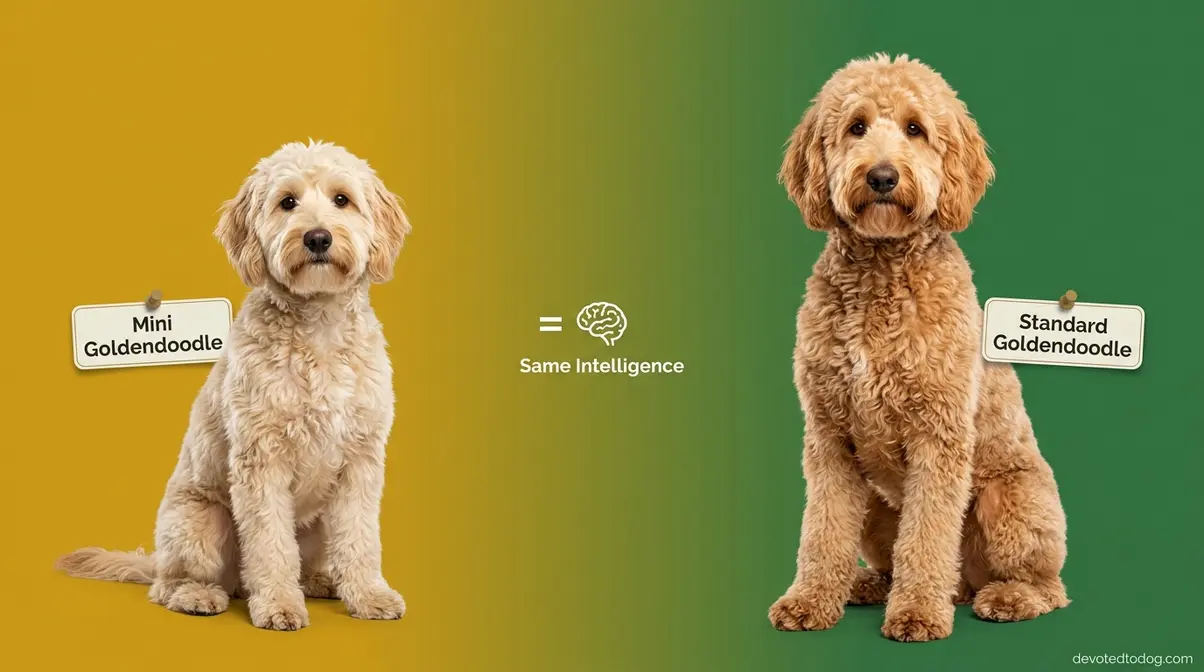
Mini Goldendoodles demonstrate equivalent cognitive abilities to standard Goldendoodles — intelligence is determined by genetics, not by size. The Intelligence Matrix applies equally across all Goldendoodle types. What changes between mini, standard, F1, and F1B is coat type, energy level, and allergy-friendliness — not raw cognitive ability.
Does Size Affect Intelligence?
Are mini Goldendoodles smart? Yes — and at the same level as their standard-sized counterparts. Both inherit the same cognitive traits from the same parent breeds. The Mini Goldendoodle, a smaller version typically bred with a Miniature Poodle rather than a Standard Poodle, carries the same Poodle intelligence lineage in a compact package.
One nuance worth noting: some breeders and sources (including the intelligence of mini Goldendoodles discussion at devotedtodog.com) suggest minis may show slightly quicker thinking due to a higher proportion of Miniature Poodle genetics in some breeding lines. This is a minor tendency, not a meaningful intelligence gap.
| Trait | Standard Goldendoodle | Mini Goldendoodle |
|---|---|---|
| Intelligence Level | High | High |
| Primary Parent Breeds | Standard Poodle + Golden Retriever | Miniature Poodle + Golden Retriever |
| Trainability | Excellent | Excellent |
| Learning Speed | Fast | Fast to Very Fast |
| Best For | Families with space | Apartments, smaller homes |
Size doesn’t change the intelligence equation. But what about generation — does being an F1B (75% Poodle) make a Goldendoodle smarter than an F1?
How Generation Affects Training
Before diving in, here’s a quick translation guide for generation terminology — because these terms get thrown around constantly but rarely explained:
- F1 = first generation (50% Golden Retriever, 50% Poodle)
- F1B = first generation backcross (25% Golden Retriever, 75% Poodle)
- F2 = second generation (two F1 Goldendoodles bred together)
Are F1B Goldendoodles smart? Yes — and the higher Poodle genetics in an F1B Goldendoodle’s traits and trainability may produce slightly higher working intelligence scores on average. However, this is a tendency, not a guarantee. Individual variation within a single litter can be larger than any generation-level difference.
The practical takeaway for beginners: generation affects coat type and allergy-friendliness far more than it affects how quickly your dog learns. Don’t choose a generation based on intelligence alone — choose based on your household’s needs.
Whether you have a mini, standard, F1, or F1B — the intelligence is there. The more interesting question is how that intelligence shows up in your daily life, especially their remarkable emotional awareness.
Intelligence and Family Life

When people ask, are goldendoodles smart, they often overlook emotional intelligence. Goldendoodles are good dogs for families precisely because of how their intelligence expresses itself — not just in learning tricks, but in reading the room. Their emotional attunement, cooperative nature, and deep bonding capacity make them exceptional companions in ways that raw obedience rankings don’t fully capture.
Emotional Intelligence Explained

The emotional intelligence dimension of The Goldendoodle Intelligence Matrix is where Goldendoodles truly shine above many other breeds. Emotional intelligence in dogs means the ability to recognize, interpret, and respond to human emotional states — and Goldendoodles are remarkably good at it.
Here’s the distinction that matters: a dog can know 200 commands (working intelligence) and still not notice you’re upset. Goldendoodles do both. They learn the commands AND they sense the mood. Owner consensus across Goldendoodle communities confirms this pattern consistently — dogs sitting closer during stressful moments, offering comfort without prompting, and tracking subtle changes in body language before any verbal signal is given.
Goldendoodles score exceptionally high in emotional intelligence — they regularly sense their owner’s emotional state before any verbal cues are given, a trait observed consistently across Goldendoodle owner communities.
The most advanced expression of this is what researchers call “intelligent disobedience” — the highest level of canine emotional intelligence, where a service dog intentionally ignores a command if following it would harm their handler. According to the concept of intelligent disobedience in service dogs, service dog training emphasizes this high-level cognitive trait where a dog intentionally ignores a command if following it would put their handler in danger (University of Arizona, 2024). Goldendoodles are used as service dogs specifically because of this capacity.
“The Goldendoodles are not just smart. They are intuitive, sensitive, knowing and aware. They are like little kids who are always thinking one…”
This emotional intelligence is also part of why Goldendoodles are so friendly and sought-after as family companions. For a complete picture of Goldendoodle temperament and behaviors, including their energy levels and separation anxiety tendencies, our dedicated guide covers the full picture.
That emotional depth is beautiful — but it also raises a practical question: if Goldendoodles are this emotionally tuned-in, are they protective enough to be guard dogs?
Guard Dog and Hunting Potential
Are Goldendoodles good guard dogs? The honest answer is no — and it’s worth understanding why before you’re surprised. Their friendly, trusting nature — the exact same trait that makes them extraordinary family pets — means they are far more likely to greet an intruder with tail-wagging enthusiasm than with protective alarm. They may bark to alert you, but they lack the territorial protective instincts that define effective guard breeds.
Are Goldendoodles good hunting dogs? The answer here is more nuanced. Their Golden Retriever heritage gives them genuine retrieval instincts — they can learn to fetch downed birds and assist in hunting environments. However, they are not purpose-bred for hunting. They lack the single-minded drive and physical endurance of dedicated hunting breeds like Labrador Retrievers or Vizslas. Expect enthusiastic assistance, not field-trial performance.
What they ARE exceptional at: therapy dogs, service dogs, emotional support animals, and family companions. Their intelligence is best channeled into cooperative, human-centered roles where emotional attunement is the primary asset — not protection or pursuit.
Now that we’ve covered their roles, let’s answer one of the most common questions Goldendoodle owners ask: do they bond with the whole family, or pick a favorite person?
Attachment to One Person
Yes — Goldendoodles commonly form a particularly strong bond with one primary caregiver. This is typically whoever leads their feeding, training, and daily routines. It’s a pattern consistent across social, people-oriented breeds and reflects their high emotional intelligence in action.
The nuance matters, though: this isn’t exclusivity. Goldendoodles are naturally affectionate and social with the entire household. The “attached to one person” experience is a degree of preference, not rejection of everyone else. Other family members are loved — just perhaps a little less obsessively.
Practically speaking, the primary attachment figure can be shaped deliberately. Whoever takes the lead on training and daily care tends to earn that top-bond status. This is a trainable outcome, not a fixed personality trait. Size also plays a role in family fit — see our guide on Goldendoodle size and family suitability for more on matching the right size to your household.
Understanding how Goldendoodles bond helps you appreciate their intelligence. But how does that intelligence stack up against other smart breeds? Let’s put the numbers side by side.
Comparing to Other Smart Breeds

When we apply The Goldendoodle Intelligence Matrix lens to breed comparisons, Goldendoodles outperform many purebreds in emotional intelligence even where working intelligence scores are comparable. According to AKC intelligence rankings based on Dr. Coren’s research, the Poodle ranks #2 and the Golden Retriever ranks #4 — placing Goldendoodles in the top tier of canine intelligence by inheritance (AKC).
Before the comparisons, a quick methodology note: Coren’s rankings are based on how quickly breeds learn new commands and how reliably they obey on the first try — surveyed across hundreds of expert obedience judges. It’s the most widely referenced framework in canine intelligence research.
Vs. Golden Retrievers
Are Golden Retrievers smart? Absolutely — the Golden Retriever ranks #4 in working intelligence according to AKC’s ranking of the smartest dog breeds, based on Dr. Coren’s research (AKC). But comparing a Goldendoodle to a Golden Retriever directly is tricky: Coren only ranks purebreds, so Goldendoodles don’t have an official position.
In practical real-world training, Goldendoodles often match or exceed Golden Retrievers in responsiveness — the Poodle influence adds an extra layer of working intelligence. Golden Retrievers hold a slight edge in instinctive intelligence (they were purpose-bred for retrieving game with precision). Goldendoodles typically show stronger adaptive intelligence — the problem-solving creativity that makes them seem almost clever in a human sense.
| Trait | Goldendoodle | Golden Retriever |
|---|---|---|
| Working Intelligence Rank | Hybrid (inherits #2 + #4) | #4 (Coren) |
| Trainability | Excellent | Excellent |
| Emotional Intelligence | Very High | High |
| Adaptive Intelligence | Very High | High |
| Instinctive Intelligence | Moderate (retrieval) | High (retrieval) |
For a complete comparison of temperament, size, and care needs, see our guide on Goldendoodle intelligence compared to Golden Retrievers. You can also explore how smart are Golden Retrievers as a standalone deep-dive into the parent breed.
Golden Retrievers are a close match. But what about Aussiedoodles — the other popular “smart doodle” that Goldendoodle owners often compare?
Vs. Aussiedoodles
Are Aussiedoodles smart? Yes — and they represent a genuinely different intelligence profile. The Aussiedoodle, a hybrid of Australian Shepherd and Poodle, inherits from the Australian Shepherd, ranked #66 in working intelligence by Coren but considered exceptionally high in adaptive and herding intelligence, combined with the Poodle’s #2 ranking. Different combination, different result.
Aussiedoodles tend toward higher energy and stronger herding instincts. Goldendoodles lean toward emotional attunement and cooperative learning. Which is “smarter” depends entirely on what you mean by the word.
In agility, problem-solving challenges, and outdoor tasks, Aussiedoodles may have an edge. In family training environments — where reading emotions, following cooperative cues, and bonding with multiple family members matters most — Goldendoodles typically perform better. They’re less driven by herding instincts and more focused on human connection.
Practical advice: choose an Aussiedoodle if you want a dog that’s brilliant at agility and outdoor challenges. Choose a Goldendoodle if you want a dog that’s brilliant at reading your family’s emotional needs.
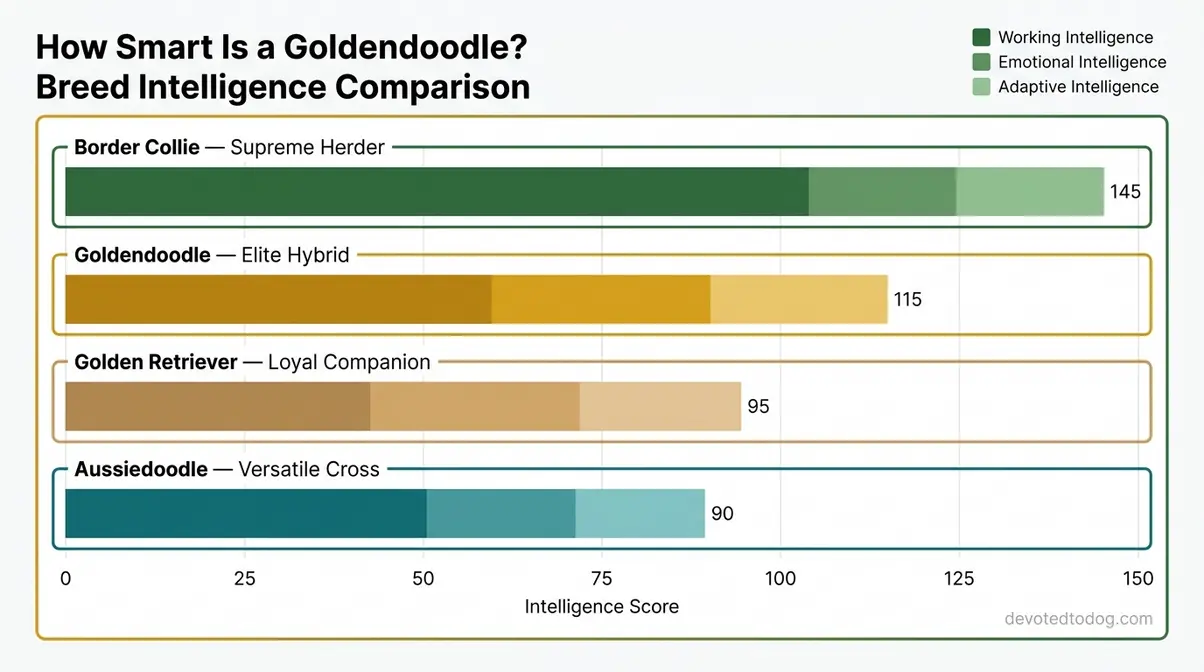
So where does all this leave Goldendoodles in the grand hierarchy of canine intelligence? Let’s answer the question directly.
What Is the #1 Smartest Dog Breed?
The Border Collie, consistently ranked the #1 smartest dog breed in canine intelligence research, holds the top position. According to Dr. Stanley Coren’s rankings — cited by the AKC — Border Collies learn new commands in fewer than 5 repetitions and obey on the first command 95%+ of the time. No other breed matches this combination of learning speed and reliability.
The Poodle ranks #2 and the Golden Retriever ranks #4 — both parent breeds of the Goldendoodle. For context, Coren’s research also found that the average dog understands around 165 words and operates at roughly the cognitive level of a 2- to 2.5-year-old human child in vocabulary and basic problem-solving (APA, 2009). Top breeds like Border Collies and Poodles exceed this significantly.
While Goldendoodles aren’t officially ranked as a hybrid breed, their parentage places them in elite company. In practical training environments, they perform at or above the level of most recognized breeds.
Knowing where Goldendoodles rank is useful. But there’s a side of their intelligence that most articles completely ignore — and it’s the side that can make or break your experience as an owner.
The Dark Side of Goldendoodle Intelligence

If you find yourself asking, are goldendoodles smart when they chew your shoes, remember that boredom is often the culprit. High intelligence is wonderful — until your Goldendoodle decides to redecorate your living room because they had nothing to do for four hours. This section covers the ownership realities that most breed guides skip entirely: boredom, stubbornness, and the real cost of keeping a smart dog engaged and happy.
Without adequate mental stimulation, highly intelligent dogs like Goldendoodles can develop destructive behaviors within hours of boredom onset — chewing, digging, and excessive barking are common symptoms.
Bored or Just Stubborn?
Highly intelligent dogs need mental stimulation the way athletes need physical exercise. A Goldendoodle left alone with nothing to do is like a gifted student with no homework: they’ll find their own projects, and you probably won’t like what they come up with.
The key diagnostic question is whether your dog is bored (an intelligence problem) or stubborn (a training problem). These look similar but have completely different solutions.
| Sign | Likely Cause | What to Do |
|---|---|---|
| Chewing furniture or shoes | Boredom | Add puzzle toys; 20-min training sessions |
| Selective hearing on commands they know | Stubbornness / needs refresher | Return to basics with reward-based training |
| Following you room to room, whining | Separation anxiety | Gradual alone-time desensitization training |
| Barking at nothing | Under-stimulated | More off-leash time; scent games |
| Escaping the yard | Boredom + problem-solving | Enrichment activities + secure fencing |
The “goofy” or apparently “dumb” behavior owners sometimes worry about is often the opposite: a Goldendoodle so bored they’re entertaining themselves with whatever’s available. Research on predictors of dog training success from the University of Nebraska-Lincoln shows that owner consistency and engagement are primary predictors of training success in dogs (UNL, 2019). In other words: the dog’s intelligence isn’t the variable — your engagement with it is.
Now that you can diagnose the problem, here’s the solution — a five-step mental stimulation routine that works for any Goldendoodle, any age.
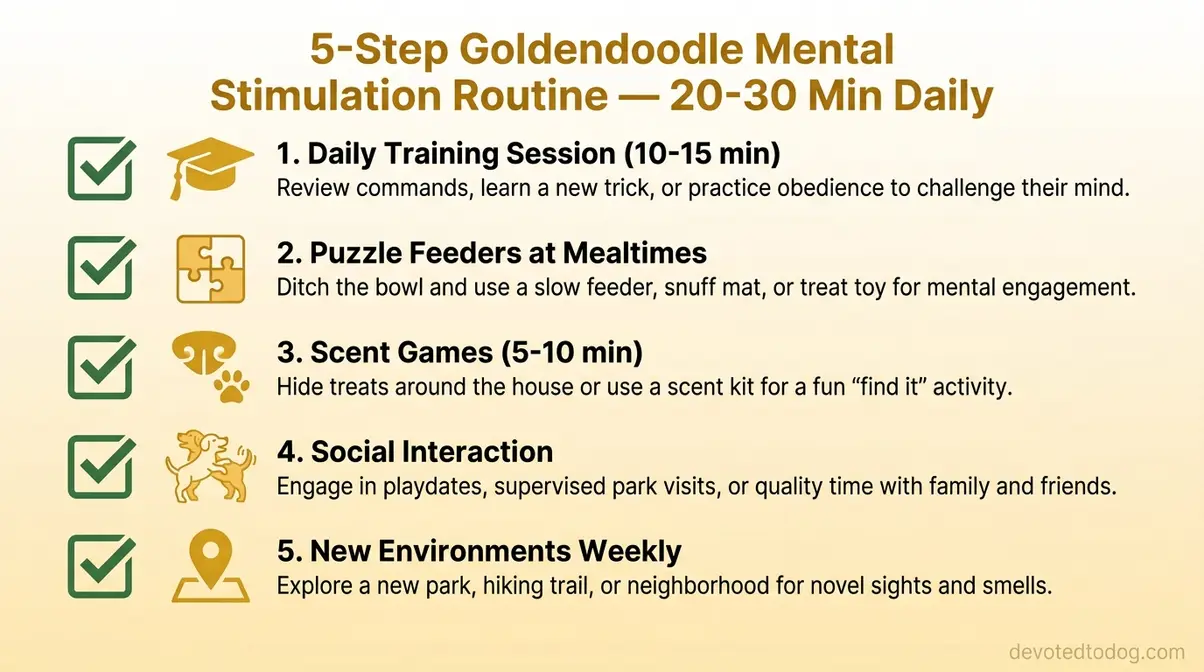
5-Step Mental Stimulation Guide
Think of mental stimulation as exercise for your dog’s brain. Aim for at least 20-30 minutes of dedicated mental challenge daily, in addition to physical exercise. Mini Goldendoodles are also easy to potty train thanks to their intelligence — the same cognitive capacity that drives curiosity makes them quick to understand routines.
Estimated time: 20-30 minutes daily
Tools needed: Training treats, puzzle feeders, leash
Step 1: Daily Training Session (10-15 minutes)
Teach one new command per week using positive reinforcement. Rotate through “place,” “leave it,” “find it,” and “roll over.” Goldendoodles thrive on learning new things — repetition without novelty leads to disengagement.
Step 2: Puzzle Feeders at Mealtimes
Replace one regular bowl meal per day with a puzzle feeder or Kong toy. This turns eating — something that happens anyway — into a cognitive activity.
Step 3: Scent Games (5-10 minutes)
Hide treats around the house and use “find it” to send your dog hunting. Scent work is mentally exhausting in the best way — 10 minutes of nose work can be the equivalent of 30 minutes of physical exercise for your dog’s brain.
Step 4: Social Interaction
Regular playdates with other dogs or supervised park visits keep social intelligence sharp. Goldendoodles learn from other dogs, not just from humans — peer learning is a genuine cognitive stimulus.
Step 5: New Environments Weekly
A different walking route, a new park, a pet-friendly store visit. Novel sensory input is powerful mental stimulation. The unfamiliar keeps the brain actively processing rather than running on autopilot.
You’re ready to handle the intelligence. But before you commit, there’s one more practical question most owners have: what does owning a Goldendoodle actually cost?
The Real Cost of Ownership
Are Goldendoodles expensive? Yes — and understanding why helps you plan realistically. The best way to avoid hidden costs is finding a reputable Goldendoodle breeder from the start, because poorly bred dogs often carry higher veterinary costs down the road.
Purchase price from reputable breeders typically ranges from $1,900 to $5,000+, depending on generation, size, and location (A-Z Animals; Love of Puppies). Mini Goldendoodles often cost more than standard Goldendoodles due to the additional complexity of miniature breeding. Why are Goldendoodles so expensive? Ethical breeders invest in health testing, genetic screening, and multi-year health guarantees — that overhead is reflected in the price.
Grooming is the biggest ongoing hidden expense. Their low-shedding coats require professional grooming every 6-8 weeks, typically costing $75-$150 per session for a full groom including bath, blow-dry, brush-out, and haircut (Much Ado About Doodles). Budget $900-$1,440 annually for grooming alone.
The intelligence dividend is real, though: their trainability means lower long-term professional trainer fees. Basic obedience comes faster than with average breeds, and their eagerness to please makes group classes highly effective. For a full picture of long-term costs and commitment, see our guide on Goldendoodle lifespan and health.
One honest downside to factor in: separation anxiety. Goldendoodles bond deeply, and dogs left alone for long hours regularly can develop anxiety that requires professional management — doggy daycare or dog walkers add $20-$40 per day if needed.
Goldendoodle Intelligence FAQs
Negatives of a Goldendoodle?
Goldendoodles have several notable downsides that prospective owners should weigh honestly. Their high intelligence means they require significant daily mental stimulation, and without it, they develop destructive behaviors like chewing furniture and excessive barking. Additionally, they are prone to separation anxiety and have substantial grooming costs that require professional sessions every 6-8 weeks.
Is Goldendoodle the Smartest Dog?
Goldendoodles are not officially ranked as the smartest dog breed, but they are among the most intelligent crossbreeds available. According to the AKC, they inherit their intelligence from the Poodle (ranked #2) and the Golden Retriever (ranked #4). This combination makes them exceptionally quick learners who pick up new commands faster than most breeds. In practical training environments, Goldendoodles often match the performance of top-ranked purebreds.
Attached to One Person?
Yes, Goldendoodles commonly form a strong primary bond with one person. This is typically whoever leads their feeding and training routines. However, this doesn’t mean they ignore other family members. Goldendoodles are naturally social and affectionate with everyone in the household. The primary attachment is a matter of degree, not exclusivity. This bonding behavior is consistent across Goldendoodle owner communities and reflects their high emotional intelligence.
What Is the #1 Smartest Dog Breed?
The Border Collie is consistently recognized as the #1 smartest dog breed according to canine intelligence research. Dr. Stanley Coren’s rankings, cited by the AKC, place Border Collies first based on their ability to learn new commands in under five repetitions and obey on the first command 95% of the time. While Goldendoodles aren’t officially ranked as a hybrid breed, their parentage (Poodle at #2 and Golden Retriever at #4) places them in elite company.
Why Not Get a Goldendoodle?
Critics of Goldendoodles typically point to high maintenance requirements as the primary reason to reconsider. Their intelligence demands constant mental stimulation, so owners who work long hours often end up with destructive, anxious dogs. Furthermore, their coats require expensive regular grooming that many owners underestimate before purchasing. Ethical concerns also exist around hybrid breeding practices, with some advocates preferring adoption over designer breeds.
What Is the Calmest Doodle Breed?
The Cavapoo (Cavalier King Charles Spaniel + Poodle) is generally considered the calmest doodle breed. Cavapoos inherit the naturally gentle, low-energy temperament of the Cavalier, making them less demanding in terms of exercise and mental stimulation than Goldendoodles or Labradoodles. Goldendoodles, while friendly and highly trainable, are higher-energy dogs that genuinely thrive with active families who can match their engagement needs.
Your Goldendoodle’s Intelligence: What to Do Next
So, are goldendoodles smart? Absolutely. For families and first-time dog owners, Goldendoodles are genuinely smart dogs — inheriting their intelligence from the Poodle (#2) and Golden Retriever (#4) in canine intelligence rankings (AKC). The science behind this isn’t breeder marketing — a 2019 peer-reviewed study in Animals confirmed that Goldendoodle trainability scores fall above the all-breed average. The best owners channel their dog’s intelligence through daily training, mental stimulation, and strong social bonds that honor all three dimensions of their capability.
The Goldendoodle Intelligence Matrix — working intelligence, emotional intelligence, and instinctive intelligence — isn’t just a framework for understanding your dog academically. It’s a practical ownership tool. When you understand that your Goldendoodle’s “selective hearing” is often boredom rather than defiance, and that their emotional attunement is a cognitive skill worth nurturing, you stop fighting their nature and start working with it. So yes, your Goldendoodle is smart — in more ways than you probably realized.
Start with a 10-minute daily training session this week — pick one new command and practice it in five repetitions. You’ll be genuinely surprised how quickly your Goldendoodle picks it up. For your next step, explore our complete guide to finding a reputable Goldendoodle breeder to ensure you’re starting with a well-bred dog whose genetics give that Intelligence Matrix the best possible foundation.