📊 The Numbers That Matter
12-14 hr
adult sleep daily
healthy baseline
healthy baseline
18-20 hr
puppy sleep daily
growth phase
growth phase
~16 hr
senior sleep daily
age 8+
age 8+
REM
dream stage
twitching is normal
twitching is normal
How Long Do Golden Retrievers Sleep?
How Many Hours Do They Sleep?
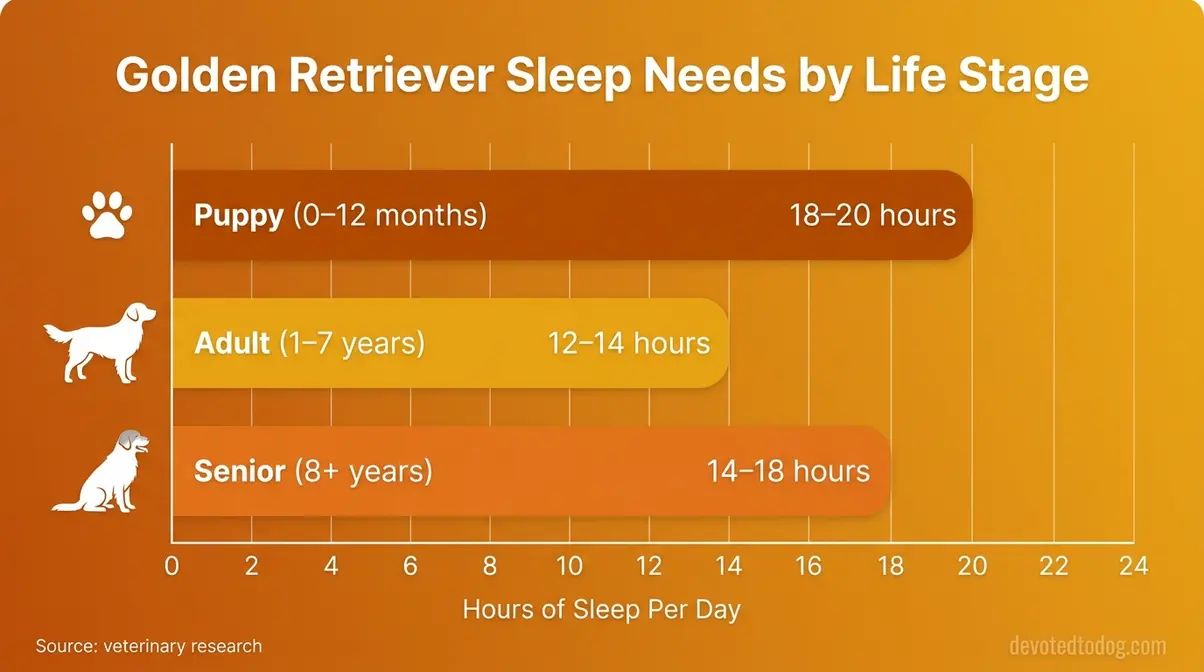
Adult Golden Retrievers sleep 12 to 14 hours per day, their normal, healthy range. According to Golden Meadows Retrievers, this figure holds true across the breed regardless of individual temperament. Understanding golden retriever sleeping time starts with one key concept: polyphasic sleep (sleeping in multiple short bursts rather than one long stretch). Your Golden isn’t sleeping 12 hours straight, they’re napping throughout the day in cycles. Think of it this way: humans sleep 7 to 9 hours in one consolidated block. Dogs evolved differently. A healthy Golden Retriever might sleep 2 hours, wake up for 30 minutes of play, then sleep again, repeating this pattern all day and overnight. That behavior you describe when your dog “naps so hard” between walks? That’s perfectly normal polyphasic behavior, not a cause for concern. For context, here’s a quick breakdown by age:| Life Stage | Age | Daily Sleep Need |
|---|---|---|
| Puppy | 0-12 months | 18-20 hours |
| Adult | 1-7 years | 12-14 hours |
| Senior | 8+ years | 14-18 hours (varies) |
Why Do They Sleep So Much?
Your Golden’s golden retriever sleeping habits are shaped by a biological reality most owners don’t know: dogs sleep more than humans because they spend less time in deep, restorative sleep per cycle. PetMD’s veterinary guide notes that dogs cycle through REM sleep (the deep dreaming stage) more quickly than humans do, which means they need more total sleep hours to achieve the same level of physical and mental recovery. Golden Retrievers are also a working and sporting breed. Their bodies are built for activity, and they recover from physical and mental stimulation during sleep. A long morning at the dog park, a training session, or even an emotionally intense afternoon with the kids at home translates directly into a longer afternoon nap. That’s not exhaustion; that’s healthy recovery. There’s a temperament factor at play, too. Goldens are naturally social and emotionally attuned dogs, among the most people-oriented breeds in existence. Processing the day’s interactions, sights, and learning experiences happens during sleep. A Golden who has been socializing, training, or meeting new people will often sleep more deeply afterward. Understanding Golden Retriever lifespan and overall health helps put this in context, their high-energy nature across a full lifespan makes quality sleep essential, not optional. Notice your Golden sleeping longer after a trip to the dog park? That’s normal recovery sleep, not exhaustion.Sleep Needs: Puppy to Senior
Sleep needs shift significantly across your Golden’s life, and knowing what to expect at each stage helps you spot when something is actually off. Puppies need 18 to 20 hours per day for brain and body development. This sounds extreme, but it’s essential, more on this in the full puppy section below. Adults settle into the stable 12 to 14 hour range from roughly 1 to 7 years of age. Senior Golden Retrievers (age 8 and older) often sleep more again, returning to puppy-like levels. This isn’t automatically a health problem. Polysomnographic research on aging dogs, a sleep study measuring brain waves and breathing patterns, found that senior dogs experience measurable changes in their sleep-wake cycle, which can be linked to cognitive changes as they age (PubMed, 2023 study). This is a content gap nearly every competitor misses entirely. As your Golden approaches the later years of their lifespan, more sleep is often normal. If your 10-year-old Golden is sleeping 16 hours a day, that may simply reflect their age. However, a sudden increase from their established baseline, especially paired with other behavioral changes, is worth mentioning to your vet. Now that you know what’s normal for adult Goldens, let’s zoom in on the life stage that causes the most new-owner anxiety: puppyhood.How Should Golden Retriever Puppies Sleep?

How Much Sleep Does a Puppy Need?
Sleeping golden retriever puppies follow a different pattern than adults, this isn’t polyphasic napping, it’s intense, frequent deep sleep. The normal range for Golden Retriever puppies under 6 months is 18 to 20 hours per day. That might sound alarming to a new owner, but every hour of that sleep is doing critical developmental work. During sleep, puppies release growth hormones, consolidate learning from the day (that “sit” command you practiced? It gets locked in during sleep), and actively build their immune system. Sleep isn’t downtime for a puppy, it’s when the real growth happens. Here’s a data point that directly answers the crate-vs-bed debate many new owners have: research on puppy sleeping habits found that at 16 weeks of age, 49.1% of puppies primarily slept in a kennel or crate, while by 12 months, 31.7% preferred a dog bed, showing that sleep location preferences shift naturally with age (PubMed, 2020 study). No competitor cites this specific finding. A 10-week-old Golden puppy might sleep 2 hours, wake up for 30 minutes of play, then sleep again. This is perfectly normal polyphasic puppy behavior, not a sign of illness. But knowing how much your puppy should sleep is only half the picture. Understanding why they need all that rest makes it much easier to stop worrying and start enjoying those sleepy moments.Why Do Puppies Sleep So Much?
If you’re concerned about your golden retriever puppy sleeping a lot, here’s the reassurance you need first: this is developmental, not a health problem. The caveat is this, it’s only worth worrying if excessive sleep is paired with other symptoms like no appetite, vomiting, or lethargy even when awake. Brain development explains most of it. The first 12 weeks of a puppy’s life involve more neural development than any other period. Sleep is literally when neural connections form and strengthen. Interrupting sleep too frequently can actually slow learning, which is why letting your puppy nap undisturbed is part of good training, not just kindness. Physical growth adds to the picture. Golden Retrievers grow from roughly 1 pound to 65+ pounds in their first year. That extraordinary rate of growth requires enormous energy, energy that comes from rest. Here’s a simple way to assess your puppy:| Situation | What It Means |
|---|---|
| Sleeps a lot + playful and alert when awake + eating well + gaining weight | Healthy, this is normal |
| Sleeps a lot + lethargic even when awake + not eating or losing weight | Worth a vet check |
Creating a Safe Sleeping Space
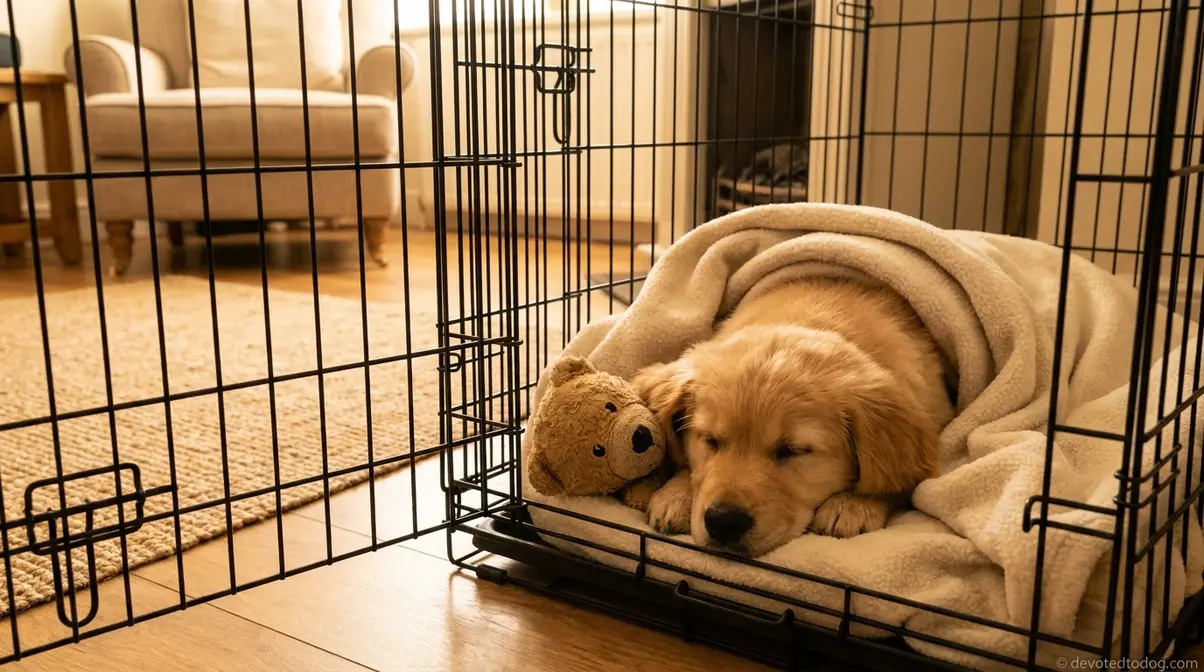
Your puppy’s golden retriever puppy sleeping habits in the early weeks are heavily shaped by their environment. A well-designed sleep space reduces nighttime anxiety, supports better rest, and makes the whole first-weeks experience easier for both of you. Here’s a step-by-step checklist:- Choose the right sleep location. A crate, puppy pen, or dog bed in a quiet area of the house all work. A crate is not a punishment, it’s a safe den that mimics the enclosed spaces dogs instinctively seek.
- Add a soft, washable blanket. Golden Retriever puppies can overheat, avoid heavy fleece in warm weather. A thin, soft blanket is ideal.
- Include a comfort item. A toy with your scent, or a heartbeat toy for the first nights, can significantly reduce whining. The familiar scent signals safety.
- Maintain the right room temperature. Keep the sleep area at 68-72°F (20-22°C), comfortable for a double-coated breed even at puppy age.
- Position the crate where the puppy can hear or see you. Proximity reduces anxiety without requiring you to be in the same room. Even across the hall is often enough.
Sleeping Through the Night
Whining at night is normal for the first one to two weeks. Your puppy has never been alone before, this is a genuinely new and disorienting experience for them. Brief, calm reassurance is fine. However, avoid bringing them into your bed as a response to whining, since it sets a precedent that’s hard to undo. A consistent pre-bedtime routine makes a significant difference. Follow these steps each night:- A short walk or play session to tire them out physically
- A final potty break immediately before bed
- Straight to the crate with a small treat and a calm “settle” cue
- Lights dim, noise reduced, consistency signals “sleep time”
What Do Golden Retriever Sleeping Positions Mean?
Every golden retriever sleeping position your dog chooses is a message, about how safe they feel, how warm they are, and how much they trust you. This is what I call The Golden Sleep Decoder: a framework for reading your Golden Retriever’s sleep positions and behaviors as direct messages about their emotional state, comfort level, and health. Here are the 7 most common Golden Retriever sleeping positions and exactly what each one means.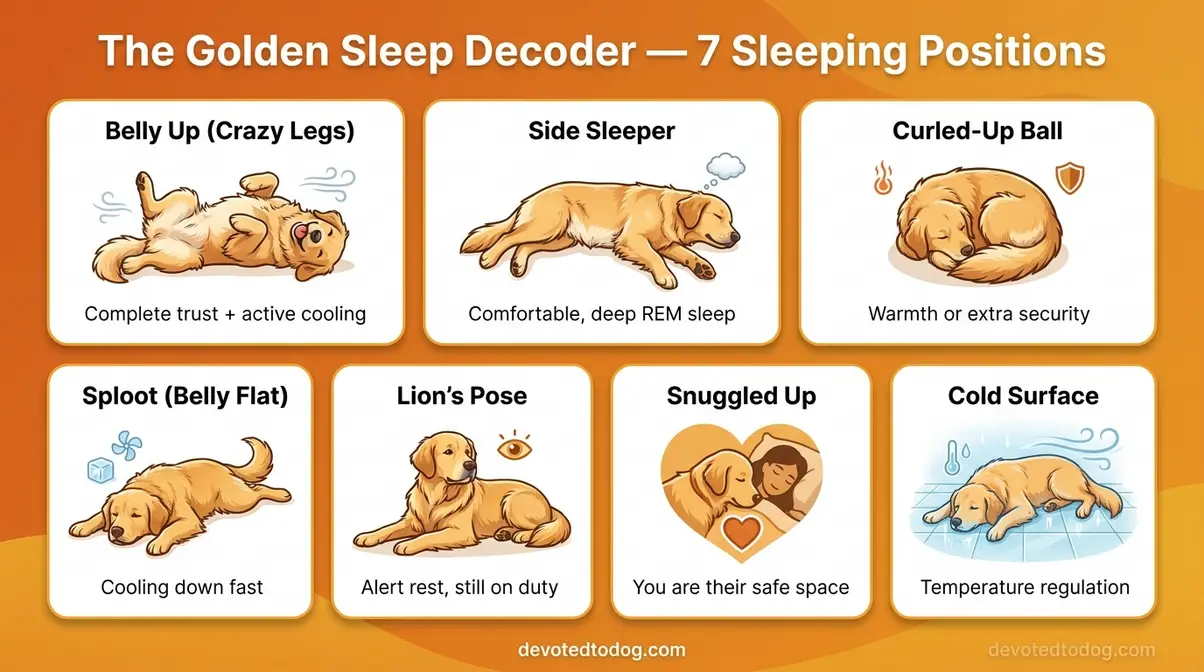
1. The Belly Up (Crazy Legs)
Golden retriever sleeping on back, all four legs in the air, belly fully exposed, is one of the most endearing and informative positions in the Golden Sleep Decoder. The emotional meaning is clear: this is complete trust and total relaxation. Exposing the belly is the most vulnerable position a dog can sleep in, leaving vital organs unprotected. Dogs only sleep this way when they feel 100% safe in their environment. If your Golden does this regularly, they’re giving you a daily trust report, and the grade is excellent. There’s also a breed-specific physical reason Goldens love this position. Golden Retrievers’ double coat (a layer of dense undercoat beneath their silky outer fur) traps heat efficiently, which is great in winter, but means they run warm. Exposing the belly, which has significantly thinner fur, is an active cooling strategy. Texas A&M veterinary research notes that leg movements, twitching, and vocalizations during sleep are strong indicators of active dreaming in dogs, and the belly-up position is often where the deepest REM sleep occurs. Goldens are among the breeds most likely to sleep in this position, precisely because of their trusting temperament and their double-coat thermoregulation needs. If the Crazy Legs position is your Golden’s signature move, they’re basically giving you a daily trust report. Next up: the most common position of all.2. The Side Sleeper
The side sleeper, lying on their side, legs extended, breathing slow and regular, is the most common golden retriever sleeping position for adult dogs. It signals comfort and ease, though it’s not quite as vulnerable as belly-up. In this position, your Golden is relaxed enough to extend their legs fully, which requires confidence in their surroundings. They’re not braced for movement or alert to potential threats. This is also the position where the deepest REM sleep most often occurs, you may notice twitching, paddling paws, or soft whimpers here, all of which are completely normal dreaming behaviors. If your Golden is a dedicated side sleeper, consider it a sign that they feel genuinely at home. It’s the “default comfortable” of dog sleep positions. Side sleeping is the “default comfortable” position. But when your Golden curls up tight like a croissant, that means something different.3. The Curled-Up Ball
When your Golden curls into a tight ball, nose tucked near their tail, paws pulled in, they’re drawing on an ancient instinct. In the wild, curling up conserves body heat and protects vital organs. In your living room, it usually means one of two things: they feel slightly cold, or they want a little extra security. This position is particularly common in new environments or when something has changed in the household, a new person, a new schedule, or even rearranged furniture. Even the friendliest Golden needs alone time occasionally, and the curled-up ball is their polite way of asking for it. Don’t read anxiety into this position unless it’s accompanied by other stress signals (panting, pacing, trembling). Most of the time, it simply means your Golden is cozy and self-contained. The curled-up ball is your Golden asking for a little space. The next position is almost the opposite, and it’s uniquely Golden.4. The Sploot (Belly Flat)
The sploot is a Golden Retriever classic, and one of the most-photographed positions in the breed. Flat on their belly, all four legs splayed out (back legs stretched straight behind them like a frog), your dog is doing something very deliberate: cooling down fast. Pressing their belly against a cool floor rapidly lowers body temperature. This behavior is disproportionately common in thick-coated breeds like Golden Retrievers precisely because they run warm. You’ll see it most often on tile, hardwood, or in summer. It’s also called the “pancake” or “frog dog” position in Golden Retriever communities, and it’s often what owners photograph as golden retriever sleeping funny content. This is healthy thermoregulation, not laziness. If your Golden sploots on the kitchen tile while their plush dog bed sits empty nearby, they’re not rejecting the bed, they’re solving a temperature problem. The sploot is basically your Golden saying “I am too warm and I refuse to move.” Next: the position that looks like a tiny lion.5. The Lion’s Pose
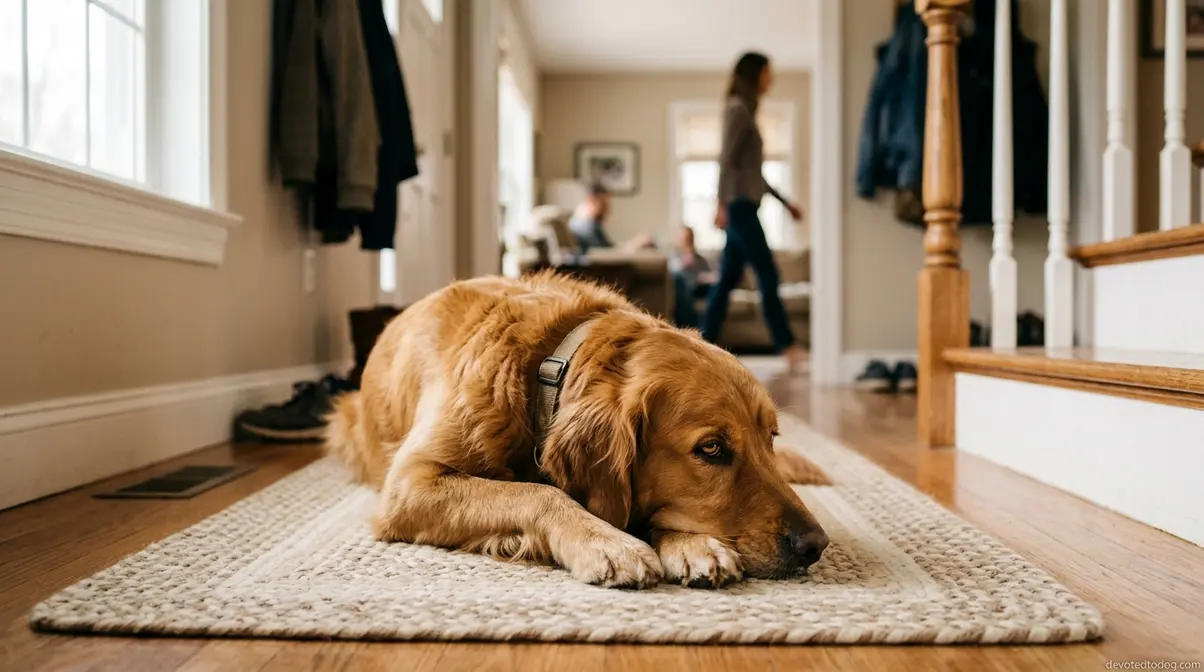
6. Snuggled Up or Back-to-Back
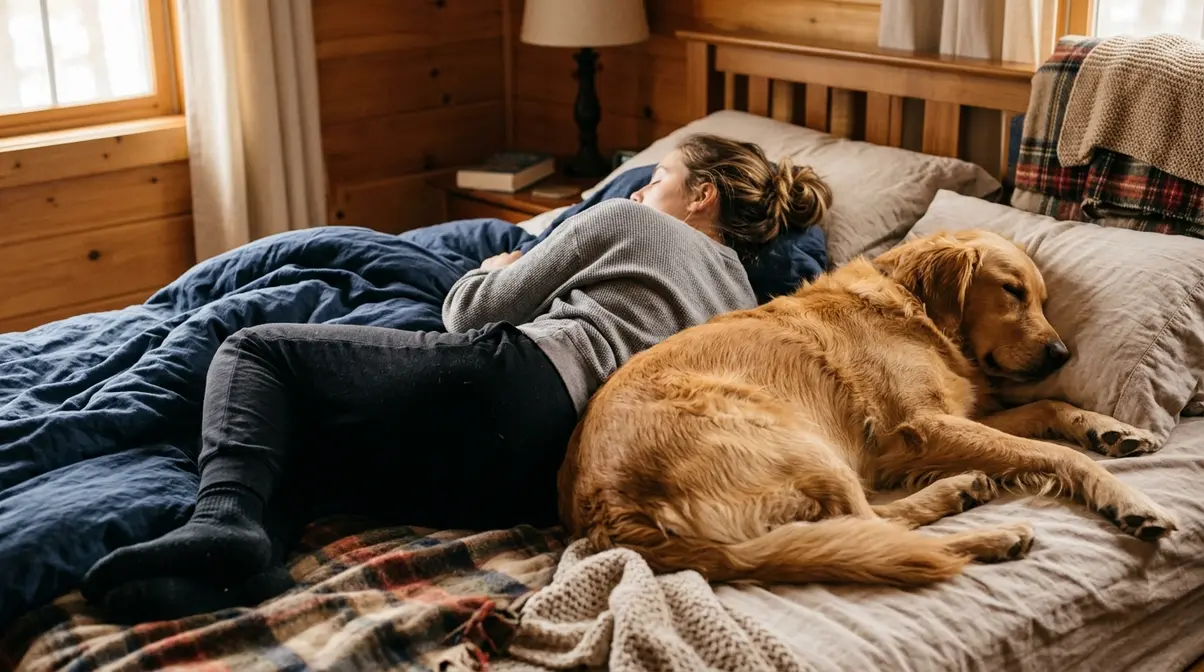
7. On a Cold Surface
Your Golden abandons their perfectly good dog bed and settles on the bathroom tile at 2am. You might worry they’re unhappy with their bed, but they’re actually just flipping to the cool side of the pillow. Golden Retrievers have a dense double coat and run warm. A cool surface is their version of temperature management. You’ll notice this most in summer or in warm rooms, and it’s completely normal thermoregulation behavior. The same instinct that drives the sploot (Position #4) drives the cold-floor preference, just in a different form. This is not a rejection of their bed. Many Goldens use their bed in winter and migrate to the tile in summer. University of Iowa neuroscience research found that twitching during sleep plays a role in neural development and brain activity, and you’ll often see this behavior most clearly when your Golden is fully relaxed on a cool surface, entering deep sleep quickly. Practical fix: a cooling mat placed near or inside their bed gives them a cool option without abandoning comfort entirely. Some owners notice their cute golden retriever sleeping on cool concrete near a patio or garden area in summer, this is the same behavior, just outdoors.Why Do Dogs Sleep on Cold Floors?
You might ask why dogs sleep on cold floors instead of their plush beds. For double-coated breeds like Golden Retrievers, a cold tile or hardwood floor acts as a natural cooling mechanism. Their thick fur traps heat, so pressing their belly against a cold surface helps them regulate their body temperature effectively. Now that you can decode what your Golden is telling you through their sleeping position, let’s tackle the question that keeps more owners up at night than their dog does: should you let your Golden sleep in your bed?Should Your Golden Sleep in Your Bed?
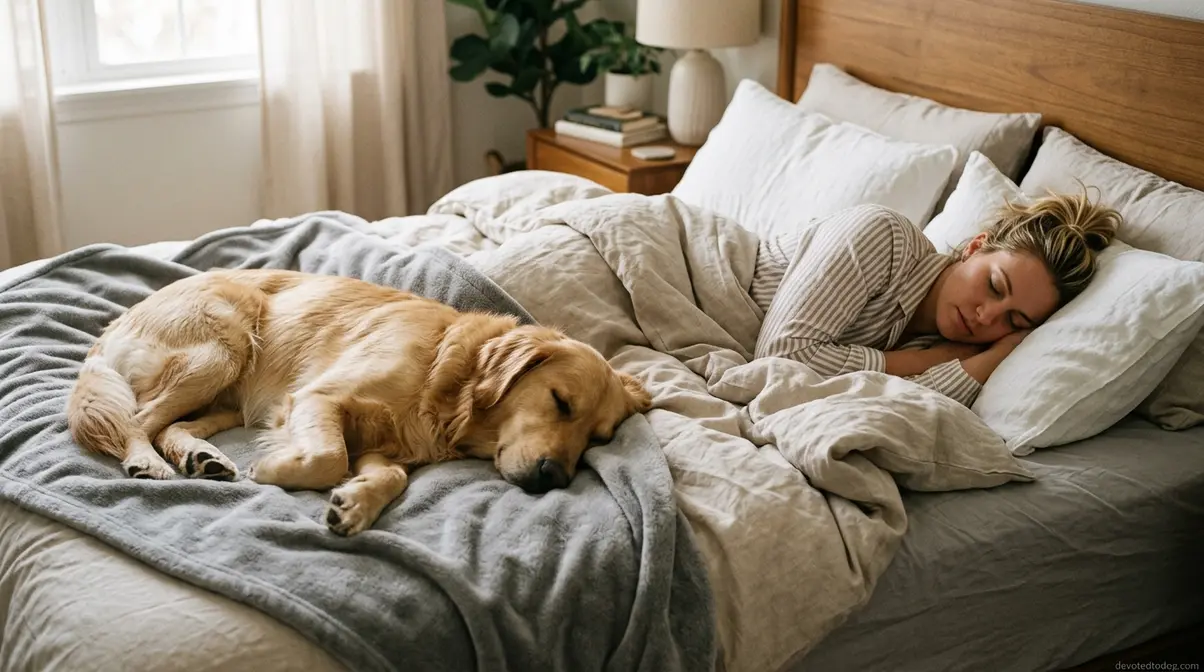
Benefits of Co-Sleeping
Golden retriever sleeping with owner is a topic where community experience tells a clear story. Across the r/goldenretrievers community on Reddit, one of the largest Golden Retriever owner communities online, the most upvoted responses consistently say co-sleeping strengthened their relationship with their dog, especially during the puppy phase. The benefits are real and documented. Physical proximity during sleep deepens the human-dog bond, particularly for dogs with separation anxiety tendencies. Sleeping near their owner reduces cortisol (the stress hormone) levels in dogs, which matters most during the adjustment period of a new home. For owners, many report feeling calmer and sleeping better with their dog nearby. The rhythmic breathing of a relaxed Golden Retriever can be genuinely soothing, and the warmth of a large dog has a comfort effect that’s hard to dismiss. Co-sleeping with your Golden Retriever can strengthen your bond, but it works best when both you and your dog sleep soundly through the night. If you’re waking up repeatedly because a 65-pound dog has claimed two-thirds of the mattress, the benefits start to erode quickly.The Drawbacks to Consider
Honesty matters here. Golden Retrievers are active dreamers, twitching, paddling, occasional sleep-barking. A large dog sharing your space can significantly disrupt your sleep, especially during their REM cycles. If you’re already a light sleeper, this is worth weighing seriously. Hygiene is another practical consideration. Dogs who spend time outdoors, dogs who aren’t bathed regularly, or dogs with skin conditions or allergies may not be ideal consistent bed partners. Dander is a real concern if anyone in your household has pet allergies, even mild ones can worsen with nightly close contact. Some dogs also develop resource guarding around “their” spot on the bed over time. Establishing clear rules from the start (their designated side, not the whole bed) prevents this from becoming a behavioral issue.| Pros | Cons | |
|---|---|---|
| For Your Dog | Reduced anxiety, stronger bond | May develop over-dependence |
| For You | Calming, companionship | Sleep disruption, allergies |
| For Both | Routine and security | Hygiene management needed |
Tips for Successful Co-Sleeping
If you choose to co-sleep, these five steps make it work long-term:- Establish rules from day one. Choose a designated side or spot and be consistent, your Golden will learn their territory quickly.
- Wash bedding weekly. Golden Retrievers shed year-round. Your sheets will thank you.
- Keep a dog bed on the floor nearby as an alternative. Some Goldens start on the bed and migrate to the floor mid-night, having the option reduces disruption.
- For puppies: wait until they’re house-trained and past the chewing phase before allowing unsupervised bed access. Golden retriever puppy sleeping in bed is adorable but practically challenging before 4 to 6 months.
- If your Golden shows any growling or resource guarding around the bed, work with a trainer before continuing co-sleeping. This is a behavior to address early, not accommodate.
What Sleep Behaviors Should Concern You?
Most concerning Golden Retriever sleep behaviors, twitching, soft crying, rapid breathing, are completely normal signs of active dreaming. But a small number of behaviors do signal something worth investigating. This section breaks down each one so you know exactly when to watch and wait, and when to call your vet. The Golden Sleep Decoder applies here too: these behaviors are all messages. Most say “I’m having a vivid dream.” A few say “something needs attention.” Knowing the difference is what this section is for.Fast or Heavy Breathing

Twitching or “Glitching” in Sleep
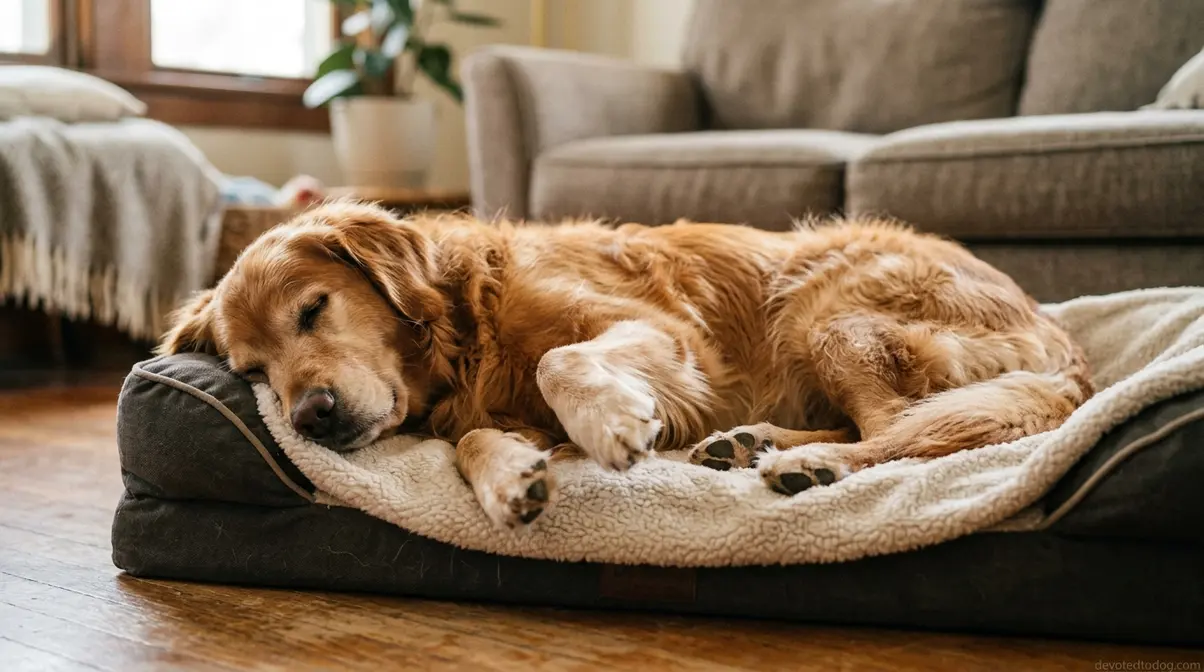
“My dog sleeps like a zombie. Her eyes are open and rolled back lol it’s so creepy!” , Golden Retriever owner, r/goldenretrieversIf you’ve seen this, you know exactly what they mean. And the reassurance is immediate: this is almost always completely normal. Eyes rolling back during sleep is caused by the eye muscles relaxing during REM sleep. The nictitating membrane (the third eyelid, a thin protective membrane dogs have that humans don’t) becomes visible as the eyeball relaxes backward. It looks genuinely alarming. It is harmless. Twitching, leg paddling, soft crying, and “glitching”, those rapid muscle movements that look like your dog is malfunctioning, are all REM dreaming behaviors. Texas A&M veterinary research confirms that dogs frequently exhibit leg movements, facial twitching, and vocalizations during sleep, strong indicators of active dreaming. Your Golden is probably chasing something, playing with another dog, or reliving the morning’s fetch session in vivid detail. One important rule: never wake a twitching dog abruptly. They may startle and snap reflexively, not out of aggression, but out of genuine confusion. If you need to wake them, call their name softly from a distance and let them surface on their own.
Why Do Dogs Twitch in Their Sleep?
Many owners wonder why their dogs twitch in their sleep. This is a completely normal part of the REM (Rapid Eye Movement) sleep cycle. During this phase, your Golden is actively dreaming, which causes involuntary muscle spasms, paw paddling, and sometimes soft vocalizations. It is a sign of healthy, deep rest.Drooling and Panting During Sleep
Golden retriever drooling while sleeping is usually nothing to worry about. Relaxed jaw muscles during deep sleep allow saliva to escape, it’s simple physics. Goldens are not heavy droolers by breed standard, so light sleep drooling is typically harmless. The red flag version is different and serious: excessive drooling that soaks the bed or floor, combined with pawing at the mouth, vomiting, or a visibly distended abdomen could indicate bloat (gastric dilatation-volvulus, or GDV, a condition where the stomach twists and traps gas inside). Bloat is a life-threatening emergency in large breeds like Golden Retrievers and requires immediate veterinary attention. Don’t wait to see if it resolves. Panting during sleep is worth noting separately. A dog who pants excessively during sleep in a cool room may be overheating, in pain, or experiencing anxiety. Occasional panting during a dream is normal. Sustained panting in a comfortable environment warrants a vet check. Know common Golden Retriever health issues to know about, several of them present first as behavioral changes during rest.When to Call the Vet
This is the “when to worry” list. Format it, save it, and check it whenever you’re unsure. These are the behaviors that warrant a veterinary call, not tomorrow, but today or immediately:- Labored breathing that persists beyond a brief dream cycle, chest heaving, visible effort, belly pumping with each breath
- Gum color changes, pale, blue, gray, or white gums are a medical emergency; call your vet immediately, do not wait
- Inability to wake up or extreme difficulty rousing from sleep
- Sudden change in sleep patterns lasting more than 2 to 3 days without an obvious cause (illness, weather change, significant activity change)
- Repeated waking and repositioning, may indicate pain or discomfort that prevents comfortable sleep
- Excessive drooling combined with a distended abdomen, possible bloat emergency (see above)
- Seizure-like movements that do not stop after 1 to 2 minutes, involve the whole body, and are followed by confusion or disorientation when awake
⚠️ Veterinary Disclaimer: This guide provides general information for educational purposes only. If your Golden Retriever shows any of the red flag signs above, consult your veterinarian. When in doubt, call your vet, they would rather hear from you than have you wait.Now that you know what to watch for, let’s make sure your Golden has a sleep environment that supports the best possible rest, and reduces the chances of any of those red flags appearing.
How Do You Create the Perfect Sleep Setup?

Choosing the Right Dog Bed
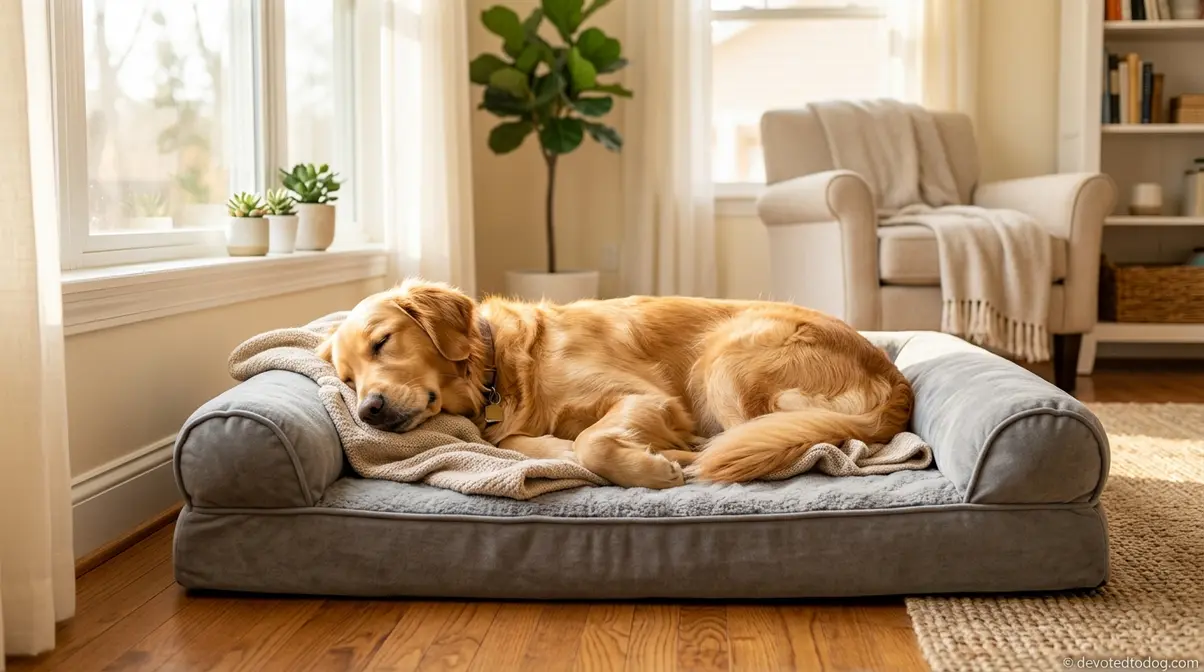
Adult golden retriever sleeping needs a bed that accommodates their size (55 to 75 lbs for most adults), supports their joints, and addresses their double-coat heat retention. Three bed types work particularly well:- Orthopedic foam bed, best for adults and seniors. Supports joints, reduces pressure points, and is especially important for Golden Retrievers over 6 years old, when joint issues can begin to emerge.
- Cooling elevated cot, best for summer and warm climates. Allows airflow underneath the dog rather than trapping heat against the floor. This directly addresses the “sleeping on cold floor” behavior covered in Position #7, give them a cool option that’s also comfortable.
- Bolster or donut bed, best for Goldens who prefer the curled-up ball position. The raised edges provide the security they seek without restricting movement.
Indoor vs. Outdoor Sleeping
Golden retriever sleeping outside is possible in the right conditions, but there are clear safety limits. Golden Retrievers can tolerate cool temperatures thanks to their double coat, but they should not sleep outdoors in temperatures below 45°F (7°C) without proper insulated shelter. Here’s the outdoor sleeping safety checklist:- Temperature above 45°F (7°C). Below this threshold, bring them inside, their double coat helps, but it’s not a substitute for shelter in genuinely cold conditions.
- Secure, enclosed outdoor space. No escape routes, no access points for predators or wildlife.
- Weatherproof shelter. A dog house with insulation, raised off the ground to avoid cold-ground contact.
- Fresh water that won’t freeze overnight. Dehydration risk is real even in cool weather.
- Morning check for distress signs. Shivering, lethargy, cold ears, or reluctance to move warrant immediate attention.
Keeping Your Golden Cool
Golden Retrievers run warm, their double coat is excellent insulation that works against them in heat. These practical steps help:- Place a cooling mat inside or next to their bed, most Goldens will use it instinctively
- Use an elevated cot bed that allows airflow underneath the dog’s body
- Maintain indoor temperature at 68-72°F during sleep hours
- Never cover a Golden Retriever with a thick blanket in warm weather, their coat is already doing that job
- Let them choose cool surfaces. Tile, cool concrete, or the bathroom floor in summer is healthy thermoregulation. Some Goldens seek these out at 2am, this is normal, not a problem
What Are the Funny Golden Retriever Sleep Moments?
Golden Retrievers have elevated sleeping into an art form. They “nap so hard” they end up sideways off the couch. They claim entire beds while their humans cling to the edge. They find the most quirky sleeping spots, laundry baskets, bathroom floors, the middle of the hallway, and commit to them completely. The thing that makes Golden Retriever sleeping moments so shareable is how completely committed they are. No halfway measures. When a Golden decides to sleep, they sleep. And now that you know the Golden Sleep Decoder, every one of those funny moments has a story behind it:- That “glitching” behavior where they twitch and paddle? Pure REM dreaming, your Golden is probably chasing a squirrel through a very good dream.
- The full-body sploot on the kitchen tile? Active thermoregulation, their double coat is doing its job too well.
- The zombie eyes rolled back? Third eyelid relaxation during deep REM sleep, harmless and very creepy-looking.
- The Crazy Legs belly-up sprawl? A trust signal and a cooling strategy combined, your Golden is comfortable, safe, and slightly too warm.
When Does Your Golden’s Sleep Need Attention?
This guide has covered a lot of reassuring territory, and most of what you’ll observe in your Golden’s sleep is genuinely normal. But balanced perspective matters. Here’s a clear summary of when to seek professional help, and a reminder of what looks alarming but isn’t.Signs That Warrant a Vet Visit
These five scenarios should prompt a call to your veterinarian, not panic, but a conversation:- Breathing changes that persist when awake (not just during sleep), this moves it from “possible dream behavior” to “something worth investigating”
- Sleep pattern changes lasting more than 3 to 5 days without a clear explanation, sudden shifts in how much or how deeply your dog sleeps are worth noting
- Any sign of pain when lying down or standing up from sleep, whimpering, stiffness, reluctance to settle are all signals
- Snoring that is new, loud, and worsening, this may indicate weight gain or an emerging airway issue, both of which are manageable when caught early
- Any seizure-like episode, always a vet call, always urgent, regardless of how quickly it resolves
When Normal Behaviors Aren’t Problems
These behaviors look alarming. They’re fine:- Eyes rolling back during sleep, the third eyelid (nictitating membrane) becoming visible during REM. Normal.
- Twitching and paddling, REM dreaming. Normal. Let them finish their dream.
- Sleeping 14+ hours after a very active day, recovery sleep. Normal. You’d do the same.
- Preferring the cold floor over their bed, thermoregulation. Normal. Consider a cooling mat as an upgrade.
⚠️ Disclaimer: This article is for informational purposes only and does not constitute veterinary advice. If you have concerns about your Golden Retriever’s health, sleep patterns, or behavior, consult a licensed veterinarian.
Frequently Asked Questions
How many hours does a Golden Retriever sleep?
Adult Golden Retrievers sleep 12 to 14 hours per day, a completely healthy amount for the breed. This sleep is typically broken into several naps throughout the day rather than one long overnight block, a pattern called polyphasic sleep. Puppies need even more rest, sleeping 18 to 20 hours daily to support their rapid brain and physical development (mygoldenretrieverpuppies.com). Senior Golden Retrievers (age 8+) often return to puppy-like sleep levels. If your dog’s sleep falls within these ranges, they are getting exactly what they need.Do dogs dream like humans?
Yes, dogs dream, and Golden Retrievers are especially active dreamers. Like humans, dogs experience REM (Rapid Eye Movement) sleep, the stage where vivid dreaming occurs. During REM sleep, you may notice your Golden twitching, paddling their paws, making soft whimpers, or even “glitching” with rapid muscle movements. Texas A&M University’s veterinary researchers confirm that these behaviors are strong indicators of active dreaming in dogs. Your Golden is most likely running through a field, chasing squirrels, or reliving the day’s fetch session in full technicolor.Do dogs like having a blanket on them?
It depends on the individual dog and the temperature, and for Golden Retrievers, the answer often surprises people. Many dogs enjoy the security and warmth of a blanket, as it mimics the snug feeling of a den. However, Golden Retrievers have a thick double coat that already provides substantial insulation. In warm or even moderate temperatures, most Goldens will kick off a blanket or move away from it entirely. In cooler conditions (below about 60°F/15°C), a light blanket may be welcome, watch your individual dog’s behavior and let them show you what they prefer (Fetch Pet Insurance, veterinary guidance).Are dogs happy sleeping all day?
For Golden Retrievers, sleeping 12 to 14 hours a day is a sign of health and contentment, not sadness. Dogs are polyphasic sleepers, they naturally distribute sleep across multiple periods throughout the day rather than staying awake for long stretches. A Golden who sleeps a lot but is energetic, engaged, and enthusiastic when awake is thriving. However, if your dog suddenly sleeps significantly more than usual, shows no interest in activities they normally enjoy, or seems lethargic even when awake, that warrants a veterinary check. Healthy sleep and healthy wakefulness go together.How does a dog say “I love you”?
Golden Retrievers have several unmistakable ways of saying “I love you”, and many of them happen around sleep. Sleeping pressed against you, or choosing to sleep in your room rather than alone, is one of the strongest love signals in dog behavior. Soft eye contact with slow blinking, leaning their full body weight against you, and bringing you a toy when you wake up are all documented signs of deep canine affection (American Kennel Club). The back-to-back sleeping position, belly against your back, is a pack bonding behavior signaling complete trust. When your Golden “naps so hard” right next to you, that’s love in action.What is the silent killer in Golden Retrievers?
The “silent killer” most commonly associated with Golden Retrievers is hemangiosarcoma, an aggressive cancer of the blood vessel walls. It is called “silent” because it often develops with no visible symptoms until it reaches an advanced stage, tumors can grow on the spleen, heart, or liver without causing obvious pain. In the Golden Retriever Lifetime Study, 233 of 3,044 enrolled dogs (7.65%) had been diagnosed with hemangiosarcoma as of September 2022 (Hillman et al., Veterinary and Comparative Oncology, 2023). Ask your vet whether check-ups for a Golden over 8 years should include an abdominal ultrasound. If your Golden seems more tired than usual, has a distended abdomen, or experiences sudden collapse, contact your vet immediately.What smell do dogs absolutely hate?
Dogs have a sense of smell 1,000 to 10,000 times more sensitive than humans, making certain everyday scents genuinely overwhelming for them (Royal Canin Foundation). The smells dogs most consistently avoid include citrus (lemon, orange, grapefruit), white vinegar, isopropyl alcohol, strong perfumes, and ammonia. For Golden Retrievers, a citrus spray near furniture you don’t want them sleeping on can discourage that particular quirky sleeping spot. However, never use these scents in a way that causes distress or interferes with their comfort in their designated sleep area. If a scent causes your dog to leave the room or show stress signals, remove it immediately.How do dogs apologize?
Dogs don’t apologize the way humans do, but Golden Retrievers have clear submissive behaviors that function as an apology. Common “apology” signals include: ears pinned back flat against the head, tail tucked low or wagging in a slow, low sweep, avoiding direct eye contact, and a lowered body posture, sometimes combined with licking your hand or face (Psychology Today, canine behavior research). These submissive gestures evolved as conflict-resolution signals within dog packs and are your Golden’s way of communicating “I know I did something you didn’t like.” Some Goldens will also bring you a toy as a peace offering. Responding with calm reassurance helps them understand the situation is resolved.How Do You Decode Your Golden’s Sleep?
Golden retriever sleeping habits are one of the most misunderstood parts of owning this breed. Adult Goldens need 12 to 14 hours of sleep per day, and puppies need up to 20. Most behaviors that look alarming (twitching, open-eyed sleep, rapid breathing during dreams) are completely normal REM sleep activity. The real warning signs are labored breathing that persists when awake, gum color changes, and sudden shifts in sleep patterns lasting more than a few days. Across Golden Retriever owner communities, the consistent experience is that once owners understand the biology, the worry fades almost entirely. That’s the core idea behind The Golden Sleep Decoder: every position, sound, and movement your Golden makes while sleeping is a message. The curled-up ball says “I want security.” The belly-up Crazy Legs says “I trust you completely.” The zombie-eyed glitching says “I’m having a very good dream.” Once you learn the language, the worry fades, and the amusement takes over. The Golden Sleep Decoder turns every 2am floor migration and every twitching dream sequence into something you understand, rather than something that keeps you up worrying. If you’re setting up a sleeping space for a new puppy, start with our full 7-day crate training guide for Golden Retriever puppies, it walks you through the first week step by step, from that first anxious night to sleeping soundly through until morning. If you’re looking to upgrade your adult Golden’s sleep setup, our guide to the best dog beds for Golden Retrievers covers every option for every sleep style, from orthopedic foam to cooling elevated cots.
Reviewed by Alliyah Strange, Certified Dog Trainer & Behaviorist (CPDT-KA)
Alliyah Strange is a CPDT-KA certified dog trainer and behaviorist. She reviews DevotedToDog training and behavior articles for accuracy and alignment with current positive-reinforcement, force-free training standards.
Related gear: see our guide to the best dog beds.