
⚠️ Veterinary Disclaimer: This article is for informational purposes only and does not substitute professional veterinary advice. Always consult a licensed veterinarian for your puppy’s health, vaccination schedule, and dietary needs.
You’re watching TV with a small furry tornado attached to your ankle. Your 8 week old Golden Retriever has been home for approximately 36 hours and you’ve already Googled “is this normal” four times.
“Realistic evening with an 8 week old golden retriever puppy aka attempting to watch tv with a baby shark, to be honest made this for myself because I almost caught puppy fever and then remembered I can’t go back to these nights.”
The exhaustion is real. But here’s what every generic article misses: the first 14 days aren’t random chaos, they’re a predictable pattern you can actually plan for. In this guide, you’ll get the exact hour-by-hour schedule, feeding amounts, potty intervals, and bite-stopping techniques your 8 week old Golden Retriever needs, all in one place. We’ll cover gear, growth, feeding, sleep, biting, socialization, and what’s ahead at 12 weeks and beyond.
Our editorial team, led by Sarah, who brought home her own Golden at 8 weeks and survived the exact chaos you’re facing now, has reviewed veterinary guidelines and community consensus from thousands of Golden Retriever owner discussions to compile what follows. The hour-by-hour schedule below is the same framework Sarah used with her own pup, refined with input from three veterinarians.
enforce nap routine
AKC 2026
after eat/sleep/play
people/places/things
What Do You Need Before Day One?
For owners tracking earlier developmental stages, see our guide on the 3-month-old Golden Retriever.

The smartest thing you can do for your 8 week old Golden Retriever happens before they set foot in your house. Arriving home with the wrong-size crate, no puppy-proofing done, and no plan is the #1 reason the first 48 hours feel like absolute chaos. Here’s what to do first.
An 8 week old Golden Retriever puppy typically weighs 10-15 lbs with a neck circumference of 9-12 inches, measurements that determine your first gear purchases before pickup day (Pawlicy, 2026). Getting the sizing right from the start prevents wasted money and, more importantly, prevents the anxiety and potty problems that come from ill-fitting equipment.
Essential Gear Checklist Before Pickup
Golden Retrievers are one of the most popular dog breeds in the United States, and the gear market reflects that, there’s a lot of it. But for an 8 week old puppy, you need very little, and you need it sized correctly.
Crate: Buy a 36-inch or 42-inch wire crate with a divider panel, a removable insert that shrinks the usable space. Why does this matter? Golden Retrievers grow fast, and buying one large crate now saves you money over the next year. More importantly, a crate that’s too spacious lets the puppy use the back half as a bathroom, which derails potty training from night one. Section the divider so your puppy can stand, turn around, and lie down, nothing more.
Collar: If you are wondering what size collar for 8 week old golden retriever puppies works best, their neck circumference is typically 9-12 inches. Choose a flat, soft nylon breakaway collar adjustable to 9-14 inches (labeled “XS” by most brands). Avoid heavy metal buckles, puppy necks are sensitive and heavy hardware can cause skin irritation.
Harness: Chest girth at 8 weeks averages 14-17 inches. A soft step-in harness in size “XS” typically fits. A harness is safer than a collar alone for on-leash walks before your puppy has learned to heel, it distributes pressure across the chest rather than the throat. For specific fit guidance, see our guide to finding the right harness size for your Golden.
Full checklist before pickup day:
- Wire crate (36″ or 42″) with divider panel
- Soft nylon breakaway collar (XS, adjustable 9-14″)
- Step-in harness (XS, for chest girth 14-17″)
- 6-foot leash (lightweight nylon)
- Stainless steel food and water bowls
- Enzymatic cleaner (for accidents, this breaks down odor at the molecular level; regular cleaners mask the scent but the puppy can still smell it)
- Puppy-proof baby gate (for confining to one room)
- Safe chew toys (rubber, rope, or stuffed, nothing small enough to swallow)
- Puppy food, ideally the same brand the breeder was feeding to avoid digestive upset in the first week
Physical development benchmarks at 8 weeks indicate a puppy is ready to transition to a new home with appropriate gear (Texas A&M veterinary guidelines, Texas A&M VMBS, 2026).
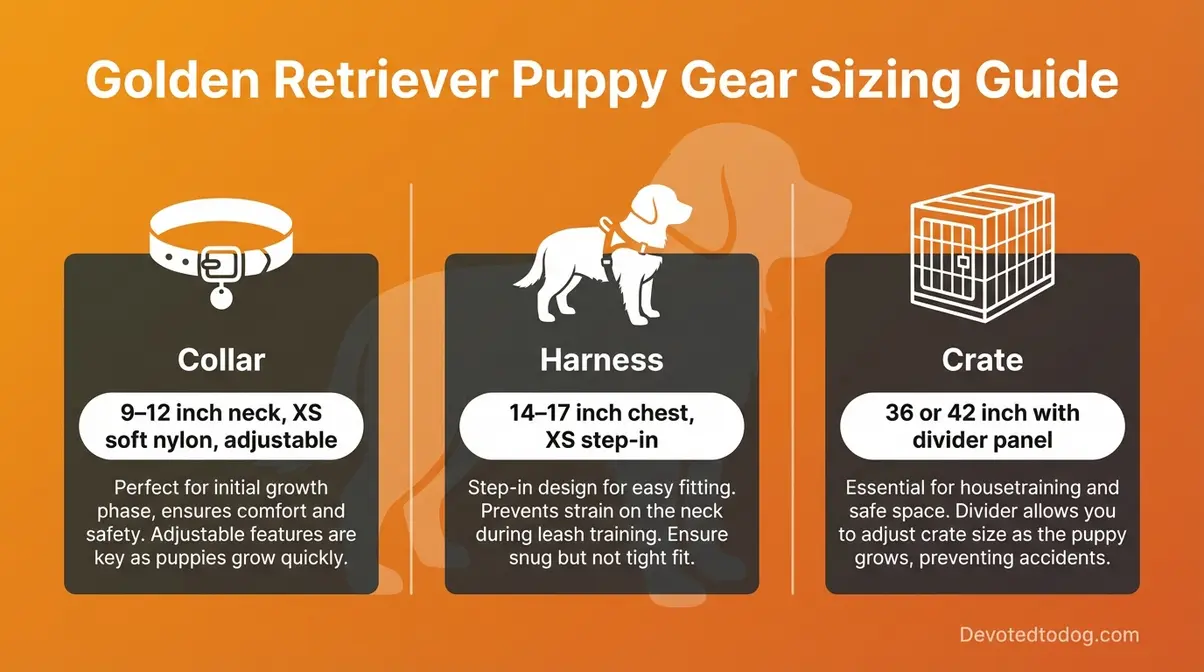
Caption: Exact sizing guide for collars (9-12″ neck), harnesses (14-17″ chest girth), and crates (36-42″) for an 8 week old Golden Retriever.
Once your gear is ready, the next step is making sure your house is ready, because a Golden Retriever puppy treats everything at nose-height as a potential chew toy.
Puppy-Proofing Your Home in an Afternoon
By 8 weeks, puppies have developed sufficient bite inhibition with littermates and are developmentally ready to transition to a new home, but “ready to move” doesn’t mean “ready for free roam” (Cornell University College of Veterinary Medicine, Cornell Vet, 2026). Start with a small, manageable “puppy zone.”
Define the puppy zone first. Use baby gates to confine your new arrival to one or two rooms, typically the kitchen and a connected living area. Why does this matter? Overwhelming a new puppy with a large, unsecured house increases anxiety and makes potty training exponentially harder. A contained zone means every accident is recoverable, every success is reinforced in context.
Start with the kitchen or a similar easy-to-clean room. Block off stairs, remove anything at puppy-mouth height, and tape down loose cables. The goal is a space where your puppy can’t fail, and where you won’t lose your mind cleaning up.
Floor-level hazard scan. Get on your knees and look at every room from puppy height. The five most common hazards to address before bringing your puppy home:
- Electrical cords (serious chewing and electrocution risk)
- Small objects that fit in a puppy’s mouth (coins, hair ties, children’s toys)
- Toxic plants, lilies, philodendrons, pothos, and sago palms are especially dangerous
- Cleaning products stored under sinks (move to a locked or high cabinet)
- Loose baseboards or drywall corners at chew height
For a comprehensive room-by-room sweep, our complete checklist for bringing your new puppy home covers every room in detail.
The car ride home matters. Bring a helper to sit in the back seat holding the puppy, never place an 8-week-old puppy in a crate in the trunk alone for their first ride. Bring a towel with the breeder’s scent; it provides comfort during the transition. Have a clean towel ready for accidents. When you arrive home, take the puppy directly to their designated potty spot before entering the house, this is the first repetition of a habit you’ll reinforce hundreds of times.
Now you know what to buy and how to set up the house. But where do you actually get your puppy? This matters more than most people realize.
Finding a Reputable Breeder vs. a Puppy Mill
When searching for an 8 week old golden retriever for sale, the difference between an ethical breeder and a puppy mill isn’t always obvious, especially online.
Here’s what to look for.
🚩 Red flags, walk away:
- No health testing documentation (OFA hip/elbow, cardiac clearances)
- Puppies available immediately with no waitlist
- Won’t let you visit the facility or meet the mother
- Price significantly below market ($300-$500 range)
- Multiple breeds simultaneously available
- Sells exclusively via Craigslist or social media with no verifiable contact
✅ Green flags, ethical breeder:
- OFA health testing documentation readily shared
- AKC (American Kennel Club) registration on both parents
- Active waitlist, good breeders don’t have puppies sitting unsold
- Welcomes home visits and encourages you to meet the dam
- Sends home with full vaccination records and a puppy pack
- Follows up after the sale and remains a resource for questions
- Price typically $1,500-$3,500 for health-tested lines
For a rescue alternative, many Golden Retriever rescue organizations place puppies and young dogs, worth exploring if you want to provide a home to a puppy in need. For full vetting guidance, see our guide on choosing reputable Golden Retriever breeders.
Once your Golden is home, the first question most new owners have is simple: “Is my puppy the right size?” Let’s answer that.
How Big Is an 8 Week Old Golden Retriever?

A typical 8 week old Golden Retriever weighs between 10 and 15 pounds, roughly the size of a large watermelon. However, genetics play a major role, a perfectly healthy puppy can weigh as little as 4.5 lbs or as much as 22 lbs at this age (Pawlicy, 2026). If your puppy falls outside the typical range, consult your vet rather than panicking.
Typical Weight Range at 8 Weeks
The standard weight range for an 8 week old Golden Retriever is 10-15 lbs, confirmed across veterinary and breed data sources. Males trend slightly heavier (10-14 lbs) versus females (9-13 lbs) at this stage, though both ranges overlap significantly, and individual genetics from field lines vs. show lines explains much of the variance. A field-line (hunting) Golden may be leaner and lighter; a show-line Golden may trend heavier and blockier.
Community reports from Golden Retriever owner forums include healthy puppies as small as 4.2 lbs at 8 weeks, unusual, but not automatically a health concern. If your puppy’s weight is an outlier, your vet is the right first call.
The table below gives you a forward look at what’s coming, so you can track your puppy’s physical development with our growth chart:
| Age | Male Average Weight | Female Average Weight |
|---|---|---|
| 8 weeks | 10-14 lbs | 9-13 lbs |
| 12 weeks | 22-27 lbs | 18-23 lbs |
| 16 weeks | 30-40 lbs | 25-35 lbs |
(Pawlicy growth data, Pawlicy, 2026)
Weight tells only part of the story. Here’s what a healthy puppy looks like at this exact age.
What Does an 8 Week Old Golden Look Like?
At 8 weeks, a Golden Retriever puppy’s coat is soft, fluffy, and medium-length, almost teddy-bear-like. The adult double coat (a dense undercoat beneath a water-resistant outer layer) hasn’t grown in yet. Coat color at this stage is typically light golden to gold; many puppies appear lighter than their adult color will be. Don’t be surprised if the shade deepens significantly over the first year.
Eyes are fully open and typically dark brown. Some puppies may still show the faint blue-gray tint present in very early puppyhood, but this fades quickly. Paws will look disproportionately large for the body, this is completely normal and is actually a useful indicator of adult size potential.
Teething begins at approximately 8 weeks as all 28 puppy teeth are in place. Adult teeth start arriving around 4 months. This timing is the direct biological driver of the “land shark” biting phase, the puppy’s gums itch, their instinct is to mouth everything, and you are the nearest available chew toy. Connect this fact to the biting section later; it reframes frustration as biology.
For a visual reference of what’s normal from now through 6 months, what to expect from an 8-week-old Golden Retriever covers the developmental arc week by week.

Caption: Golden Retriever growth curve from 8 weeks to 6 months, male and female averages plotted against typical range boundaries.
Male vs. Female Size Differences
At 8 weeks, behavioral differences between male and female Golden Retrievers are minimal and not reliably predictable. Temperament at this age is primarily shaped by individual genetics and the breeder’s socialization practices during weeks 3-7, not by sex.
A useful myth to dispel directly: coat color and gender do NOT reliably predict temperament at 8 weeks. A female isn’t automatically calmer than a male from the same litter. Individual variation within a litter is typically greater than any sex-based pattern.
What does differ over time: adult males typically reach 65-75 lbs, while adult females settle at 55-65 lbs. This is useful context for long-term planning, choosing the right adult-size crate, budgeting for food, and anticipating exercise needs. For a deep look at the lighter-coated variation popular in Europe, explore the English Cream Golden Retriever variation.
Size and appearance give you the baseline. What every new owner really wants is a plan for the day, so let’s build one together.
What Is the First 14 Days Framework Daily Schedule?
The First 14 Days Framework turns puppy chaos into a repeating, predictable loop: Eat → Potty → Play → Sleep. Most new owners skip the structure because they’re too tired to implement it, which is exactly why the first two weeks feel impossible. When Sarah brought her Golden home, the first three nights were a blur of 2 AM potty runs and ankle biting, but by day five on this schedule, overnight wake-ups dropped from three to one. A reliable schedule is the single fastest way to reduce accidents, biting incidents, and overnight wake-ups.
Golden Retriever puppies at 8 weeks need a potty break every 1-2 hours during waking hours and every 2-3 hours overnight, consistent intervals prevent accidents and build reliable habits (AKC, 2026).
The Hour-by-Hour Schedule Template
| Time | Activity | Notes |
|---|---|---|
| 7:00 AM | Outside, potty | First thing, no exceptions |
| 7:15 AM | Meal 1, 1/3 cup kibble | In bowl or used as training treats |
| 7:30 AM | Play (15-20 min) | Supervised, on the floor |
| 7:50 AM | Outside, potty | 5-15 min after eating is the window |
| 8:00 AM | Crate nap | 1.5-2 hours; enforce before overtiredness |
| 10:00 AM | Outside, potty | Immediately on waking |
| 10:15 AM | Meal 2, 1/3 cup kibble | |
| 10:30 AM | Play + training (10-15 min) | Name recognition, sit |
| 10:50 AM | Outside, potty | |
| 11:00 AM | Crate nap | 1.5-2 hours |
| 1:00 PM | Outside, potty | |
| 1:15 PM | Meal 3, 1/3 cup kibble | |
| 1:30 PM | Play (15-20 min) | |
| 1:50 PM | Outside, potty | |
| 2:00 PM | Crate nap | 2 hours |
| 4:00 PM | Outside, potty | |
| 4:15 PM | Meal 4, 1/3 cup kibble (optional 4th meal) | Skip if feeding 3x/day |
| 4:30 PM | Play + socialization | Low-stimulation handling |
| 5:00 PM | Crate nap or quiet time | |
| 7:00 PM | Outside, potty | |
| 7:15 PM | Short play or calm training | 5-10 min only, wind down |
| 7:30 PM | Crate nap | |
| 10:00 PM | Outside, final potty of night | Last chance before bed |
| 10:30 PM | Crate for the night | Alarm set for 2-3 hours later |
| 1:00 AM | Overnight potty trip | Carry outside, no play, back to crate |
| 3:30 AM | Second overnight trip (if needed) | Most 8-week pups need 1-2 per night |
Puppies at 8 weeks benefit from consistent potty breaks at timed intervals; voice command reinforcement during the act builds reliable habits (AKC potty training timeline, AKC, 2026).
Enforced naps, the community term for placing your puppy in their crate before they hit the overtired wall, are the single most underused tool in the first 14 days. The “zoomies-into-biting” spiral is a tiredness signal, not a behavior problem. At the first sign of spinning, fixating, or escalating bite pressure, crate them with a stuffed Kong and close the door. They’ll protest for 2-3 minutes and then crash.
The mechanic that makes this schedule work: puppies typically need to go within 5-15 minutes of eating. Meal timing drives potty timing. Once you see this pattern, the schedule stops feeling arbitrary and starts feeling like clockwork.
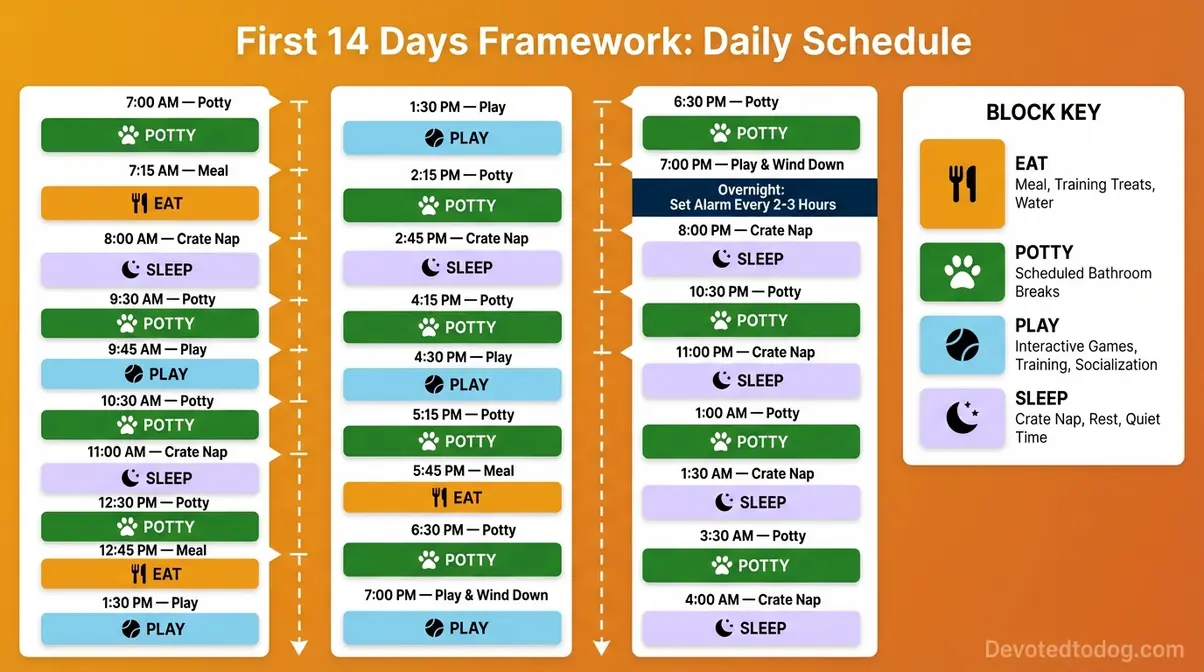
Caption: The First 14 Days Framework daily schedule, color-coded Eat, Potty, Play, and Sleep blocks for 8 week old Golden Retriever puppies.
For a visual walkthrough of this schedule in action:The schedule only works if your puppy actually sleeps when you need them to. Here’s what 18-20 hours of sleep really means in practice.
Understanding Your Puppy’s Sleep Needs
At 8 weeks, puppies need 18-20 hours of sleep per day. This isn’t optional, sleep is when the brain consolidates learning, the body grows, and the immune system develops. Young puppies typically sleep 12-20 hours per day depending on activity and breed; routine crate naps support healthy development (PetMD puppy sleep research, PetMD, 2026).
Overtiredness is the #1 driver of biting escalation. Signs your puppy is past their sleep window: excessive biting that won’t redirect, spinning in circles, inability to focus on anything, sudden wild energy after a period of calm. When you see these signs, skip the redirection, go straight to the crate with a stuffed Kong. Most overtired puppies fall asleep within minutes.
Overnight expectations deserve honest framing. At 8 weeks, most puppies can hold their bladder for only 2-3 hours at night. Expect 1-2 overnight wake-ups for the first several weeks, this is normal, not a sign your puppy is broken. The good news: it improves faster than you’d expect when the daytime schedule is consistent.
The overnight piece is where most owners struggle most. Here’s a step-by-step system that actually works.
Night-Time Potty Training: A Step-by-Step Plan
Potty training an 8 week old Golden Retriever overnight is one of the most manageable challenges, when it’s systematic. Consistent night-time potty trips train your puppy to return to sleep quickly rather than expecting play (Puppy School UK night training guide, Puppy School UK, 2026).
Follow these six steps every night for the first 14 days:
Step 1: 10:30-11:00 PM Take your puppy outside for the last trip of the night. Remove water 1-2 hours before bed (but keep water freely available all day, hydration is critical for growing puppies).
Step 2: Place the crate near your bed The puppy can hear and smell you. This reduces separation anxiety and means you’ll hear them before they start crying loudly.
Step 3: Set an alarm for 2-3 hours after bedtime Don’t wait for the puppy to cry, anticipate the need.
Step 4: When the alarm goes off Carry the puppy directly outside. No talking, no eye contact, no play. The trip has one purpose.
Step 5: Say your chosen potty cue word Say “go potty” or “hurry up” and wait quietly. The moment they go, give calm, quiet praise, a soft “yes, good” is enough.
Step 6: Back to the crate immediately No play, no cuddle session. Puppies learn fast: if they make the trip boring, the puppy learns that nighttime wake-ups aren’t worth the excitement.
If accidents happen inside the crate, it means the crate is too large. Use the divider to reduce the space. Clean with enzymatic cleaner, regular cleaners mask the scent for humans but the puppy can still smell the residue, which acts as a location cue to go again.
For everything to expect during these early weeks, our guide on what to expect from an 8-week-old Golden Retriever puppy has you covered.
With sleep and potty sorted, you can focus on the next critical piece: getting nutrition exactly right.
How Should You Feed Your 8-Week-Old Golden?
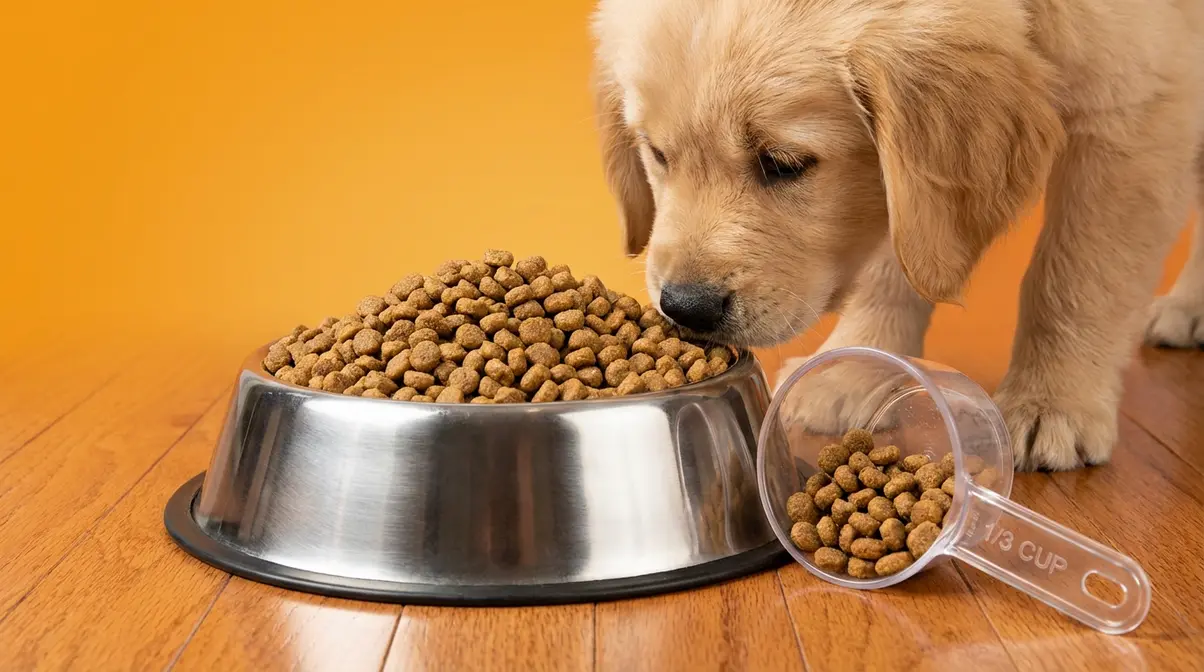
Feeding an 8 week old Golden Retriever isn’t complicated, but the details matter. Get the amount right and you’ll have a puppy that’s alert, growing well, and using mealtimes as natural potty cues. Get it wrong and you’ll deal with digestive upset, energy crashes, and a puppy that’s constantly hungry or uncomfortable.
Large breed puppies like Golden Retrievers should be fed unmoistened dry puppy food 3-4 times daily starting at 8 weeks, transitioning to twice daily at 6 months (AKC, 2026).
How Much to Feed: Exact Portions & Frequency
The standard starting point: approximately 1/3 cup of high-quality puppy kibble per meal, 3-4 times daily. Total daily intake: approximately 1 to 1.5 cups. Always defer to the feeding guidelines on your specific kibble bag and your vet, bag guidelines are calculated per that formula’s caloric density, and brands vary.
Why 3-4 meals instead of 2? A puppy’s stomach is roughly the size of their fist. Small, frequent meals maintain stable blood sugar, reduce digestive stress, and prevent hypoglycemia, a real risk in rapidly growing puppies. Two large meals a day creates energy spikes and crashes that you’ll feel as the owner.
Transitioning from the breeder’s food requires a slow swap to avoid GI upset. Use this schedule:
| Days | Old Food | New Food |
|---|---|---|
| Days 1-3 | 75% | 25% |
| Days 4-6 | 50% | 50% |
| Days 7-9 | 25% | 75% |
| Day 10+ | 0% | 100% |
Large breed puppies should be fed unmoistened dry puppy food 3-4 times daily; portion per the kibble manufacturer’s guidelines adjusted for age and weight (AKC puppy feeding fundamentals, AKC, 2026). For age-specific amounts as your puppy grows, our detailed feeding chart for Golden Retriever puppies by age is a helpful ongoing reference.
Amount is only half the equation, the type of food matters just as much at this stage.
What to Feed: Choosing the Right Puppy Food
Look for a “large breed puppy” formula, not “all life stages” or adult food. Here’s why that specific label matters: large breed puppy formulas have a controlled calcium-to-phosphorus ratio that allows bones and joints to grow at the correct pace. Too much calcium too fast causes developmental orthopedic disease. Golden Retrievers are already prone to hip dysplasia; choosing the right formula from week one is a genuine health decision, not just marketing.
What to look for on the label:
- AAFCO statement for “growth” or “all life stages for large breeds” (this is the regulatory minimum for a puppy food)
- First ingredient is a named meat protein, “chicken” or “salmon,” not “poultry meal” or “meat by-products”
- No artificial colors, flavors, or preservatives
- Calcium content between 1.0-1.5% on a dry matter basis (ideal for large breeds)
Food as a training tool, the smarter approach. Instead of always feeding from a bowl, reserve 20-30% of each meal to use as training treats throughout the day. This is called food-luring (using food to guide a behavior you want to reinforce). Golden Retrievers are intensely food-motivated, mealtimes become training opportunities, and training becomes feeding time. It’s a surprisingly effective reframe. For our complete recommendations by weight and age, see our complete Golden Retriever puppy feeding chart by weight and age.
For the moments between meals, treats play a bigger role in training than most owners expect.
Training Treats: What’s Safe at 8 Weeks?
At 8 weeks, treats must be tiny (pea-sized), soft, and easily digestible. Hard or large treats pose a choking risk and can cause GI upset in a puppy whose digestive system is still developing. Good options: small pieces of cooked chicken, tiny chunks of soft commercial puppy treats, or individual pieces of their regular kibble.
The 10% rule: treats should make up no more than 10% of total daily calories. This keeps the diet nutritionally balanced and maintains the treat’s value as a reward.
Timing is everything at this age. Deliver the treat within 2-3 seconds of the desired behavior. A 5-second delay breaks the association for an 8-week-old Golden, they’ve already moved on mentally. Immediate reward is what creates the learning connection. For how feeding and training evolve as your puppy grows, see how feeding and training evolve at 12 weeks.
Now you have the schedule and the food plan. The final piece of the survival puzzle is the one that leaves the most scratches on your hands, the biting.
How Do You Train Through the “Land Shark” Phase?
Your 8 week old Golden Retriever is not being aggressive. They’re being a puppy. Biting is a puppy’s primary way of exploring the world and communicating, and yes, those tiny teeth are razor sharp (Sarah’s forearms looked like she’d lost a fight with a rosebush during week one). It is the primary way puppies communicate, and Golden Retrievers are especially mouthy because they were bred to use their mouths, literally, for retrieving waterfowl. The goal isn’t to eliminate biting overnight; it’s to teach bite inhibition (the skill of understanding how hard is too hard) so your baby shark learns the rules of mouthing before they have adult teeth.
Why Your Puppy Bites (and How to Stop It)
Bite inhibition develops through littermate interaction, by 8 weeks, puppies have already started learning the concept. When a puppy bites a sibling too hard, the sibling yelps and play stops. That’s the whole lesson. When your 8 week old Golden Retriever bites you, you become the continuing teacher of that same lesson.
Overtired puppies bite more, when a biting episode escalates suddenly, the right response is a crate timeout, not redirection (AKC, 2026). Check the schedule first: is it past nap time?
Follow this protocol consistently:
- When bitten: Immediately give a high-pitched yelp, “OW!”, and go limp. This mimics littermate communication your puppy already understands.
- If biting stops: Calmly redirect to an appropriate chew toy. Praise the moment they mouth the toy instead of you.
- If biting escalates or continues: Calmly place the puppy in their crate for 3-5 minutes. No scolding, no drama.
- Never: Use your hand as a play toy. Engage in chasing or rough play that encourages mouth contact. Apply physical punishment, it creates fear, not understanding.
A high-pitched yelp followed by pausing interaction teaches the puppy that hard biting ends the fun (ASPCA puppy biting guide, ASPCA, 2026). For additional techniques, our guide on tips to stop a Golden Retriever puppy from biting and nipping goes deeper on each method.
Also see: AKC bite inhibition guide (AKC, 2026) for how overtiredness drives escalation in young puppies.
Biting is easier to manage when your puppy has had the right early experiences. That’s where the 7-7-7 Rule comes in.
The 7-7-7 Socialization Rule Explained
The Rule of 7s (sometimes called the Rule of Sevens) is a puppy socialization benchmark developed by behaviorists. By 7 weeks of age, and continuing through the first weeks at home, a well-socialized puppy should have experienced:
- 7 different physical surfaces (grass, gravel, tile, carpet, wood, concrete, mud)
- 7 different types of containers to eat from (bowls, plates, slow-feeders, hand feeding)
- Been held by 7 different people
- Heard 7 different sounds (traffic, appliances, children, music, construction)
By 7 weeks, a well-socialized puppy should have experienced 7 different surfaces, people, containers, and sounds to build behavioral confidence (the Rule of 7s for early socialization, SPCA of Wake County, 2026). The goal of this framework isn’t to overwhelm your puppy, it’s to build the neurological foundation that makes new experiences feel normal rather than frightening.
Safe socialization before full vaccination. At 8 weeks, your puppy has had their first vaccine but not the full series. Safe options: interaction with fully vaccinated adult dogs in your home, reputable puppy classes that require vaccination records, and carrying your puppy into busy environments (markets, parks, school pick-up lines) without placing them on the ground. The socialization window closes between 12-16 weeks, missing it has behavioral consequences that training later struggles to fully reverse. Sarah made the mistake of skipping car-ride exposure during this window with her first dog, and it took months of counter-conditioning to undo the anxiety. Don’t repeat that, start early, even if it feels like overkill.
Does this address Golden Retriever clinginess? Yes, directly. Golden Retrievers are naturally people-bonded dogs, and puppies that miss the socialization window are significantly more likely to develop separation anxiety. The 7-7-7 Rule builds confidence, a confident puppy can be alone in their crate without spiraling into distress.
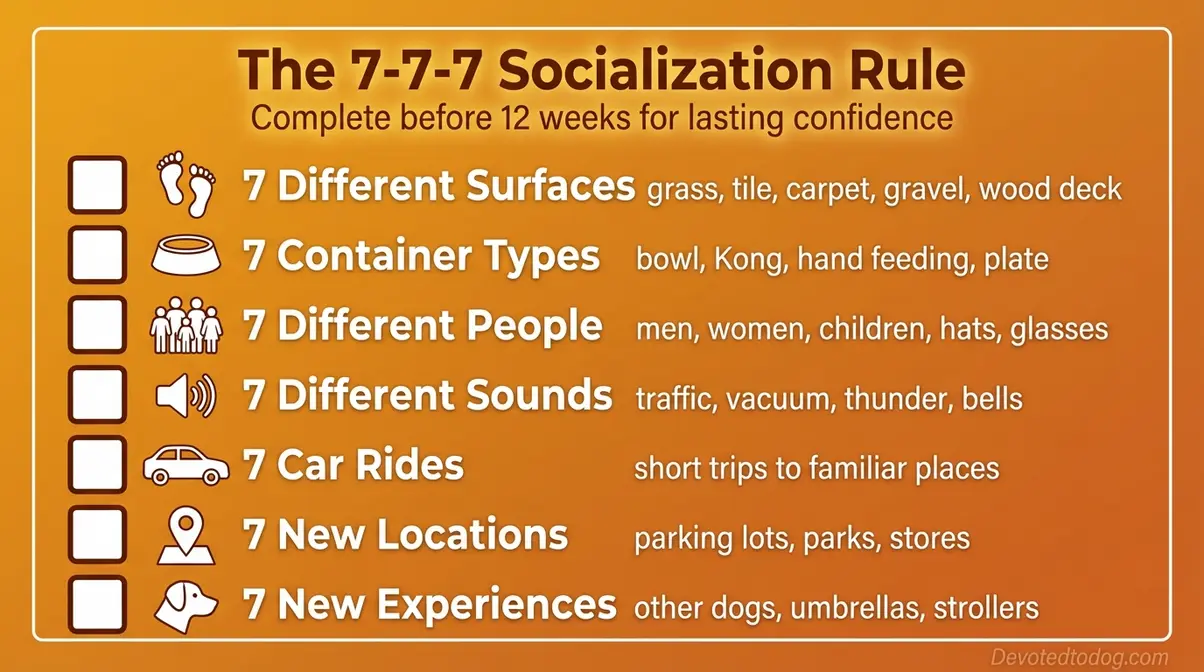
Caption: The 7-7-7 socialization checklist, print and post to the fridge; check off each category during the first two weeks at home.
Socialization and biting go hand-in-hand with basic training, and yes, you can absolutely start teaching commands at 8 weeks.
Basic Commands to Start This Week
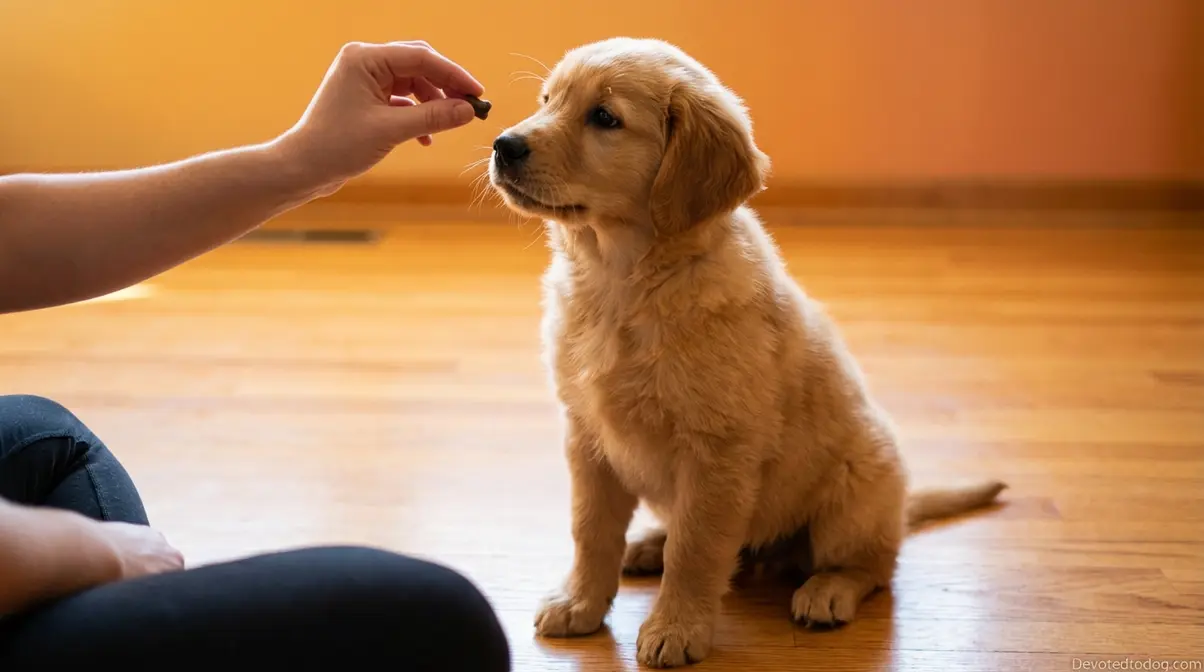
Training an 8 week old golden retriever puppy is not only possible, it’s the right time to start. Young puppies haven’t yet developed competing habits, and Golden Retrievers are food-motivated people-pleasers who are wired to engage. Three commands are appropriate right now:
- Name recognition, say the puppy’s name once, and the moment they look at you, mark with “yes!” and reward. Repeat 10-15 times per day in natural settings (not just formal sessions).
- Sit, hold a small treat just above the puppy’s nose and move it slowly back toward their tail. As their nose follows the treat up and back, their bottom naturally lowers. The instant they sit, say “Sit” clearly and reward immediately.
- Come, crouch down, open arms, say “Come” in an enthusiastic tone. When they reach you, big praise and treat. Never call “come” for something unpleasant (bath, nail trim), it poisons the command.
Keep sessions to 5-10 minutes maximum. Two to three successful repetitions per session is enough at this age. Always end on a success, even if it means asking for an easy behavior they already know. Puppies practice communication and learning with littermates prior to 8 weeks, providing a foundation for early at-home training (Cornell Vet puppy development research, Cornell Vet, 2026).
Positive reinforcement at this stage creates faster learning than correction-based methods, and for how to train an 8 week old golden retriever, “tiny treat, immediate timing, short sessions” covers 90% of what you need.
Now that you’re managing the basics, here’s a question many new owners have: does it matter what kind of Golden you have?
What Golden Retriever Puppy Variations Show at 8 Weeks?
When searching for an 8 week old Golden Retriever, you’ve probably seen terms like “English Cream,” “White Golden,” or “Red Golden.” These are not different breeds, they are all Golden Retrievers, differentiated by coat color and breeding line. Here’s what actually matters about each type, and what doesn’t.
English Cream, Red & White: What’s the Difference?
| Variation | Coat | Typical Build | Energy Level |
|---|---|---|---|
| English Cream (White) | Cream to off-white | Blockier, broader skull | Moderate |
| American Standard | Medium to dark gold | Classic feathered, medium build | Moderate-high |
| Red (Field-Line) | Dark copper-red, shorter | Leaner, more athletic | High |
English Cream (White) Golden Retrievers are bred to European and British standards. They tend to have a slightly blockier build, broader skulls, and cream-to-white coats. Many owners describe them as calmer in temperament, though this is anecdotal and not guaranteed by breed standards. For a deeper look, explore the English Cream Golden Retriever in depth.
Red (Field-Line) Golden Retrievers were bred for hunting. They’re leaner and more athletic, with shorter, darker coats and generally higher energy. They tend to have a stronger prey drive than their show-line counterparts. They’re excellent for active owners who want a working dog partner. Learn more about the Red Golden Retriever.
American Standard Goldens are the “classic” Golden Retriever most people picture, medium-length feathered coat in shades of gold, moderate energy, bred to AKC show standards.
Beyond color, many owners wonder whether the myth about temperament differences is real.
Does Coat Color Affect Temperament?
The short answer: no. Coat color is determined by pigment genes that are entirely separate from behavioral genes. A cream-colored puppy is not inherently calmer than a red-colored puppy from the same litter, the genes responsible for coat pigmentation and those influencing personality don’t travel together.
What does affect temperament at 8 weeks is the breeding line (show vs. field), individual genetics within that litter, and, most critically, the breeder’s socialization practices during weeks 3-7. A well-socialized red Golden from a skilled breeder will typically be more confident and adaptable than an under-socialized cream Golden, regardless of color.
A practical note: behavioral testing at 8 weeks (boldness vs. submissiveness, startle response, recovery speed) can indicate general tendencies. But adult temperament is heavily shaped by your training environment and socialization over the following months. An 8 week old red golden retriever with a high-energy line can absolutely become a calm, settled adult, given consistent structure and the First 14 Days Framework from the start.
Whether you have a Cream, Red, or classic Golden, the same milestones lie ahead, and knowing what’s coming makes everything more manageable.
What Growth Milestones Come After 8 Weeks?
The first 14 days are the hardest. After that, things genuinely start to get easier, not because the puppy stops being a puppy, but because you understand the pattern and they start understanding the rules. Here’s the honest timeline of what changes, and when.
10 to 12 Weeks: Early Progress
Between 8-12 weeks, puppies enter a critical socialization window where positive exposure to new stimuli has lasting behavioral impact (Texas A&M veterinary puppy timeline, Texas A&M VMBS, 2026). This window is the reason the 7-7-7 Rule is urgent, not eventually urgent, now urgent.
At 10 weeks, potty training begins to click. The puppy starts making it to the door more consistently. Bladder control improves slightly, most can hold for 2-3 hours during the day with the schedule in place.
At 12 weeks, most owners report the first meaningful behavioral improvement. The schedule from The First 14 Days Framework can begin to loosen, nap times become more self-directed, and many puppies can sleep 4-5 hours overnight. This is the milestone most sleep-deprived owners are counting down to.
A 12 week old Golden Retriever typically weighs 22-27 lbs (males) or 18-23 lbs (females). Adult teeth haven’t arrived yet, biting continues, but bite pressure is better understood through the consistent training from the first 14 days. For growth milestones for a 12-week-old Golden Retriever puppy, our detailed guide covers the next phase in full.
The months that follow bring an entirely new challenge, the Golden Retriever “teenage” phase.
4 to 6 Months: The Teenage Phase Arrives
By 4 months, most Golden Retrievers complete their core vaccination series and can safely explore public spaces, dog parks, and group puppy classes for full socialization (Texas A&M VMBS, 2026). This is the milestone most new owners are eagerly anticipating, and rightly so.
A brief milestone reference for the months ahead:
| Age | Key Development | What Changes for You |
|---|---|---|
| 4 months | Core vaccines complete | Can attend puppy classes, visit dog parks |
| 4-5 months | Adult teeth arriving | Second chewing surge, freeze Kongs |
| 6 months | Adolescence begins | Commands may seem “forgotten”, normal |
| 18-24 months | Physical maturity | Full adult size and settling temperament |
At 4-5 months, adult teeth start coming in, triggering a second significant biting and chewing surge. Stock frozen Kongs (stuffed with peanut butter or wet food and frozen overnight), these are the best tool for teething relief. The bite inhibition work from weeks 1-14 pays significant dividends here.
At 6 months, hormonal changes begin. Previously reliable commands may suddenly seem forgotten, the puppy appears to have selective hearing. This is normal adolescent boundary-testing, not a failure of training. Maintain consistency; it passes.
A question competitors miss: “At what age is a Golden Retriever fully grown?” Golden Retrievers reach physical maturity around 18-24 months, though many remain emotionally “puppy-brained” until age 2-3. The investment made in the first 14 days pays compound interest all the way to adulthood. Track the full journey with our full Golden Retriever growth and weight chart from puppy to adult.
Even with the best plan, every new owner hits snags. Here are the most common, and when to stop troubleshooting and call your vet.
What Common Pitfalls Should You Avoid and When Should You Call the Vet?
Every new owner makes mistakes. The owners who get through the first 14 days most successfully aren’t the ones who do everything perfectly, they’re the ones who recognize the pattern of a mistake quickly and correct it. Here are the four most common.
Common Mistakes New Owners Make
Pitfall 1: Waiting too long between potty breaks. The result is a streak of accidents that teaches the puppy it’s acceptable to go indoors. The fix is simple but requires discipline: stick to the schedule, especially the critical 5-15 minute window after eating. If you miss that window, you will likely clean up an accident.
Pitfall 2: Free-feeding (leaving food out all day instead of scheduled meals). Free-feeding destroys the meal → potty timing relationship that makes the schedule work. It also increases overweight risk, which in Golden Retrievers contributes to joint problems later. Feed at scheduled times, pick up the bowl after 15-20 minutes regardless of whether the puppy finished.
Pitfall 3: Skipping enforced naps. An overtired puppy enters the biting spiral, spinning, excessive mouthing, inability to settle. The fix is immediate crating, not more redirection. This is the most common mistake in the first week, and the one owners most often recognize in retrospect.
Pitfall 4: Inconsistent command words across family members. If one person says “off” when the puppy jumps and another says “down,” the puppy learns nothing, they’re hearing two different sounds for the same context. Have a family meeting before the puppy comes home. Write the command list on the fridge. Consistency is more important than any specific word choice.
When to Call Your Vet
Frame this as empowering information, not an emergency list. Contact your veterinarian if you observe any of the following, don’t wait and don’t Google:
- Diarrhea lasting more than 24 hours, or blood in stool
- Vomiting more than twice in a short period
- Refusal to eat for more than 12 hours
- Lethargy, unusual unresponsiveness, or collapse
- Limping or obvious discomfort when moving
- Swollen abdomen (a potential emergency, call immediately)
- Any question about your puppy’s vaccination status or schedule
Veterinary guidance on developmental health checks and vaccination windows for the first 16 weeks is outlined by Texas A&M veterinary milestones (Texas A&M VMBS, 2026).
This guide is for informational purposes only. Always consult a licensed veterinarian for health concerns specific to your puppy.
Frequently Asked Questions
How big is a 8-week-old Golden Retriever?
A typical 8 week old Golden Retriever weighs between 10 and 15 pounds and stands roughly 8-12 inches at the shoulder (Pawlicy, 2026). However, healthy puppies can range from as little as 4.5 lbs to over 20 lbs depending on genetics, with field-line Goldens tending to be lighter. Most puppies reach 22-30 lbs by 12 weeks and settle between 55-75 lbs at full adult size.
What to expect from a 8-week-old Golden Retriever?
Expect your 8 week old Golden Retriever to be energetic, curious, and in an active biting phase commonly called the “land shark” stage. They require constant supervision during waking hours, potty breaks every 1-2 hours, and a strict daily schedule. They’ll sleep 18-20 hours daily, making enforced nap time as important as playtime (PetMD, 2026). Prepare for at least 1-2 overnight wake-ups for the first several weeks.
What are the hardest weeks with a puppy?
The hardest weeks with a puppy are typically weeks 8 through 16, when potty training, biting, and sleep deprivation peak simultaneously. Most new owners report a meaningful improvement around the 12-week mark, when puppies begin sleeping longer stretches overnight and potty training starts to click. A second challenging period arrives between 6-18 months during adolescence, when hormonal changes cause boundary-testing behavior (AKC, 2026). Owners who implement a consistent daily schedule from day one consistently report the early weeks as more manageable than expected. Consistency is the key variable that determines how quickly things improve.
Is it hard to train an 8 week old puppy?
Training an 8 week old puppy is very achievable, and in many ways easier than waiting, because young puppies haven’t yet developed bad habits. Golden Retrievers are especially receptive at this age because they are highly food-motivated people-pleasers (Cornell Vet, 2026). Keep training sessions to 5-10 minutes, use tiny high-value treats, and focus on basic commands like name recognition, “sit,” and “come.”
Can my 8 week old puppy be around my other dog?
Yes, your 8 week old puppy can safely interact with other fully vaccinated dogs in your household, and this early socialization is critical for developing healthy bite inhibition (ASPCA, 2026). However, avoid dog parks or areas with unknown dogs until your puppy has completed their full vaccination series around 16 weeks. Supervised, calm introductions on neutral ground produce the best outcomes. If your resident dog shows stress or reactive behavior, consult a certified professional dog trainer.
How often should I bathe an 8 week old Golden Retriever?
Limit baths to once every 4-6 weeks at most during the early months. Over-bathing strips the natural oils from your Golden’s developing coat, leading to dry skin and irritation. For day-to-day cleanup, use a warm damp cloth or unscented puppy wipes between baths. When you do bathe, use a gentle, soap-free puppy shampoo and keep the water lukewarm, never hot. Most importantly, make the first few bath experiences positive with treats and calm praise so your puppy doesn’t develop water anxiety.
When should my 8 week old Golden Retriever start puppy classes?
Enroll in a puppy socialization class as early as 8-9 weeks, provided the class requires proof of first vaccinations and keeps the environment clean (American Veterinary Society of Animal Behavior, 2026). The behavioral benefits of early socialization outweigh the minimal disease risk in a controlled class setting. Look for classes that use positive reinforcement methods, limit class sizes to 6-8 puppies, and include supervised off-leash play. Avoid any class that uses punishment-based techniques or doesn’t verify vaccination status.
How long can I leave my 8 week old puppy alone?
An 8 week old Golden Retriever should not be left alone for more than 1-2 hours during the day. Their tiny bladders can’t hold longer than that, and prolonged isolation at this age can trigger separation anxiety that becomes difficult to reverse. If you work full-time, arrange for a midday dog walker, enlist a trusted neighbor, or stagger schedules with a partner. Crate training helps, but the crate is a safe space, not a storage solution. Gradually increase alone time by 15-minute increments as your puppy matures.
What Does 14 Days of Structure Actually Buy You?
For new Golden Retriever owners, the first 14 days with an 8 week old Golden Retriever set the foundation for everything that follows. Consistent meal schedules (1/3 cup, 3-4 times daily), enforced naps totaling 18-20 hours, and potty breaks every 1-2 hours are not optional extras, they’re the system that transforms chaos into rhythm. At Devotedtodog.com, our editorial team has reviewed thousands of owner experiences and cross-referenced them against veterinary guidelines; the pattern is consistent: structure in week one means fewer problems at week twelve.
The First 14 Days Framework works because it respects how your puppy is wired, not against how you wish they’d behave. When you catch your baby shark mid-zoomie at 11 PM, remember: they’re not being bad. They’re being exactly what they are. Your job is the schedule, the redirect, and the crate. Let the framework do the heavy lifting.
Download the daily schedule infographic, bookmark the feeding chart, and put the 7-7-7 Rule on your fridge. Then, when 12 weeks rolls around and your puppy sleeps through the night for the first time, you’ll know the system worked. Here’s everything to expect at 12 weeks.
Brianna York is a former veterinary technician with hands-on clinical experience in canine health. She contributes medical accuracy review to DevotedToDog health articles and validates clinical claims against current AVMA, AAHA, and OFA standards.
Wondering how big your Golden will get.