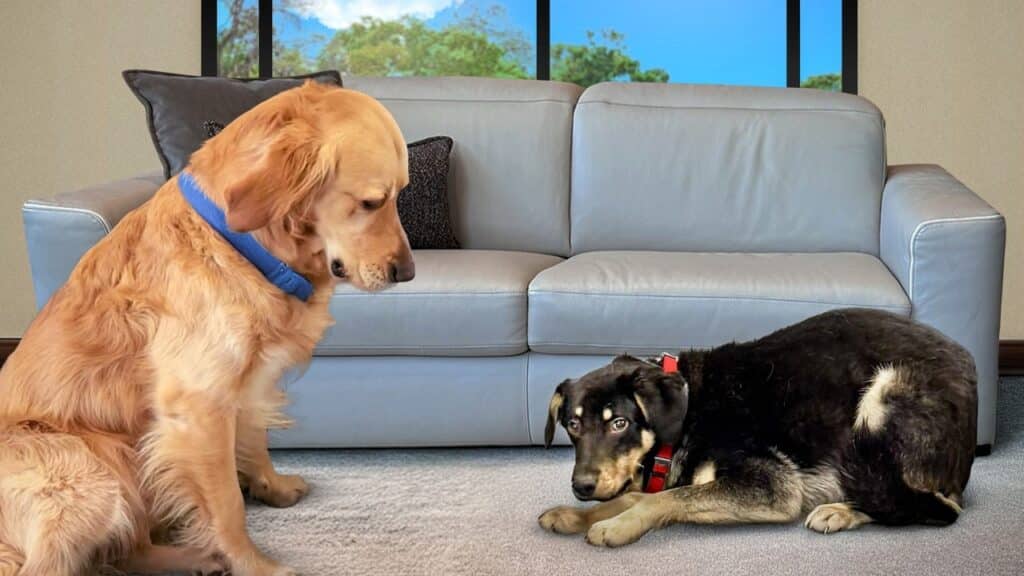
Scout was 11 months old when he arrived, pressed into the corner of a room in the UK, and decided to disappear.
Not run. Not fight. Disappear — the way a dog disappears when every experience with people has told him that smaller is safer.
He’d made the journey from North Macedonia in the back of a van over three days, locked in a crate. He hadn’t eaten. He hadn’t gone to the toilet.
When JJ and Ella of The Golden Kobe Family opened the door, Scout didn’t move.
He Won’t Even Look At Us
The first thing JJ noticed was the stillness. Not the kind of stillness that passes in a few minutes — the kind that comes from a body that has learned being still is survival.
“I’ve never seen a dog like this scared,” JJ said. “He won’t even look at us.”
Scout had no collar. No harness. He’d arrived that way because anything around his neck had felt like a threat. Puppy pads lined the floor. At one point, fear took over his body entirely — he hadn’t been able to stop it.
Three Days In A Crate
North Macedonia is roughly 1,700 miles from London. Scout had covered most of that distance in the dark, in a crate, without a familiar smell in the world.
On the drive, when handlers tried to lift him out for a toilet break, he’d bitten in pure panic. JJ said he didn’t blame Scout at all.
A dog who has likely been beaten by people doesn’t draw much distinction between the hand that hurt him and the hand trying to help.
JJ and Ella had visited Scout in North Macedonia before his transport. They knew one thing about him from that visit: he loved other dogs. That detail was going to matter.
He Wants To Be Invisible
JJ sat across the room and did nothing. No reaching, no eye contact, no coaxing. Just presence.
“Even me sitting here is scaring him a bit,” he said. The goal wasn’t connection — not yet. It was just to let Scout learn, slowly, that a human in the room didn’t automatically mean pain.
Scout had been tucked against the baseboard for hours, nose pressed to the floor, watching nothing. “A dog has to be so insanely scared,” JJ said quietly, “to not even wonder where they are.”
Kobe’s Got One Job
JJ brought in the golden retriever first.
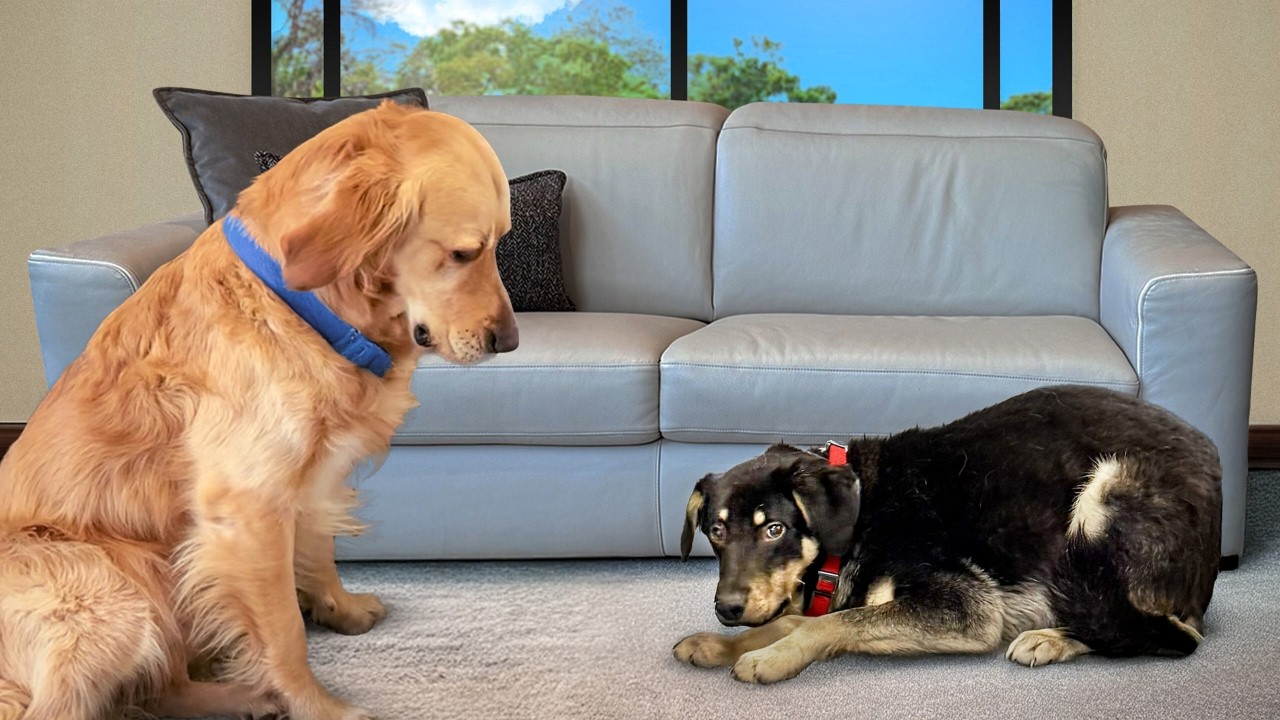
Kobe had done this before — walked into a room where a traumatized dog was trying to disappear and simply been there. Calm, unhurried, reading the room the way goldens often do. He wasn’t trying to help. He was just Kobe.
He crossed the room. Caught Scout’s scent. Turned toward him.
“Oh, he’s perked up a bit,” JJ said, watching. “He’s trying to have a sniff. He’s really scared of me — but you can see he’s like, oh, there’s another dog here.”
Something Shifted
It wasn’t a dramatic moment. It was a puppy lifting his nose — just barely — toward another dog.
But it was the first thing Scout had done voluntarily since he walked through the door. His whole body had been telling him the world was dangerous. For a second, curiosity was louder.
Kobe stayed. Scout’s nose worked. JJ held still.
The Bowl Was Empty
That night, Scout didn’t leave his crate. He stayed in the same position for ten hours. JJ and Ella placed a piece of steak in his bowl with a few drops of hemp oil — a mild stress support — and stepped back.
They checked the pet camera in the morning. The bowl was empty.
“I’m gutted the camera didn’t pick it up,” JJ said, “because obviously we thought he wouldn’t actually move.” Somewhere in those quiet hours — the first quiet hours Scout may have known in a long time — he got up and ate.
A Paw On The Sofa
At around 4 a.m., JJ heard movement downstairs. He came to find Scout out of his crate, inching through the room, nose to the floor. Sniffing the camera. Putting one tentative paw on the sofa to see what was up there.
He went to the toilet for the first time since arriving.
JJ watched on the camera and didn’t go down. When a dog that scared takes a step toward the world, the best thing a person can do is not interrupt it.
By day three, Ella sat quietly in the room during feeding time. Scout still wouldn’t make eye contact. But he ate — with humans in the room, in the light of day — and that was enormous.
“We’re only three days in,” JJ said, “and what a journey it’s been already — from literally being too scared to move to showing tiny signs of hope. But boy, we have a lot of work to do.”
What rescuers call “behavioral shutdown” is common in dogs with severe trauma histories: the nervous system floods, movement stops, and the animal goes inward.
It isn’t stubbornness. It’s a survival response. With time, patience, and — in Scout’s case — one calm golden retriever — it begins to lift.
For his first ten hours, he didn’t move. Then Kobe walked through the door. And something in Scout slowly decided: maybe not yet, but maybe someday.
Story and footage: The Golden Kobe Family (YouTube/@thegoldenkobefamily · Instagram: @thegoldenkobefamily) — consider following or supporting their rescue work at gofundme.com/f/thegoldenkobefamily.
More Stories You’ll Love
If Scout’s story moved you, these are worth reading next:
- She Was Carried Inside Because She Couldn’t Move — Then A Golden Retriever Did Something Unexpected
- The Most Broken Rescue Dog They’d Ever Seen — And the Family That Refused to Give Up
Written by Coral Drake · Reviewed by Sarah Thacker. We’re dog people, not a vet clinic — for health questions, ask your vet.