
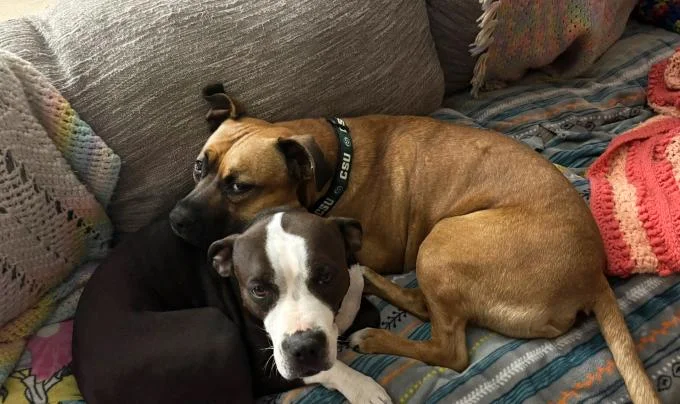
Every time someone new walked past his kennel at the New York City shelter, Nigel lunged forward and started barking — and no one could figure out how to make it stop.
He wasn’t being aggressive. He wasn’t a mean dog. He was completely overwhelmed, and barking was the only tool he had left.
The shelter tried everything. It wasn’t enough.
The City Had Already Won
New York City is a lot for any dog. The noise, the foot traffic, the nonstop stimulation — even easygoing dogs need time to adjust.
For Nigel, it was too much to handle. Every new face that approached triggered the same response: lunge, bark, repeat. Over and over.
He didn’t want to be that dog. You could see it in him. But the city had already won, and the shelter environment wasn’t helping him recover.
More Than a Bad Label
The shelter team didn’t give up quickly. They tried training. They tried treats and positive reinforcement. They adjusted his environment, moved him around, gave him extra one-on-one time.
Nigel kept barking. Not because he was beyond help — but because no amount of effort could fix what was actually wrong: the environment itself.
High-stimulation city shelters can push an already-anxious dog past his limit fast. What looked like a behavior problem from the outside was really a dog shouting that he needed something no one there could give him.
A Canyon Fifteen Hundred Miles Away
Best Friends Animal Sanctuary sits on 3,700 acres of canyon land in Kanab, Utah. The place is big, quiet, and designed specifically for dogs who’ve been passed over, mislabeled, or worn down by systems that weren’t built for them.
Nigel made the transfer from New York City to southern Utah.
For the first time in a long time, the noise stopped. The strangers weren’t constant. The pressure, just a little, began to lift.
Natalie’s First Move Was Patience
Caregiver Natalie Nilsen started where most people don’t: at the very beginning.
She built predictable routines around the smallest things — how his harness went on, when he was fed, how new people were introduced. No surprises. No moments where Nigel had to scramble to catch up with what was happening.
She added dual-leash walks for safety, and paired every new introduction with treats tossed gently from a distance. He didn’t have to accept anything before he was ready. She just kept showing up, consistently, until ready started to look like something possible.
The Leash Went Slack
The shift happened before she expected it to.
“We found quickly that something had changed,” Natalie said, “and we really didn’t need the second leash because the leashes were always slack.”
Not pulled tight. Not braced for impact. Just slack — the way a leash looks on a dog who’s decided the world might be okay after all.
That slack leash was the first real signal that Nigel was coming back to himself.
One Woman Made the Drive
Tracy Wrinkle heard about Nigel and made the trip to the Sanctuary to meet him.
Not as a drive-by, not to browse — she came specifically for him. That kind of intentionality matters. A dog who’s been overlooked and labeled knows when someone is really there.
Natalie introduced them the same way she’d approached everything with Nigel: carefully, with treats and time. Tracy let him lead.
He Already Knew
It didn’t take long at all.
All the work Natalie had done hadn’t just helped Nigel get through the day. It had prepared him to recognize the right person when she showed up. And when Tracy walked in, something in him settled.
He went home with her to Colorado.
In the days that followed, he figured out the doggy door on his own. He bonded with his dog siblings without much fuss. He found his spot in the family like he’d been waiting for exactly this — which, really, he had been.
The Dog He Always Was
Today, Nigel takes neighborhood walks without pulling, without lunging, without the constant low-grade alarm that had followed him through the shelter.

He swims. He plays with toys. He sleeps curled up with his family.
The barking that once echoed through his kennel is gone. Not because anyone trained it out of him — but because the fear that drove it finally had somewhere to go.
Natalie saw a dog worth reaching. Tracy drove across the state to find him. And Nigel, given the right conditions and the right people, turned out to be exactly who they hoped he was.
Dogs that bark and lunge in shelter environments are often reacting to stress, not acting out of aggression. According to the ASPCA, barking can be a dog’s primary signal that something is wrong — and high-stimulation environments like city shelters can significantly amplify anxiety behaviors. Structured desensitization and predictable routines, like the approach Natalie Nilsen used with Nigel, are among the most effective tools for helping these dogs decompress. If your dog shows similar behaviors, a certified trainer or behaviorist can make a real difference.
Story: Best Friends Animal Society · Rescue and care: Best Friends Animal Sanctuary — consider following or supporting their work.
More stories you’ll love
These dogs also found their way through the hardest chapters:
- The Dog on the Euthanasia List Who Jumped for Joy the Day He Was Saved
- He Watched a Woman Through the Gym Doors Every Day — Until She Finally Came Back for Him
- Lily’s Golden Retriever Transformation — Before and After Photos From GRRAND
Written by Coral Drake · Reviewed by Alliyah Strange, CPDT-KA. We’re dog people, not a vet clinic — for health or behavior questions, ask a certified trainer or your vet.