Goldendoodles come in four sizes: Petite (under 25 lbs), Miniature (typically 26–35 lbs), Medium (36–50 lbs) and Standard (51+ lbs), according to the Goldendoodle Association of North America (GANA). Height at the withers runs from under 14 inches for a Petite to over 21 inches for a Standard. Some Minis grow larger than their label, so ask the breeder for both parents’ adult weights. New to the cross? Start with our Goldendoodle guide, and once you know the size you want, see Goldendoodle breeders.
Many owners discover their “Mini” Goldendoodle has grown into a 50-pound dog because they relied on a size label without understanding the genetics behind it. Choosing the wrong size isn’t just inconvenient — size surprises are a common reason owners rehome Goldendoodles. By the end of this guide, you’ll know exactly how each size is defined, what factors influence your puppy’s adult weight, and how to predict growth so you can make a confident choice. We cover all four official sizes, the Mini in depth, the genetic and gender factors that shape final size, color and coat variations, and the common misconceptions that trip up new owners.
Key Takeaways: Goldendoodle Sizes at a Glance
- Petite & Mini: Best for apartments and low-activity households
- Medium: The sweet spot — manageable size, full doodle personality
- Standard: Needs space; males typically run heavier than females
- “The Doodle Size Drift”: Genetics mean your doodle may outgrow its size label — learn why in this guide
- Growth prediction: An 8-week puppy’s weight × 4.3 gives a rough Mini adult estimate
Goldendoodle Size Categories Explained
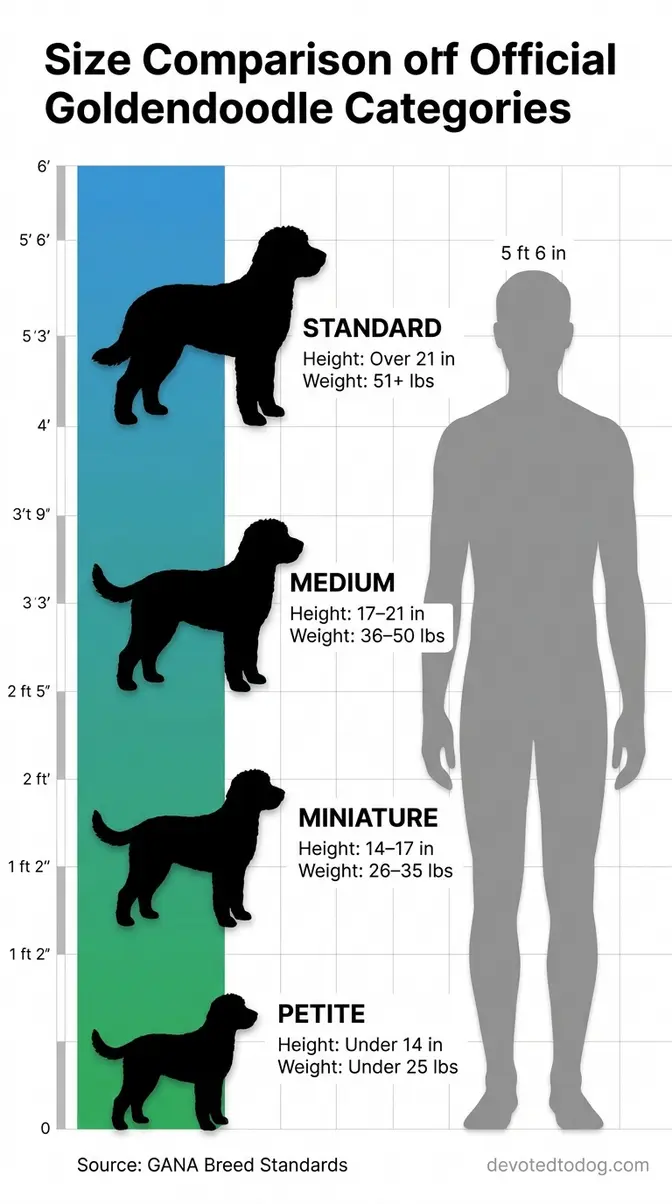
According to GANA breed standards, the Goldendoodle Association of North America, a breed association, lists four sizes: Petite (under 14 inches / under 25 lbs), Miniature (14–17 inches / 26–35 lbs), Medium (17–21 inches / 36–50 lbs), and Standard (over 21 inches / 51+ lbs). These different goldendoodle sizes affect everything from your living space to your daily exercise routine, so understanding them before you visit a breeder is essential.
Here’s a quick-reference summary of all four sizes:
- Petite Goldendoodle: Under 14 inches tall, under 25 lbs
- Miniature Goldendoodle: 14–17 inches tall, 26–35 lbs
- Medium Goldendoodle: 17–21 inches tall, 36–50 lbs
- Standard Goldendoodle: Over 21 inches tall, 51+ lbs
- Size is measured at the withers — the highest point of a dog’s shoulder blades, not the top of the head
- “Toy” Goldendoodle is a marketing term, not an official GANA category — it generally falls within the Petite range
The 4 Official Sizes (GANA)
Goldendoodle sizes are defined by GANA, the Goldendoodle Association of North America, a breed association. A “breed standard” is simply a set of agreed-upon measurements and traits that define what a breed should look like — think of it as the rulebook breeders use. Because Goldendoodles aren’t registered with the AKC (they’re a hybrid breed), GANA fills that role. Here’s why their standards matter: when a breeder says “Mini,” they should mean the GANA-defined range. Without that standard, “Mini” is just a word.
Here is how each size breaks down, with a lifestyle note for each:
- Petite Goldendoodle (under 14 inches / under 25 lbs): Ideal for apartment living, seniors, and owners with limited outdoor space. Roughly the size of a Cocker Spaniel.
- Miniature Goldendoodle (14–17 inches / 26–35 lbs): The most popular size category. Comfortable in smaller homes, great for families, and easy to travel with.
- Medium Goldendoodle (17–21 inches / 36–50 lbs): Versatile and well-suited to most households. Think of a dog about the size of a Border Collie.
- Standard Goldendoodle (over 21 inches / 51+ lbs): Closer to a Labrador Retriever in size. Thrives with space and an active lifestyle.
One important note: “Toy Goldendoodle” is a term some breeders use, but it is not an officially recognized GANA category. Dogs marketed as “Toys” typically fall within the Petite range — under 25 lbs. Always ask a breeder which GANA category a puppy falls into, not just the marketing name.
You’ll also notice that the AKC Standard Poodle breed standard defines the Standard Poodle as over 15 inches at the shoulder — which directly influences Standard Goldendoodle size, since the Poodle is one of the two parent breeds.
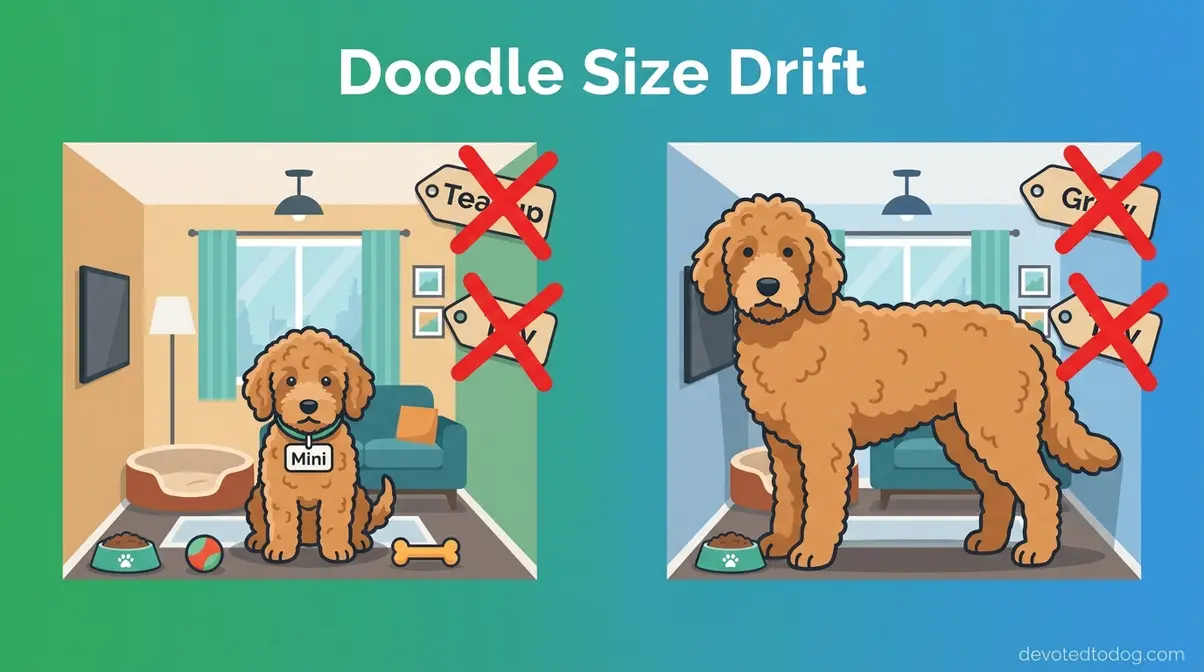
One more concept to keep in mind as you explore these categories: a phenomenon called “The Doodle Size Drift” — where Goldendoodles consistently grow larger than their breeder’s size label suggests, driven by genetic variability. We’ll explain the full mechanism in the genetics section, but it’s worth naming now so you can watch for it.
Size Chart: Height & Weight
Use this goldendoodle sizes chart as your quick reference. All measurements are for fully grown adult dogs, measured at the withers — the highest point of a dog’s shoulder blades. This is how all dog heights are officially measured.
| Size Category | Height at Withers | Adult Weight | Best For |
|---|---|---|---|
| Petite | Under 14 in | Under 25 lbs | Apartments, seniors |
| Miniature | 14–17 in | 26–35 lbs | Small homes, families |
| Medium | 17–21 in | 36–50 lbs | Most households |
| Standard | Over 21 in | 51+ lbs | Active families, houses with yards |
These ranges reflect GANA official standards. Individual dogs may vary based on parent size and generation — we cover exactly why in the genetics section below. According to the Poodle Club of America size standards, Standard Poodles typically fall within the 22–27-inch range, which directly sets the ceiling for Standard Goldendoodle adult height.
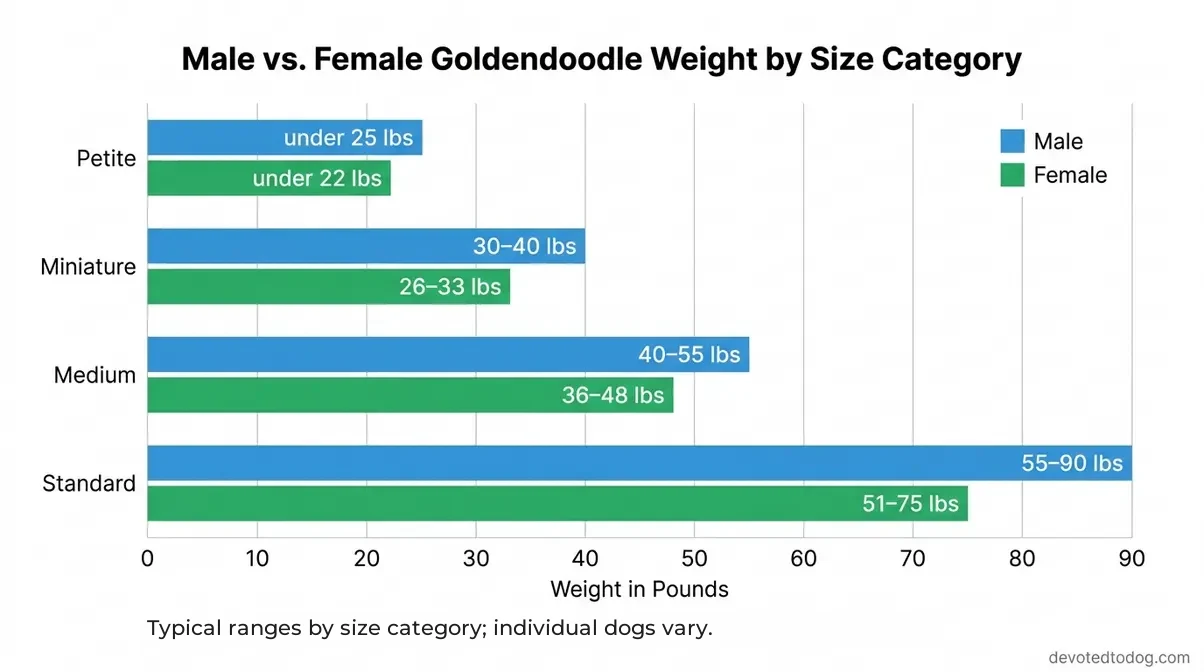
Males typically weigh more than females within the same size category. That means a male Mini may land at or above the top of the 26–35 lb range while a female from the same litter stays closer to the lower end — a meaningful difference if space is a concern.
Which Goldendoodle Size Fits Your Life?
Choosing between goldendoodle types and sizes isn’t just about weight — it’s about your daily routine. Here’s a practical breakdown:
Petite and Mini: Best for apartment living, older adults, or owners with limited mobility. Lower exercise demands — typically 20–30 minutes of activity per day. Much easier to travel with, whether by car or plane.
Medium: The most versatile option. Comfortable in most homes, excellent with children, and manageable for first-time dog owners. Expect moderate exercise needs — around 30–45 minutes of activity daily. Most owners find this size hits the sweet spot between manageable and substantial.
Standard: Needs space. Thrives in homes with a yard and suits active owners who enjoy hiking, running, or outdoor adventures. High energy that requires consistent daily exercise.
One thing to keep in mind as you decide: “The Doodle Size Drift” means your dog may grow beyond its category label. We’ll explain exactly why — and how to predict it — in the genetics section coming up.
Mini Goldendoodle Sizes Guide
Mini goldendoodle sizes are among the most searched topics in the Goldendoodle world — and for good reason. Per GANA breed standards, a Miniature Goldendoodle stands 14–17 inches at the withers and weighs 26–35 lbs as an adult. They’re the most popular size category, but they’re also the most likely to surprise owners who relied on a breeder’s label without understanding the genetics behind it.
Mini Goldendoodle Size and Weight Range
The GANA-official Mini Goldendoodle range is 14–17 inches at the withers (the top of the shoulder blades — this is how all dog heights are measured) and 26–35 lbs at adult weight. Most Miniature Goldendoodles reach their full size between 10 and 14 months of age.
But here’s the honest truth that many breeders don’t mention upfront:
“Is my doodle really a miniature? He weighed 18kg/40lbs at his 6 month vet visit. I think he was accidentally swapped with a baby dinosaur at birth.”
This experience is far more common than people realize — and it has a name. “The Doodle Size Drift” is especially common in Mini Goldendoodles from F1 litters (more on that in a moment). The reason isn’t that breeders are dishonest; it’s that F1 genetics are inherently variable, and the Golden Retriever parent’s size is consistently underestimated.
Some Mini Goldendoodles from F1 litters may reach 40–45 lbs. That doesn’t mean they’re “not Mini” — it means the label is a range, not a guarantee. Think of the 26–35 lb window as the target, not a promise. It’s like a weather forecast: the science is solid, but nature has the final word.
The UKC Miniature Poodle measurements define the Miniature Poodle as over 10 inches and up to 15 inches at the withers — the primary parent influencing Mini Goldendoodle size. Similarly, the AKC Miniature Poodle standard recognizes Miniature Poodles as measuring 15 inches or under at the shoulder, directly setting the ceiling for Mini Goldendoodle height.
For the full Mini picture, including temperament and what to ask a breeder, read our Mini Goldendoodle guide.
Mini Growth Chart: Birth to 12 Months
Use this mini goldendoodle sizes chart as a rough guide built from breeder-reported ranges, not a strict target. Individual puppies vary based on genetics, nutrition, and health. If your puppy is “right on target,” great. If they’re running a little ahead, don’t panic — read on.
| Age | Typical Weight Range (Mini) | Notes |
|---|---|---|
| Birth | 0.5–1 lb | Smallest of litter may trend Petite |
| 8 weeks | 4–9 lbs | Key weight for adult prediction (see below) |
| 3 months | 8–16 lbs | Rapid growth phase |
| 6 months | 18–28 lbs | ~60–75% of adult weight |
| 12 months | 24–35 lbs | Near full adult size |
| 18 months | 26–35 lbs | Final adult size (most reach this by 10–14 months) |
If your Mini is tracking above these ranges at 6 months — say, 30+ lbs — it may be on track for the Medium category. That’s not a problem. It’s just useful information. A 40-lb dog at 6 months, like the “baby dinosaur” in the quote above, is tracking toward roughly 53–67 lbs as an adult by the 60–75% rule in the chart above — Standard territory (51+ lbs).
For context on how weight estimates work, a PubMed growth-curve study of guide dogs (German Shepherds and Labrador Retrievers, 880 dogs) found males had a higher estimated mature weight than females and noted that growth curves may help estimate mature weight early. It did not study Goldendoodles, so treat the 8-week formula below as a breeder rule of thumb.
F1B Mini: Does Generation Affect Size?
An F1B Goldendoodle is a second-generation cross — the offspring of an F1 Goldendoodle bred back to a Poodle, making the puppy approximately 75% Poodle and 25% Golden Retriever. Think of it as “three-quarters Poodle.”
Because F1B Minis have more Poodle genetics in the mix, they tend to be more consistent in size. They’re less likely to drift toward the upper end of the weight range than F1 Minis. Additionally, they’re more likely to have the low-shedding, curly coat many buyers specifically want.
However, F1B still doesn’t guarantee a specific adult weight. Parent size remains the strongest predictor of all. If size predictability is your top priority, ask your breeder specifically for F1B puppies from a Miniature Poodle parent under 15 lbs — and ask for the exact weight of both parents, not just the Poodle.
What Determines Your Goldendoodle’s Final Size?
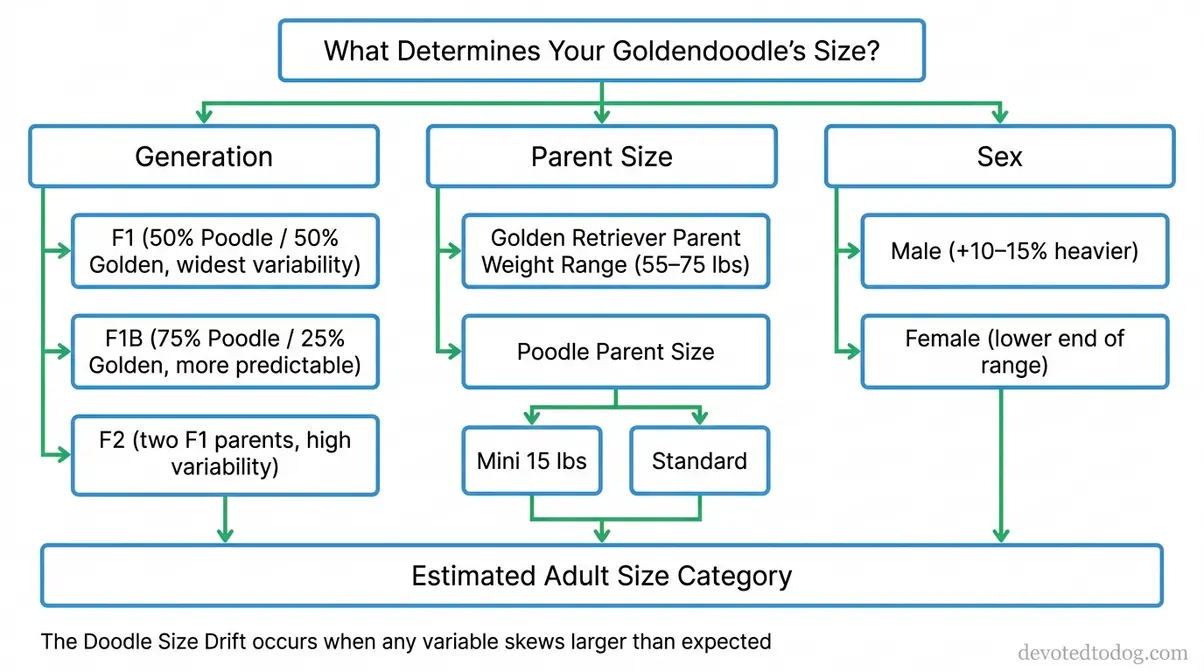
Three factors determine your Goldendoodle’s final size: the generation (F1, F1B, or F2), the size of each parent dog, and the puppy’s sex. Breeders’ size labels are estimates built on these three variables — not guarantees. This is precisely why “The Doodle Size Drift” happens: when any one of these variables skews larger than expected, the puppy grows beyond its label.
Parent Size and Generation Explained
Understanding Goldendoodle generations is easier when you think of it like a recipe. Here’s how the three main generations break down:
- F1 Goldendoodle — a first-generation cross: 50% Golden Retriever + 50% Poodle. Most genetic variability, widest possible size range.
- F1B Goldendoodle — a second-generation cross: F1 Goldendoodle + Poodle (75% Poodle, 25% Golden Retriever). More predictable size and coat.
- F2 Goldendoodle — two F1 Goldendoodles bred together. Similar to F1 in variability — wide range of outcomes, often unpredictable.
The more Poodle in the recipe, the more predictable the result. An F1B from a known Miniature Poodle parent is far more likely to stay within the Mini range than an F1 from a Standard Golden Retriever.
Here’s the factor most breeders don’t emphasize: the Golden Retriever parent’s size is consistently underestimated. Standard Golden Retrievers typically weigh 55–75 lbs. When the Golden parent is on the larger end of that range, F1 puppies carry more size genes than a Miniature Poodle can offset — and this is the core mechanism of “The Doodle Size Drift.” A Mini Goldendoodle from a 15-lb Miniature Poodle and a 75-lb Golden Retriever will typically grow larger than a Mini from a 15-lb Mini Poodle and a 55-lb Golden Retriever.
The practical takeaway: always ask your breeder for the exact weight of both parents — not just the Poodle parent. The Golden Retriever’s size is the most commonly overlooked predictor in the entire process.
For a deeper look at how generation affects coat and size, see our complete guide to F1B Goldendoodle genetics and generations.
Does Gender Affect Goldendoodle Size?
Male Goldendoodles typically weigh more than females of the same size category — a few extra pounds in a Mini and more in a Standard. This is one of the most consistently overlooked variables when buyers are comparing puppies from the same litter.
In practical terms: a female Mini might finish in the middle of the 26–35 lb range, while her male littermate could finish at the top of it or slightly above. That male “Mini” now overlaps with the lower end of the Medium category. The goldendoodle sizes and weights difference between sexes is real and worth factoring into your decision.
Height differences between males and females are less dramatic than weight differences. Males tend to be stockier and more substantial in build rather than significantly taller. If you’re choosing between littermates and space is a concern, a female puppy will typically stay closer to the lower end of the size range. If you prefer a slightly bigger, more robust dog, a male is a natural choice — just go in with accurate expectations.
The 8-Week Puppy Weight Trick
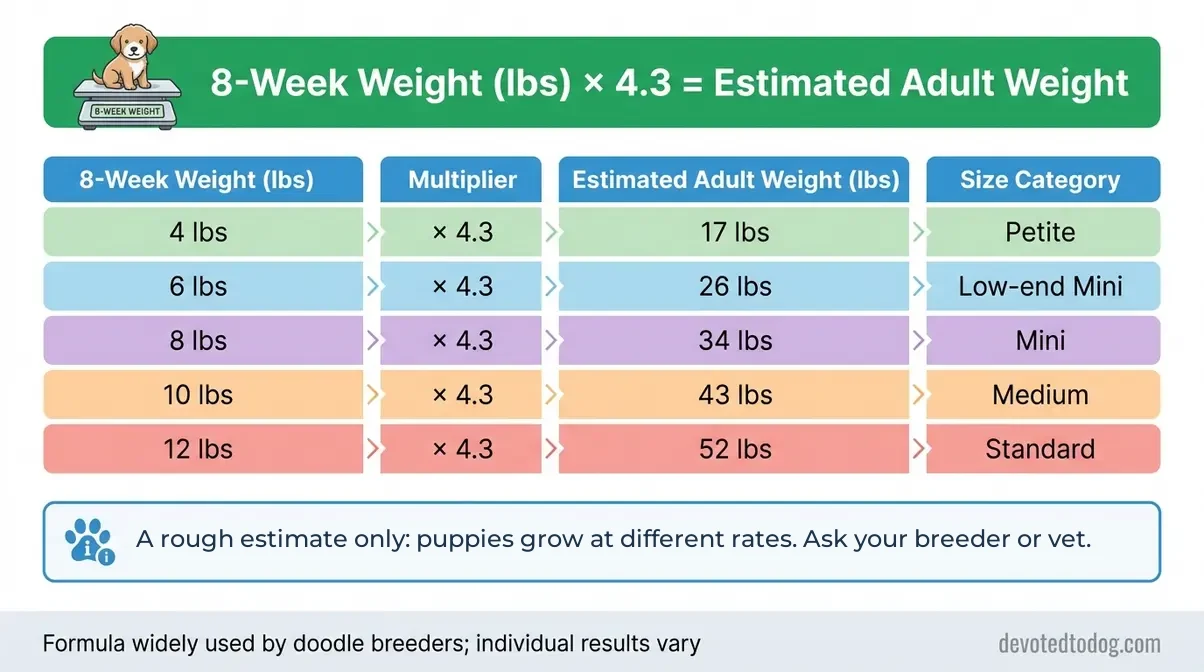
This is a simple rule of thumb. At 8 weeks, you can estimate a Mini Goldendoodle’s adult weight using a simple calculation:
8-week weight (lbs) × 4.3 = estimated adult weight
So a puppy weighing 7 lbs at 8 weeks is likely to reach approximately 30 lbs as an adult — solidly within the Mini range. This is a breeder-derived estimate widely used across the doodle community; individual results can vary a lot with nutrition, health, and genetics.
For Standard Goldendoodles the multiplier is lower because larger dogs keep growing longer, so ask your breeder for their own growth records.
Here’s how the formula plays out across common 8-week weights:
| 8-Week Weight | Estimated Adult Weight (Mini) | Likely Size Category |
|---|---|---|
| 4 lbs | ~17 lbs | Petite |
| 6 lbs | ~26 lbs | Low-end Mini |
| 8 lbs | ~34 lbs | Mini |
| 10 lbs | ~43 lbs | Medium |
| 12 lbs | ~52 lbs | Standard |
Goldendoodle Types, Colors, and Coat Variations
Goldendoodles come in a remarkable range of colors and coat types — goldendoodle sizes and colors are often the first two questions prospective owners ask. Beyond size, the coat your dog inherits affects grooming time, shedding levels, and weekly maintenance costs. Here’s what to know.
Common Goldendoodle Colors
When it comes to goldendoodle sizes and colors, color is the part most people find delightful and the least complicated. Goldendoodles come in over 18 recognized color variations (Dogster, 2026), with apricot and cream being the most popular by far.
The most common colors include:
- Apricot — soft, warm, creamy-red; the classic “teddy bear” look most people picture
- Cream — pale gold to near-white; very common in F1 litters
- Red — deeper and richer than apricot; rarer and often priced higher
- Chocolate (brown) — warm brown to dark cocoa; fades slightly with age
- Black — solid black, more common in F1B and multigen litters
- Golden — mid-tone gold, closely resembling the Golden Retriever parent
Less common but highly sought-after patterns include parti (two distinct colors), phantom (specific tan-point markings, similar to a Doberman), abstract (small white patches on a solid base), and merle (a mottled, swirled pattern — rare in Goldendoodles and linked to health risks in some lines when bred irresponsibly).
One important point: color does not affect size. A black Standard Goldendoodle and a cream Standard Goldendoodle are the same size — color is purely aesthetic. To see the full range of patterns and color photos, explore all 18+ Goldendoodle coat colors and patterns.
Coat Types and Grooming Needs
Goldendoodle coat type varies by generation — and it directly affects how much time and money you’ll spend on grooming. There are three main types:
- Wavy coat — most common in F1 Goldendoodles. Moderate grooming required; brushing 2–3 times per week is usually sufficient. The most forgiving coat for new owners.
- Curly coat — most common in F1B Goldendoodles. Low shedding, but high maintenance. Curly coats mat quickly and typically require professional grooming every 6–8 weeks ($60–$120 per session).
- Straight coat — rarer, and more likely to shed than the other two types.
Smaller Goldendoodles — Petite and Mini — with curly F1B coats often have the most demanding grooming schedules relative to their body size. That tight, Poodle-like curl is beautiful, but it mats faster than a wavy coat on a larger dog.
For everything you need to know about care by coat type, see our F1B Goldendoodle coat types and grooming guide.
Size Misconceptions & Rehoming Risks
Not every size label tells the full story — and some labels are simply invented. This section covers the misconceptions that catch buyers off guard, the marketing terms to avoid, and the honest reasons Goldendoodles end up in shelters.
Why Your “Mini” Might Not Stay Mini
“The Doodle Size Drift” — the phenomenon where Goldendoodles consistently grow larger than their breeder’s size label suggests — happens most often because of two compounding factors: F1 genetic variability and an underestimated Golden Retriever parent. When a large Golden (say, 70+ lbs) is bred to a Miniature Poodle, the resulting F1 puppies carry a wider size range than the Poodle parent alone would suggest.
Before you sign anything, ask your breeder these three questions:
Step 1: Verify Parent Weights What is the exact weight of both parents? Do not accept an estimate — ask for the actual recorded weight.
Step 2: Confirm the Generation Is this puppy F1, F1B, or F2? The generation significantly affects size predictability and coat type.
Step 3: Check Previous Litters What was the weight of previous litters from these same parents? Past litters are the best real-world evidence of what to expect.
If a breeder can’t or won’t answer these questions, that’s a red flag worth taking seriously. Reputable breeders track this data because they care about matching puppies to the right homes.
Watch Out for Misleading Size Labels
Terms like “Teacup Goldendoodle,” “Tiny Toy Goldendoodle,” and “Royal Standard Goldendoodle” are not recognized by GANA, the AKC, or any official breed body. They are marketing terms — nothing more. The Poodle Club of America official warning explicitly identifies terms like “Royal Standard,” “Tea Cup Toy,” and “Tiny Toy” as marketing gimmicks rather than recognized breed sizes (AKC / Poodle Club of America).
Avoid these labels entirely:
- “Teacup Goldendoodle”
- “Tiny Toy Goldendoodle”
- “Royal Standard Goldendoodle”
- “Micro Mini Goldendoodle”
Dogs bred to extreme smallness can come with health problems, so ask your veterinarian before buying one. If a breeder is advertising “Teacup Goldendoodles,” walk away. The only recognized categories are GANA’s four: Petite, Miniature, Medium, and Standard.
Why So Many Doodles End Up in Shelters
Goldendoodles are often rehomed because owners underestimate three things: energy levels (from 20–30 minutes of daily activity for Petites and Minis up to an hour of vigorous exercise for active Standards), grooming costs ($60–$120 every 6–8 weeks for curly coats, every year of the dog’s life), and the reality of a 50-lb dog in a small apartment when you were expecting a 30-lb one.
The “baby dinosaur” scenario — buying a Mini and getting a dog that grows into Standard territory — can contribute to this problem. When a dog is twice the size you planned for, every practical challenge multiplies: the cost of food, the space they take up, the force on the leash, the vet bills.
The good news: doing this research now is exactly how you avoid becoming a rehoming statistic. You’re already ahead of most first-time buyers.
Goldendoodle Size FAQs
Are there different sizes?
Yes, Goldendoodles officially come in four sizes: Petite (under 14 inches / under 25 lbs), Miniature (14–17 inches / 26–35 lbs), Medium (17–21 inches / 36–50 lbs), and Standard (over 21 inches / 51+ lbs), as defined by GANA, the Goldendoodle Association of North America. This variety allows prospective owners to choose a dog that fits their living space, activity level, and lifestyle. Individual dogs may vary from these ranges based on genetics and parent size. Some breeders use terms like “Toy,” but this is not an official GANA category — it falls within the Petite range.
Are F1 or F2 Goldendoodles better?
Neither F1 nor F2 Goldendoodles is inherently better — it depends on your priorities. F1 Goldendoodles (50% Poodle, 50% Golden Retriever) have the most genetic variety, which means less predictable coat and size outcomes. F2 Goldendoodles (two F1 parents) can be similarly variable in both traits. For the most predictable, low-shedding coat and more consistent adult size, many owners prefer an F1B — a cross of an F1 Goldendoodle bred back to a Poodle, making it approximately 75% Poodle. Ask your breeder which generation best matches your priorities around size predictability and grooming.
How big do Minis get fully grown?
A fully grown Miniature Goldendoodle typically reaches 14–17 inches tall at the withers (shoulder) and weighs 26–35 lbs, per GANA breed standards. Most Mini Goldendoodles reach their adult size by 10–14 months. However, F1 Minis can occasionally exceed this range — some reach 40–45 lbs — due to genetic variability from the Golden Retriever parent. Males generally run heavier than females within the same litter, so a male Mini may overlap with the lower end of the Medium category.
When is a Goldendoodle fully grown?
Most Goldendoodles reach their full adult size by 12–16 months, depending on their size category. Petite and Miniature Goldendoodles typically finish growing around 10–14 months. Medium Goldendoodles are usually fully grown by 12–14 months. Standard Goldendoodles — like most large breeds — may continue filling out until 16–18 months, though their height typically stabilizes earlier. A useful checkpoint: your dog’s weight at 6 months is usually about 60–75% of their adult weight, making it a good early indicator of where they’re heading.
How do I predict my puppy’s size?
A common breeder puppy size predictor is the 8-week weight formula: for Miniature Goldendoodles, multiply the puppy’s 8-week weight in pounds by 4.3 to estimate adult weight. An 8-lb puppy at 8 weeks is likely to reach approximately 34 lbs as an adult — solidly within the Mini range. Also ask your breeder for both parents’ exact weights — the Golden Retriever parent’s size is the most commonly overlooked factor in predicting final adult weight. For Standard Goldendoodles the multiplier is lower, so ask your breeder for their own growth records.
Choosing Your Goldendoodle
For prospective Goldendoodle owners, understanding all four GANA-recognized sizes — Petite (under 25 lbs), Miniature (26–35 lbs), Medium (36–50 lbs), and Standard (51+ lbs) — is the foundation of a good match between dog and household. Breeder data and owner reports consistently show that the best decisions combine knowing both parent weights, understanding the generation (F1, F1B, or F2), and using the 8-week puppy weight formula as an early checkpoint. Getting these three inputs right dramatically reduces the chance of an unexpected size outcome.
“The Doodle Size Drift” — the tendency for Goldendoodles to outgrow their breeder’s size label — is not a mystery once you understand F1 genetic variability and the underestimated role of the Golden Retriever parent. The “baby dinosaur” surprise happens when buyers focus only on the Poodle parent’s size. Armed with the full picture, you can set accurate expectations before you ever visit a breeder.
Your next step is straightforward: ask your breeder for both parents’ exact weights, confirm the generation (F1, F1B, or F2), and use the 8-week weight formula at your first vet visit to check your puppy is on track. Those three actions put you ahead of the vast majority of first-time Goldendoodle buyers — and give your doodle the best chance of being in the right home for life.
This article is general information, not veterinary advice. For questions about your puppy’s growth, weight or health, talk to your veterinarian.