

Written by Coral Drake · Last updated July 2026
Personality shapes behavior at every life stage. Our Golden Retriever behavior guide traces exactly how.
Golden Retrievers are the 3rd most popular dog breed in America, yet most people don’t know the 160-year-old Scottish hunting story behind that famous smile. According to AKC registration data, they’ve held a top-three spot for over a decade, and the science behind their warmth is even more remarkable than their reputation suggests.
“I am thinking of adopting one and considering pros and cons. Would love to hear the opinion of someone who has one.”
, A question asked by thousands of people searching for Golden Retriever information every month
You’ve seen the fluffy face and the wagging tail, but the science, history, and quirks behind this breed are far more fascinating than any Instagram photo suggests. In this guide, you’ll discover 33 verified facts about the golden retriever personality, history, physical traits, and working life, so you know exactly what this breed is really about. We cover everything from Lord Tweedmouth’s 1860s Scottish breeding program to the genetic studies that explain why Goldens are wired to love you.
Golden Retrievers rank 4th in canine intelligence and carry an approximately 60% lifetime cancer risk, two facts that define both their extraordinary appeal and the genuine care they need.
- Origins: Bred in 1860s Scotland by Lord Tweedmouth as hunting companions, not family pets
- Intelligence: 4th smartest breed (Stanley Coren), trained to a high standard in fewer than 5 repetitions
- The Golden Standard: Every physical trait, webbed feet, soft mouth, double coat, was purpose-built for a specific job
- Health reality: ~60% lifetime cancer risk (Morris Animal Foundation), the most studied breed alive
- Velcro dogs: Specific sociality genes drive their need to follow you from room to room
Where Golden Retrievers Come From: 5 Origin & History Facts
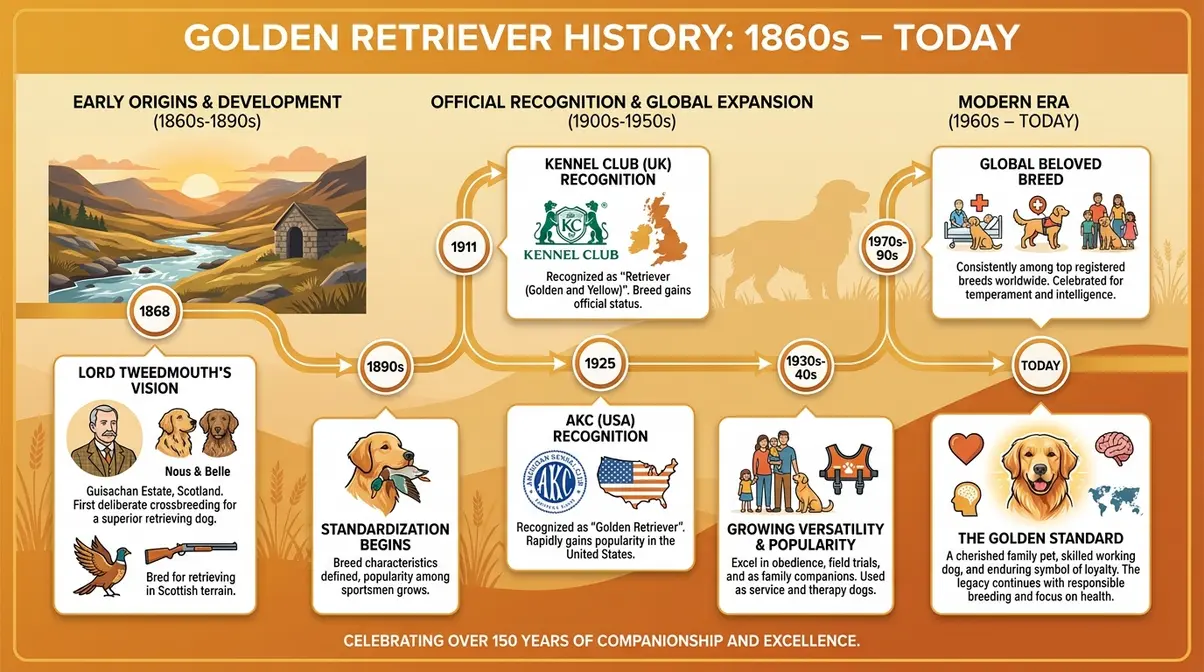
Most dog breeds have murky origins. Golden Retrievers are different. Lord Tweedmouth began systematically breeding Golden Retrievers in the Scottish Highlands in the 1860s, keeping detailed breeding records that survive to this day (AKC breed history). That paper trail makes them one of the best-documented breeds in history.
Fact #1: Born in Scotland, Not a Pet Store
Lord Tweedmouth, a Scottish aristocrat and passionate hunter, crossed a Flat-Coated Retriever (a now-less-common sporting breed) with the Tweed Water Spaniel, a now-extinct Scottish breed, in the 1860s Scottish Highlands. His goal was deliberate: create a dog with a soft mouth capable of retrieving undamaged waterfowl (ducks and geese hunted over water) across cold, fast-moving rivers. That single design decision explains nearly every trait Goldens carry today, including their famous love of water. The Golden Standard begins here.
Fact #2: AKC Recognition Took About 60 Years
The American Kennel Club (AKC) officially recognized the Golden Retriever as a distinct golden retriever dog breed in 1925, roughly 60 years after Lord Tweedmouth began his program. Recognition in the UK arrived earlier, in 1911, under the Kennel Club. Why this matters for owners today: official recognition standardized the breed traits that define every Golden Retriever you’ll meet, the temperament, the coat, the size, ensuring remarkable consistency across generations.
Fact #3: Three Types, One Breed
There are three Golden Retriever types: American (leaner build, darker golden coat), Canadian (taller, thinner coat), and British/English Cream (stockier frame, lighter cream coat). All three are the same breed, the differences reflect regional breeding preferences over decades, not separate lineages. If you’re curious about the specific differences in appearance and temperament, the English vs. American Golden Retriever differences are worth understanding before you choose a breeder.
Fact #4: “Retriever” Is a Job Description
The name “retriever” isn’t decorative, it describes a working purpose. Golden Retrievers were bred specifically to retrieve shot waterfowl without damaging the game, which required an exceptionally “soft mouth” (the ability to carry objects gently without biting down hard). This trait was bred so reliably into the line that it shows up in everyday life: it’s precisely why your Golden greets you by gently carrying a toy, a shoe, or whatever they can find near the door.
Fact #5: They Were Originally Called Yellow Retrievers
Before 1920, Golden Retrievers were commonly referred to as “Yellow Retrievers” in the UK. The Kennel Club officially changed the name to “Golden Retriever” in 1920, reflecting the range of golden coat shades the breed produced. Here’s the surprising part: Lord Tweedmouth’s preference for a golden-colored coat was a deliberate aesthetic choice, not a random genetic outcome, he selected specifically for that warm color across multiple breeding generations.
How Smart and Sweet They Really Are: 6 Personality & Intelligence Facts
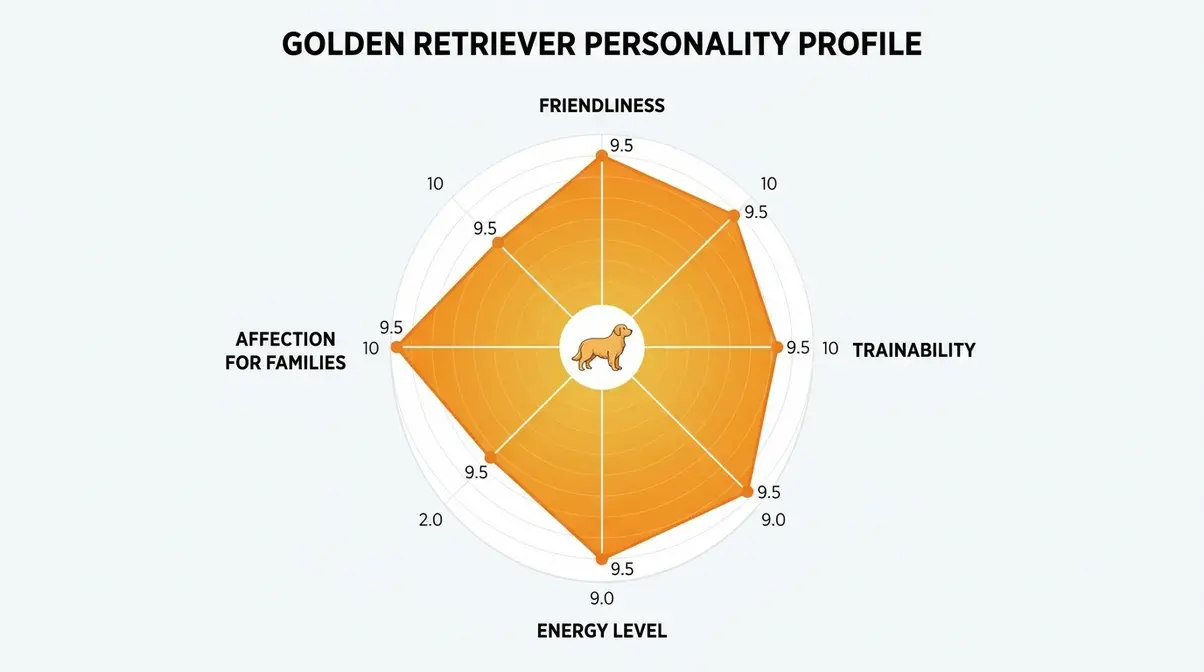
The golden retriever personality isn’t just a feel-good reputation, it’s encoded in their DNA. A 2024 genome-wide study of approximately 1,000 Golden Retrievers identified 12 genetic loci (specific locations on chromosomes where genes are found) linked to 8 behavioral traits, including trainability and fear responses (National Library of Medicine, 2024). Here’s what the science says about what makes Goldens, well, Golden.
Fact #6: The 4th Smartest Dog Breed on Earth
According to Dr. Stanley Coren, a psychologist and canine behavior expert at the University of British Columbia, Golden Retrievers rank 4th in canine intelligence in his landmark book The Intelligence of Dogs (1994), behind only Border Collies, Poodles, and German Shepherds. Practically, this means they learn new commands in fewer than 5 repetitions and obey the first command approximately 95% of the time. Coren’s ranking measures working and obedience intelligence specifically, which is why their eagerness to please is so consistent and trainable.
Fact #7: Their Trainability Is Written in Their Genes
A genome-wide association study (a scientific method for identifying which genes influence specific traits) of approximately 1,000 Golden Retrievers identified 12 significant genetic loci linked to 8 behavioral traits, including trainability and fear responses, according to genetic study on Golden Retriever behavioral traits (National Library of Medicine, 2024). What this means for your dog: their golden retriever personality traits, the eagerness to please, the responsiveness to training, aren’t just habits. They’re biology. Early, consistent training works so well with Goldens precisely because you’re working with the grain of their genetics.
Fact #8: Goldens and Humans Share an Intelligence Gene
Researchers at the University of Cambridge discovered that the ROMO1 gene, associated with trainability in Golden Retrievers, is also linked to intelligence and emotional sensitivity in humans, according to University of Cambridge research on shared behavioral genes (Science Daily, 2026). This is “The Golden Standard” moment in the science: the same genetic architecture that makes Goldens exceptional learners may be exactly what makes the human-Golden bond feel so unusually deep. It’s not just affection, it may be a shared biological resonance.
Fact #9: Breed Alone Doesn’t Guarantee Friendliness
Here’s something that surprises many prospective owners: according to a UMass Chan Medical School study on dog breed behavior, a Golden Retriever is only marginally more likely to be friendly than a well-raised mixed-breed dog. Individual upbringing, socialization, and training matter more than breed alone in shaping behavior. The practical implication is important for beginners: early socialization isn’t optional, it’s what activates the warm, confident golden retriever personality characteristics you’re hoping for. Breed is a starting point, not a guarantee.
Fact #10: Their “Soft Mouth” Can Carry a Raw Egg
A well-trained Golden Retriever can reportedly carry a raw egg in their mouth without breaking it, a direct demonstration of the “soft mouth” trait Lord Tweedmouth bred for waterfowl retrieval. The AKC documents this as a hallmark of the breed’s gentle bite inhibition. This is why Goldens often greet visitors by gently carrying a shoe, a toy, or a stuffed animal to the door: it channels their retrieve drive into the most polite greeting they know how to offer.
Fact #11: They’re “Eternal Puppies” Until Age 2–3
Most Golden Retrievers don’t fully mature emotionally until 2–3 years of age, significantly later than many breeds of similar size. Owners across communities consistently describe the first two years as living with a furry toddler in a dog suit: enthusiastic, distractible, and boundlessly energetic. For a full age-by-age breakdown of when the puppy energy begins to settle, read about when Golden Retrievers typically calm down. If the high-energy phase brings challenges, our guide to common Golden Retriever behavior problems covers what to expect and how to manage it.

Built for the Outdoors: 5 Physical Trait Facts
Golden Retrievers look like sunshine in dog form, but their physical features are a precision engineering job. Every trait from their webbed feet to their wagging tail was designed for one purpose: retrieving waterfowl from cold Scottish rivers without damaging the catch (AKC Breed Standard). Once you see them as a functional system rather than just a beautiful dog, everything about their body makes sense.
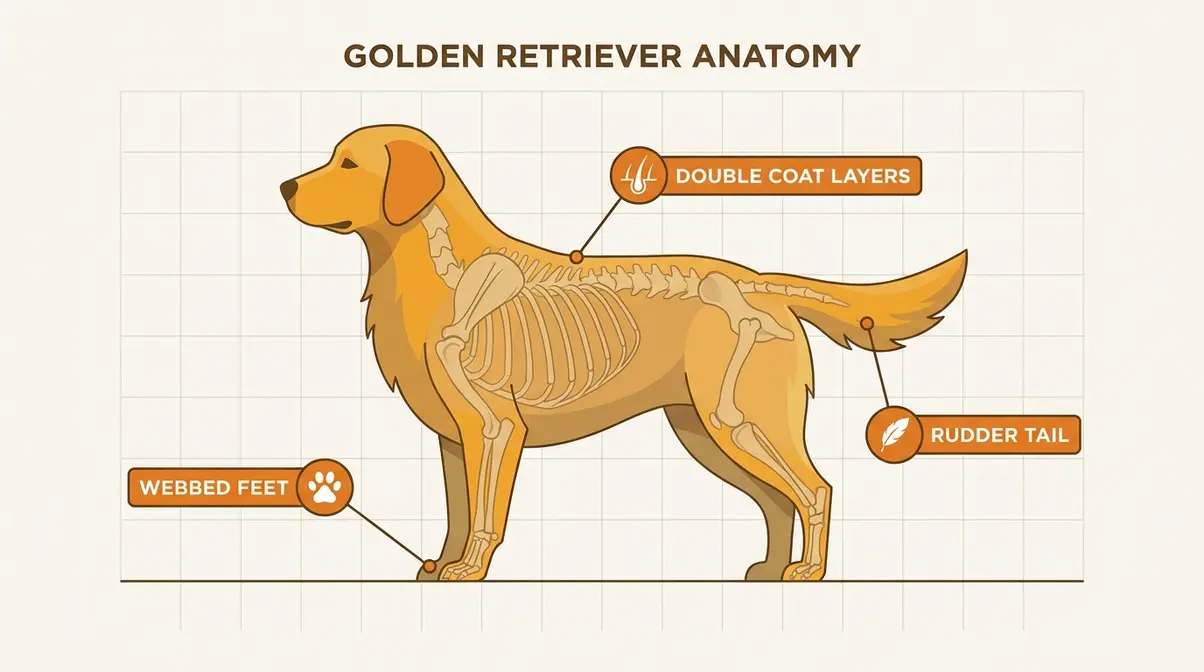
Fact #12: They Have Webbed Feet
Golden Retrievers have webbed toes, the skin between their toes is connected, similar to a duck’s foot, making them powerful, natural swimmers. Most owners never notice this trait until they look closely. It explains why Goldens almost universally love water, often wading in before you’ve finished setting up a picnic at the lake. Their enthusiasm for swimming isn’t a personality quirk, it’s anatomy doing exactly what it was designed to do.
Fact #13: Their Coat Has Two Jobs
A Golden Retriever’s double coat (two layers: a dense warm undercoat and a longer water-repellent outer layer) does two things simultaneously: insulates against cold water and repels moisture after a swim. The practical trade-off every owner discovers quickly: this coat sheds year-round, not just seasonally. Most Golden owners treat a lint roller as a permanent household fixture. Regular brushing (two to three times per week) manages the shedding, it never eliminates it.
Fact #14: Males and Females Are Noticeably Different in Size
Adult male Golden Retrievers weigh 65–75 lbs and stand 23–24 inches at the shoulder; females run slightly smaller at 55–65 lbs and 21.5–22.5 inches (AKC breed standard). These aren’t just cosmetic differences, males and females also show subtle temperament and maturity differences that matter for first-time owners. For a detailed breakdown, the guide on male vs. female Golden Retriever size differences covers what prospective owners most commonly ask.
Fact #15: Four Shades of Gold
Golden Retrievers come in four recognized coat shades: light golden (often called English Cream), golden, dark golden, and field/red. All fall under the same AKC breed standard, they are one breed, not four. One important note for beginners: coat color does not reliably predict temperament. The popular belief that English Cream Goldens are calmer is not supported by breed research. If you’re weighing a Golden against a lower-shedding option, see how Golden Retrievers compare to Goldendoodles before deciding.
Fact #16: Their Tail Was Designed as a Rudder
A Golden Retriever’s tail serves as a steering rudder when swimming, helping them navigate through water while carrying retrieved game. It also doubles as their most expressive communication tool, breed descriptions consistently note that a Golden’s tail wags with greater frequency and amplitude than most other breeds. As one popular observation among owners goes: the wagging tail is just the rudder doing its second job, and it never seems to stop.

Golden Retrievers at Work and on Screen: 6 Working Roles & Famous Golden Facts
Golden Retrievers were built to work, and they’ve never stopped. From guiding the visually impaired to finding survivors in disaster zones to comforting patients in hospitals, Golden Retrievers serve in more professional roles than almost any other breed (AKC). And they’ve also found time to become movie stars.
Fact #17: Among the First Guide Dogs in America
Golden Retrievers were among the first breeds used as guide dogs, dogs trained to help visually impaired people navigate safely, in the United States, with formal guide dog programs expanding significantly through the 1930s and 1940s. Their combination of calm temperament, intelligence, and eagerness to please made them ideal candidates alongside German Shepherds. Labrador Retrievers now share this role equally with Goldens; for a detailed comparison of how these two breeds differ in working roles and family settings, see how Golden Retrievers compare to Labradors in working roles.
Fact #18: A Nose 50x More Powerful Than Yours
Golden Retrievers have approximately 300 million scent receptors compared to 6 million in humans, roughly 50 times more powerful. This makes them exceptional search and rescue (S&R) dogs, capable of detecting human scent under rubble, water, or snow. A useful analogy: if your nose is a basic calculator, a Golden’s is a supercomputer. According to a UMass Chan Medical School study on breed behavior, their working success in S&R still depends heavily on training and handler relationship, genetics provides the hardware, but training runs the software.
Fact #19: Natural-Born Therapy Dogs
Golden Retrievers consistently rank among the top therapy dog breeds, dogs trained to provide comfort and emotional support in hospitals, schools, nursing homes, and disaster relief settings. Their gentle temperament, patience with strangers, and natural calmness under stress make them almost uniquely suited for this role. Owners and handlers who work with therapy Goldens frequently describe the same thing: they seem to sense when someone needs comfort before the person has said a word.
Fact #20: Liberty Lived in the White House
Liberty, President Gerald Ford’s Golden Retriever, was a beloved fixture of the Ford White House throughout the mid-1970s. Liberty appeared in numerous official photographs and became a public favorite, Ford reportedly used Liberty’s puppies as diplomatic gifts to foreign dignitaries. She represents one of the most visible moments in the breed’s cultural history, cementing the Golden Retriever’s association with warmth, family, and trustworthiness at the highest levels of American public life.
Fact #21: Air Bud Was a Real Dog
Air Bud, the basketball-playing Golden Retriever from the 1997 Disney film, was based on a real dog named Buddy who could genuinely make basketball shots. Buddy was discovered by his owner Dodd Bing, who trained him to shoot hoops, and his skills were captured on camera, not created with CGI. The “we expected a stunt double but found a real athlete” story is accurate: Buddy’s basketball ability was verified through real footage, which is what made the film possible in the first place.
Fact #22: Comet Made Goldens America’s Family Dog
Comet, the Golden Retriever from the TV series Full House (1987–1995), spent eight seasons as the Tanner family dog and helped cement the Golden Retriever’s image as the quintessential American family companion throughout the 1990s. The cultural impact was measurable: AKC registration data from the era shows Golden Retrievers consistently climbing in popularity during the show’s run. Comet didn’t just play a family dog, he helped define what a family dog looked like for an entire generation.

Health, Lifespan & What to Expect: 5 Health Facts
Golden Retrievers are one of the most medically studied dog breeds in history, not despite their health challenges, but because of them. The Morris Animal Foundation enrolled over 3,000 Golden Retrievers in a lifetime health study, the largest of its kind ever conducted on a single breed. After more than 14 years of tracking, the findings are reshaping veterinary care for the entire species.
Fact #23: A 10–12 Year Lifespan
The average Golden Retriever lifespan is 10–12 years, according to AKC breed data. This is comparable to Labrador Retrievers (also 10–12 years) but shorter than some smaller breeds like Poodles, which can reach 15 years or more. The practical implication for prospective owners is straightforward: adopting a Golden is a 10–12 year commitment. Those years, owners consistently report, tend to be full, joyful, and deeply rewarding ones, which is part of why the grief when they’re gone hits so hard.
Fact #24: An Approximately 60% Lifetime Cancer Risk
Golden Retrievers face an approximately 60% lifetime cancer risk, significantly higher than the average dog breed, according to the Morris Animal Foundation’s landmark Golden Retriever Lifetime Study, the largest breed-specific health study ever conducted (Morris Animal Foundation, 2026 update). This is the most important health fact any prospective owner should know. What you can do: regular veterinary screenings and awareness of early symptoms, unexplained lumps, weight loss, lethargy, can meaningfully improve outcomes. The elevated risk makes annual wellness exams essential, not optional.
Fact #25: The Most Studied Dog Breed Alive
The Morris Animal Foundation, a nonprofit dedicated to animal health research, enrolled over 3,000 Golden Retrievers in their Lifetime Study, tracking health, behavior, diet, and environment across each dog’s entire life since 2012. After 14 years of data collection, this makes Golden Retrievers the single most comprehensively studied dog breed in history. The research has already produced new findings about cancer prevention, nutrition, and behavioral health that benefit dogs of all breeds, not just Goldens.
Fact #26: Aggressive Behavior Is Heritable, But It Fades
A behavioral study of 83 Golden Retrievers found that aggressive behavior shows high heritability, meaning it can be passed from parents to offspring (research on aggressive behavior in Golden Retrievers, PubMed, 2006). However, more than 50% of the dogs in the study became less aggressive after an average interval of 4.3 years, suggesting that age and environment meaningfully reduce the behavior over time. One honest caveat: this is a 2006 study with a small sample of 83 dogs, so it should be read as indicative rather than definitive. The broader takeaway remains useful: even heritable tendencies in Goldens tend to soften with maturity.
Fact #27: Hip Dysplasia Is a Known Risk
Hip dysplasia (a developmental condition where the hip joint doesn’t form properly, leading to pain and arthritis) and elbow dysplasia are among the most common orthopedic issues in Golden Retrievers. The OFA, or Orthopedic Foundation for Animals, which certifies dogs free of inherited joint conditions, recommends screening all breeding dogs before they’re used for reproduction. Practical guidance for prospective owners: always ask breeders for OFA clearance certificates before adopting a Golden Retriever puppy, a reputable breeder will have them readily available.

Quirks, Records & Celebrations: 6 Fun Behavior & World Record Facts
The golden retriever personality has a scientific explanation for every quirky behavior you’ve ever noticed. Why do they follow you to the bathroom? Why do they carry a shoe when you come home? Why can’t they seem to stop wagging? The answers are in their genes, and in the record books.
Fact #28: “Velcro Dogs” by Genetic Design
The “velcro dog” label, Golden Retrievers’ tendency to follow their owners from room to room, isn’t just affectionate behavior. Research published in PubMed (2019) found that specific genetic variants (called SNPs) in Golden Retrievers are directly associated with human-directed social behaviors, including how long they seek physical contact with their owners (genetic link to human-directed social behaviors in Golden Retrievers). Their social drive is biological, not merely habitual, which is why leaving a Golden alone for long periods is particularly hard on them. Understanding this helps owners plan realistically for their dog’s companionship needs.
Fact #29: Golden Retriever Day Is February 3rd
When is Golden Retriever Day? February 3rd. National Golden Retriever Day was established in 2012 by Kristen Shroyer to honor her Golden Retriever, Quincey, and has since grown into an annual social media celebration with thousands of owners sharing photos, videos, and tributes to their dogs. It’s one of the most widely observed breed-specific holidays in the United States, which, when you consider the breed’s devoted following, makes complete sense.
Fact #30: They Carry Things When Excited
Golden Retrievers often pick up an object, a shoe, a toy, a TV remote, when greeting visitors at the door. This isn’t random or chaotic: their strong retrieve drive (the instinct to carry objects in their mouth, bred specifically into the line by Lord Tweedmouth) kicks in when they’re excited but want to channel that excitement in a socially acceptable way. Most owners interpret it correctly: it’s their version of offering a gift, and it’s one of the breed’s most endearing habits.
Fact #31: The World’s Loudest Dog Bark
The Guinness World Record for the loudest bark by a dog belongs to Charlie, a Golden Retriever from Adelaide, Australia, who registered 113.1 decibels in 2012, louder than a chainsaw (approximately 110 dB) and approaching rock concert levels. For reference, a typical dog bark averages 80–90 dB. The fact that this record belongs to a Golden Retriever, a breed known for gentleness, is exactly the kind of surprising detail that makes this the most text-message-worthy fact in the article.
Fact #32: America’s 3rd Most Popular Dog Breed
Golden Retrievers rank as the 3rd most popular dog breed in the United States according to AKC registration data, a position they’ve held consistently for over a decade, trailing only French Bulldogs and Labrador Retrievers. This enduring popularity is the quantified proof of “The Golden Standard”: across more than 190 recognized breeds, Goldens remain what most people picture when they imagine the perfect family dog. That’s not marketing, it’s 160 years of deliberate design paying off.
Fact #33: The Lion, Otter, Beaver & Golden Retriever Personality Test
In the four-animal personality framework popularized by Focus on the Family, the “Golden Retriever” type describes people who are loyal, relationship-focused, conflict-avoidant, and harmony-seeking, golden retriever personality traits that the actual dog breed embodies completely. This is where the concept crossed from dogs into human culture: the Golden became shorthand for a specific kind of warmth and reliability that people recognize instantly. For readers who love the Golden personality but are exploring other breeds, see dog breeds with a similar personality to Golden Retrievers.


Frequently Asked Questions
What Is a Golden Retriever Personality in a Person?
A person with a “Golden Retriever personality” is typically friendly, loyal, enthusiastic, and genuinely eager to make others happy. They tend to be naturally warm, affectionate, and excited by the people around them, much like the dog breed they’re named after. This personality type is often described as reliably upbeat, emotionally supportive, and difficult to dislike. In relationships, they’re known for being attentive partners who consistently prioritize the other person’s comfort and happiness. The term is widely considered a high compliment.
What Are the Good and Bad Traits of Golden Retrievers?
Golden Retrievers are friendly, intelligent, gentle, and highly trainable, among the most forgiving breeds for first-time owners. Their eagerness to please makes them responsive to training, and their patient temperament makes them excellent with children and other pets. The challenges include high energy requiring 60–90 minutes of daily exercise, significant year-round shedding, and a strong need for companionship that can lead to separation anxiety when left alone frequently. They are also poor guard dogs due to their trusting, welcoming nature toward strangers. For most active families, the benefits far outweigh the challenges.
What Are the Behavior Issues With Golden Retrievers?
The most common Golden Retriever behavior issues stem from their high energy and intense need for social connection. Without enough daily exercise (at least 60 minutes) and mental stimulation, Goldens often become destructive, chewing furniture, shoes, or anything within reach. Separation anxiety is particularly prevalent: many Goldens bark, pace, or become destructive when left alone for extended periods. Their extended puppyhood, lasting 2–3 years, means these behaviors can persist longer than owners expect. Consistent training and regular exercise resolve most issues over time.
What Age Do Golden Retrievers Calm Down?
Most Golden Retrievers start to calm down between 2 and 3 years of age, when they reach emotional maturity. Before that milestone, expect a high-energy, easily distracted dog that behaves more like an oversized puppy than a settled adult. Even after calming down, Goldens retain their playful enthusiasm well into old age, it simply becomes easier to manage and redirect. Individual variation is significant: some Goldens settle closer to 18 months, others not until age 4. Consistent training and daily vigorous exercise accelerate the process noticeably.
What Is the Downside of a Golden Retriever?
The primary downsides of Golden Retrievers are their high exercise requirements, heavy year-round shedding, and strong need for companionship. They need 60–90 minutes of vigorous activity daily, a real commitment for busy households. Their double coat sheds continuously, requiring regular brushing and a tolerance for dog hair on clothing and furniture. Their deeply social nature means they struggle with long periods alone, making them a poor fit for owners who work long hours without dog care arrangements. They are also prone to certain health conditions, most notably an elevated lifetime cancer risk of approximately 60%.
Are Golden Retrievers Good With Kids?
Golden Retrievers are consistently rated among the best dog breeds for families with children of all ages. Their patient temperament, gentle mouth, and natural eagerness to please make them highly tolerant of the unpredictable behavior of young children. They rarely snap or bite, a trait that is both behavioral and genetic, as research confirms low bite inhibition thresholds in well-bred Goldens. Adult supervision is still recommended with very young children, as an excited Golden’s size and enthusiasm can accidentally knock over a toddler. With proper early socialization, they are exceptionally reliable family companions.
How Much Exercise Does a Golden Retriever Need Daily?
Golden Retrievers need at least 60–90 minutes of vigorous exercise every day, not just a gentle walk around the block. Active exercise such as fetch, swimming, hiking, or running is ideal, as it satisfies both their physical energy and their retrieve drive simultaneously. Without adequate exercise, Goldens become restless, destructive, and prone to anxiety. Puppies under 18 months should have their exercise limited to protect developing joints, a commonly recommended guideline is 5 minutes of exercise per month of age, twice daily. Mental stimulation through training sessions also counts meaningfully toward their daily activity needs.
The Golden Standard: What 33 Facts Add Up To
For families considering a Golden Retriever, the golden retriever personality you see in the park is backed by 160 years of deliberate breeding and, increasingly, peer-reviewed genetics research. Golden Retrievers rank 4th in canine intelligence, face an approximately 60% lifetime cancer risk (Morris Animal Foundation, 2026), and are hardwired by specific sociality genes to seek human connection, making them one of the most studied and most loved breeds in the world. The 33 facts in this guide are the story of how a Scottish hunting dog became America’s family companion.
That’s what “The Golden Standard” really means. It’s not marketing, it’s history. Lord Tweedmouth didn’t set out to create a family pet. He set out to create the perfect working dog. The fact that his design ended up being the benchmark for everything people want in a companion says something remarkable about what “perfect” actually looks like when you get it right.
If you’re thinking about bringing a Golden home, the next step is understanding their behavior in detail. Read our guide to common Golden Retriever behavior problems or find out when Golden Retrievers typically calm down, two questions every prospective owner should have answered before adoption day.
➤ Golden Retrievers don’t just meet the standard for a family dog, they set it, one wagging tail at a time.
Curious where the breed comes from? Read where Golden Retrievers come from.