

- Author: Coral Drake
If you have ever watched your Golden Retriever carry a toy to a stranger with those soft eyes and a wagging tail, you already know something special is happening. That gentleness feels almost too good to be true. The surprising thing is, it was engineered on purpose, over 150 years ago in the Scottish Highlands.
Most people assume dogs are gentle because of good training or a lucky personality. The real answer goes back to 1868 and one man’s very specific requirements for a hunting dog. Understanding why Golden Retrievers were bred for gentleness and kindness changes the way you see every gentle moment your dog gives you.
“We don’t deserve them as they are too nice and friendly for our own good lol.”
— Golden Retriever owner, Reddit r/goldenretrievers
In this guide, you will discover exactly why Golden Retrievers were bred for gentleness and kindness, and why that history shows up in everything from their soft eyes to the way they play with your kids. You will also find five practical training techniques, a side-by-side comparison with Labradors, and answers to the most common questions Golden owners ask.
If you are wondering why are the golden retrievers bred for gentleness and kindness, the answer starts in 1868 when Lord Tweedmouth needed a dog with a “soft mouth” to retrieve game without damage. That single requirement shaped every gentle trait you see today.
- The Soft Mouth Standard is the root of all Golden Retriever gentleness traits
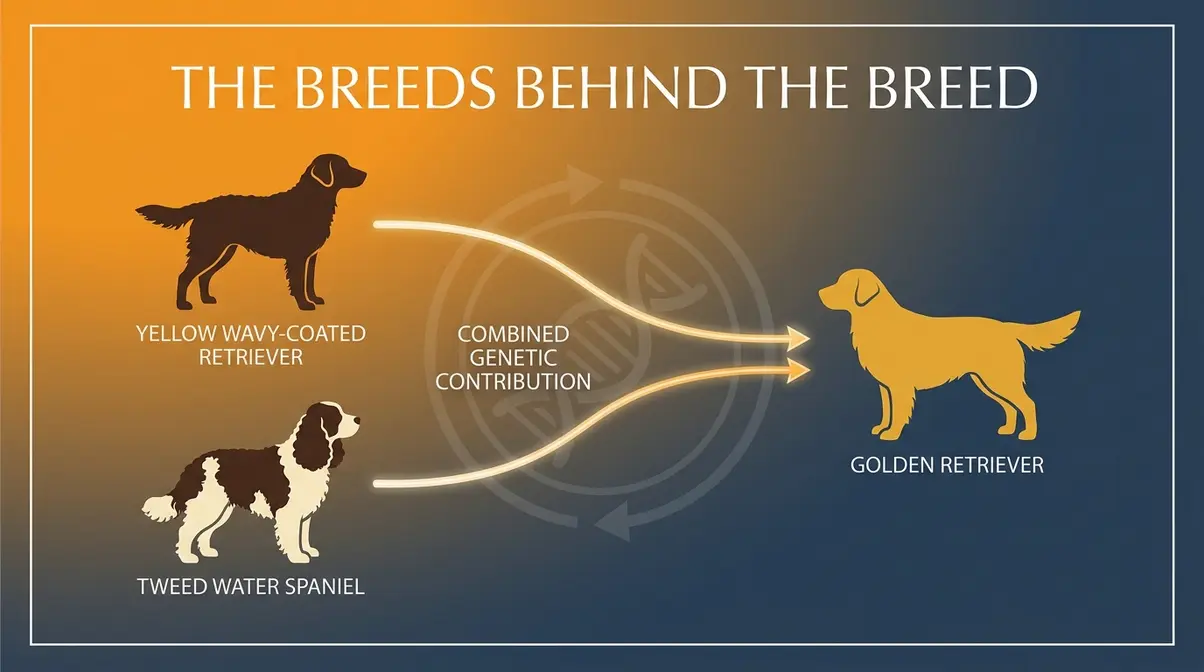
- Lord Tweedmouth crossed a Yellow Wavy-Coated Retriever with a Tweed Water Spaniel in 1868
- University of Cambridge research links the ROMO1 gene in Goldens to trainability and emotional sensitivity
- Bite inhibition can be reinforced with 5 simple training techniques
- Golden Retrievers consistently rank among the top 3 friendliest dog breeds globally
Why Were Golden Retrievers Bred for Gentleness?

When people ask why are the golden retrievers bred for gentleness and kindness, the answer always points back to Lord Tweedmouth. Golden Retrievers were bred for gentleness because Lord Tweedmouth needed a hunting dog with a “soft mouth,” meaning a dog that could carry shot birds back to the hunter without biting down hard enough to damage them. This single requirement demanded calm, patient, obedient dogs, and those behavioral traits became the genetic foundation of the entire breed.
Coral Drake, who has researched Golden Retriever breeding history extensively for this guide, notes that no single design decision in dog breeding history has produced a more family-friendly result. The gentleness you see in your Golden today is not a side effect. It was the goal.
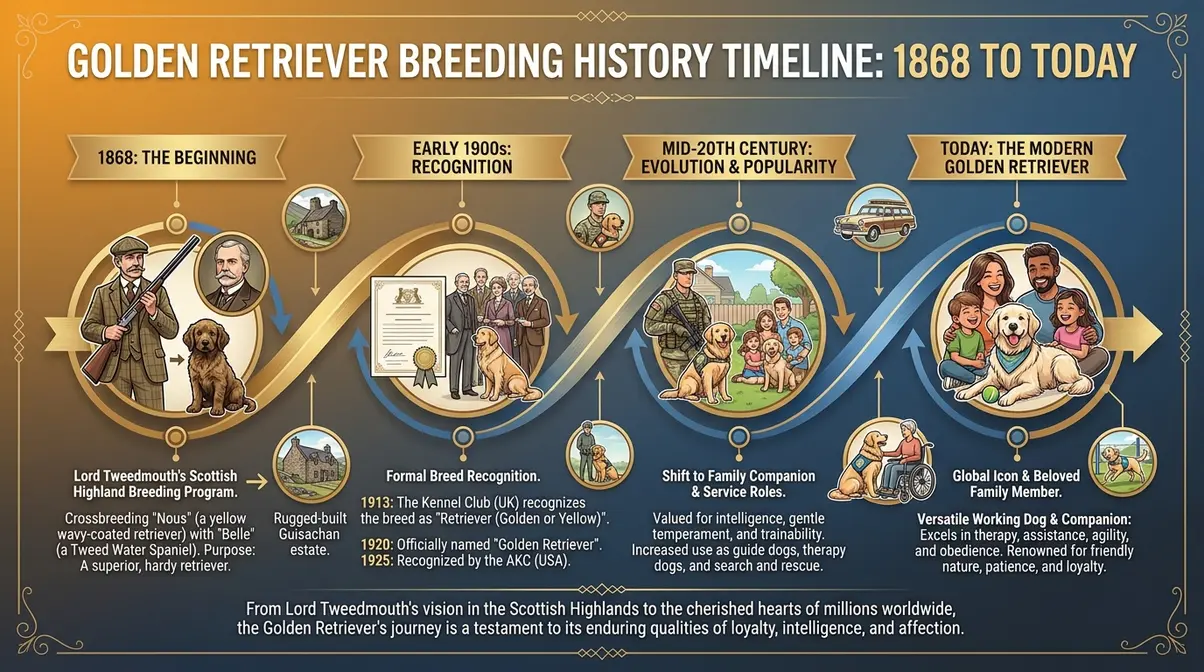
Lord Tweedmouth’s 1868 Breeding Program
In the mid-19th century, a Scottish aristocrat named Lord Tweedmouth, or Sir Dudley Marjoribanks, set out to create the perfect gun dog at his Highland estate, Guisachan, in the Scottish Highlands. The terrain was wet, rugged, and demanding. He needed a dog that could navigate rivers and moorland, follow commands reliably, and return shot game undamaged. His meticulous breeding records, kept from 1835 to 1890, are the earliest documented evidence of the breed’s creation and remain one of the most detailed accounts in dog breeding history.
To learn about the true origins of Golden Retrievers, you have to start with that first litter. In 1868, Lord Tweedmouth crossed a Yellow Wavy-Coated Retriever named Nous with a liver-colored Tweed Water Spaniel, an extinct retriever breed, named Belle. The result was the first Golden Retriever litter. According to the BBC historical account of Lord Tweedmouth’s breeding program, the first litter was sired by a yellow wavy-coated retriever named Nous and a liver-colored Tweed water spaniel called Belle (BBC News).
The soft mouth requirement was absolutely essential for hunters. They needed birds brought back intact for the table, and a dog that bit too hard destroyed the game and its own usefulness. This demanded extraordinary self-control, patience, and a gentle grip from every dog in the program. One modern illustration of this trait still shows up today: some Golden Retrievers can hold a raw egg in their mouth without cracking it, a direct descendant of what Lord Tweedmouth selected for in 1868.
The “Soft Mouth” Requirement Explained
For beginner readers, “soft mouth” means a dog that picks up and carries an object without biting down hard enough to damage it. It is both a trained behavior and a genetically reinforced one, not just luck or coincidence.
Achieving a reliable soft mouth required three specific behavioral traits in every dog. First, the dog had to be calm under pressure, meaning no explosive chasing instinct that overrode its training the moment a bird hit the ground. Second, the dog had to be patient, willing to wait for the hunter’s command before moving. Third, the dog had to be eager to please, motivated to return the bird rather than run off with it. These three traits are the behavioral building blocks of the Golden Retriever’s famous kindness toward people.
The connection to modern family life is direct and unbroken. The same calm that kept a 19th-century Golden steady in a hunting blind is what keeps your dog calm around your toddler today. According to the 1868 origins of the Golden Retriever as a Scottish Highland gun dog, bred by aristocrat Sir Dudley Marjoribanks, the first litter of Golden Retrievers was born in 1868 (BBC News).
What Lord Tweedmouth created was, in effect, The Soft Mouth Standard: a checklist of behavioral traits that every Golden Retriever had to meet to survive in the breeding program. No other single design decision explains the breed’s temperament as completely. You can read more about why Golden Retrievers are known for their gentle, non-aggressive nature to see how that standard plays out behaviorally today.
Genetics Behind Their Gentle Behavior
Modern science has now confirmed what Lord Tweedmouth observed through decades of practical breeding. University of Cambridge research linking ROMO1 to trainability and emotional sensitivity found that trainability in Golden Retrievers is associated with the ROMO1 gene, the same gene linked to intelligence and emotional sensitivity in humans (University of Cambridge). This is the strongest scientific confirmation available that the breed’s gentleness is genetic, not simply trained in.
An NIH behavioral genetics study on Golden Retrievers examined behavioral traits in approximately 1,000 Golden Retrievers using the C-BARQ questionnaire and identified 12 genome-wide significant loci, meaning measurable genetic locations, for traits including trainability and friendliness (PubMed/NIH). Separately, NIH sociality research found that specific genetic variants in Golden Retrievers are associated with how long they maintain physical contact with owners and how frequently they make eye contact with them (PubMed/NIH).
In plain English: when your Golden looks up at you with those soft eyes, that behavior is literally written into their genes.
Now that you understand where the gentleness comes from historically and genetically, the next section looks at how it plays out in daily life: why Golden Retrievers are so friendly, so happy, and so safe around children.
Are Golden Retrievers Really Friendly and Happy?

To fully understand why are the golden retrievers bred for gentleness and kindness, you have to look at how their historical field traits translate into modern family life. Yes, Golden Retrievers are genuinely as friendly and happy as they appear, and it is not a performance. Their sociability, their eagerness to greet strangers, and their seemingly constant good mood all trace back to the same genetic foundation established in 1868. Specific genetic variants in Golden Retrievers are associated with owner-gazing frequency and physical contact with owners, confirming their affectionate behavior has a biological basis (PubMed/NIH).
Why Golden Retrievers Are So Nice to Everyone

The breed’s friendliness toward strangers, children, and other animals was a deliberate product of Lord Tweedmouth’s selection process. He needed dogs that worked closely with hunters all day without showing aggression or fear. Dogs that were skittish, snappy, or difficult to handle were removed from the breeding program entirely. Over many generations, this created a dog that is instinctively trusting of humans as a default setting, not as a trained response.
The NIH sociality research supports this at the genetic level: specific genetic variants in Golden Retrievers are directly associated with the duration of physical contact with owners and owner-gazing frequency. Their friendliness is not just a matter of socialization; it is encoded in their DNA. To discover why Golden Retrievers are excellent family dogs, that genetic foundation is where the story starts.
Across Golden Retriever owner communities, the consistent feedback is that these dogs treat every stranger as a potential new best friend. The “pure oxytocin machine” label the community uses is scientifically accurate. Oxytocin is the hormone associated with bonding and happiness, and when your Golden makes eye contact with you, both of you release it. Their owner-gazing behavior is not just sweet; it is a genetically reinforced bonding mechanism.
Their friendly, tolerant attitude and unwavering loyalty contribute to the AKC’s official description of the breed as “friendly, reliable, and trustworthy.” That combination of traits is rare, and it is entirely intentional.
Why Golden Retrievers Are So Happy
Golden Retrievers were bred to be eager to please, which means completing a task, whether that is retrieving a bird, responding to a command, or simply making a human smile, generates a positive feedback loop for them. Their happiness is largely driven by successful social interaction. When you respond warmly to your Golden, you are reinforcing a cycle the breed was designed to sustain.
Their “soft eyes” and expressive faces are not accidental either. The breed’s facial musculature evolved to communicate with humans more effectively. Their faces are literally built to signal non-aggression and to look lovable, which in turn encourages more human interaction, which feeds back into their happiness. These are the biggest lovebugs in the dog world, and their anatomy is part of why.
Their patience with babies and toddlers comes from the same source as their field patience. A dog that bolted after every bird without waiting for the hunter’s command was useless to Lord Tweedmouth. That same patience now means your Golden waits calmly while your toddler pulls on their ears. To explore the depth of a Golden Retriever’s bond with its family, that patience is inseparable from their attachment.
Why Are Golden Retrievers Known for Being So Gentle With Babies?
Golden Retrievers are gentle with babies because of their even-tempered, patient nature, a direct result of field breeding requirements. Their patience was selected for because a dog that bolted after every bird without waiting for the hunter’s command was useless. That same patience now applies naturally to toddlers who move unpredictably and make sudden noises. NIH research confirms their loyalty and bonding instinct have a genetic basis, which makes them protective of the smallest family members. Socialization from puppyhood reinforces these natural traits.
Five Bite Inhibition Training Examples
Bite inhibition is the ability to control the force of their mouth, and while Golden Retrievers have a natural head start, puppies still need consistent guidance. Bite inhibition is the modern training expression of the Soft Mouth Standard your Golden inherited. These five techniques work with their natural instincts rather than against them.
Step 1: The Yelp-and-Freeze Method When your puppy bites too hard during play, let out a sharp “ow” and freeze all movement for 3 to 5 seconds. This mimics how littermates communicate pain and teaches bite pressure limits in a language your puppy already understands.
Step 2: The Redirect-to-Toy Technique The moment your Golden mouths your hand, swap it immediately for a rope toy or chew. Repeat consistently. The breed’s retrieving instinct means they want to carry something, so give them something appropriate to carry.
Step 3: The Timeout Approach If biting continues after two yelp-and-freeze attempts, calmly leave the room for 30 to 60 seconds. Golden Retrievers are so socially motivated that brief social withdrawal is a powerful consequence.
Step 4: The “Hold” Command Drill Teach your Golden to hold a soft object, like a stuffed toy or rolled sock, on command without biting down. This directly exercises the soft-mouth neural pathway and generalizes to gentler mouthing in all contexts.
Step 5: The Open-Palm Greeting Train visitors to offer a flat, open palm rather than fingers for your Golden to sniff. This removes the finger-shaped trigger and reinforces calm, gentle greetings from the start.
Your Golden’s natural gentleness gives you a head start with these techniques. But how does that gentleness compare to the other breed most often in the same conversation: the Labrador Retriever?
Which Is Calmer, a Golden Retriever or a Labrador?

As adults, both Golden Retrievers and Labrador Retrievers are calm, family-friendly dogs that are excellent with children and easy to train. The most meaningful difference is emotional sensitivity: Golden Retrievers are generally described as more emotionally attuned to their owners’ moods, while Labradors tend to be more outgoing and slightly less sensitive to emotional cues.
While both breeds are exceptional companions, the Golden Retriever’s slightly higher emotional sensitivity makes them particularly attuned to human moods. Labradors, on the other hand, often display a more robust, outgoing energy that bounces back quickly from corrections. This means that while a Golden might need a softer training approach, they often excel in therapy roles where deep emotional mirroring is required.
Both breeds mature slowly. Expect puppy-level energy for at least two to three years with either breed. As puppies, both can be boisterous and mouthy, though the Soft Mouth Standard means Golden Retrievers often respond faster to bite inhibition training.
| Feature / Trait | Golden Retriever | Labrador Retriever |
|---|---|---|
| Indoor calmness (adult) | High | High |
| Puppy energy level | Very high | Very high |
| Emotional sensitivity | Higher | Moderate |
| Trainability | Excellent | Excellent |
| Grooming needs | Higher (longer coat) | Lower |
| Typical temperament | Eager to please, affectionate | Outgoing, energetic |
For families prioritizing emotional connection and a dog that mirrors their mood, Golden Retrievers often edge out Labradors. For high-energy outdoor activities or owners who prefer lower grooming maintenance, either breed performs equally well. To compare Golden and Labrador Retriever temperaments in full detail, or to find other breeds with a similar gentle temperament, those guides go much deeper into the side-by-side differences.
What Is the Silent Killer in Golden Retrievers?
The term “silent killer” in Golden Retrievers most commonly refers to hemangiosarcoma, an aggressive cancer of the blood vessels. It develops deep inside the body with few visible symptoms until it is already advanced, making early detection extremely difficult without imaging. Brianna York, Vet Tech, flags this as one of the most important health conversations to have with your veterinarian if you own a Golden.
Golden Retrievers in the US face a 20 percent lifetime risk of developing hemangiosarcoma, according to an NIH study on hemangiosarcoma risk in Golden Retrievers (PubMed/NIH). The prognosis once the disease is present is sobering: University of Minnesota veterinary research on hemangiosarcoma survival reports that only 10 to 15 percent of dogs diagnosed with hemangiosarcoma of the spleen survive one year or longer (University of Minnesota CVM). Additionally, NC State Veterinary Hospital on cancer predisposition notes that Golden Retrievers, Labrador Retrievers, and German Shepherds have a breed predilection for non-cutaneous hemangiosarcoma (NC State University Veterinary Hospital).
Symptoms to watch for include sudden lethargy, pale gums, a distended abdomen, and unexplained collapse. Because the disease progresses silently, research suggests that regular monitoring is the most effective early intervention available. Speak with your veterinarian about annual ultrasounds if your Golden is over six years old, particularly if your dog shows any of the warning signs above.
Lymphoma is also more common in Golden Retrievers than in most other breeds and should be part of your regular veterinary conversation. To understand common health issues in Golden Retrievers in full, or to learn about hip dysplasia in Golden Retrievers, those guides cover the complete picture.
Before Bringing a Golden Retriever Home
Golden Retrievers are remarkable dogs, but they are not a no-effort breed. Their gentleness is a starting point, not a finished product. Understanding a few common pitfalls and honest limitations before you bring one home will set both of you up for a much better experience.
Common Mistakes New Golden Owners Make
- Assuming gentleness means no training needed. Golden Retriever puppies are exuberant and mouthy. Without consistent bite inhibition training (the five techniques above are a good starting point), puppy nipping is common and can surprise first-time owners who expected a perfectly behaved dog from day one.
- Underestimating exercise needs. Golden Retrievers were bred for full days of field work. An under-exercised Golden becomes anxious and destructive, which can look like aggression or disobedience to new owners. Plan for at least one hour of vigorous activity daily.
- Leaving them alone for long periods. Their deep bonding instinct, genetically confirmed by the NIH sociality research, means Golden Retrievers are genuinely prone to separation anxiety when left alone frequently. This is not a training failure; it is biology.
When a Golden Retriever Might Not Be the Right Fit
A Golden Retriever may not be the best match for every household, and recognizing that honestly is the most responsible thing a prospective owner can do.
Small-space living without outdoor access is a real challenge. Golden Retrievers need significant daily exercise. Apartment living without a nearby park or green space can lead to a frustrated, under-stimulated dog regardless of how loving the owner is.
Owners with dog-hair allergies should also reconsider. Golden Retrievers shed heavily year-round and more intensely twice a year. Their coat is not hypoallergenic, and no amount of grooming fully eliminates the shedding.
Finally, if home security is your primary motivation for getting a dog, a Golden Retriever is a poor match. Their gentle, trusting nature makes them enthusiastic greeters of strangers, not deterrents. A different breed would serve that purpose far better.
Frequently Asked Questions
Why Are Golden Retrievers Known for Being So Gentle?
Golden Retrievers are known for being gentle because their entire breed was deliberately shaped around the need for a calm, controlled mouth and a cooperative temperament. Lord Tweedmouth’s 1868 breeding program in the Scottish Highlands selected only dogs that were patient, obedient, and non-aggressive. University of Cambridge research has since confirmed that the ROMO1 gene in Golden Retrievers is linked to trainability and emotional sensitivity. Proper socialization from puppyhood reinforces what their genetics already built.
What Was the Purpose of Golden Retrievers Bred For?
Golden Retrievers were originally bred as gun dogs in 19th-century Scotland. Their primary purpose was to retrieve shot waterfowl, including ducks and grouse, from water and land without damaging the game. Lord Tweedmouth created the breed in 1868 at Guisachan estate by crossing a Yellow Wavy-Coated Retriever with a Tweed Water Spaniel. Those same traits, including gentleness, intelligence, and eagerness to please, now make them ideal family dogs, therapy dogs, and guide dogs.
Is a Golden Retriever the Kindest Dog?
Golden Retrievers are consistently ranked among the kindest and most affectionate dog breeds in the world. Their friendly, tolerant attitude and unwavering loyalty contribute to this reputation, and the AKC officially describes them as “friendly, reliable, and trustworthy.” Kindness in dogs is somewhat subjective, and several other breeds including the Labrador Retriever, Cavalier King Charles Spaniel, and Beagle are also known for exceptional gentleness. For most families, though, the Golden Retriever’s combination of gentleness, trainability, and natural empathy places them at or near the top of any such list.
What Is the Most Clingy Dog Breed?
Golden Retrievers are among the most “velcro” dog breeds, meaning they tend to follow their owners from room to room and seek constant proximity. This behavior stems from their genetic bonding instinct, confirmed by NIH research linking specific gene variants to owner-contact duration and gazing frequency. Other notably clingy breeds include the Vizsla, Border Collie, and Cavalier King Charles Spaniel. This clinginess is generally a sign of deep attachment rather than anxiety, though separation anxiety can develop if Goldens are left alone frequently.
Which Is Calmer, a Labrador or a Golden Retriever?
As adults, both Golden Retrievers and Labrador Retrievers are similarly calm and family-friendly. The main difference is emotional sensitivity: Golden Retrievers are generally described as more emotionally attuned to their owners’ moods, while Labradors tend to be more outgoing and less reactive to emotional cues. Both breeds mature slowly, with puppy-level energy lasting two to three years. For families prioritizing emotional connection, Golden Retrievers often edge out Labradors; for high-energy outdoor activities, either breed performs equally well.
What Is the #1 Nicest Dog Breed?
The Golden Retriever is most frequently cited as the number one nicest dog breed in surveys and breed rankings. Their combination of trainability, patience, friendliness with strangers, and gentleness with children makes them the benchmark against which other breeds are measured. The AKC, The Spruce Pets, and multiple veterinary organizations consistently place Golden Retrievers in the top three for family friendliness. Labrador Retrievers and Cavalier King Charles Spaniels are the closest competitors for this recognition.
What Is the Silent Killer in Golden Retrievers?
The term “silent killer” in Golden Retrievers most commonly refers to hemangiosarcoma, an aggressive cancer of the blood vessels. It develops with few visible symptoms until it is advanced, making early detection difficult without imaging. US Golden Retrievers have a 20 percent lifetime risk of this cancer (PubMed/NIH). Symptoms to watch for include sudden lethargy, pale gums, and abdominal swelling. Speak with your veterinarian about regular check-ups and ultrasound monitoring if your Golden is over six years old.
The Gentle Dog That History Built
When you ask why are the golden retrievers bred for gentleness and kindness, the answer is a fascinating blend of history and genetics. For anyone who has ever wondered why their Golden looks at them with those soft eyes and that quality of unwavering loyalty, the answer is over 150 years old. The Golden Retriever’s gentle temperament is not an accident of nature or a result of luck. University of Cambridge research confirms that the ROMO1 gene links their trainability and emotional sensitivity to their DNA, and NIH research on approximately 1,000 Golden Retrievers identified 12 measurable genetic locations for those same traits. The best approach to living with a Golden combines understanding their history, working with their natural soft-mouth instincts, and providing the exercise and companionship their genetics demand.
The Soft Mouth Standard that Lord Tweedmouth established in 1868 is the single clearest explanation for everything you love about the breed. Understanding this history does not just satisfy curiosity. It helps you work with your Golden’s natural instincts rather than against them, which makes you a more patient, more effective owner.
Start with the five bite inhibition techniques in this guide if you have a puppy, and understand common health issues in Golden Retrievers to stay ahead of the health risks the breed carries. Your Golden has already shown up for you with everything they have. Now you know exactly why.
➤ Every gentle look, every soft nudge, every patient moment with your child traces back to one 1868 Scottish Highlands breeding decision: The Soft Mouth Standard.
Curious where the breed comes from? Read the Golden Retriever’s full history and Scottish origins.