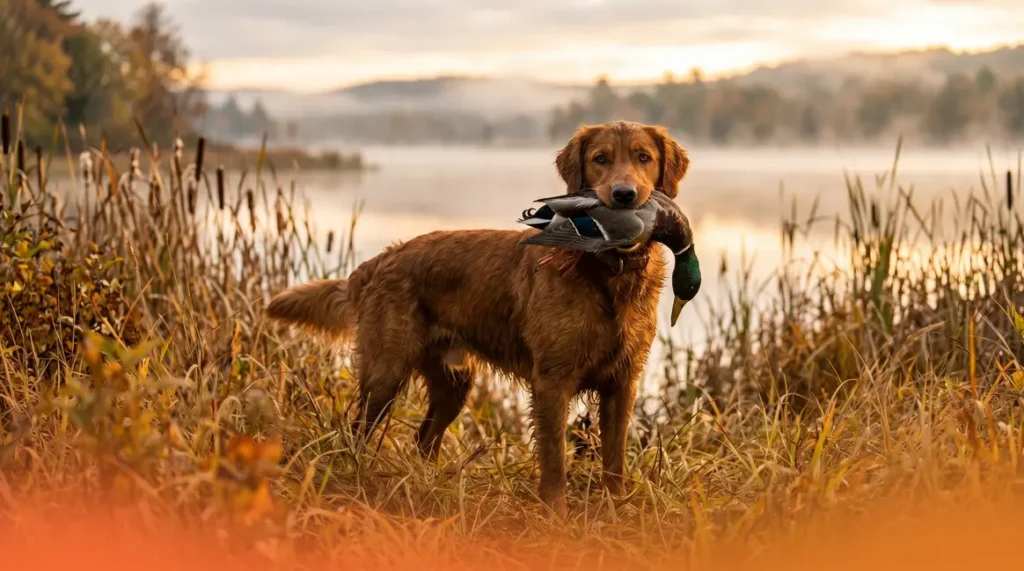
Most people picture a Golden Retriever lounging by the fireplace or fetching a tennis ball — not crashing through cattails to retrieve a downed mallard. Here is the truth: the Golden Retriever was never bred to be a pet. It was bred to hunt.
If you have spent time researching golden retriever hunting dogs, you have probably hit a wall of vague advice that never tells you whether the dog on your couch has what it takes for the field. That confusion costs hunters real time and money. In this guide, you will learn exactly what makes a Golden Retriever a capable hunting dog, how field-bred and show-line dogs differ, what game they hunt best, and how to find and train one. We also cover the health risks every hunting Golden owner needs to know.
- Originally bred for hunting: The American Kennel Club recognizes the Golden as a working sporting breed developed in 19th-century Scotland for waterfowl retrieval.
- Field vs. show lines matter: Field-bred Goldens are leaner, more driven, and built for all-day work; show-line dogs lack the same hunting instinct.
- The Field-Ready Test: Look for 5 specific traits — drive, trainability, coat type, health lineage, and physical build — before committing to any hunting Golden.
- Health awareness is non-negotiable: Hemangiosarcoma, an aggressive blood vessel cancer, is the most common cancer diagnosed in the Golden Retriever Lifetime Study cohort and the leading cause of death in older working Goldens.
Are Golden Retrievers Good Hunting Dogs?
Yes, Golden Retrievers are excellent hunting dogs, and the proof is in their origin, not their reputation as family pets. The American Kennel Club (AKC) officially classifies the Golden as a sporting breed, developed in 19th-century Scotland specifically to retrieve waterfowl from cold, rough terrain. That heritage is why a well-bred Golden still carries the nose, the drive, and the soft mouth (the ability to carry game without crushing it) that hunters depend on.
The Golden Retriever’s Hunting Origins
Is a Golden Retriever a hunting dog? Absolutely — and the record is specific. In 1868, Lord Tweedmouth began a deliberate breeding program in the Scottish Highlands, crossing a yellow wavy-coated retriever with a Tweed Water Spaniel. His goal was a dog that could retrieve shot waterfowl from cold water and dense cover while working alongside hunters all day. The result was the Golden Retriever.
The breed’s defining trait from the start was its soft mouth — the ability to carry game in the mouth without puncturing the skin, delivering it intact to the hunter. This matters because a soft-mouthed dog keeps your birds table-ready. The AKC officially recognizes the Golden as a serious worker in hunting and field work, originally bred in the Scottish Highlands (AKC, 2026). For a full comparison of how that history shapes today’s breed, see our guide to the historical role of Golden Retrievers as hunting dogs.
The Golden Retriever Club of America (GRCA) still runs active field events and hunting tests — proof that the breed’s working heritage is maintained, not just archived.
Coral Drake, who has researched field-bred Golden Retrievers extensively for devotedtodog.com, notes that this working history is not just trivia. It explains why field-bred Goldens behave so differently from the average pet Golden you meet at a dog park.
Not every Golden qualifies for serious hunting work, which is exactly why we created The Field-Ready Test in the next section.
Why Field-Bred Goldens Differ from Pets
Golden retriever hunting dogs come in two very different flavors, and the difference matters more than most people realize. Decades of breeding for conformation shows have produced a show-line Golden with a heavier build, a lighter and fuller coat, and a lower prey drive (the instinctive desire to find, chase, and retrieve game). This dog makes a wonderful companion but will frustrate a hunter who needs a dog to push through cover and work all day.
Field-bred Goldens — sometimes called Performance Goldens or field Goldens in hunting communities — retain the drive, stamina, and athleticism of the original breed. The gap between a field Golden and a show Golden is not cosmetic. It is functional.
Field hunters in the GRCA community describe it well:
“The ones I’ve met are so enthusiastic to go hunting, bust heavy cover, and want nothing more than to…”
That enthusiasm is not an accident. It is the result of generations of selective breeding for exactly those traits. As John Robinson writes for the Golden Retriever Club of America (GRCA), hunting his Performance Goldens reveals a dog that is as serious about the field as any retriever breed.
If that enthusiasm sounds like what you want in a hunting partner, the next step is knowing exactly what to look for in a field-bred dog.
Field-Bred vs. Show-Line Golden Retrievers
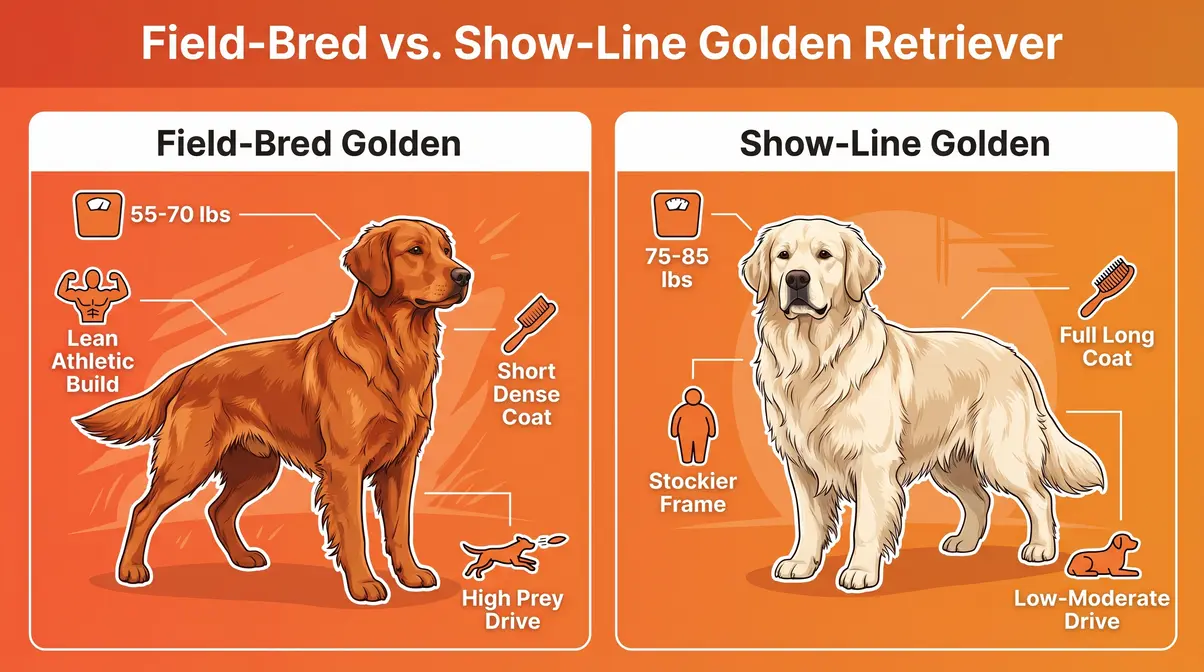
A Golden Retriever bred for hunting looks and acts differently from one bred for the show ring. Field-bred Golden Retrievers are leaner, more driven, and typically darker in coat color than show-line dogs — and for hunting, that distinction determines everything (Project Upland, 2026). Understanding these differences before you choose a dog saves you years of frustration.
Physical and Temperament Differences
A Golden retriever bred for hunting looks noticeably different from a show-line dog. Field-bred Goldens weigh 55–70 lbs and carry a lean, wedge-shaped head with a longer snout. Show-line dogs run 75–85 lbs with a blockier, square head and a fuller, heavily feathered coat. Here is how the two lines compare across the traits that matter most for hunting:
| Trait | Field-Bred Golden | Show-Line Golden |
|---|---|---|
| Build | Lean, athletic, 55–70 lbs | Stockier, heavier, 75–85 lbs |
| Coat | Shorter, denser, darker (red to gold) | Fuller, longer, lighter (cream to gold) |
| Prey Drive | High — bred for it | Low to moderate |
| Energy Level | High — needs a job | Moderate |
| Best For | Hunting, field trials, active work | Companionship, conformation shows |
Red-coated Goldens are almost always from field lines. The richer the coat color, the closer to working genetics. English Cream Golden Retrievers, a lighter-coated variant popular in show rings, are typically show-line dogs and rarely carry the same hunting drive.
Field-bred Goldens are highly regarded in upland bird hunting for their naturally soft mouth and strong desire to please, distinguishing them clearly from show-line counterparts (Project Upland Golden Retriever breed profile, 2026). A show-line Golden may happily fetch a tennis ball in the yard, but it will not push through thick brush to flush a pheasant the way a field-bred dog will. For a deeper breakdown of the two types, see our guide to the differences between field-bred and show-line Golden Retrievers.
Knowing the difference is one thing. Knowing how to apply that knowledge when you meet a specific dog is another. That is what The Field-Ready Test is for.
The Field-Ready Test: 5 Key Traits
A dog from a hunting line should pass all five of these tests before you commit. The Field-Ready Test is a five-trait checklist for evaluating whether a specific Golden Retriever has the genetic and physical makeup for hunting work. Run through it every time you visit a breeder or meet a dog.
- Drive: Does the dog actively seek out scent and chase it? Low-drive dogs quit in the field when conditions get tough.
- Trainability: Does the dog respond to positive reinforcement quickly and eagerly? Field Goldens are known for their desire to please — a dog that tunes you out early will only get harder to work with.
- Coat type: Is the coat shorter, denser, and water-resistant rather than long and fluffy? Long coats collect burrs and weigh the dog down in cold water.
- Health lineage: Do both parents have OFA hip, elbow, and cardiac certifications? Working dogs need sound bodies. A dog whose parents were not health-tested is a gamble.
- Physical build: Is the dog lean and athletic, not barrel-chested or low-slung? A dog built for the couch will struggle to keep pace in the field.
When you visit a breeder or meet a dog, run through this checklist before you commit.
Now that you know what to look for in a dog, it is time to look at what that dog can actually do in the field.
Golden Retriever Hunting Applications
A field-bred Golden Retriever is a versatile bird dog. It can spend Saturday morning in the duck blind and Sunday afternoon pushing through tall grass for pheasant — and do both well. The breed’s physical design and natural instincts make it genuinely suited to two distinct hunting disciplines.
Golden Retrievers compete in AKC Retriever Hunting Tests across all four title levels, demonstrating memory, marking ability, and obedience in both water and land retrieves (AKC Retriever Hunting Tests, 2026). That formal recognition is a useful benchmark for understanding what a well-trained Golden can actually accomplish.
What Can You Hunt With a Golden?
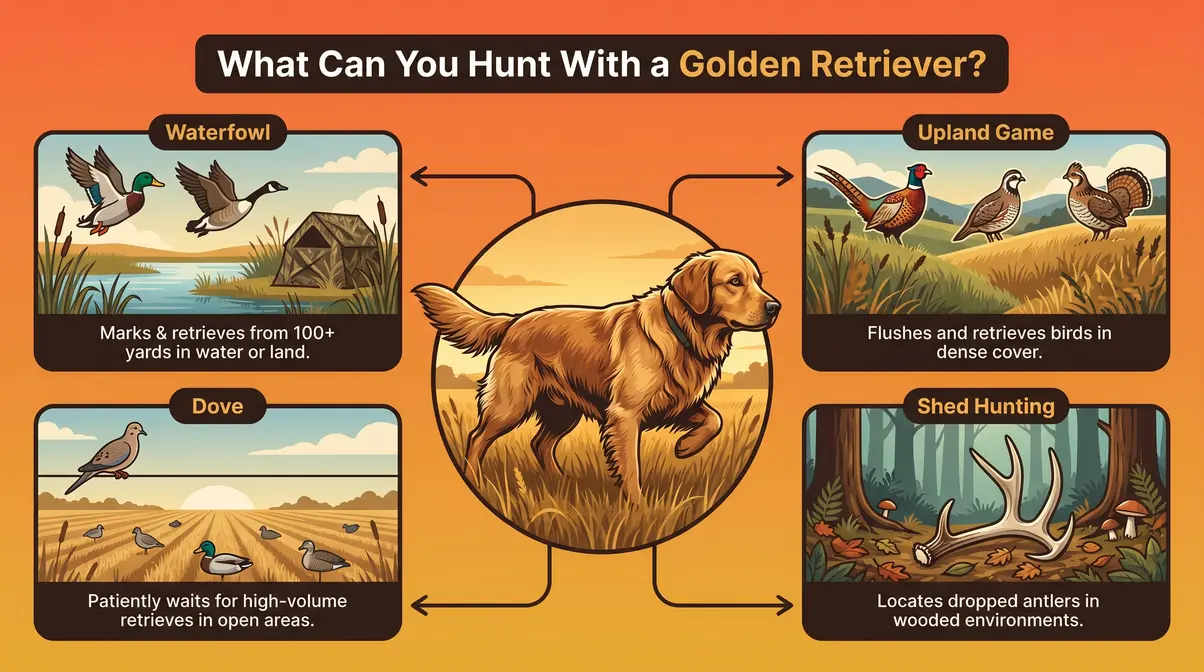
Golden Retrievers excel at two types of hunting: waterfowl and upland game. In waterfowl hunting, they retrieve ducks and geese from cold water using their double coat and webbed feet. In upland hunting, they flush and retrieve birds like pheasant, quail, and grouse from fields and heavy cover. Many Golden owners also use their dogs for shed hunting (finding antler sheds) in the off-season, keeping the dog sharp between seasons. A field-bred Golden can handle both disciplines in the same season with proper conditioning.
Waterfowl: Goldens in the Duck Blind
Golden retriever duck hunting is where the breed’s physical design becomes most obvious. The Golden’s double coat — a dense, water-resistant outer layer and a thick insulating undercoat — was built for cold Scottish lochs. In a duck blind (a concealed hunting shelter) on a November morning, that coat keeps the dog working when other breeds would shiver and slow down.
Webbed feet and a natural love of water make the Golden a strong swimmer. A well-trained field Golden marks (watches the fall of a bird) accurately and retrieves from distances of 100 yards or more in open water. Goldens are also calm and quiet in the blind until sent for a retrieve — unlike more excitable breeds that fidget and flush birds at the wrong moment.
The game list includes mallards, teal, wood ducks, and Canada geese. The Golden’s soft mouth keeps feathers intact and birds table-ready. AKC Retriever Hunting Tests evaluate Golden Retrievers on marking ability and cold-water retrieves (AKC, 2026), confirming that waterfowl work is where the breed has always excelled.
The duck blind is one venue. For hunters who prefer walking fields, the Golden is just as capable — with a different set of skills engaged.
Upland Game: Pheasant, Quail, and More
In upland hunting (flushing and retrieving birds like pheasant, quail, and grouse from open fields and dense cover), the Golden works close to the gun — typically within 30–40 yards — flushing birds into the air for the shot. Golden retriever upland hunting rewards the breed’s combination of nose and stamina in ways that pure waterfowl work does not.
A field-bred Golden’s stamina is notable. These dogs can work cover for 6–8 hours without losing focus, which is essential for golden retriever pheasant hunting, where birds hold tight and require persistent, methodical pressure. The specific game list includes ring-necked pheasant (the most common upland application), bobwhite quail, mourning dove, and ruffed grouse.
Goldens also excel at shed hunting (finding and retrieving antler sheds in the off-season) — a growing application that uses the same nose and drive as bird work. It keeps the dog sharp between hunting seasons and builds the handler-dog bond year-round.
Knowing what a Golden can hunt is the foundation. Choosing the right breed partner often comes down to one more question: how does a Golden compare to a Labrador?
Golden Retriever vs. Labrador for Hunting
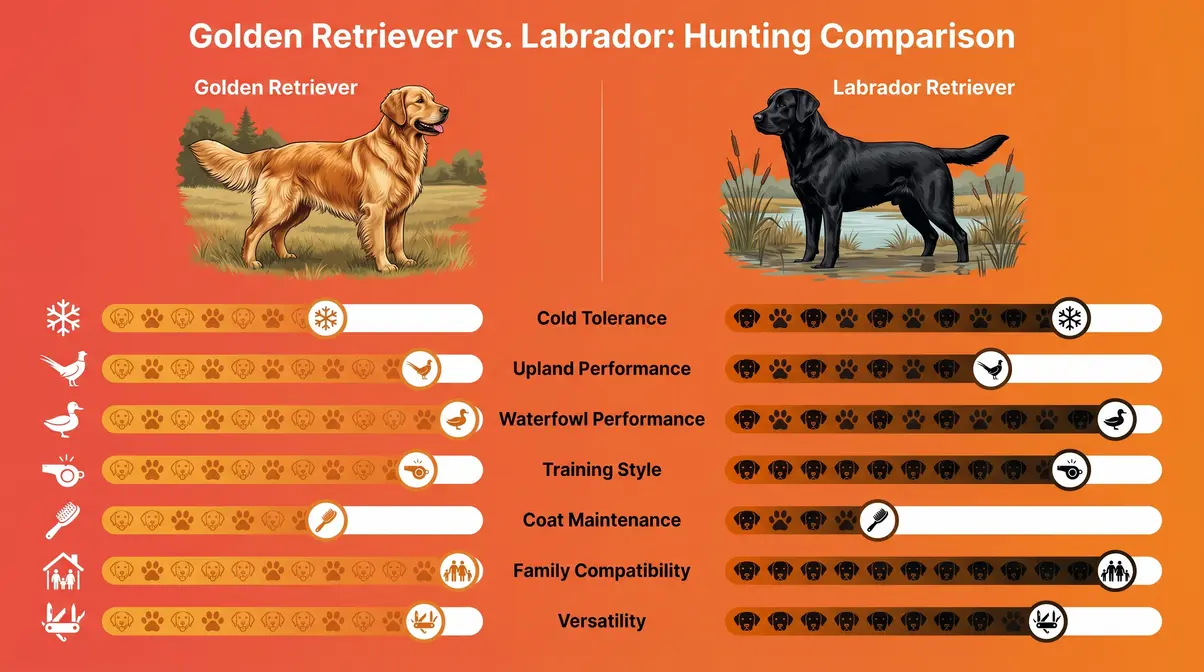
If you are deciding between a Golden Retriever and a Labrador Retriever — the Golden’s closest competitor in the retriever field — you are choosing between two exceptional breeds with slightly different strengths. Here is how they compare across the traits that matter most in the field.
| Hunting Trait | Golden Retriever | Labrador Retriever |
|---|---|---|
| Coat | Dense, water-resistant, longer — needs more post-hunt grooming | Short, dense, easier to maintain |
| Cold Tolerance | Good — double coat insulates well | Excellent — slight edge in extreme cold |
| Training Style | Responds best to positive reinforcement; sensitive to harsh correction | Adapts to a wider range of training styles |
| Upland Performance | Excellent — close-working flusher and retriever | Good — primarily a retriever, not a natural flusher |
| Waterfowl Performance | Excellent | Excellent — slight edge in icy conditions |
| Family Compatibility | Extremely high | Very high |
| Coat Maintenance (post-hunt) | High — burrs, matting, wet coat management | Low |
In competitive field trials, field-bred Golden Retrievers match Labrador Retrievers in marking ability and trainability, though Labs maintain a slight edge in cold-water endurance (Purina Pro Club field trial analysis, 2026).
Choose a Golden if you hunt both ducks and upland game in the same season, if you prioritize positive-only training, or if the dog needs to double as a family companion. Choose a Lab if you run extreme cold-water duck operations, prefer a firmer training approach, or want to minimize post-hunt grooming time.
Labs outnumber Goldens in professional waterfowl operations, but the gap is closing as field-bred Golden lines continue to improve. For a full breakdown, see our Golden Retriever versus Labrador Retriever for hunting comparison.
How Do You Train a Golden Retriever for Hunting?
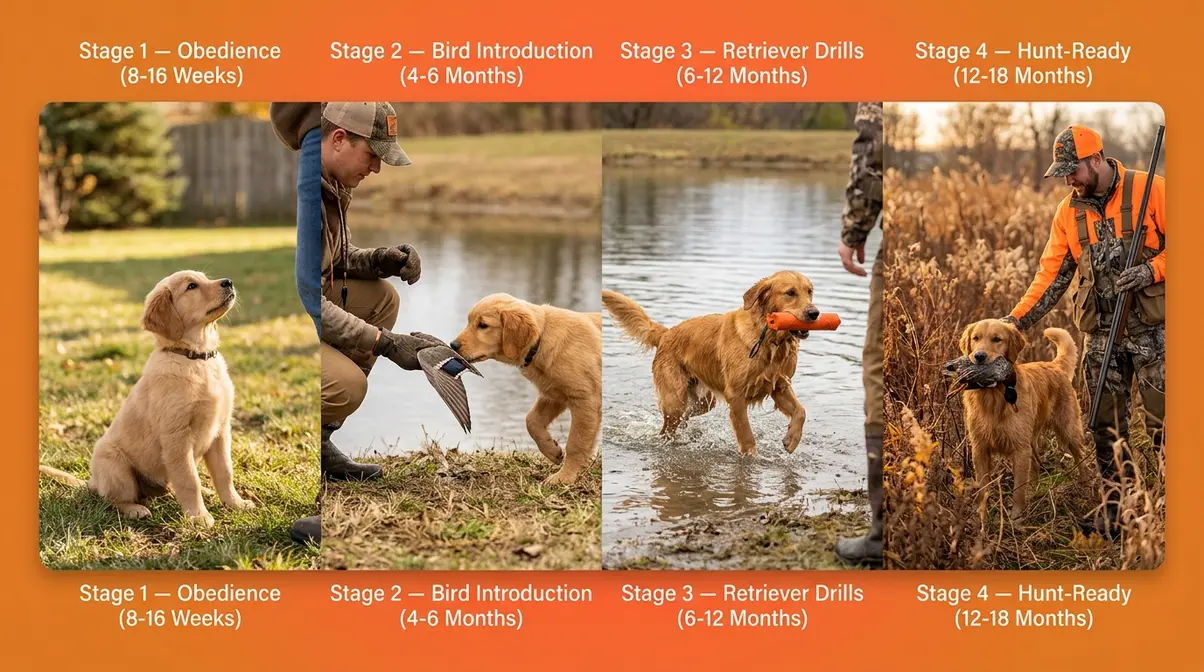
Golden Retrievers are among the most trainable sporting breeds you will ever work with — but their sensitivity means harsh corrections can shut them down fast. Here are four golden retriever hunting training milestones to build a hunt-ready dog using positive reinforcement. Most field-bred Goldens are ready for their first hunting season by 12 to 18 months with consistent positive reinforcement training started at 8 weeks (Gun Dog Magazine guidance).
As training experts at Gun Dog Magazine note, the Golden’s desire to please makes it one of the most responsive breeds to positive-only methods — which means your training investment pays off faster than with harder-tempered breeds.
Step 1 — Foundation Obedience (8–16 weeks)
Sit, stay, come, heel, and “leave it” — all on a verbal cue before introducing any hunting-specific commands. A dog that does not have solid obedience will break on a retrieve and flush birds at the wrong moment. This is also where you start building the recall that keeps your dog safe in the field.
Step 2 — Introduction to Birds and Water (4–6 months)
Introduce frozen or fresh birds (pigeons or ducks) for scent exposure. Let the puppy carry and play — do not correct. Introduce water with a shallow pond or kiddie pool and reward enthusiastically for any water entry.
For waterfowl prep: begin marking drills (tossing bumpers for the dog to watch fall and retrieve). For upland prep: use a check cord in light brush to practice staying close — within 30–40 yards — to the handler.
Step 3 — Retriever Drills (6–12 months)
Transition from play retrieves to formal “hold” and “fetch” commands. Introduce “back” — a cue that sends the dog in the direction you point for a blind retrieve (retrieving a bird the dog did not see fall). Introduce gunshot sounds at distance, pairing them with positive rewards. Never start with a gun fired close to the dog.
Note on force fetch: this is a formal retrieving training method used by some professional trainers. Most beginner Golden owners should start with positive-only methods and consult a professional trainer before introducing any compulsion-based techniques.
Step 4 — Hunt-Ready Testing (12–18 months)
Run the dog in a controlled hunting situation with planted birds before the real season. Use AKC Hunting Tests at the Junior Hunter level as a benchmark — if the dog passes, it is field-ready. This milestone directly tests The Field-Ready Test trait #2 (trainability): a dog that progresses through these four milestones consistently demonstrates the trainability required for real hunting work.
Finding & Gearing Up Your Hunting Golden
Finding golden retriever hunting dog breeders who specialize in field lines requires a different search than finding a general pet breeder. You need someone who prioritizes hunting titles and health testing in the pedigree — not just coat color and temperament. Field-bred Golden Retriever puppies from health-tested, titled parents typically cost between $1,000 and $2,500 — a price that reflects the breeder’s investment in genetic screening and field work.
Breeder vetting checklist — ask these four questions before you commit:
- Do both parents have OFA certifications (hip, elbow, cardiac)? The Orthopedic Foundation for Animals (OFA) certifies joint and cardiac health in breeding dogs — this tells you the breeder screens for heritable conditions that would limit a working dog’s career.
- Do the parents have earned AKC field titles (Junior Hunter minimum) or GRCA field event points?
- Can you see the dogs work? Any reputable breeder should welcome this request.
- What early bird exposure and socialization has the puppy received?
A “started dog” — a field-bred Golden aged 1–2 years with basic hunting training already installed — is a valid option if you want to skip the puppy phase. You get a dog that already understands birds, water, and basic commands, which shortens your path to the field. See our guide to finding reputable field-bred Golden Retriever breeders for a full list of questions and red flags.
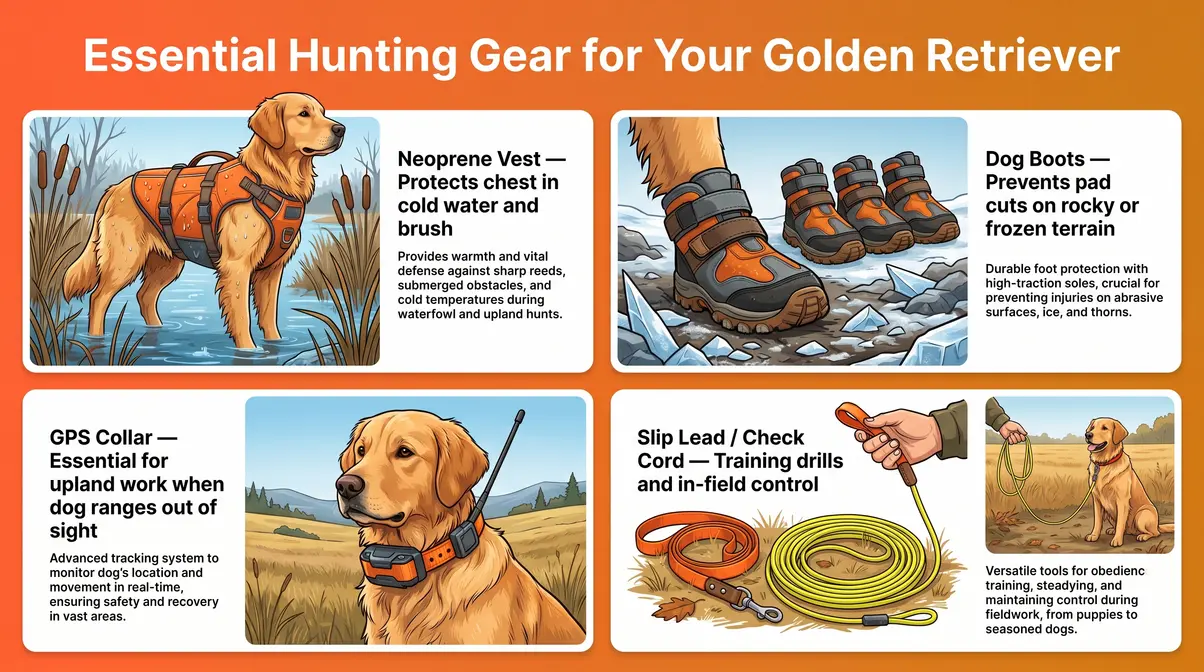
Essential gear for your hunting Golden:
- Neoprene vest: Protects the dog’s chest from cold water and brush in both duck and upland work.
- Dog boots: Optional but useful in rocky or frozen terrain to prevent pad cuts.
- GPS/tracking collar: Essential for upland work where the dog ranges out of sight.
- Slip lead or check cord: For training drills and in-field control during early seasons.
For a general guide to finding any quality Golden breeder, see our resource on how to choose a reputable Golden Retriever breeder.
Health Risks for Hunting Golden Owners
The “silent killer” in Golden Retrievers is hemangiosarcoma, an aggressive cancer of the blood vessels that develops rapidly and often without visible symptoms until it reaches an advanced stage. For hunting Goldens who push their bodies hard in the field, awareness and early detection are the best tools you have.
The Silent Killer in Golden Retrievers
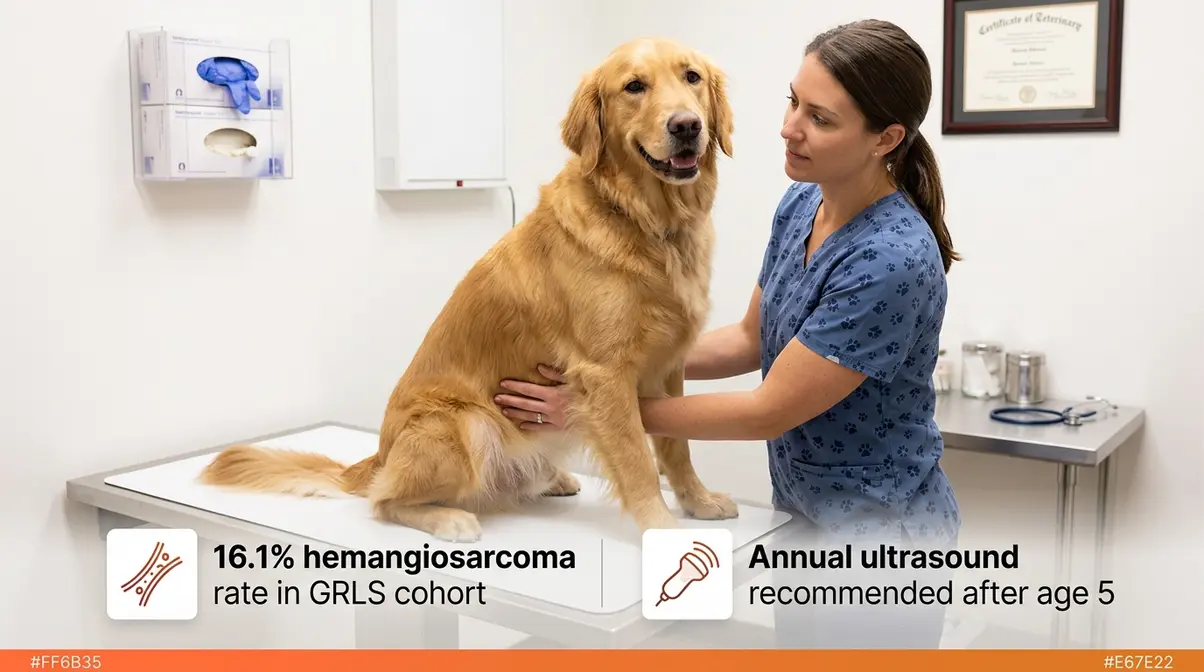
The “silent killer” in Golden Retrievers is hemangiosarcoma, an aggressive cancer of the blood vessels that often develops without obvious symptoms until it reaches an advanced stage. It is the most common cancer in the Golden Retriever Lifetime Study cohort and typically appears in dogs over age 6, frequently affecting the spleen, heart, or liver. Regular veterinary check-ups and abdominal ultrasounds after age 5 are the most practical monitoring tools available.
Hemangiosarcoma Data: The Golden Retriever Lifetime Study on cancer incidence (GRLS, PMC, published in 2022) found that hemangiosarcoma incidence rises steeply after age 6 with a median diagnosis age of 9.73 years. Approximately 16.1% of the study cohort received a hemangiosarcoma diagnosis. The consequence for hunting dog owners is serious: a dog showing normal energy in the field can have a ruptured spleen or heart tumor within weeks of the first symptom. Annual abdominal ultrasounds after age 5 are a reasonable precaution — discuss the protocol with your veterinarian.
The Morris Animal Foundation cancer diagnoses data confirms that the GRLS has recorded over 500 diagnoses of major cancers in Golden Retrievers, including hemangiosarcoma and lymphoma (Morris Animal Foundation, reported in 2023). The AKC Canine Health Foundation hemangiosarcoma research notes that the lifetime cancer risk for dogs broadly is between 1 in 2 and 1 in 3, making breed-specific awareness essential for every Golden owner (AKC CHF, updated in 2024).
Joint health: Working dogs put significant stress on hips and elbows. Hip and elbow dysplasia can become symptomatic in dogs that retrieve on hard ground or swim in cold water repeatedly throughout a hunting career. Pre-season conditioning — building muscle before the season begins — reduces injury risk meaningfully. OFA screening in your breeding stock is the first line of defense.
Practical action: Schedule a pre-season vet check before each hunting season. Consult your veterinarian about cancer screening protocols appropriate for your dog’s age and activity level. Brianna York, Vet Tech, emphasizes that early detection conversations with your vet are especially important for active working dogs over age 5.
Frequently Asked Questions
Are Golden Retrievers Good at Hunting?
Yes, Golden Retrievers are excellent hunting dogs, particularly those from field-bred lines. Originally developed in 19th-century Scotland to retrieve waterfowl, they bring a powerful nose, a soft mouth, and the stamina to work all day in the field. Field-bred Goldens have competed successfully in AKC Retriever Hunting Tests at all four title levels. Results depend significantly on lineage, as a dog from show-line parents will not perform the same as one from a hunting-line pedigree.
What Breed of Dog Is Best for Hunting?
No single breed is best for all hunting — the right dog depends on what you hunt and how you hunt it. Labrador Retrievers lead in popularity for cold-water duck hunting, while Golden Retrievers offer a strong combination of waterfowl and upland performance. For hunters who want one dog that handles both ducks and upland game with a family-friendly temperament, a field-bred Golden Retriever is a top-tier choice.
Do Goldens Have a Soft Mouth?
Yes, Golden Retrievers are naturally soft-mouthed, meaning they can carry game without puncturing the skin. This trait was specifically bred into them in 19th-century Scotland to ensure waterfowl was delivered intact to the hunter. A soft mouth is essential because it keeps retrieved birds table-ready.
Are Field-Bred Goldens Good Pets?
Field-bred Golden Retrievers make excellent family pets, provided their high energy and drive are properly channeled. Because they are bred for stamina and work, they require more daily exercise and mental stimulation than a typical show-line Golden. If their physical needs are met through hunting, training, or vigorous exercise, they are incredibly affectionate and calm indoors. They seamlessly transition from a serious hunting partner in the field to a gentle companion at home.
Your Next Step with a Hunting Golden Retriever
For hunters seeking a versatile bird dog, golden retriever hunting is a serious and rewarding pursuit — but only with the right dog. Field-bred Goldens from health-tested, titled parents deliver the drive, nose, and trainability that the breed’s show-line reputation obscures. The Golden Retriever Lifetime Study confirms that working-line health awareness is equally important: hemangiosarcoma is the most common cancer in the GRLS cohort, with risk rising sharply after age 6, making annual vet check-ups a non-negotiable part of the hunting dog lifestyle. The team at devotedtodog.com has found that hunters who understand this combination — field genetics plus health vigilance — get the most from their dogs over a full working career.
Before you commit to any dog, run it through The Field-Ready Test: drive, trainability, coat type, health lineage, and physical build. If the dog passes all five, you have found a canine athlete worthy of the duck blind. If it fails even one, keep looking. The right field Golden is out there — and the investment in finding one pays off every season for the next decade.
Start by finding a field-bred Golden from a breeder who health-tests and titles their dogs — our guide to finding reputable field-bred Golden Retriever breeders gives you a full vetting checklist. Then begin foundation obedience training at 8 weeks. Most field-bred Goldens are hunt-ready by their first birthday, and many go on to earn AKC field titles that prove what this breed has always been: a purpose-built hunting dog that happens to sleep at the foot of your bed.
Curious where the breed comes from? Read why Golden Retrievers were originally bred.
Related gear: see our guide to dog frisbees and training toys.